银行

Search documents
金价涨了,金条能变现吗?这些回购规则要知道
Sou Hu Cai Jing· 2025-10-17 06:21
随着国际金价持续走高,银行销售的投资金条被不少人视为"硬通货"。但金条购买容易,如果想变现,其中还有许多回购规定。比如,各家银行 的回购规则不一样,不是所有金条银行都照单全收,也不是每个银行网点都能回购金条。 那么,去银行买金条时,要关注哪些要点?回购时,有什么问题要注意? 买时容易卖时难? 金条变现流程复杂、周期长 半年前,浙江的王先生在手机银行App上购买了50克金条。最近,他拿其中的10克去银行变现,赚了1000多元差价。在王先生看来,黄金价格持 续走高,他很看好投资金条。 王先生回忆,买金条时,银行业务员特意提醒,不要轻易打开金条的塑封膜,以免造成损失。"金条有包装有鉴定证书,塑封膜和包装不要打开, 如果打开,银行可能会拒收。如果银行收,还会去鉴定、称重。" 安徽的苏女士在去银行变现金条时,才发现回购流程较为复杂。 "回购时,要带上买的金条、身份证,还有回执单。银行要查当时购买的流水,包括金条的核实、称重,还要联系厂家,整个业务办下来要一个多 小时。钱也不能立马到账,银行称要把金条寄回厂家,等厂家核实确认无误,钱才到我的卡里,大概要花一两周。" 限品牌限网点、还收折损费 银行回购规则严格 近日,记者来 ...


【头条评论】 优化综合金融服务体系 助力新型工业化
Zheng Quan Shi Bao· 2025-10-16 22:57
Core Viewpoint - New industrialization is the core engine for advancing Chinese-style modernization, characterized by high-end, intelligent, and green development, which creates diverse and systematic new demands for financial services [1] Group 1: Policy and Regulatory Framework - The National Financial Supervision Administration and other departments issued a notice in April 2024 to enhance financial services for the manufacturing sector, emphasizing the need for separate credit plans and increasing the proportion of medium- and long-term loans [1] - In August 2025, the People's Bank of China and seven other departments released guidelines to create a financial tool system that integrates loans, bonds, equity, and insurance to support the transformation of technological achievements [1] Group 2: Current Banking Service System - The banking service system has begun to form a multi-dimensional support structure, with leading banks developing unique service models that integrate domestic and international resources [2] - New financial products such as intellectual property pledge loans and insurance for first-time equipment are emerging to address financing challenges faced by technology enterprises [2] Group 3: Challenges in Financial Services - There are significant structural adaptation challenges, including an imbalance in resource allocation and insufficient long-term funding for traditional manufacturing upgrades and emerging industries [2] - The risk-return matching mechanism is not well established, leading to banks' reluctance to lend due to the high-risk nature of technology research and development [2] - Digital service capabilities lag behind industry needs, resulting in inadequate assessment of enterprise technology value [2] Group 4: Recommendations for Optimization - To optimize the banking service system, there should be a focus on aligning with the core demands of new industrialization, enhancing policy guidance, and combining market mechanisms [3] - Banks should innovate product and service models, providing tailored financial services throughout the lifecycle of technology enterprises [3] - Digital transformation and risk management upgrades are essential for sustainable development, requiring the establishment of new assessment systems based on technology and team capabilities [3] Group 5: Collaborative Ecosystem - Banks should actively engage with national industrial funds and innovation platforms to build an ecosystem that supports the financial chain of technology achievement transformation [4] - Regulatory bodies need to implement a due diligence exemption system and optimize the process for handling non-performing loans to alleviate banks' concerns regarding credit investments [4] Group 6: Future Outlook - The deepening of new industrialization presents a historical opportunity for banks to transform, while optimizing the banking service system is crucial for industrial upgrading [5] - A well-integrated financial supply side reform will enhance the precision of resource allocation, adaptability of products and services, and effectiveness of risk management, ultimately driving the development of high-end, intelligent, and green manufacturing [5]
【头条评论】优化综合金融服务体系 助力新型工业化
Zheng Quan Shi Bao· 2025-10-16 19:01
Core Viewpoint - New industrialization is the core engine for advancing Chinese-style modernization, characterized by high-end, intelligent, and green development, which creates new systemic and diversified financial service demands [1] Group 1: Policy and Regulatory Framework - The National Financial Supervision Administration and other departments issued a notice in April 2024 to enhance financial services for the manufacturing sector, emphasizing the need for separate credit plans and increased long-term loan ratios [1] - In August 2025, the People's Bank of China and seven other departments released guidelines to create a financial tool system integrating loans, bonds, equity, and insurance to support the transformation of technological achievements [1] Group 2: Current Banking Service Landscape - Major banks have begun to establish distinctive service models, integrating resources through a "commercial bank + investment bank" and "domestic + overseas" dual coordination mechanism [2] - New financial products such as intellectual property pledge loans and insurance for first sets of equipment are emerging to address financing challenges faced by technology enterprises [2] Group 3: Challenges in Financial Services - There is a significant imbalance in resource allocation, with unmet long-term funding needs for traditional manufacturing upgrades and emerging industries, particularly affecting small and medium-sized enterprises [2] - The risk-return matching mechanism is not well established, leading to banks' reluctance to lend due to the high-risk nature of technology research and development [2] - Digital service capabilities lag behind industry needs, with data barriers affecting the accurate assessment of enterprise technology value [2] Group 4: Recommendations for Improvement - Banks should enhance policy guidance and market mechanism integration, focusing on directing more funds to weak areas such as basic components and industrial software [3] - A full lifecycle service system should be developed, offering tailored financial services based on the growth stage of technology enterprises [3] - Digital transformation and risk management upgrades are essential for sustainable development, requiring the establishment of new assessment systems that focus on technology and team capabilities [3] Group 5: Collaborative Ecosystem - Banks should engage with national industrial funds and innovation platforms to build an ecosystem that supports the financial chain of technology achievement transformation [4] - Regulatory bodies need to implement a due diligence exemption system and optimize bad loan disposal processes to alleviate banks' concerns regarding credit investments [4] - The ongoing advancement of new industrialization presents a historical opportunity for banks to transform, which in turn is crucial for the upgrading of the manufacturing sector [4]
有184家银行解散了,存款取不出来吗?建议了解这3点,存款更放心
Sou Hu Cai Jing· 2025-10-16 05:59
Core Viewpoint - The increasing number of small bank dissolutions raises concerns among depositors about the safety of their savings, linking bank dissolutions to potential financial fraud or loss of funds [1] Group 1: Reasons for Small Bank Dissolutions - The competitive banking environment has made it difficult for small banks to survive, leading some to merge into larger banks to better withstand systemic financial risks [3] - Some small banks are dissolved by their larger regional bank shareholders to streamline operations and enhance their own business development [3] - Poor management and prolonged losses have forced some small banks to dissolve, with their operations taken over by other financial institutions [3] Group 2: Depositor Concerns and Protections - Depositors need not worry excessively, as dissolved banks often rebrand and continue operations under new names, allowing customers to access their funds as usual [5] - The "Deposit Insurance Regulation" ensures that deposits up to 500,000 yuan, including interest, are fully compensated within seven working days in the event of a bank failure, covering over 99% of depositors [5][7] - For deposits exceeding 500,000 yuan, compensation will depend on the liquidation of the failed bank's assets and liabilities, which may result in some losses for depositors [7] Group 3: Recommendations for Depositors - Depositors should verify the presence of a "Deposit Insurance" sign at the bank, indicating that their deposits are protected up to the insured limit [7] - It is advisable for depositors to diversify their savings across multiple banks to minimize risk, especially if their total deposits exceed 500,000 yuan [9] - Understanding the scope of the "Deposit Insurance Regulation" is crucial, as it only covers bank deposits and not other financial products, which may not be compensated in case of bank failure [9]
银行里买的正规金条,怎么回收时推三阻四,工作人员说出真相
Sou Hu Cai Jing· 2025-10-14 08:15
Core Insights - The gold market has seen significant activity, with international gold prices surpassing $1850 per ounce and domestic prices exceeding 500 yuan per gram, benefiting early investors who purchased at lower prices [3] - Selling gold in China is often challenging, as banks and gold shops are generally reluctant to buy back gold jewelry and investment bars, leading to a complicated resale process for investors [3][5] Group 1: Investment Gold Bars - Investors are advised to confirm with banks about the buyback policies for investment gold bars before purchase, as many banks show limited willingness to repurchase these bars [5][9] - When selling investment gold bars back to banks, customers must provide key documents such as the original purchase invoice and a certification from an authoritative body, with matching serial numbers being crucial [6][9] Group 2: Challenges in Resale - Banks often exhibit a reluctance to repurchase gold bars due to the associated risks and costs, including the requirement for customers to pay for the certification process, which many find unappealing [8][9] - Selling gold bars to gold shops may not yield favorable prices, as shops tend to offer lower buyback prices due to their own profit margins and operational costs, along with a delayed response to international price changes [8]

Banks Poised for Strong Third Quarter, But Yellow Flags on Consumer Health Loom
WSJ· 2025-10-13 17:35
Core Viewpoint - A lengthy government shutdown, along with rising student and auto loan delinquencies, could negatively impact banks as the year concludes [1] Group 1: Government Shutdown - The potential for a prolonged government shutdown poses risks to the banking sector, affecting overall economic stability and consumer confidence [1] Group 2: Loan Delinquencies - Increasing delinquencies in student and auto loans are expected to further strain banks, indicating a rise in credit risk and potential losses [1]


银行不良资产处置手段之:不良贷款证券化原理和对利润影响的探讨
数说者· 2025-10-12 23:47
Core Viewpoint - The article argues that securitization is not an effective method for disposing of non-performing loans, despite its appearance of providing immediate liquidity and reducing the bank's non-performing loan balance [2][3]. Summary by Sections Securitization Process - A bank issued a securitized product based on personal credit non-performing loans, with a total principal amount of 11.10 billion yuan and an expected recovery of 2.37 billion yuan over 2-3 years [3][5]. - The securitized product was issued for 1.82 billion yuan, which is only 16.40% of the total principal amount [4]. Investor and Bank Perspectives - Investors are attracted to the securitized product because the expected recovery of 2.37 billion yuan exceeds the issued amount of 1.82 billion yuan, providing potential profit [6]. - The bank benefits from securitization by reducing its non-performing loan balance and receiving service fees for managing the loans post-securitization [7]. Profit Impact Analysis - The actual recovery from the securitized loans during the transition period was 1.05 billion yuan, which is 60.73% of the investment amount received [11]. - If the bank had not securitized, it could have potentially increased its profit by approximately 1.14 billion yuan through recovery and reversal of provisions [19][21]. Accounting and Provisioning - The securitized loans had a book value of 1.725 billion yuan after provisioning, and the profit from the securitization was only 0.004 billion yuan, indicating minimal financial benefit [16][19]. - The article highlights that the bank's profit from securitization is limited due to the high level of provisions already accounted for [20]. Long-term Implications - The article suggests that securitization may lead to a long-term negative impact on the bank's profitability, as future recoveries from the securitized loans will not contribute to the bank's profits [21]. - The potential for multiple securitizations could cumulatively result in significant profit losses for the bank [21].

智见|AI时代国人消费习惯的变化及问题对策——基于城乡收入分层的分析
Sou Hu Cai Jing· 2025-10-08 23:24
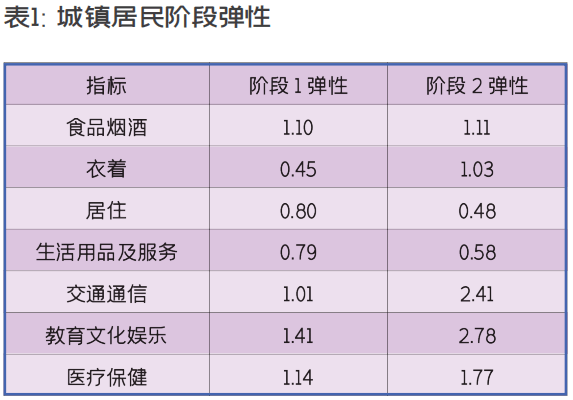
Core Insights - The article discusses significant changes in consumer habits in China under the influence of AI, analyzing how AI reshapes consumption decision-making paths, consumption stratification, and equity issues, including whether AI exacerbates consumption gaps [1] - It highlights the differences in consumption patterns between urban and rural areas, emphasizing that urban high-income groups adapt more quickly to AI technologies, while rural low-income groups remain focused on basic survival needs [2][3] - The research employs compound annual growth rate (CAGR) and consumption elasticity calculations to compare consumption differences across urban and rural areas during different stages of AI penetration [3][4] Urban vs. Rural Consumption Differences - Urban residents, particularly high-income groups, have better education and digital literacy, leading to quicker adaptation to AI technologies and a shift towards high-end products and services [2] - Rural low-income groups exhibit weaker consumption habit effects, relying on survival rationality and showing slower AI penetration, primarily focusing on basic living expenses [2][8] Stages of AI Impact and Consumption Elasticity - The impact of AI on consumption is gradual, with long-term data smoothing out short-term fluctuations. The study divides AI's influence into two stages: initial (2020-2022) and mature (2022-2024) [3][4] - Consumption elasticity is calculated for various categories, revealing differences in responsiveness to income changes between urban and rural residents across the two stages [4][5] Urban Residents: Basic vs. Quality Consumption - In the initial stage, urban residents prioritize improving living conditions and essential goods, leading to high consumption elasticity. In the mature stage, as basic needs become saturated, elasticity decreases [6][10] - The transition from survival needs to quality pursuits in urban areas results in increased elasticity for categories like transportation and education, driven by income growth and enhanced AI applications [7][10] Rural Residents: Saturation and Activation of Developmental Consumption - Rural residents experience a saturation effect in basic consumption as income rises, leading to reduced elasticity in essential goods. However, there is a growing demand for quality-driven consumption in the mature stage [8][12] - The digitalization of rural areas and improved infrastructure stimulate new consumption patterns, such as online education and smart devices, enhancing responsiveness to income changes [9][12] Banking Strategies for Urban and Rural Residents - For urban residents, banks should shift focus from traditional consumer credit for basic needs to customized financial services for quality consumption, such as smart home products and health management services [10][11] - For rural residents, banks can provide small, short-term loans for essential goods while enhancing digital payment solutions and promoting financial services to meet the growing demand for quality-driven consumption [12][13] Conclusion - AI technology profoundly influences consumer habits in China, reshaping decision-making processes and highlighting urban-rural disparities. The findings indicate a transition from basic consumption to quality consumption in urban areas, while rural areas experience a shift from saturation in basic needs to activation of developmental consumption [14]
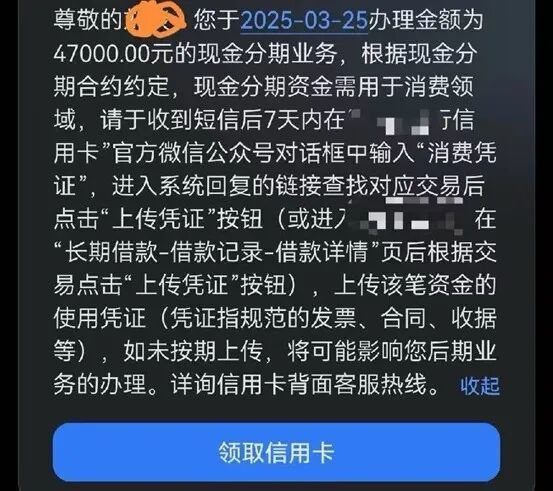
前脚消费贷,后脚被银行追讨发票,7天内上传,否则后果严重!有人为此焦虑,有人却趁机牟利:帮开票包过审
Mei Ri Jing Ji Xin Wen· 2025-09-30 09:57
Core Insights - The article discusses the emerging issue of "voucher anxiety" among consumers who have taken out personal loans but are now required to provide proof of expenditure, leading to confusion and potential financial risks [2][3][4] - A gray market for invoice services has developed, where intermediaries offer to create fake invoices for a fee, highlighting the challenges in tracking loan usage and the regulatory environment [6][9][20] Group 1: Consumer Concerns - Many consumers, like Xia, are confused about the requirement to submit invoices for small purchases, fearing that failure to do so could lead to loan recalls or frozen credit lines [2][4][8] - Discussions on social media reveal widespread anxiety about the need for invoices, with users sharing experiences and seeking advice on how to comply with bank requirements [4][8] - Some consumers express frustration over the difficulty of obtaining valid invoices for everyday purchases, leading to a dilemma between unnecessary spending and the risk of losing access to funds [8][15] Group 2: Gray Market for Invoices - A gray market has emerged where intermediaries offer to provide invoices for a fee, often claiming a high success rate in passing bank audits [6][9][12] - These intermediaries can create invoices that do not correspond to actual purchases, exploiting loopholes in the verification process used by banks [12][20] - The existence of this gray market indicates a significant gap in the regulatory framework and the practical needs of consumers [20][21] Group 3: Banking and Regulatory Challenges - Banks are tightening their post-loan management practices to ensure that funds are used for legitimate purposes, as past misuse has led to regulatory scrutiny [12][13] - Different banks have varying requirements for the types of proof needed, leading to confusion among consumers about what is acceptable [15][17] - The challenge for banks lies in effectively verifying the authenticity of invoices while managing the diverse and small-scale nature of consumer spending [17][22] Group 4: Technological Solutions and Future Directions - The potential for blockchain technology to enhance invoice tracking and verification is noted, but widespread implementation is still lacking due to various constraints [20][21] - Suggestions for improving the consumer experience include simplifying the documentation process and providing clearer guidelines on what constitutes acceptable proof of expenditure [22][23] - The article emphasizes the need for a balance between regulatory oversight and consumer convenience to foster a more mature financial ecosystem [25]
前脚消费贷,后脚被银行追讨发票,7天内上传,否则后果严重!
Mei Ri Jing Ji Xin Wen· 2025-09-30 09:41
Core Insights - The article discusses the emerging issue of "voucher anxiety" among consumers who have taken out personal loans but are required to provide proof of expenditure within a short timeframe, leading to confusion and potential financial risks [1][2][4] - A gray market for "voucher services" has developed, where intermediaries offer to create fake vouchers for a fee, highlighting the challenges banks face in verifying the actual use of loan funds [3][5][7] Consumer Concerns - Many consumers are confused about the requirement to submit vouchers for small purchases, leading to widespread discussions on social media about the necessity and difficulty of obtaining these vouchers [2][4] - Users express anxiety over the potential consequences of not submitting vouchers, including the risk of loan recall or penalties [4][8] Gray Market Development - A gray market has emerged where intermediaries offer services to create fake vouchers for a fee of 0.5% of the loan amount, indicating a significant demand for such services [5][7] - These intermediaries can tailor vouchers to match the bank's requirements, exploiting loopholes in the verification process [7][8] Banking Challenges - Banks are tightening their post-loan management practices to ensure that loan funds are used for legitimate purposes, as past misuse has led to regulatory scrutiny [8][13] - The inconsistency in voucher requirements across different banks adds to consumer confusion and complicates the verification process [12][13] Technological Solutions - The article mentions the potential of blockchain technology to enhance the traceability of vouchers, although widespread implementation is still pending due to various challenges [16][17] - Blockchain electronic invoices could provide a solution to the issues of voucher authenticity and tracking, but the adoption is limited by costs and user habits [16][17] Regulatory Recommendations - Experts suggest that regulatory bodies should consider tiered verification processes based on loan amounts and user credit ratings to alleviate the burden on consumers [18][19] - There is a call for banks to optimize voucher submission rules and improve user education on the importance of retaining vouchers for significant expenditures [19][20] Conclusion - The interplay between consumer voucher anxiety, the rise of a gray market, and banks' stringent verification processes reflects a broader challenge in financial regulation, emphasizing the need for a balance between risk management and consumer convenience [21]