中国移动

Search documents
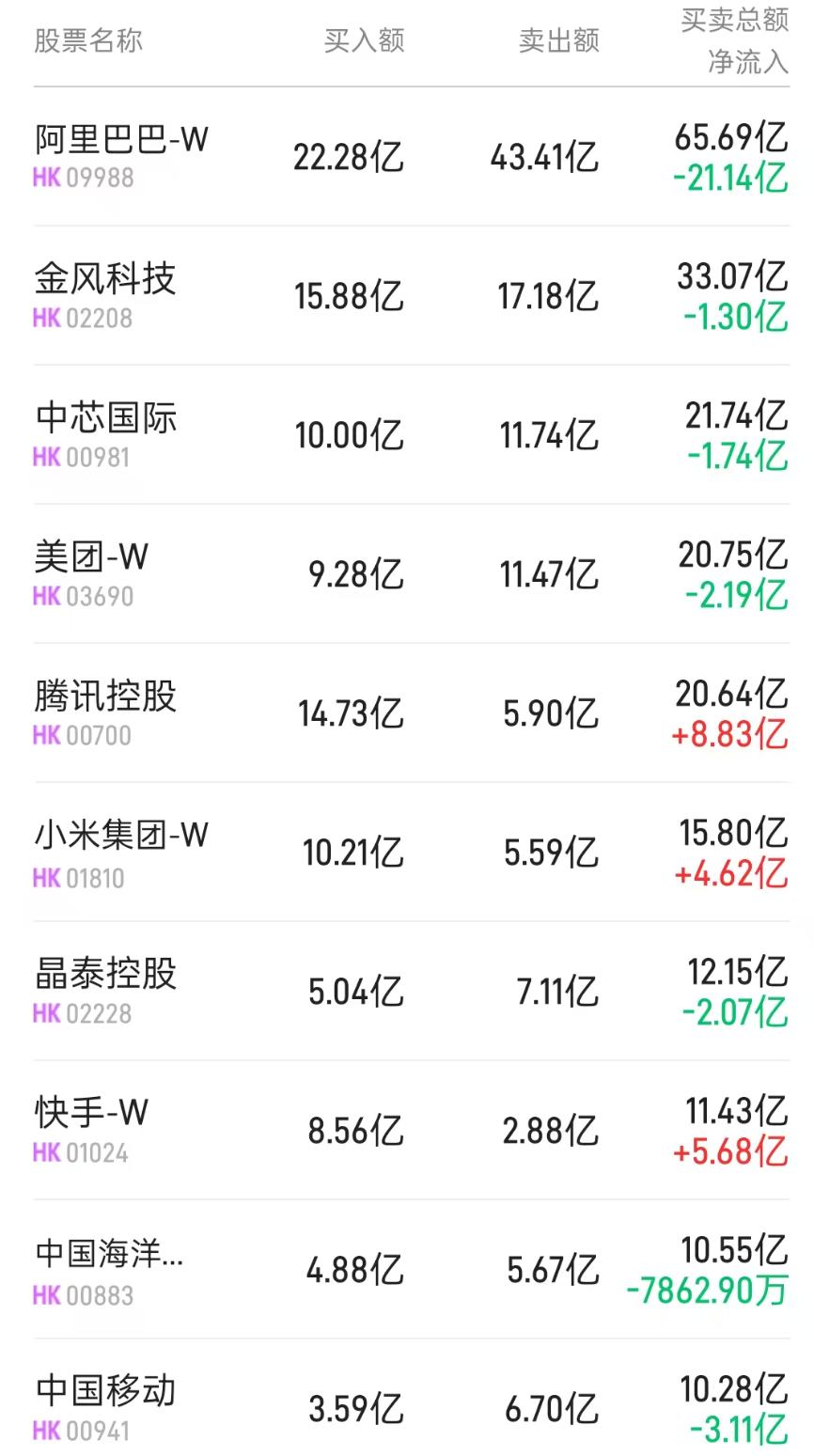
港股通(深)净买入51.55亿港元
Zheng Quan Shi Bao Wang· 2026-01-09 14:34
Core Viewpoint - On January 9, the Hang Seng Index rose by 0.32% to close at 26,231.79 points, with a net inflow of HKD 6.815 billion through the southbound trading channel [1] Group 1: Market Activity - The total trading volume for southbound trading on January 9 was HKD 111.389 billion, with a net buying amount of HKD 6.815 billion [1] - The Shanghai Stock Exchange's southbound trading amounted to HKD 67.084 billion, with a net buying of HKD 1.660 billion, while the Shenzhen Stock Exchange recorded HKD 44.305 billion in trading with a net buying of HKD 5.155 billion [1] Group 2: Active Stocks - In the Shanghai Stock Exchange's southbound trading, Alibaba-W had the highest trading volume at HKD 65.69 billion, followed by Goldwind Technology at HKD 33.07 billion and SMIC at HKD 21.74 billion [1] - Tencent Holdings had the highest net buying amount of HKD 0.883 billion, despite a closing price drop of 0.81% [1] - Alibaba-W recorded the highest net selling amount of HKD 2.114 billion, while its closing price increased by 2.73% [1] Group 3: Detailed Stock Data - The top active stocks in the southbound trading on January 9 included: - Alibaba-W: Trading amount of HKD 656.911 million with a net selling of HKD 211.364 million, closing up by 2.73% [3] - Goldwind Technology: Trading amount of HKD 330.673 million with a net selling of HKD 13.003 million, closing up by 3.41% [3] - SMIC: Trading amount of HKD 217.368 million with a net selling of HKD 17.406 million, closing down by 0.73% [3] - Tencent Holdings: Trading amount of HKD 209.478 million with a net buying of HKD 52.898 million, closing down by 0.81% [3]
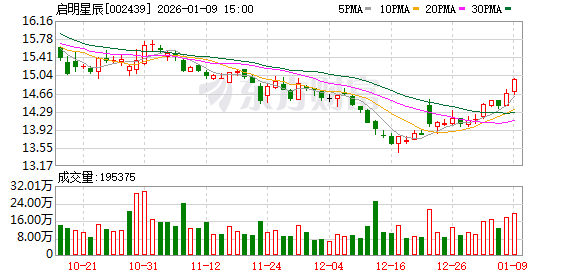
启明星辰:公司携手中国移动积极跟进量子科技等前沿技术
Zheng Quan Ri Bao· 2026-01-09 14:15
Core Viewpoint - The company is actively engaging in quantum technology research, particularly focusing on security threats related to quantum computing, and is integrating these advancements into its products [2]. Group 1: Quantum Technology Initiatives - The company is collaborating with China Mobile to explore cutting-edge technologies in quantum science [2]. - Research is being conducted on security threats posed by quantum computing, leading to product capability upgrades [2]. Group 2: Product Enhancements - The company has upgraded its post-quantum cryptography system, achieving product integration and smooth evolution of post-quantum algorithms [2]. - Quantum key distribution technology has been integrated into the company's VPN products, enhancing key supply and business collaboration capabilities [2]. Group 3: Industry Applications - Successful implementation of quantum security measures has been achieved in critical information infrastructure sectors such as finance and telecommunications [2].



AR眼镜首次实现独立通信 十年“附属品”地位或终结
Zhong Guo Jing Ying Bao· 2026-01-09 12:57
Core Insights - The introduction of RayNeo's X3 Pro Project eSIM marks a significant shift in the smart glasses industry, transitioning from dependency on smartphones to becoming independent devices capable of standalone functions like calls and AI interactions [1][2][3] - The partnership between RayNeo and major telecom operators like China Mobile and China Unicom is expected to enhance market reach and consumer adoption through innovative service models [3][4][5] Group 1: Product Development - The RayNeo X3 Pro Project eSIM features dual-color MicroLED display technology and integrates an eSIM communication module, allowing functionalities such as making calls, AI conversations, and streaming music without a smartphone [2][3] - The introduction of eSIM technology is anticipated to revolutionize the smart glasses market by eliminating the "accessory" perception and enabling a more autonomous user experience [2][4] Group 2: Market Dynamics - The collaboration between hardware manufacturers and telecom operators is likely to become a mainstream model in the industry, leveraging the strengths of both parties to accelerate product promotion and market penetration [4][5] - The market for eSIM-enabled devices is projected to grow significantly, with consumer awareness of eSIM services increasing from 25% in 2022 to 60% in 2025, indicating a rising interest in independent smart devices [6][7] Group 3: Challenges and Opportunities - Despite the promising outlook, the application of eSIM in AR glasses faces challenges such as battery life, the need for killer applications, and the physical design of the devices to enhance user comfort [7][8] - The development of suitable applications for independent AR glasses is crucial, as the current number of applications tailored for such devices is limited, necessitating further investment from developers [8]
港股9日涨0.32% 收报26231.79点
Xin Hua She· 2026-01-09 11:58
Core Viewpoint - The Hong Kong Hang Seng Index increased by 82.48 points, or 0.32%, closing at 26,231.79 points, with a total turnover of HKD 245.13 billion [1] Group 1: Index Performance - The Hang Seng Index rose by 82.48 points, closing at 26,231.79 points, reflecting a 0.32% increase [1] - The National Enterprises Index increased by 9.19 points, closing at 9,048.53 points, with a 0.1% rise [1] - The Hang Seng Technology Index gained 8.8 points, closing at 5,687.14 points, marking a 0.15% increase [1] Group 2: Blue-Chip Stocks - Tencent Holdings decreased by 0.81%, closing at HKD 611 [1] - Hong Kong Exchanges and Clearing rose by 0.38%, closing at HKD 426.8 [1] - China Mobile remained unchanged at HKD 80.95 [1] - HSBC Holdings increased by 0.4%, closing at HKD 124.8 [1] Group 3: Local Hong Kong Stocks - Cheung Kong Holdings fell by 0.33%, closing at HKD 42.1 [1] - Sun Hung Kai Properties rose by 1.36%, closing at HKD 104.2 [1] - Henderson Land Development increased by 0.89%, closing at HKD 29.62 [1] Group 4: Chinese Financial Stocks - Bank of China decreased by 0.68%, closing at HKD 4.39 [1] - China Construction Bank fell by 0.26%, closing at HKD 7.59 [1] - Industrial and Commercial Bank of China rose by 0.49%, closing at HKD 6.13 [1] - Ping An Insurance decreased by 0.28%, closing at HKD 70 [1] - China Life Insurance increased by 1.09%, closing at HKD 31.48 [1] Group 5: Oil and Petrochemical Stocks - China Petroleum & Chemical Corporation rose by 0.43%, closing at HKD 4.69 [1] - PetroChina increased by 1.63%, closing at HKD 8.1 [1] - CNOOC gained 1.26%, closing at HKD 20.94 [1]
智通港股通活跃成交|1月9日




智通财经网· 2026-01-09 11:22
Group 1 - On January 9, 2026, Alibaba-W (09988), Goldwind Technology (02208), and SMIC (00981) were the top three companies by trading volume in the Southbound Stock Connect, with transaction amounts of 6.569 billion, 3.307 billion, and 2.174 billion respectively [1] - In the Southbound Stock Connect for the Shenzhen-Hong Kong Stock Connect, Alibaba-W (09988), Tencent Holdings (00700), and SMIC (00981) also ranked as the top three, with transaction amounts of 3.420 billion, 2.095 billion, and 1.749 billion respectively [1] Group 2 - The top active companies in the Southbound Stock Connect included Alibaba-W (09988) with a net buy amount of -2.114 billion, Goldwind Technology (02208) with -0.130 billion, and SMIC (00981) with -0.174 billion [2] - In the Shenzhen-Hong Kong Stock Connect, Alibaba-W (09988) had a net buy amount of -0.508 billion, Tencent Holdings (00700) had +0.529 billion, and SMIC (00981) had +0.866 billion [2]
资金动向 | 北水大买港股逾68亿港元,连续7日加仓小米
Ge Long Hui A P P· 2026-01-09 11:13
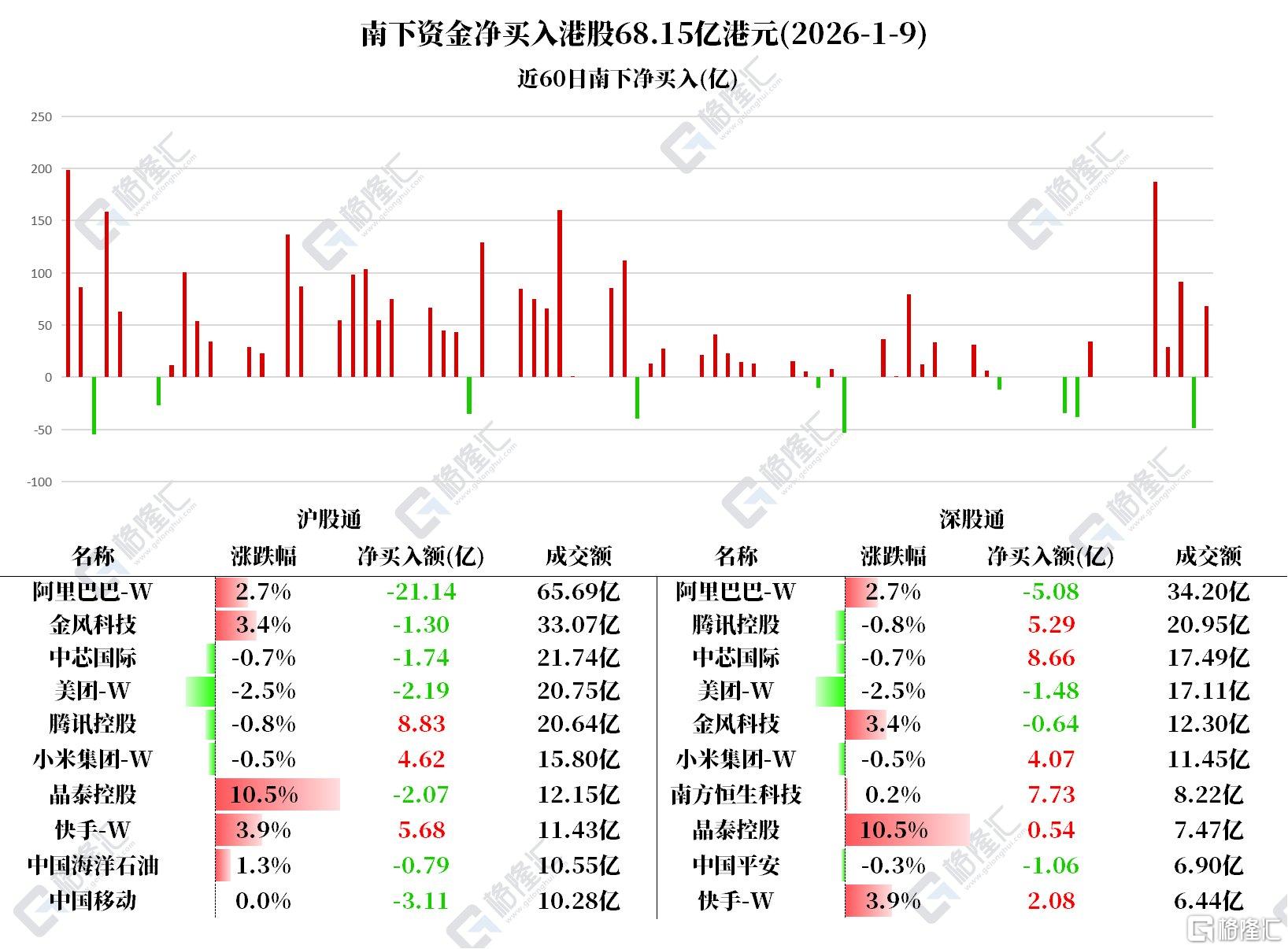
Group 1: Investment Trends - Net purchases included Tencent Holdings at 1.412 billion, Xiaomi Group-W at 0.869 billion, Kuaishou-W at 0.776 billion, Southern Hang Seng Technology at 0.772 billion, and SMIC at 0.692 billion [1] - Net sales included Alibaba-W at 2.622 billion, Meituan-W at 0.366 billion, China Mobile at 0.311 billion, Goldwind Technology at 0.194 billion, Jingtao Holdings at 0.153 billion, and Ping An Insurance at 0.105 billion [1] - Southbound funds have recorded net purchases of Xiaomi for 7 consecutive days totaling 5.55407 billion HKD and Tencent for 3 consecutive days totaling 4.23097 billion HKD [1] Group 2: Stock Performance - Alibaba-W saw a decline of 2.7% with a net outflow of 2.114 billion [3] - Tencent Holdings experienced a slight decrease of 0.8% with a net inflow of 0.883 billion [3] - Kuaishou-W had a positive performance with a 3.9% increase and a net inflow of 0.568 billion [3] Group 3: Company Announcements - Xiaomi Group-W announced a price drop of 300 yuan for the Xiaomi 17 standard version, now starting at 4299 yuan, with the promotion running until January 31 [4] - Kuaishou-W's revenue forecast for its Keling AI is projected to exceed 140 million USD in 2025 and reach approximately 230 to 240 million USD in 2026, following a model upgrade and new feature launch [4] - China Ping An received a "buy" rating from Guosen Securities, indicating clear recovery potential in its valuation [5]
北水动向|北水成交净买入68.15亿 阿里(09988)拟加大淘宝闪购投入 北水全天抛售阿里超26亿港元
智通财经网· 2026-01-09 10:02
Group 1 - The Hong Kong stock market saw a net inflow of 68.15 billion HKD from northbound trading, with 16.6 billion HKD from Shanghai and 51.55 billion HKD from Shenzhen [1] - The most bought stocks included Tencent (00700), Xiaomi Group-W (01810), and Kuaishou-W (01024), while the most sold stocks were Alibaba-W (09988), China Mobile (00941), and Goldwind Technology (02208) [1][2] Group 2 - Alibaba-W (09988) had a net outflow of 26.21 billion HKD, with a total trading volume of 65.69 billion HKD, indicating significant selling pressure [2][7] - Tencent (00700) received a net inflow of 14.11 billion HKD, supported by a report from Morgan Stanley highlighting its AI strategy and high potential for monetization [4][5] - Xiaomi Group-W (01810) attracted a net inflow of 8.69 billion HKD, with plans for 200 billion HKD in R&D investment over the next five years [5] - Kuaishou-W (01024) saw a net inflow of 7.76 billion HKD, driven by strong performance in AI-generated content [5] - Semiconductor company SMIC (00981) had a net inflow of 6.92 billion HKD, following a strategic acquisition that is expected to positively impact earnings [6] - Goldwind Technology (02208) faced a net outflow of 1.94 billion HKD, despite potential positive catalysts from its stake in Blue Arrow Aerospace [7]


图解丨南下资金净买入腾讯和小米,大幅净卖出阿里
Ge Long Hui A P P· 2026-01-09 10:00
Group 1 - Southbound funds net bought Hong Kong stocks worth 6.815 billion HKD today, with notable purchases including Tencent Holdings (1.412 billion HKD), Xiaomi Group (0.869 billion HKD), and Kuaishou (0.776 billion HKD) [1] - Southbound funds have continuously net bought Xiaomi for 7 days, totaling 5.55407 billion HKD, and Tencent for 3 days, totaling 4.23097 billion HKD [1] - Southbound funds have continuously net sold China Mobile for 5 days, totaling 3.45009 billion HKD [1] Group 2 - Alibaba-W experienced a net sell of 2.622 billion HKD, while Meituan-W saw a net sell of 0.366 billion HKD [4] - Tencent Holdings had a net buy of 0.883 billion HKD despite a 0.8% decline in stock price [4] - Kuaishou-W recorded a net buy of 0.568 billion HKD with a stock price increase of 3.9% [4]

南向资金 | 腾讯控股获净买入14.12亿港元
Di Yi Cai Jing· 2026-01-09 09:55
Group 1 - Southbound funds recorded a net purchase of 68.15 billion HKD today [1] - Tencent Holdings, Xiaomi Group-W, and Kuaishou-W were the top three net purchases, with net buys of 14.12 billion HKD, 8.70 billion HKD, and 7.76 billion HKD respectively [1] - On the sell side, Alibaba-W, Meituan-W, and China Mobile experienced net sales of 26.22 billion HKD, 3.67 billion HKD, and 3.11 billion HKD respectively [1]
通信行业双周报(2025、12、26-2026、1、8):商用航天建设持续推进-20260109
Dongguan Securities· 2026-01-09 09:31
Investment Rating - The report maintains an "Overweight" rating for the communication industry, expecting the industry index to outperform the market index by more than 10% in the next six months [2][44]. Core Insights - The commercial aerospace sector is showing significant momentum both domestically and internationally, shifting focus from mere technological breakthroughs to the integration of technology, ecosystem development, and market applications. Leading companies are enhancing their commercialization capabilities [3][39]. - The report anticipates that the communication industry will experience a period of technological iteration and policy dividends in 2025, with new growth drivers emerging from AI, quantum communication, and low-altitude economy sectors. The recovery of cellular IoT modules and ongoing construction of communication facilities are expected to create new demands for devices, equipment, and service operations [3][39]. Summary by Sections 1. Communication Industry Market Review - The communication sector index fell by 1.18% over the two weeks from December 26, 2025, to January 8, 2026, underperforming the CSI 300 index by 3.22 percentage points, ranking last among 31 sectors [11][12]. - In January 2026, the communication sector index increased by 0.85%, again underperforming the CSI 300 index by 1.48 percentage points [11][12]. 2. Industry News - The Ministry of Industry and Information Technology and seven other departments jointly issued the "Implementation Opinions on the Special Action of 'Artificial Intelligence + Manufacturing'" [15]. - The first offshore reusable rocket recovery base in China has commenced construction with a total investment of 5.2 billion yuan [21]. - SpaceX's Starlink has connected over 9 million active users across 155 countries, showcasing significant growth from 14.5 million users in December 2021 [22]. 3. Company Announcements - Feiling Kesi plans to indirectly invest in Nanfei Microelectronics, focusing on high-speed network communication interconnect chips, with a total investment of 40.8 million yuan [23][24]. - Guangku Technology expects a net profit growth of 152%-172% for 2025, driven by revenue growth and cost control measures [26]. 4. Industry Data Updates - As of November 2025, the mobile phone user base reached approximately 1.828 billion, a year-on-year increase of 2.20% [27]. - The total number of 5G base stations reached 4.83 million, with a net increase of 579,000 compared to the end of the previous year [36].