
荣耀

Search documents
智能体上场,手机厂商猛攻AI
2 1 Shi Ji Jing Ji Bao Dao· 2025-10-28 06:53
Core Insights - The smartphone industry is transitioning from "hardware competition" to "intelligent evolution" by 2025 [1] - AI and form innovation are the two core competitive directions for smartphone manufacturers, representing both technological innovation and brand differentiation [2] AI Development and Strategy - Domestic smartphone manufacturers are accelerating their AI strategies, with Honor being particularly aggressive, launching the Magic 8 and the first Honor AI Terminal Ecological Conference [4] - Honor's Magic 8 emphasizes "self-evolving AI native phone" with the upgraded MagicOS 10, featuring various AI agents supported by the MagicGUI model, which integrates multimodal data for task execution [6] - Honor's AI strategy includes the HONOR AI Connect platform and eight AI solutions, aiming to lower the entry barrier for ecosystem partners and promote collaboration across various industries [6][7] Competitive Landscape - Other major domestic manufacturers are also enhancing their AI capabilities, with Huawei launching HarmonyOS 6 and over 80 AI applications, OPPO introducing intelligent computing frameworks, and vivo integrating multimodal reasoning models [7] - The evolution of AI in smartphones is shifting from isolated features like voice assistants to system-level intelligent collaboration, with AI capabilities moving from cloud to edge computing [7] Consumer Insights and Market Trends - According to Omdia, Chinese consumers frequently use AI features such as AI tools, smart voice assistants, photo editing, enhanced search engines, and real-time translation [8] - There is a noted disconnect between the AI capabilities highlighted by manufacturers and the features most used by consumers, although significant improvements have been made in functionality and user experience over the past year [8][9] Future Directions - Manufacturers need to effectively communicate their AI development roadmap to consumers and partners, focusing on user pain points to enhance understanding and retention of AI features [9] - Form innovation is evolving alongside AI, with new designs like foldable and robotic phones being explored, indicating a shift towards embodied intelligence [9][10] - Honor views the AI Phone era as the next stage in smartphone evolution, following the feature phone and smartphone eras, with ongoing exploration into new hardware directions [10]

对话荣耀MagicOS 10核心高管:当手机系统学会思考,AI正重塑人机关系
Feng Huang Wang· 2025-10-28 04:57
Core Viewpoint - The release of Honor's MagicOS 10 signifies a major shift in the operating system landscape, moving from hardware specifications to AI-driven user experience and interaction [7] Group 1: AI and User Experience - Honor emphasizes that the future competition in smart operating systems will focus on functional experience rather than just performance metrics [2] - The goal of MagicOS 10 is to transform devices from "cold tools" into "partners" that actively perceive and simplify user interactions with the digital and physical worlds [2][3] Group 2: YOYO Intelligent Agent - The YOYO intelligent agent is designed to cover various aspects of daily life, supported by advanced technologies including visual models and multi-modal models [3] - YOYO features capabilities such as "YOYO sees," which allows it to recognize and automatically execute tasks based on user context, enhancing its utility [3] - The agent is being developed to create a personalized knowledge base for users, enabling it to provide tailored responses based on past interactions [3] Group 3: System Architecture and Aesthetics - MagicOS 10 incorporates a new "Hummingbird" architecture that enhances system fluidity through a comprehensive redesign at the motion, scheduling, and kernel levels [4] - The introduction of "AI trajectory real-time calculation technology" allows for personalized motion trajectories based on user interactions [4] - The "zero-gravity transparent UX design" aims to maintain consistent visual clarity across various backgrounds, addressing challenges in content visibility [4][5] Group 4: Strategic Direction and Market Positioning - Honor is breaking down barriers by enabling cross-brand connectivity, allowing users to share information seamlessly across different device brands [6] - The company is responding to user feedback by modernizing its design approach, aiming to attract younger demographics who previously found its designs outdated [6] - The strategic shift towards a more youthful and refined aesthetic is a direct response to the loss of users to competitors, particularly among younger and female demographics [6]
QuestMobile2025年三季度AI应用行业报告:移动端AI应用规模突破7亿大关,模型升级加速,MCP助推产业开放
3 6 Ke· 2025-10-28 03:26
Core Insights - The AI application market is experiencing significant growth, with mobile and PC active user counts reaching 729 million and 200 million respectively by September 2025, driven by a shift towards ecosystem collaboration and model optimization [1][6][14]. Market Overview - As of September 2025, the mobile AI application market includes 287 million users for native apps, 706 million for In-App AI, and 535 million for smartphone manufacturer AI assistants, with respective growth rates of 3.4%, 9.3%, and 1.2% [1][14]. - The overall scale of mobile AI applications has surpassed 700 million, indicating a maturation and commercialization of the industry [6][14]. User Engagement - In-App AI applications dominate the user engagement landscape, with 31 out of the top 50 AI applications being plugins, led by Baidu AI Search, Douyin AI Search, and WeChat AI Search [2][31]. - The average number of In-App AI applications per app in the top 20 has increased to 2.5, while PC web applications and smartphone AI assistants lag behind [2][31]. Competitive Landscape - The competition has shifted from a focus on parameter comparisons to ecosystem collaboration, with major players like Baidu, Alibaba, Tencent, and Douyin updating their models frequently [1][6][14]. - The user engagement time for native AI applications remains the highest at 117.7 minutes, compared to 31 minutes for AI plugins and 5.3 minutes for smartphone AI assistants [2][16]. Trends in AI Applications - The industry is moving towards a "value-driven" model, with pricing strategies becoming more refined and user stickiness increasing, particularly for In-App AI plugins [2][12][18]. - The average single-use token consumption has decreased, indicating improved efficiency and cost control in AI applications [18][20]. Ecosystem Development - The MCP (Model Cloud Platform) services have reached 9,384 by October 20, 2025, facilitating a shift from model development to a service-oriented ecosystem [1][20]. - The integration of AI assistants into smartphones has become standard, with a collective growth of 65 million users across six major manufacturers, reflecting a 13.9% year-on-year increase [40][61]. PC Application Dynamics - The PC application market is undergoing contraction, with over 75% of web applications facing growth challenges, while the client applications are also struggling with 75% showing negative growth [50][57]. - Successful PC applications are primarily in productivity sectors, with notable growth in applications like Xiaoyi and WPS Lingxi, indicating a need for professional value to sustain growth [54][57]. Strategic Focus - Internet companies are focusing on integrating AI with business scenarios to enhance their core offerings, while smartphone manufacturers are building open ecosystems around AI assistants [61][70]. - The evolution of AI applications is characterized by a shift from single-point technology competition to an ecosystem-based collaboration model, with payment capabilities marking a significant milestone in commercialization [74][78].
新旗舰扎堆双11:米OV荣围剿iPhone17,四大趋势已明
3 6 Ke· 2025-10-28 03:15
Core Insights - The upcoming Double Eleven shopping festival has prompted a wave of flagship smartphone releases, with major brands like Vivo, OPPO, Honor, and OnePlus launching their new models around the same time, indicating a competitive landscape in the high-end market [1][3][19] - The release timing aligns with the introduction of new chipsets, such as Snapdragon 8 Elite Gen 5 and Dimensity 9500, marking the start of a new flagship cycle [3][4] - Consumers face a complex decision-making process due to the multitude of new flagship options, each emphasizing different features like battery life, imaging capabilities, AI integration, and design [3][19] Group 1: Key Upgrades - Upgrade 1: Battery capacity has significantly increased, with most new flagship models featuring batteries of at least 6000 mAh, and some reaching up to 8000 mAh, effectively addressing battery anxiety [4][7] - Upgrade 2: High refresh rates have returned as a key focus, with models like OnePlus 15 achieving 165 Hz, enhancing gaming experiences [8][10] - Upgrade 3: There is a collective shift towards long-focus capabilities, with many brands adopting 200-megapixel periscope lenses, indicating intensified competition in imaging technology [11][13] - Upgrade 4: Enhanced AI capabilities are being integrated into smartphones, with new chipsets providing the necessary computational power for advanced AI functionalities [14][18] Group 2: Differentiation Strategies - Companies are seeking differentiation through unique features and experiences rather than just hardware specifications, with brands like Xiaomi innovating with a back screen for interactive functionalities [19][21] - OPPO focuses on optimizing system performance through foundational architecture improvements, while Honor emphasizes AI in imaging [21][24] - Apple's strategy involves offering lightweight designs alongside professional-grade imaging capabilities, maintaining a competitive edge in the premium segment [24][28] Group 3: Market Trends - The smartphone industry appears to be entering a new phase, with manufacturers prioritizing user experience, system intelligence, and innovative interactions over mere performance metrics [29] - The ongoing competition in the lead-up to Double Eleven highlights the importance of consumer experience, suggesting that lasting impressions will stem from usability rather than discounts [29]


QuestMobile2025年三季度AI应用行业报告:移动端AI应用规模突破7亿大关,模型升级加速,MCP助推产业开放
QuestMobile· 2025-10-28 02:01
Core Insights - The AI application market is experiencing rapid growth, with mobile and PC active user counts reaching 729 million and 200 million respectively by September 2025 [3][4][20] - Major companies are shifting focus from parameter competition to ecosystem collaboration, optimizing models to meet customer needs and expand application scenarios [4][9] - The In-App AI plugin model has become the leading growth driver, with 31 out of the top 50 AI applications being plugins [4][5][24] Market Overview - By September 2025, the mobile AI application market has surpassed 700 million users, with native apps, In-App AI, and mobile manufacturer AI assistants reaching 287 million, 706 million, and 535 million users respectively [20][9] - The growth of mobile applications is supported by a stable head of native apps, while the PC web applications face challenges, with over 75% experiencing growth difficulties [5][60] User Engagement - The average usage time for native AI applications is 117.7 minutes, significantly higher than In-App AI plugins at 31 minutes and mobile manufacturer AI assistants at 5.3 minutes [6][24] - The top AI applications show a stable user base, with notable growth in vertical applications like AQ and Doubao, which have seen substantial increases in active users [6][38] Competitive Landscape - The competitive landscape is solidifying, with nearly 60% of native apps experiencing negative growth, indicating a narrowing window for new entrants [31][34] - Vertical applications are thriving, with AQ, Doubao, and Jimeng AI showing impressive growth rates of 83.4%, 15.7%, and 12.1% respectively [38][40] Ecosystem Development - The MCP services have reached 9,384, facilitating ecosystem collaboration and marking a new phase of commercialization in the AI industry [4][9][80] - Companies are focusing on integrating AI into business scenarios, enhancing user experience through seamless service delivery [70][72] Future Trends - The AI market is transitioning from a focus on broad capabilities to specialized, efficient solutions, with a significant increase in model updates and iterations [16][18] - The integration of payment capabilities is seen as a key milestone for the commercialization of AI applications, paving the way for an "AI as a service" economy [85][87]

半个月三场大会,AI战火蔓延手机圈
3 6 Ke· 2025-10-27 23:26
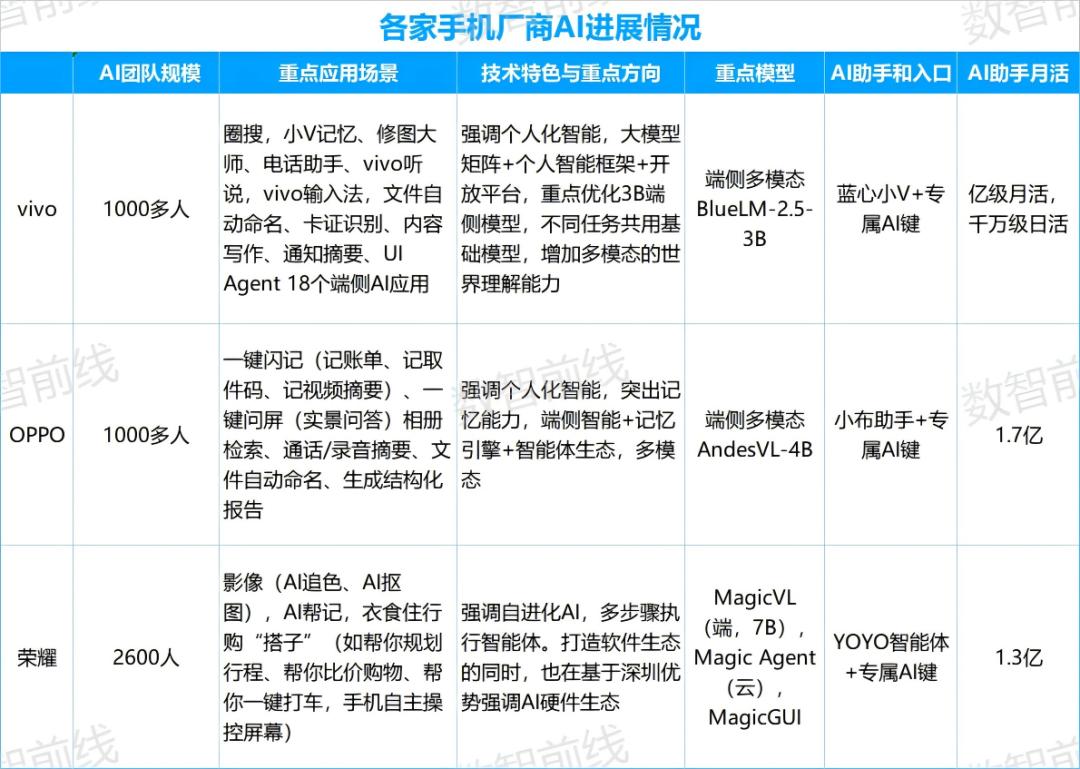
Core Insights - Mobile manufacturers are shifting focus from large parameter models to edge-based multimodal models, reflecting a significant change in AI strategy [1][8][11] - AI has become a central topic at recent developer conferences held by vivo, OPPO, and Honor, showcasing their new understanding of AI strategies and model applications [1][2] AI Development Trends - The application of AI in mobile devices has evolved from text processing to include image and voice processing, with a notable increase in edge-side multimodal models [1][3] - vivo has introduced 18 edge-side AI applications, enhancing user interaction through complex task management and intent recognition [1][4] - OPPO's features like "one-click screen inquiry" and "one-click flash note" demonstrate real-time understanding and automation of user tasks [2][4] - Honor claims over 3,000 automated scenarios, streamlining user interactions across various applications [2][4] Model Evolution - Mobile manufacturers have progressed through three stages of model development, moving from large language models to multimodal models with a focus on edge deployment [3][5] - Recent releases include Honor's 7B multimodal model MagicGUI and vivo's 3B model BlueLM-2.5-3B, integrating language, vision, and logical reasoning capabilities [5][6] Challenges in Edge Model Deployment - Current AI assistants often rely on multiple models for different tasks, leading to complexities in integrating external cloud models [8][11] - The performance of edge models is constrained by chip capabilities, with current models achieving 2B-5B parameters, equivalent to 32-70B cloud models [8][10] - The need for higher performance chips and storage for edge models poses challenges, especially in balancing cost and user experience [11][12] Ecosystem Development - The development of AI agents is still in its early stages, with current automation tasks limited to manufacturer-specific applications [13][15] - Manufacturers are building AI ecosystems to enhance cross-application functionality, with vivo, OPPO, and Honor leading efforts in creating reusable capabilities for partners [15][16] - Collaboration with internet companies is crucial for expanding the AI ecosystem, as user data and application value are significant concerns for app developers [16][17]
三季度手机业观察:换机潮下全球回暖 中国市场竞逐AI
2 1 Shi Ji Jing Ji Bao Dao· 2025-10-27 12:26
Global Smartphone Market Overview - The global smartphone market experienced a 3% year-on-year increase in shipments in Q3 2025, driven by strong replacement demand and preemptive stocking by manufacturers ahead of a busy Q4 [1][2] - Samsung and Apple maintained the top two positions in global market share, with Apple’s iPhone 17 series performing well, although the new iPhone Air saw limited shipments [1][2] - Omdia forecasts an increase of 54 million units in global smartphone shipments from 2025 to 2029, with nearly 70% of this growth coming from emerging markets [1] Domestic Market Dynamics - The Chinese smartphone market saw a 3% year-on-year decline in Q3 2025, but the decrease was less severe than in previous quarters, indicating a stabilization trend [5] - Vivo regained the top position in the Chinese market with an 18% share, followed closely by Huawei at 16%, and Apple at 15% [5] - The competition among top manufacturers is intensifying, with a focus on product differentiation through design, battery life, and camera capabilities [5][6] AI and Innovation Trends - AI and innovative designs are emerging as key growth drivers in the smartphone industry, with manufacturers increasingly focusing on enhancing user experience through AI functionalities [4][6] - Over 80% of consumers in China consider AI features important when choosing their next smartphone, indicating a shift in consumer preferences towards AI capabilities [6] - The smartphone industry is transitioning from a focus on quantity to quality, with an emphasis on high-end, intelligent devices and diversified revenue models [4][5]
红板科技:依托技术与产品优势,领跑中高端PCB市场
Cai Fu Zai Xian· 2025-10-27 06:36
Industry Overview - The global PCB industry is characterized by a large number of manufacturers, low concentration, and intense market competition. However, the industry is experiencing significant growth opportunities due to the booming sectors of electric vehicles, 5G communication, servers, cloud computing, and artificial intelligence. Prismark forecasts a steady growth of the global PCB market at a compound annual growth rate (CAGR) of 5.2% from 2024 to 2029, with the market size expected to exceed $90 billion, reaching $94.661 billion by 2029 [1]. Company Strengths - Hongban Technology has developed strong technical capabilities and production experience in the research and manufacturing of various PCB products. The company focuses on the R&D, production, and sales of printed circuit boards, targeting the mid-to-high-end application market with characteristics of high precision, high density, and high reliability. It is one of the few companies in the industry with a high revenue share from HDI boards and the ability to mass-produce any interconnected HDI boards and IC substrates [1]. Technical Capabilities - Hongban Technology has established a comprehensive technical system in the high-end HDI board production field, achieving breakthroughs in several key processes. The minimum aperture for laser blind holes can be controlled at 50μm, and the thinnest thickness of the core board plating layer is only 0.05mm. The company can produce HDI boards with up to 26 layers, with overall blind hole layer deviation accurately controlled within 50μm, placing its technology at the forefront of the industry. In the IC substrate field, the company has mastered processes such as Tenting and mSAP, achieving high-precision manufacturing with sample minimum line width/spacing reaching 10μm/10μm and mass production minimum line width/spacing of 18μm/18μm [2]. Product Structure - Hongban Technology has formed a complete product structure, including HDI boards, rigid boards, flexible boards, rigid-flex boards, class substrates, and IC substrates. The company possesses comprehensive R&D and production capabilities, providing customers with diverse product options and one-stop services. Its products are widely used in consumer electronics, automotive electronics, high-end displays, and communication electronics, with significant competitive advantages and market positions in the consumer electronics and automotive electronics sectors [2]. Customer Base - Hongban Technology has established a solid customer base in the PCB industry over the years, leveraging its leading technical strength and reliable product quality. In the consumer electronics sector, the company has formed long-term stable partnerships with globally recognized smartphone brands such as OPPO, vivo, and Honor. In the automotive electronics sector, it maintains close cooperation with well-known electric vehicle manufacturer BYD. In the high-end display sector, stable partnerships have been established with leading companies in the LED display industry, such as Zhaochi and Zhouming Technology. These high-quality customers possess strong market competitiveness and industry influence, reflecting Hongban Technology's technical strength and laying a solid foundation for the company to continue exploring new markets [3]. Future Outlook - As the PCB industry continues to grow, Hongban Technology will leverage its advantages in technology, products, and customers to focus on the R&D, production, and sales of mid-to-high-end printed circuit boards. The company aims to deepen its technical layout and strive to achieve its vision of becoming a world-class circuit board manufacturing base [3].
拍月亮变“P月亮”,当手机摄影被AI算法入侵
创业邦· 2025-10-27 03:28
Core Viewpoint - The article discusses the evolution of smartphone imaging technology, emphasizing the increasing integration of AI algorithms in flagship smartphones to enhance photo quality while raising concerns about the authenticity of images produced [5][14][19]. Group 1: Smartphone Imaging Technology - Flagship smartphones in 2025 will focus on imaging capabilities, with models like Xiaomi 17 Pro and OPPO Find X9 Pro featuring advanced camera systems [5][14]. - The integration of AI in smartphone photography has become prevalent, with many brands embedding AI algorithms to optimize image quality automatically [15][16][19]. - Users are increasingly concerned about the "algorithmic flavor" in photos, questioning the balance between realistic representation and algorithmic enhancement [14][20]. Group 2: User Experience and AI Integration - Many users prefer "foolproof" photography experiences, leading manufacturers to default to AI algorithms for photo enhancement [15][19]. - The vivo X300 Pro exemplifies the successful application of AI in enhancing user experience, with users reporting superior photo quality compared to traditional smartphone cameras [18][19]. - The article highlights a shift in user expectations, where the quality of images produced by AI-enhanced smartphones is prioritized over strict adherence to realism [19][20]. Group 3: Challenges and Future Directions - Despite advancements, challenges remain, particularly in extreme shooting conditions where AI may distort images [20][25]. - The physical limitations of smartphone hardware necessitate a reliance on software algorithms to meet user demands for high-quality images [27][28]. - The industry is moving towards a balance between AI enhancements and authentic representation, with companies like OPPO and vivo aiming to refine their AI applications to respect the integrity of real-world scenes [44][45].

爱施德:前三季度实现营收超390亿元 现金流同比增长129.21%
Zhong Zheng Wang· 2025-10-26 09:31
Core Viewpoint - Aishide has reported strong financial performance for the first three quarters of 2025, with revenue of 39.375 billion yuan and a net profit of 337 million yuan, driven by its core business and strategic investments in AI and robotics [1][2][3] Financial Performance - For the first three quarters of 2025, Aishide achieved revenue of 39.375 billion yuan and operating profit of 574 million yuan, with a net profit attributable to shareholders of 337 million yuan [1] - The net cash flow from operating activities reached 2.701 billion yuan, representing a year-on-year increase of 129.21% [1] Business Strategy - Aishide is enhancing its core business by expanding its channel system and deepening capital layout, particularly in the context of the Apple AI terminal cycle [1] - As of September 30, 2025, the total number of Apple Authorized Retail Stores (APR) reached 246, an increase of 46 stores from the beginning of the year, maintaining its position as the largest in the country [1] - The company is also strengthening its online operational capabilities across platforms like Tmall, JD.com, and Douyin [1] Investment in High-Growth Sectors - Aishide has established a 500 million yuan "Aishide Smart City Fund" in partnership with Shenzhen Smart City Industry Investment Fund, focusing on AI, smart terminals, and next-generation information technology [2] - The company has made strategic investments in two high-growth firms, Yunshen Technology and Saigan Technology, which specialize in robotics and flexible tactile sensors, respectively [2] Global Expansion - Aishide's partnership with Honor is accelerating its international business, with exclusive sales and service authorizations in regions including Hong Kong, Thailand, and Vietnam, and new authorizations in the Middle East, Africa, and Australia planned for 2025 [2] - Honor's market share in Hong Kong reached 20.2%, ranking it among the top two, while in Macau, it held a 32.4% market share, and retail activation in Vietnam grew by over 300% year-on-year [2] Transformation and Future Outlook - Aishide is transitioning from a traditional distributor to an "intelligent terminal ecosystem enterprise," leveraging stable cash flow from the Apple ecosystem and growth potential from AI and robotics investments [3] - The company aims to create a new global growth pattern through a synergistic layout of "equity + channels + regional expansion," benefiting from the appreciation of equity value and channel expansion [3]
