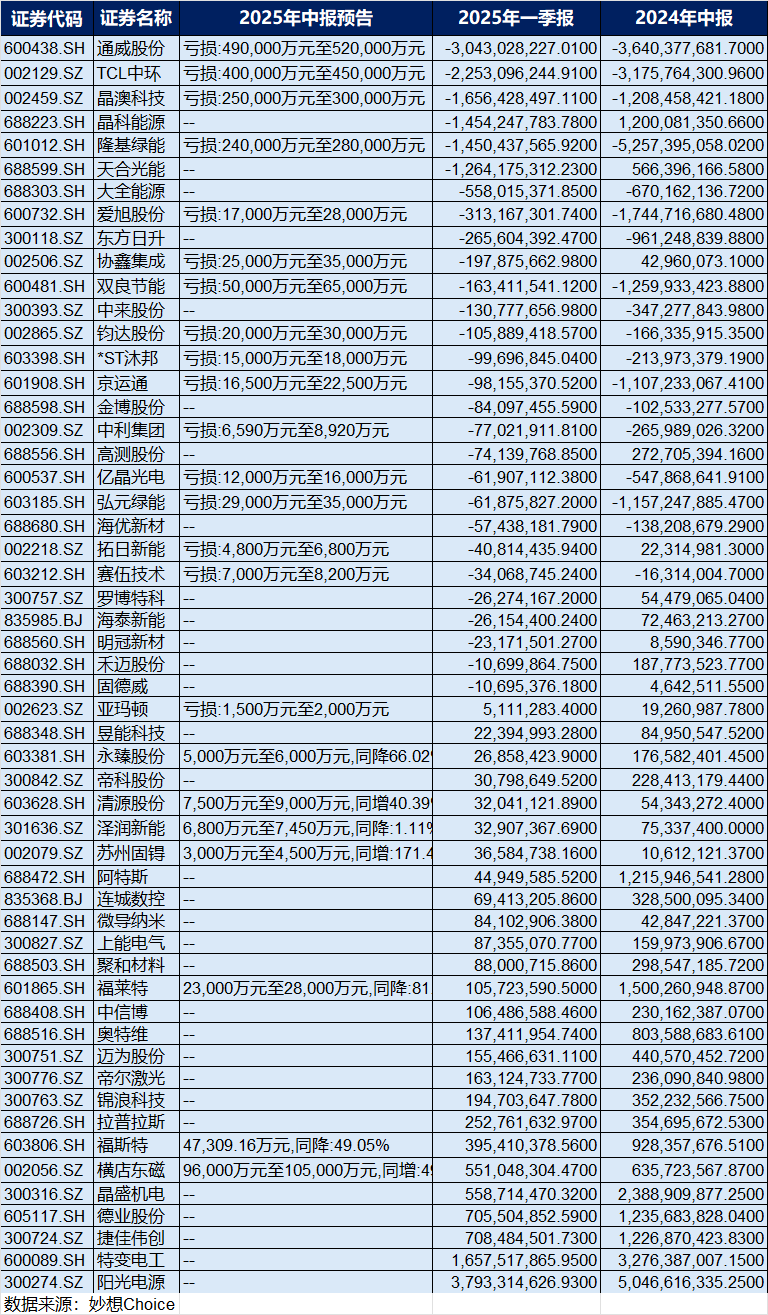
晶澳科技

Search documents
半年盘点| “反内卷”暂未将光伏企业拖出亏损泥潭,但部分企业二季度已减亏或盈利
Di Yi Cai Jing· 2025-07-15 14:39
Core Viewpoint - The photovoltaic industry is experiencing significant losses due to supply-demand imbalances and declining prices across the industry chain, although some companies have shown signs of reduced losses or profitability in the second quarter [1][2][3]. Industry Overview - The Ministry of Industry and Information Technology and industry associations have held multiple meetings to address overcapacity and chaotic competition in the photovoltaic sector, aiming to enhance product quality and facilitate the orderly exit of outdated capacity [2]. - Despite a temporary surge in demand in the distributed market, the overall industry continues to face substantial losses, with leading companies reporting increased losses compared to the previous year [2][3]. Company Performance - Major companies like Tongwei Co., Ltd. and TCL Zhonghuan are forecasting significant losses for the first half of the year, with Tongwei expecting a net loss of 4.9 billion to 5.2 billion yuan, and TCL Zhonghuan anticipating a loss of 4 billion to 4.5 billion yuan [2]. - JA Solar Technology is also projecting a net loss of 2.5 billion to 3 billion yuan, a substantial increase from the previous year's loss of 874 million yuan [2]. Second Quarter Performance - The second quarter has shown a divergence in performance among leading photovoltaic companies, reflecting differences in strategic execution and cost control measures [3][4]. - TCL Zhonghuan expects a second-quarter loss of 2.094 billion to 2.594 billion yuan, while Tongwei's loss is projected to be between 2.307 billion and 2.607 billion yuan, remaining stable compared to the first quarter [4]. Factors Influencing Performance - Longi Green Energy and JA Solar have reported reduced losses in the second quarter, with JA Solar's expected loss decreasing to between 862 million and 1.362 billion yuan from 1.638 billion yuan in the first quarter [4]. - Longi Green Energy attributes its performance improvement to enhanced internal management and a reduction in costs and expenses [5]. Market Dynamics - Aiko Solar's improved performance in the second quarter is primarily due to increased sales in overseas markets, with a focus on Europe, Australia, and Japan, leading to a better overall gross margin [6]. - The photovoltaic industry is anticipated to enter a recovery phase by the third or fourth quarter of the year, driven by measures from regulatory bodies and companies to achieve balance in the market [6].


福达合金拟收购光达电子 构建电学材料产业新生态
Cai Jing Wang· 2025-07-15 13:45
Group 1 - Fuda Alloy announced plans to acquire at least 51% of Zhejiang Guangda Electronic Technology Co., Ltd. in cash, marking a significant step in its strategic layout in the electrical metal materials sector [1] - Guangda Electronic specializes in the research and production of electronic pastes, with its core product, photovoltaic silver paste, widely used in the solar energy field [1][2] - The acquisition will allow Fuda Alloy to add conductive silver paste business to its existing operations, enhancing its electrical metal materials industry chain [1][2] Group 2 - Guangda Electronic has established a strong position in the new energy materials sector, achieving self-research and production of key raw materials for photovoltaic silver paste, thus breaking the previous reliance on imports [2] - The company ranks fifth in the global photovoltaic silver paste market with a market share of 4.6% in 2024, maintaining stable cooperation with leading firms like Tongwei Co., Ltd. and JA Solar Technology [2] - The merger is expected to create a synergistic development between electrical contact materials and photovoltaic silver paste, enriching Fuda Alloy's product line and aligning with national technological innovation strategies [2]

光伏企业上半年业绩分化,海外市场与BC技术成二季度扭亏“法宝”
Di Yi Cai Jing· 2025-07-15 12:39
Core Viewpoint - The photovoltaic industry is experiencing a divergence in performance, with some companies reporting increased losses while others manage to significantly reduce losses or even turn profitable due to overseas markets and new technology products [1][2]. Group 1: Performance Overview - As of July 14, 38 photovoltaic listed companies have announced their half-year performance forecasts, with 17 continuing to incur losses and 6 reporting first-time losses, indicating that 60% of the companies are in the red, while only 5 companies expect profit growth [1]. - The main industry chain is facing a decline in demand following a surge in installations, leading to a continuous drop in product prices, with silicon wafer prices falling below last year's fourth-quarter levels [2]. - Among the upstream silicon material manufacturers, Tongwei Co. (600438.SH) forecasts a net loss of 4.9 billion to 5.2 billion yuan for the first half of the year, which is an increase from the previous quarter's loss of 2.592 billion yuan [2]. Group 2: Company-Specific Insights - Longi Green Energy expects a loss of 2.4 billion to 2.8 billion yuan for the first half, with a maximum second-quarter loss of approximately 1.37 billion yuan, showing a reduction of about 100 million yuan from the first quarter [3]. - Aiko Solar (爱旭股份) anticipates a maximum loss of 280 million yuan for the first half, having turned profitable in the second quarter after a loss of 300 million yuan in the first quarter, driven by strong sales in overseas markets [3]. - Junda Co. (钧达股份) expects a loss of 200 million to 300 million yuan for the first half, with a first-quarter loss of 105 million yuan, benefiting from increased overseas sales which rose from 23.85% in the previous year to approximately 51.9% in the first half of 2025 [3]. Group 3: Market Conditions and Future Outlook - The photovoltaic industry is currently in a critical phase for capacity clearance, with signs of price recovery after a period of decline, although the overall market remains under pressure [6]. - Analysts suggest that the second half of the year will be crucial for observing the impact of policies on production cuts, particularly regarding the top silicon material companies' efforts to manage excess capacity [6][7]. - The demand for domestic installations is not expected to fluctuate significantly in the second half, and overseas market growth is not sufficient to alleviate domestic overcapacity, making the third quarter a key period for production cuts [7].
募资预计破1000亿,2025储能赴港IPO爆发
行家说储能· 2025-07-15 11:32
Group 1 - The core viewpoint of the article highlights the significant increase in the number of energy storage companies applying for IPOs in Hong Kong, with 18 companies noted in the first half of 2025, compared to previous years [1][10] - Notable companies such as CATL and Zhengli New Energy have successfully listed, with CATL achieving the largest IPO globally in the first half of 2025, raising over 353 billion HKD, which accounts for approximately 33% of the total financing in Hong Kong [4][5] - The article emphasizes the trend of energy storage companies seeking to list in Hong Kong to avoid the stringent requirements of the A-share market and to facilitate global expansion [18][21] Group 2 - The financing scale of energy storage companies is substantial, with 11 companies disclosing a total fundraising amount of approximately 100 billion RMB, led by CATL and Yiwei Lithium Energy [15][16] - The article notes that the majority of the funds raised are intended for capacity expansion and the establishment of global sales networks, indicating a strategic focus on international growth [16][18] - The energy storage industry is entering a phase of rapid growth, with predictions of a sixfold increase in global storage capacity by 2030, prompting companies to secure funding to enhance their competitive positioning [25][26]

“报价要严守成本红线!” 多家光伏龙头“越卖越亏”,反内卷成下半年盈利拐点?
Sou Hu Cai Jing· 2025-07-15 10:58
但从已披露的企业管窥,光伏寒冬上半年还在延续;下半年能否成为转折点,反内卷的落地是关键所在。 出品 | 搜狐财经 作者 | 王泽红 光伏抢装潮下,企业表面的销量繁荣,并未催动盈利的转向,反内卷的急迫性愈发凸显。 7月15日,A股沪深主板企业中报预告的最后截止期。从已披露的光伏企业看,2025年上半年,基本还在延续亏损,包括通威股份、TCL中环、晶澳科 技、隆基绿能、爱旭股份等。 其它头部企业,如晶科能源、天合光能、阿特斯等,因在科创板上市,采取的是自愿公告原则,并未发布中期业绩预告,上半年利润表现暂未可知。 7月初,中央财经委员会第六次会议强调依法治理低价无序竞争,推动落后产能退出;紧接着,工信部召开光伏行业座谈会,要求企业自律并加速产能整 合。 上半年,TCL中环净利润预亏40亿-45亿元,晶澳科技预亏25亿-30亿元,通威股份预亏45亿-52亿元,亏损均呈扩大态势。 三家企业的解释基本一致,因行业竞争加剧,产业链各环节产能供需失衡,产品价格持续下跌,导致经营业绩亏损。 参加座谈会的有14家企业,包括通威集团刘汉元、隆基绿能钟宝申、天合光能高纪凡、晶科能源李仙德、协鑫集团朱共山、阳光电源曹仁贤等,基本都是 ...
硅能源概念下跌2.85%,主力资金净流出39股
Zheng Quan Shi Bao Wang· 2025-07-15 09:24
Market Performance - The silicon energy concept index declined by 2.85%, ranking among the top losers in the market, with stocks like Tuojin New Energy, Guosheng Technology, and Hongbai New Materials hitting the daily limit down [1] - Among the stocks in the silicon energy sector, the top gainers included *ST Xinyuan, Xingfa Group, and Huilv Ecology, which rose by 6.30%, 3.78%, and 2.18% respectively [1] Capital Flow - The silicon energy sector experienced a net outflow of 1.403 billion yuan, with 39 stocks seeing net outflows, and 7 stocks having outflows exceeding 50 million yuan [1] - The stock with the highest net outflow was Jingyuntong, with a net outflow of 250 million yuan, followed by Tongwei Co., Longi Green Energy, and JA Solar Technology with net outflows of 250 million yuan, 98.796 million yuan, and 81.371 million yuan respectively [1][2] Stock Performance - The stocks with the largest net outflows in the silicon energy sector included Jingyuntong (-8.84%), Tongwei Co. (-2.28%), Longi Green Energy (-0.87%), and JA Solar Technology (-2.85%) [2] - Conversely, stocks with significant net inflows included Yanggu Huatai, Huaguang Huaneng, and Huilv Ecology, with net inflows of 29.9357 million yuan, 11.2402 million yuan, and 7.7037 million yuan respectively [1][2]


超纯科技重启IPO辅导:年入6.4亿元,董事长钱志刚等三人控股69.7%
Sou Hu Cai Jing· 2025-07-15 06:16
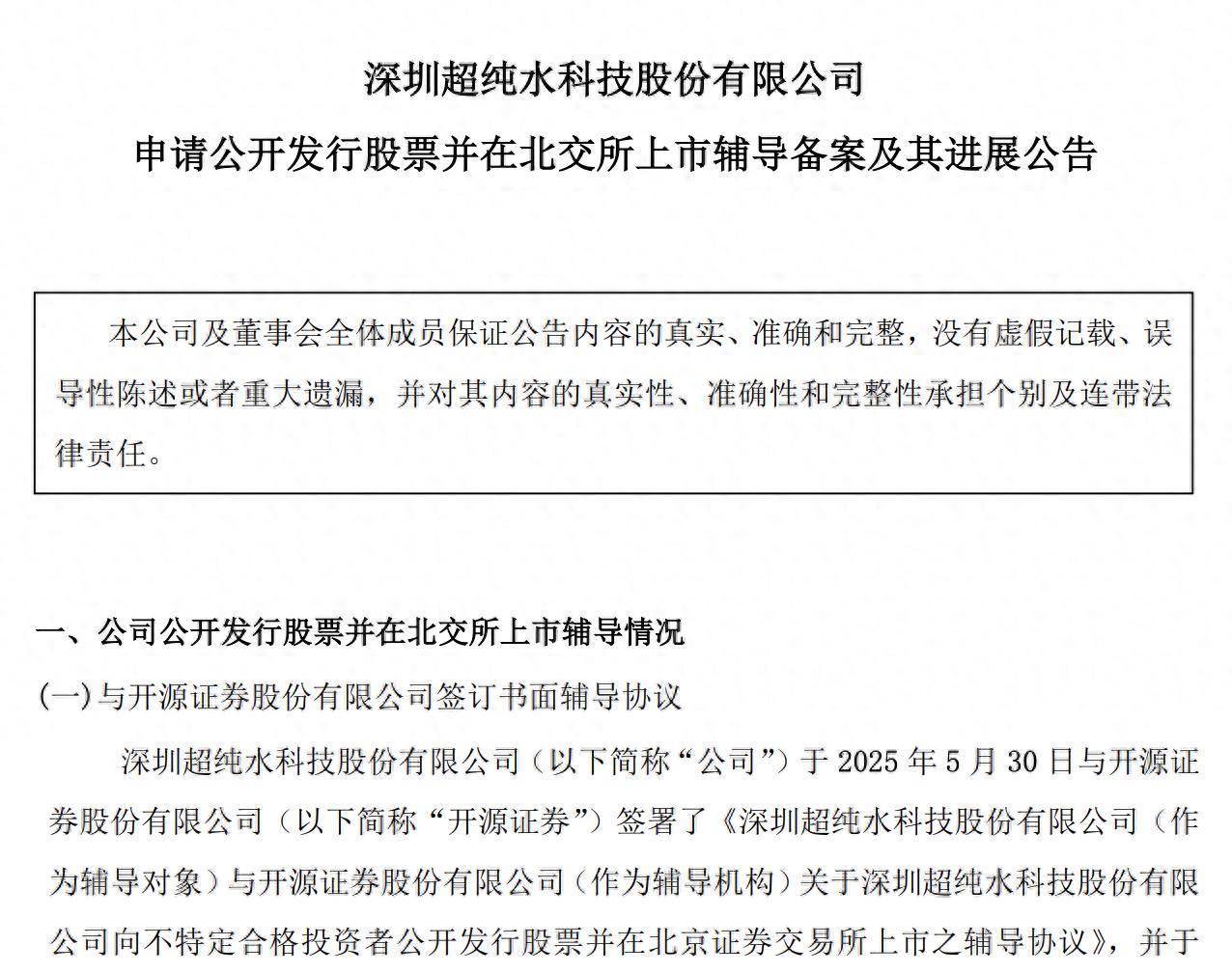
Group 1 - The company, Chaochun Technology, specializes in ultra-pure water treatment systems for the semiconductor industry and has been recognized as a national high-tech enterprise since its establishment in 2004 [4] - The company submitted its application for public offering and listing on the Beijing Stock Exchange on June 25, 2025, after a previous withdrawal due to late submission of supplementary materials [4] - Chaochun Technology's revenue and net profit have shown consistent growth from 2022 to 2025, with revenues of 4.29 billion, 4.81 billion, and 6.39 billion respectively, and net profits of 354.25 million, 440.03 million, and 487.33 million respectively [4] Group 2 - In 2024, Chaochun Technology's ultra-pure water treatment systems were reported to be competitive with international suppliers, serving major domestic clients in the semiconductor industry [5] - The top five clients contributed 34.55% of the company's revenue in 2024, with significant clients including Kaide Electronic Engineering Design Co., Ltd. and Yunnan Construction Fourth Engineering Co., Ltd. [7][8] Group 3 - The actual controllers and major shareholders of the company are Qian Zhigang, Wang Jun, and Liu Dewu, who collectively hold 66.44% of the company's shares as of March 31, 2025 [10] - Qian Zhigang serves as the chairman and general manager, while Wang Jun and Liu Dewu hold positions as vice chairman and vice general manager, respectively [10]
钙钛矿微模块光电转化效率创新高!光伏ETF基金(516180)近1周累计上涨6.03%
Xin Lang Cai Jing· 2025-07-15 03:01
Group 1 - The core achievement in solar technology is the development of perovskite micro-modules by NREL and CubicPV, which have achieved a world record efficiency of 24.0% for photovoltaic conversion [1] - The performance of the photovoltaic industry is reflected in the 中证光伏产业指数 (CSI Photovoltaic Industry Index), which has seen a decline of 0.58% as of July 15, 2025, with mixed performance among constituent stocks [1] - The top-performing stocks include 横店东磁 (9.98% increase), 科华数据 (6.85% increase), and 罗博特科 (1.75% increase), while the worst performers include 协鑫集成 (4.83% decrease) and 双良节能 (3.98% decrease) [1] Group 2 - As of June 30, 2025, the top ten weighted stocks in the CSI Photovoltaic Industry Index account for 55.39% of the index, with major companies including 阳光电源, 隆基绿能, and TCL科技 [2]


光伏BC产业专家交流
2025-07-15 01:58
Summary of Key Points from the Conference Call Industry Overview - The conference call focuses on the photovoltaic (PV) industry, specifically the development and market penetration of BC (Bifacial Cell) components in comparison to Topcon technology [1][2][20]. Core Insights and Arguments - **Market Penetration**: BC components have a penetration rate of approximately 20% in the high-end distributed market in Europe, while the domestic market penetration is only between 5% and 10% [1][2]. - **Price Comparison**: BC components are generally priced higher than Topcon components, with a domestic price premium of about 0.1 CNY per watt for distributed applications and 0.05 CNY for centralized applications. In Europe, the premiums are approximately 0.2 CNY and 0.1 CNY, respectively [2]. - **Efficiency and Power Output**: BC components theoretically offer a power increase of 25-30 watts and a generation efficiency improvement of 20-25% compared to Topcon, although these figures require practical validation [1][3]. - **Production Capacity**: By the end of 2024, Aiko is expected to reach nearly 10 GW capacity, while Longi aims for 50 GW of second-generation BC capacity, with an expected output of 20 GW in 2025 [4]. - **Outsourcing Model**: The outsourcing model allows companies to rapidly scale production and reduce costs, but it also tests supply chain management capabilities [5]. - **Cost Structure**: BC components have higher costs due to greater silver paste usage and depreciation costs, with overall component costs being about 0.05 CNY per watt higher than Topcon [1][7]. - **Technological Advancements**: New materials and technologies, such as the introduction of multi-layer composite solder strips by Yubang, are expected to enhance the efficiency and production of BC components [8][9]. Additional Important Insights - **Policy Impact**: The introduction of stricter efficiency requirements, such as the 24.2% power requirement in Shaanxi, indicates a growing emphasis on efficiency improvements in the industry [18][19]. - **Challenges in Production**: The main challenges in BC production include achieving stable mass production and high yield rates, with current yields around 95-96% [7][23]. - **Future of BC Technology**: While BC technology is gaining traction, it is unlikely to completely replace Topcon in the short term due to existing capacities and market dynamics. Both technologies are expected to coexist for the foreseeable future [20][21]. - **Patent Risks**: There are potential patent risks associated with BC technology, particularly from Maxson's patents, but these are not expected to significantly hinder market entry for other companies [29]. This summary encapsulates the key points discussed in the conference call, highlighting the current state and future prospects of the BC technology within the photovoltaic industry.
光伏企业的中期业绩预告,透露出怎样的趋势和规律?
Tai Mei Ti A P P· 2025-07-15 00:29
Core Viewpoint - The performance of photovoltaic material companies in the first half of 2025 is deteriorating, with significant losses reported across the sector, indicating that the industry is struggling to recover on its own [1][6][11]. Financial Performance Summary - A total of 24 photovoltaic companies have released their mid-year performance forecasts, with 13 out of 14 major material companies reporting losses [6][11]. - Notable losses include: - Tongwei Co., Ltd.: Expected loss of 4.9 billion to 5.2 billion CNY [1] - TCL Zhonghuan: Expected loss of 4 billion to 4.5 billion CNY [1] - JA Solar: Loss doubled compared to the previous year, with no improvement from the first quarter [9] - Longi Green Energy: Significant reduction in losses year-on-year, but no improvement from the first quarter [9] - Aiko Solar: Achieved profitability in the second quarter, attributed to innovative product offerings and market segmentation [9][10]. Industry Challenges - The photovoltaic industry is facing severe challenges, with increasing competition and financial pressures leading to widespread losses [11][12]. - The industry is characterized by high leverage, particularly among leading companies, making recovery difficult [11]. - The government is urged to implement measures to reduce excess capacity and enforce strict standards to prevent further deterioration of the industry [12][13]. Recommendations for Recovery - Suggestions include reducing polysilicon production capacity by half and halting expansions across all photovoltaic capacities [12][13]. - Establishing a unified standard system for product quality, energy consumption, and carbon emissions is essential to avoid quality issues in the future [13].