Anthropic

Search documents
МИРОВЫЕ ТЕХНОЛОГИЧЕСКИЕ ЛИДЕРЫ СОЗДАЮТ TRUSTED TECH ALLIANCE
Prnewswire· 2026-02-15 03:21
Core Viewpoint - The Trusted Tech Alliance (TTA) has been launched by 15 leading global companies from Africa, Asia, Europe, and North America to address customer needs worldwide [1]. Group 1: Alliance Formation - The TTA includes prominent companies such as Anthropic, AWS, Cassava Technologies, Cohere, Ericsson, Google Cloud, Hanwha, Jio Platforms, Microsoft, Nokia, Nscale, NTT, Rapidus, Saab, and SAP [1]. - The formation of TTA aims to enhance collaboration among technology leaders to meet global customer demands [1]. Group 2: Leadership Statements - David Zapolsky from Amazon emphasized the importance of the alliance in addressing technological needs [1]. - Strive Masiyiwa from Cassava Technologies highlighted the collaborative potential of TTA [1]. - Börje Ekholm from Ericsson and Marcus Jadotte from Google Cloud also expressed their support for the alliance's objectives [1].







WELTWEIT FÜHRENDE TECHNOLOGIEUNTERNEHMEN GRÜNDEN TRUSTED TECH ALLIANCE
Prnewswire· 2026-02-15 03:11
Core Viewpoint - The Trusted Tech Alliance (TTA) has been established by 15 leading global technology companies from 10 countries to promote a trustworthy technology stack that emphasizes transparency, security, and data privacy, addressing the growing skepticism towards digital technologies and their societal impacts [1][2]. Group 1: Formation and Purpose - The TTA aims to create a collaborative environment among technology providers to ensure reliability and resilience in technology services, responding to the rapid pace of technological change and increasing complexity in the global landscape [1]. - The alliance is built on a shared set of principles that all member companies must adhere to, focusing on creating public trust and ensuring that the benefits of emerging technologies are widely accessible [1][2]. Group 2: Member Companies and Principles - Founding members of the TTA include prominent companies such as Amazon Web Services (AWS), Google Cloud, Microsoft, and Ericsson, among others [1]. - The TTA has agreed on five key principles that define what it means to be a trusted global technology provider: 1. Upholding the rule of law and data privacy 2. Fostering an open, cooperative, inclusive, and resilient digital ecosystem 3. Ensuring reliable supply chain monitoring and security 4. Maintaining operational transparency, secure development, and independent assessment 5. Promoting transparent corporate governance and ethical behavior [1][2]. Group 3: Industry Impact and Collaboration - The TTA emphasizes the importance of collaboration among like-minded companies to enhance customer trust and maximize the benefits of technology for economic and societal advancement [2]. - The alliance seeks to strengthen global standards and promote a trustworthy digital ecosystem that can adapt to the evolving technological landscape, particularly in areas such as artificial intelligence and cybersecurity [2][3].


每千次展示60美元!OpenAI用高价拉开“AI广告”大幕
Hua Er Jie Jian Wen· 2026-02-15 03:09
Core Insights - OpenAI's CEO Sam Altman, who previously expressed discomfort with advertising, is now embracing it to support the company's high valuation and cover substantial capital expenditures by launching ad tests on ChatGPT [1][3] - The introduction of advertising marks a fundamental shift in OpenAI's business model and signals a potential reshaping of the global digital advertising market driven by generative AI [1] Pricing Strategy and Business Compromise - OpenAI's advertising strategy includes a high entry price of $60 per thousand impressions (CPM) and a minimum investment of $200,000, positioning itself as a premium advertising channel [1][3] - The initial testing phase is limited to free users in the U.S., with demand primarily coming from large, established advertisers [3] - Ads will be displayed separately from ChatGPT's generated answers, similar to traditional billboards, aimed at building brand awareness [3] Challenges to Traditional Search Giants - OpenAI's entry into the advertising space poses a direct threat to established players like Google and Amazon, which dominate a digital advertising market exceeding $1 trillion [5] - The shift from traditional search engines to conversational AI for advertising could disrupt existing revenue streams for these tech giants [5] - Google, while leading the market with over $80 billion in quarterly ad revenue, has not yet integrated ads into its core chatbot, Gemini, relying on its existing ad business as a buffer [5] Competitor Responses and Trust Concerns - Competitor Anthropic has adopted a contrasting approach, with about 80% of its expected revenue coming from enterprise clients, compared to OpenAI's 40-50% [6] - Anthropic's advertising during the Super Bowl emphasized its commitment to avoiding ads in its chatbot, highlighting industry concerns over user privacy and trust [6] - OpenAI has pledged not to use private conversation records for ad targeting, instead matching ads based on current user queries, and allowing users to opt out to alleviate privacy concerns [6] Market Potential and Future Outlook - Despite controversies, advertising executives believe that chatbots will become the next frontier in marketing as consumer habits evolve [7] - WPP estimates OpenAI's first-year ad revenue could range from $500 million to $800 million, seen as a strong start compared to its ambitious multi-billion dollar goals [7] - The mixed model of paid services and advertising is expected to be effective in AI applications, as demonstrated by companies like Netflix and Amazon [7]
DES LEADERS MONDIAUX DE LA TECHNOLOGIE LANCENT LA TRUSTED TECH ALLIANCE
Prnewswire· 2026-02-15 03:09
Core Points - The Trusted Tech Alliance (TTA) has been launched by 15 leading global technology companies from 10 countries to promote a trustworthy technology stack and enhance collaboration across borders [1][2] - The alliance aims to address concerns regarding digital technologies and their potential negative impacts by establishing common principles for transparency, security, and data protection [1][2] - Members of the TTA include major companies such as Amazon, Google Cloud, Microsoft, and Ericsson, which have committed to five specific principles that define responsible technology development and deployment [1][2] Group 1: Alliance Objectives - The TTA seeks to foster trust in technology by ensuring that all member companies adhere to shared commitments regarding data protection and operational transparency [1][2] - The alliance emphasizes the importance of collaboration among technology providers to enhance reliability and resilience in the face of rapid technological evolution [1][2] - By defining attributes of trustworthy technology, the TTA aims to support job creation and economic growth while addressing public concerns about emerging technologies [1][2] Group 2: Member Commitments - The five principles agreed upon by TTA members include respect for the rule of law, an open and cooperative digital ecosystem, robust supply chain security, operational transparency, and ethical governance [1][2] - Companies are required to implement strong corporate governance and ethical behavior, ensuring that technologies are developed and managed responsibly throughout their lifecycle [1][2] - The alliance will continue to expand its community of global suppliers dedicated to promoting a reliable, interoperable, and open technology stack [1][2]

哪怕投资者砸崩股价,2000亿美元也必须“烧下去”,亚马逊要“重整旗鼓”
Hua Er Jie Jian Wen· 2026-02-15 02:29
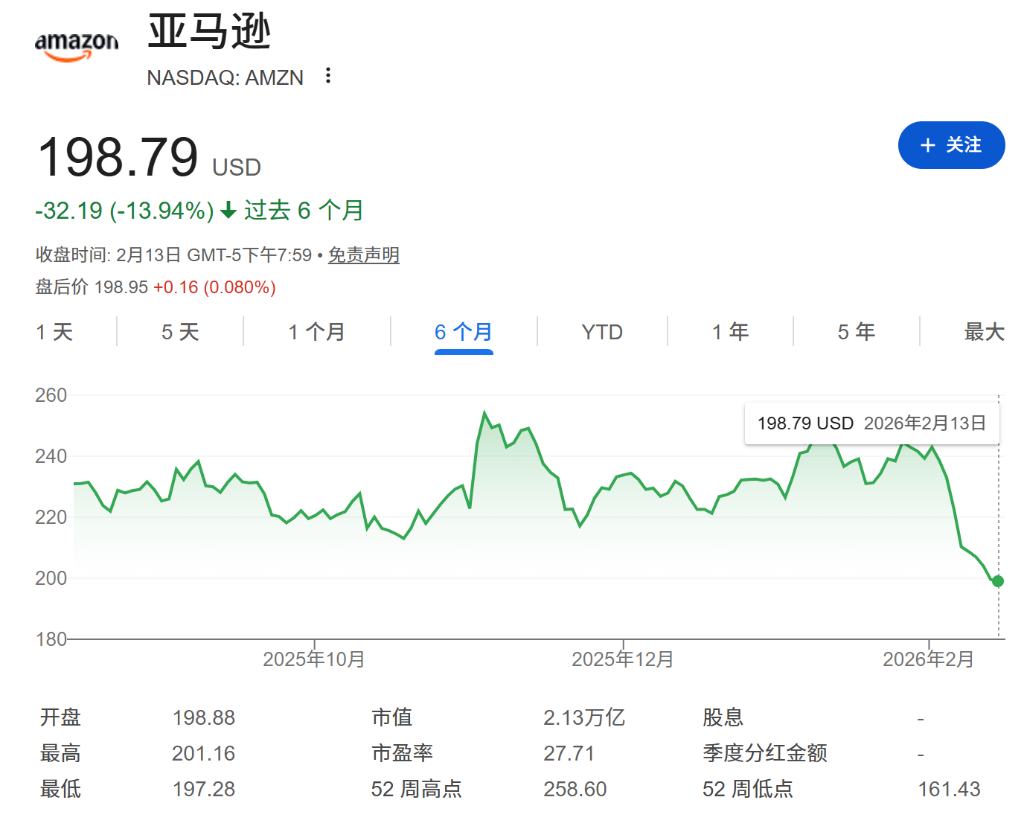
Core Insights - Amazon is initiating its largest capital expenditure plan in history, aiming to regain momentum in the AI sector and defend its leading position in cloud computing against strong competition from Microsoft and Google [1][4] - CEO Andy Jassy announced that the company's capital expenditure will rise to $200 billion this year, surpassing the spending levels of Google and Microsoft, with approximately 75% allocated to its cloud computing division, AWS [1][4] - Despite the significant investment, investor concerns about the slow conversion of spending into returns have led to a more than 20% decline in Amazon's stock price since its peak last November [1] Capital Expenditure Plan - Amazon plans to invest $200 billion, primarily focused on expanding AWS, while total spending by Microsoft, Google, and Oracle is expected to approach $400 billion this year [4] - The company aims to increase data center capacity significantly, adding nearly 4 gigawatts by 2025, equivalent to the annual energy consumption of over 3.2 million U.S. households, with plans to double this capacity by 2027 [4] - Jassy has restructured the organization to unify chip, model, and advanced research teams under a single leadership structure, emphasizing a customer-centric and agile operational approach [4] Competitive Anxiety - Despite generating nearly $130 billion in sales last year and contributing over 60% of Amazon's total profit, AWS faces predictions that Microsoft's cloud business will surpass AWS within the next three years due to the surge in demand for AI-driven cloud services [5] - Internal concerns have emerged regarding AWS's ability to secure enterprise AI contracts, with employees expressing that the company was unprepared for the rapid developments in the market [5] Strategic Partnerships and Contracts - Microsoft secured an exclusive cloud computing contract with OpenAI early on, while Amazon only signed a $38 billion agreement after OpenAI allowed for company restructuring, which pales in comparison to Microsoft's $250 billion contract [6] - Amazon's investment of $8 billion in Anthropic for data center construction came after Google had already supported the startup, indicating a reactive rather than proactive approach [6] Chip Strategy and Performance - To reduce reliance on Nvidia products and improve profit margins, Amazon is promoting its self-developed chips, with projected annual revenues exceeding $10 billion from Graviton and Trainium chips [7] - Amazon is negotiating to join OpenAI's latest funding round to ensure the adoption of its semiconductor products, although competition remains fierce, with Google successfully attracting Anthropic to purchase its TPUs [7] AI Model Development - Amazon is investing in its AI model named "Nova," positioned as a low-cost alternative to competitors, but independent benchmarks show that Nova lags behind models from OpenAI, Google, Meta, and Anthropic [8] - Some AWS employees have informally referred to Nova as "Amazon Basics," reflecting concerns about its performance, while many engineers prefer using Anthropic's Claude model over Nova [8] - The pressure to regain ground in the AI competition is palpable among employees, with fears of stagnation and decline echoing sentiments expressed by founder Jeff Bezos in 2018 [8]
广告植入引众怒!OpenAI核心研究员辞职抗议
Xin Lang Cai Jing· 2026-02-15 02:08
Core Insights - OpenAI is experiencing significant talent loss, with researcher Zoe Schizig resigning due to dissatisfaction with the company's new advertising strategy, marking another high-profile departure in a year filled with similar events [1][4] - Competitors Anthropic and xAI are also facing talent departures, indicating a broader issue within the AI industry regarding employee retention [1][4] OpenAI's Advertising Strategy - OpenAI's CEO Sam Altman previously stated that incorporating ads into ChatGPT would be a "last resort," yet the company has now officially announced that users will see ads during usage, signaling a financial struggle with quarterly losses amounting to billions [4] - Schizig expressed concerns about the ethical implications of advertising, particularly regarding user privacy, as users often share sensitive information with the chatbot [4] - The company has disbanded its mission alignment team, which was established to ensure that general artificial intelligence benefits humanity, further indicating internal turmoil [4] Industry Context - The talent exodus is not limited to OpenAI; Anthropic has also seen resignations, and at least half of the co-founders of Elon Musk's xAI have left the company [4]

谷爱凌回应被传入职硅谷风投公司:这不是真的;黄仁勋跌出全球十大富翁之列;极佳视界具身基础模型GigaBrain-0.5M*发布丨邦早报
Sou Hu Cai Jing· 2026-02-15 01:27
Group 1: ByteDance and Chip Development - ByteDance's chip research team is starting large-scale recruitment in cities like Beijing, Shanghai, and Shenzhen, focusing on positions such as chip architecture and SoC design [1] - The team is currently centered on chip design, developing custom hardware for cloud scenarios using advanced semiconductor processes to enhance performance and reduce computing costs [1] - Multiple cloud chips have already entered mass production, with steady progress in research and deployment across various advanced process nodes [1] Group 2: GigaAI and GigaBrain-0.5M* - GigaAI has launched GigaBrain-0.5M*, a more powerful model following the success of GigaBrain-0.1, which won first place in RoboChallenge [2] - The new model utilizes a world model paradigm to redefine embodied intelligence capabilities, achieving error-free performance in real-world robotic tasks [2] Group 3: Wealth Changes Among Billionaires - Jensen Huang, CEO of NVIDIA, has fallen out of the top ten billionaires list, with a net worth of $151 billion, down over $3 billion this year [3][4] - Other tech billionaires, including Larry Page and Sergey Brin, have also seen significant wealth declines, with losses exceeding $5 billion each [4] - The Walton siblings have entered the top ten billionaires list, collectively holding a net worth of $465.8 billion [4] Group 4: Automotive Industry Developments - Beijing Benz is recalling 19,481 units of EQA and EQB vehicles due to safety concerns, with the recall set to begin on June 25, 2026 [6] - BYD and Geely are reportedly in the final bidding for a Nissan-Mercedes-Benz factory in Mexico, aiming to establish a manufacturing base in the country [6] - The Chinese electric vehicle market saw exports of over 302,000 units in January 2026, marking a 100% year-on-year increase [7] Group 5: AI and Technology Investments - Anduril, a U.S. defense tech startup, is negotiating a new funding round that could value the company at $60 billion, nearly doubling its previous valuation [6] - Various companies, including Wuji Power and Starfire Space, have completed significant funding rounds to advance their technology and product development [6] Group 6: Film Industry Performance - The film "Zootopia 2" has surpassed 4.545 billion yuan in box office revenue, ranking among the top seven in Chinese film history [7] - The Valentine's Day box office for 2026 has exceeded 100 million yuan, indicating strong consumer interest during the holiday season [7]





爆火的 OpenClaw,正在重新定价所有 AI 创业赛道
创业邦· 2026-02-15 01:18
Core Insights - OpenClaw has rapidly gained popularity on GitHub, reaching 190,000 stars, making it the fastest-growing open-source AI project in history, surpassing notable projects like Kubernetes and the Linux kernel [5][8] - OpenClaw represents a significant milestone in the evolution of AI agents, fostering a collaborative ecosystem rather than mere imitation, and igniting entrepreneurial enthusiasm in the AI space [8][9] - The emergence of OpenClaw is reshaping the investment landscape, with projects related to it experiencing rapid valuation increases as investor interest surges [8][9] Interaction Paradigm Shift - OpenClaw offers a qualitative leap in user interaction compared to traditional AI assistants like ChatGPT, embedding itself within existing communication tools and operating seamlessly in the background [11][12] - This shift transforms AI from a one-time tool into a long-term partner, emphasizing user control and ownership over AI as a personal digital asset rather than a service provided by centralized platforms [12][13] Revaluation of AI Models and Agents - OpenClaw's significance lies in its ability to detach agents from platforms, allowing for personal ownership and expansion, which challenges the prevailing narrative that large models are the sole value drivers in AI [15][16] - The platform enables users to freely combine models and tools, shifting power from centralized companies to developers and users, thus redefining the valuation of both agents and models in the industry [15][16] New Entrepreneurial Opportunities - The rise of OpenClaw is creating new entrepreneurial avenues, including security systems, AI NAS, and independent agent memory solutions, as the demand for personal AI capabilities grows [20][21][22] - The concept of treating AI as a "digital life" opens up various sectors, such as security, infrastructure, and memory management, which are becoming essential for the next generation of AI agents [20][22]

“软件比白领更先被 AI 击穿”!Anthropic CEO 最新改口,反讽马斯克危言耸听,两大佬隔空互掐
AI前线· 2026-02-15 01:00
Core Viewpoint - Anthropic has raised $30 billion in Series G funding, leading to a post-money valuation of $380 billion, with plans to focus on advanced research and product development in the AI and coding market [2] Group 1: Anthropic's Funding and Market Position - Anthropic aims to become a leader in enterprise AI and coding markets with the newly raised funds [2] - The company’s valuation reflects significant investor confidence in its potential to drive advancements in AI technology [2] Group 2: Elon Musk's Critique - Elon Musk criticized Anthropic's AI for its perceived "misanthropic" tendencies, suggesting that the company's name foreshadows a negative trajectory [2] - Musk's comments highlight ongoing tensions in the AI industry regarding ethical implications and the direction of AI development [2] Group 3: Dario Amodei's Perspective - Dario Amodei, CEO of Anthropic, emphasizes a vision of AI that focuses on scaling human-level intelligence rather than creating a "machine god" [4] - Amodei argues for a symbiotic relationship between humans and AI, contrasting with Musk's more dystopian view [4] Group 4: AI's Impact on Industries - Amodei predicts that AI could significantly enhance productivity across various sectors, potentially increasing industry revenues by trillions [12] - The rapid advancement of AI technology may lead to unprecedented GDP growth, with estimates suggesting a possible increase of several percentage points in GDP growth rates [12][13] Group 5: Future of Work and AI - Amodei suggests that entry-level white-collar jobs are at risk of being disrupted by AI, particularly in fields like data entry and legal document review [20] - The software engineering sector may experience even faster changes due to the close relationship between developers and AI technology [21] Group 6: Ethical Considerations and AI Governance - Amodei raises concerns about the potential misuse of AI technologies by authoritarian regimes and the need for robust governance frameworks [38] - The discussion includes the importance of maintaining human oversight and ethical standards in AI development to prevent negative societal impacts [38][46]

黑色星期四:AI没崩,但“卖AI的”先崩了
Sou Hu Cai Jing· 2026-02-14 20:03
Core Viewpoint - The recent market turmoil is driven by fears surrounding AI's potential to replace jobs, leading to significant declines in stock prices across various sectors, particularly in software, financial services, logistics, and commercial real estate [1][3][4][5][6]. Group 1: Market Reactions - The Dow Jones Industrial Average dropped over 660 points, and the Nasdaq fell by 2%, with Apple losing nearly 1.4 trillion RMB in market value [1]. - CBRE experienced a 26% decline in stock price, reminiscent of the 2008 financial crisis [1]. - The S&P 500 consumer staples sector reached a historical closing high, indicating a shift in investor sentiment towards stable companies like Coca-Cola and Walmart [9]. Group 2: Sector-Specific Impacts - **Software Sector**: The S&P 500 software and services index fell by 15% as companies that previously benefited from AI hype faced valuation corrections [4]. - **Financial Services and Logistics**: The introduction of AI tools led to significant stock drops for companies like Willis Towers Watson and C.H. Robinson, with declines of 7.4% and 14.5% respectively [5]. - **Commercial Real Estate**: Concerns about reduced office space demand due to AI's efficiency led to fears about the viability of high-rent office spaces in Manhattan [6]. Group 3: Investor Sentiment and Future Outlook - There is a notable shift in investment strategy from "buying the future" to "buying stability," as evidenced by the performance of consumer staples [9]. - Major tech companies are investing heavily in AI infrastructure, with combined capital expenditures reaching $650 billion, raising concerns about the return on these investments [10][11]. - The current market environment reflects a mix of anxiety and excitement about AI, with some companies experiencing significant funding and valuation increases despite broader market declines [12]. Group 4: Historical Context and Comparisons - The current situation is compared to the late 1990s tech bubble, where initial excitement about the internet led to market volatility when profitability questions arose [13]. - The narrative surrounding AI is shifting from grand promises to practical applications, causing investor panic as the technology matures [13][16]. - The survival of companies post-crisis will depend on their ability to adapt and effectively leverage AI, similar to how internet companies evolved after the 1999 downturn [19][20].