盛弘股份

Search documents
关注储能容量电价机制进展 输配电价定价办法出台 | 投研报告
Zhong Guo Neng Yuan Wang· 2025-12-01 03:04
Core Insights - The National Development and Reform Commission (NDRC) has officially issued four pricing methods for transmission and distribution, marking the start of a new round of pricing review for the energy sector [1] Group 1: Energy Storage - Provincial plans for energy storage are accelerating, with Hubei and Heilongjiang provinces releasing their respective energy storage construction plans for 2025-2030 and 2025-2027 [2] - Hubei aims for an installed capacity of 8 million kW by 2027 and 17 million kW by 2030, with specific targets for new energy storage and pumped storage [1][2] - Heilongjiang targets 6 million kW of new energy storage capacity by 2027, emphasizing the importance of establishing a capacity compensation mechanism [2][3] - The introduction of electricity spot markets in Hubei and Heilongjiang is expected to enhance the profitability and financing capability of new energy storage projects [2][3] Group 2: Power Equipment - The new pricing methods for transmission and distribution are favorable for the development of UHV (Ultra High Voltage) and green electricity direct connection projects [4] - The pricing changes allow for a single capacity pricing system for grid companies serving new energy consumption, potentially lowering electricity costs for high-load enterprises and stabilizing grid revenues [4] - The exploration of two-part or single capacity pricing for clean energy transmission projects is expected to promote renewable energy consumption in receiving provinces, benefiting UHV and cross-regional projects [4][5] Group 3: Investment Recommendations - Recommended companies in the energy storage sector include integrators like Sungrow Power Supply and battery manufacturers such as CATL and EVE Energy [3] - In the power equipment sector, companies like XJ Electric and Sany Heavy Industry are highlighted for their potential growth [5]
东吴证券:HVDC将是下一代AIDC供电的方向 供电革命创千亿蓝海市场
智通财经网· 2025-12-01 01:25
Core Insights - The application of high-voltage direct current (HVDC) distribution technology is expected to significantly reduce energy consumption and improve power density in data centers, positioning HVDC as the future direction for AIDC power supply [1][3] - The global SST market is projected to exceed 100 billion by 2030, with SST expected to become the mainstream solution for AIDC external power supplies by 2029-2030 [1][3] Group 1: Domestic Market Insights - Domestic data center external DC power applications have advanced earlier, with two main technology routes: 240/336V modular HVDC power and Panama power, the latter showing high integration and efficiency up to 97.5% [2] - The domestic HVDC market is expected to exceed 80 billion by 2030, with a compound annual growth rate (CAGR) of approximately 122% from 2025 to 2030 [2] Group 2: International Market Dynamics - The core driver for overseas AIDC high-voltage direct current is the requirement for 800V DC power supply for the next-generation NV Rubin GPU, with significant penetration expected by 2027 [3] - The overseas HVDC market is projected to exceed 140 billion by 2030, with a CAGR of about 170% from 2025 to 2030 [3] Group 3: Technological Advancements - SST technology eliminates the need for frequency transformers, leading to significant improvements in size and efficiency, with domestic progress outpacing global developments [3][4] - International Tier 1 companies are actively seeking partnerships with domestic firms to develop HVDC power and SST solutions, indicating strong growth potential in the North American market [4] Group 4: Investment Recommendations - Key recommendations for comprehensive external power suppliers (SST + HVDC) include companies like Sungrow Power Supply and Jinpan Technology, while specific HVDC power recommendations include Zhongheng Electric and Keda Technology [5] - SST-focused recommendations include companies like Sifang Co. and China West Electric, with attention to core component manufacturers [5]





TPU代工视角看谷歌材料
2025-12-01 00:49
Summary of Google Materials Conference Call Company and Industry Overview - The conference call focuses on Google and its developments in the GPU manufacturing sector, particularly in relation to its data centers and self-developed chips [1][2][3]. Key Points and Arguments Google’s Data Center Efficiency - Google achieved a reduction of approximately 25% in Power Usage Effectiveness (PUE) from 2020 to 2024 by optimizing power and thermal management through special IP [1][2]. - The company plans to transition to High Voltage Direct Current (HVDC) as a secondary power source in its data centers starting in 2026 [8]. Chip Development and Supply Chain - Google has partnered with MediaTek to design its self-developed chips, with the GPT-8 billion chip expected to launch in November 2026 [1][2]. - Major suppliers for Google’s chips include Broadcom and MediaTek, with potential for future suppliers to be introduced [1][2]. - From January 2024, Flex will join Google’s manufacturing chain, with a market share distribution of 80% for Google and 20% for Flex [3]. Changes in Supplier Dynamics - In the PCB supply chain, Google switched back to Huadian from its previous largest supplier, with current shares being 70% for Huadian, 20% for Fangzheng, and 10% for TTM [4]. - The light module supply chain remains dominated by Xuchuang, while New Yisheng holds less than 10% [4]. Cost Reduction Strategies - Google plans to switch to a combination of Active Optical Cables (AOC) and LPO in its switching components starting in 2026 to reduce costs, which will alter the existing supplier structure [4]. - The company is moving from traditional AEC cables to AOC cables, with major suppliers being Changxing Bochuang domestically and Finisar internationally [4]. Liquid Cooling Solutions - Liquid cooling solutions are becoming increasingly important in GPU manufacturing, especially due to leakage issues in NVIDIA's ecosystem [5][6]. - Google is implementing stricter standards for new suppliers to ensure reliability in liquid cooling systems [6]. Performance and Cost Comparison with NVIDIA - Google’s current performance is approximately 90% to 93% of NVIDIA's, allowing for a Total Cost of Ownership (TCO) reduction of about 44% [10]. - Investment costs for Google are estimated to be 40% to 45% lower than NVIDIA's, attributed to different product design philosophies [10]. Future Plans and Market Positioning - Google plans to commercialize its TPU hardware by 2026, with a gradual transition to a leasing model for its ecosystem [11]. - The company emphasizes a distributed, cloud-based, and virtualized design for its data centers, contrasting with NVIDIA's focus on centralized computing [11]. Supply Chain Management - Google employs a direct procurement model, minimizing costs by eliminating intermediaries, which allows for competitive pricing [16]. - The company’s strategy focuses on long-term revenue through cloud services rather than short-term profits from new product launches [16]. Challenges and Competitor Landscape - NVIDIA faces challenges in adapting to distributed deployments across multiple data centers, which may limit its market share in the cloud computing sector [22]. - Google’s self-developed chips are not significantly hindered by competitors using its hardware, as performance optimization requires software alignment with Google’s systems [25][26]. Additional Important Insights - Google is exploring partnerships with Intel to address chip supply issues using EMIB technology [21]. - The company anticipates producing 6.5 million chips in 2026, with a 30% increase planned for 2027, although actual production may fall short due to technological constraints [23].


——电新环保行业周报20251130:储能产业链景气度延续,氢氨醇有望统筹、规模化、超前建设-20251130
EBSCN· 2025-11-30 12:44
Investment Ratings - The report maintains a "Buy" rating for both the power equipment and environmental protection sectors [1]. Core Views - The report highlights the continued prosperity of the energy storage industry chain, with hydrogen and ammonia expected to be developed in a coordinated, large-scale, and advanced manner [2][3]. - The National Development and Reform Commission (NDRC) has recognized the achievements in energy storage and hydrogen energy development, emphasizing the importance of market-oriented mechanisms for reasonable returns [2]. - The investment outlook for energy storage, hydrogen energy, and lithium batteries remains positive, with expectations for sustained demand and favorable bidding data in the domestic market [3][4]. Summary by Sections Energy Storage - Domestic energy storage is expected to maintain a good level of independent storage bidding in 2026, supported by a complete revenue model through energy, capacity, and ancillary service markets [3]. - Overseas energy storage demand is anticipated to rise, particularly in the U.S. due to ongoing electricity shortages, and in regions like the Middle East and Ukraine [3][6]. - The report notes a continuous high level of bidding and production in domestic energy storage, with significant projects being awarded [6][7]. Wind Power - The report states that China's onshore wind power installed capacity is projected to grow by 9.68% year-on-year in 2024, while offshore wind power capacity is expected to decrease by 40.85% [8]. - The bidding capacity for domestic wind power projects has seen a significant increase, with a 90% year-on-year growth in 2024 [11]. - The profitability of wind turbine manufacturers is expected to improve due to rising order deliveries and ongoing cost reductions [18]. Lithium Batteries - The lithium battery supply chain is experiencing strong demand, particularly in the electric vehicle and energy storage markets, with expectations for a favorable supply-demand balance [19][22]. - The report suggests focusing on investment opportunities in lithium mines and components that are not yet supporting production expansion [22]. - The pricing dynamics for lithium carbonate and other battery materials are expected to remain strong due to tight supply conditions [21][23].
又签2GW订单!大储PCS供应持续紧张
行家说储能· 2025-11-28 11:33
Core Insights - The article discusses the rapid growth and opportunities in the energy storage industry, particularly in the context of power market reforms and digitalization [2][3]. Group 1: Industry Trends - The global energy storage market is entering a "blowout period," with an increase in both project numbers and product specifications, leading to a tight supply of energy storage PCS (Power Conversion Systems) [3]. - The mainstream price range for 2.5MW PCS is between 0.075-0.078 yuan/W, with a penetration rate rapidly increasing to 70%-80%, making it the current industry standard [7][8]. Group 2: Company Developments - CRRC Zhuzhou Electric Locomotive Co., Ltd. (中车时代电气) has received over 2GW in orders for its liquid-cooled centralized storage PCS-2.5MW, which has passed national standard certification [4][8]. - Other companies such as Sungrow Power Supply, Shenghong Electric, and Kehua Data have also actively positioned themselves in the energy storage market [5]. Group 3: Product Innovations - The 2.5MW liquid-cooled centralized storage PCS developed by CRRC Zhuzhou Electric features a response time of 5 milliseconds and can handle overload outputs of three times the rated current within 10 seconds [4][7]. - The industry is transitioning towards 3MW+ PCS models, with companies like Xingyun Co., Ltd. and CRRC Zhuzhou Electric releasing models ranging from 3.2MW to 3.5MW to match larger capacity storage systems [10]. Group 4: Market Challenges - Transitioning from 2.5MW to 3MW+ PCS involves overcoming multiple technical challenges, including increased cooling requirements and the need for more complex control algorithms [11]. - The delivery cycle for large PCS has extended from 45 days to 75 days due to increased demand and supply chain constraints [13].


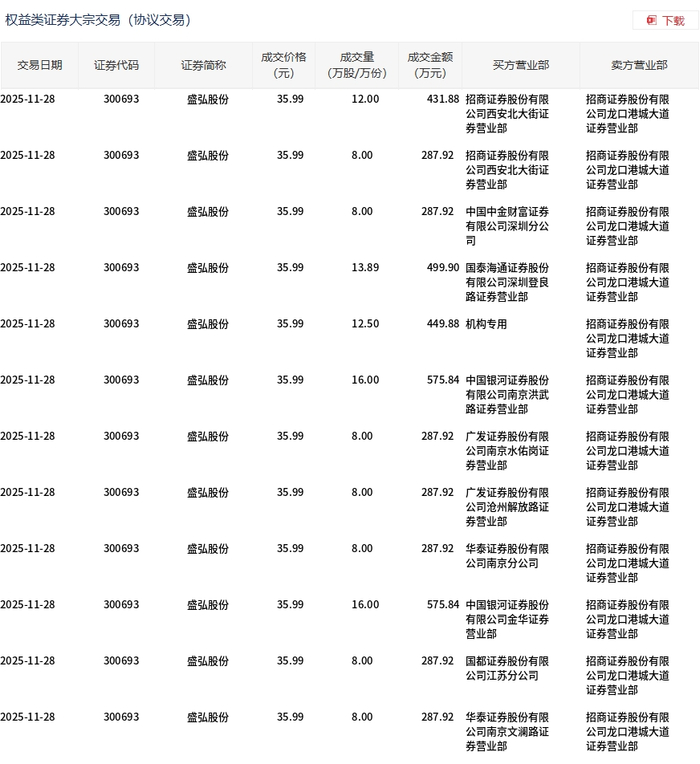
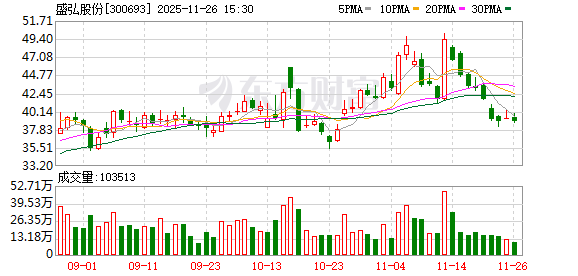
盛弘股份今日大宗交易折价成交126.39万股,成交额4548.78万元
Xin Lang Cai Jing· 2025-11-28 08:57
Summary of Key Points Core Viewpoint - On November 28, Shenghong Co., Ltd. executed a block trade of 1.2639 million shares, amounting to 45.4878 million yuan, which represented 10.72% of the total trading volume for the day. The transaction price was 35.99 yuan, reflecting an 8.33% discount compared to the market closing price of 39.26 yuan [1]. Trading Details - The block trade involved multiple transactions with a consistent price of 35.99 yuan per share [2]. - The total trading volume for Shenghong Co., Ltd. on that day was 1.2639 million shares, with a total transaction value of 45.4878 million yuan [1][2]. - The block trade accounted for 10.72% of the total trading volume on that day, indicating significant trading activity [1]. - The discount of 8.33% from the market closing price suggests a potential opportunity for investors looking for lower entry points [1].
盛弘股份大宗交易成交546.16万元,买方为机构专用席位
Zheng Quan Shi Bao Wang· 2025-11-26 13:24
Group 1 - The core transaction of Shenghong Co., Ltd. on November 26 involved a block trade of 140,400 shares, amounting to 5.4616 million yuan, with a transaction price of 38.90 yuan per share [2] - The closing price of Shenghong Co., Ltd. on the same day was 38.90 yuan, reflecting a decrease of 0.92%, with a turnover rate of 3.85% and a total trading volume of 405 million yuan [2] - Over the past five days, the stock has experienced a cumulative decline of 9.64%, with a total net outflow of funds amounting to 71.6376 million yuan [2] Group 2 - The latest margin financing balance for Shenghong Co., Ltd. is 516 million yuan, which has decreased by 4.7709 million yuan over the past five days, representing a decline of 0.92% [2] - The buyer of the block trade was an institutional special account, while the seller was CITIC Securities Co., Ltd. Beijing Anwai Street Securities Business Department [2]
“星耀鹏城”20+8产业沙龙举办新型储能投融资专场,助力深圳世界一流新型储能产业中心建设
Quan Jing Wang· 2025-11-26 08:32
Core Insights - The event "Starry Shine in Pengcheng" focused on new energy storage investment and mergers, aiming to connect capital with industry in Shenzhen's energy transition context [1] - Over 80 representatives from leading listed companies, investment institutions, and innovative enterprises participated to explore new opportunities in energy storage [1] Group 1: Event Overview - The event was held on November 26 at the International Innovation Center in Shenzhen, emphasizing the importance of the 14th Five-Year Plan for energy transformation [1] - The Shenzhen Stock Exchange experts provided insights on how the capital market can empower new productive forces [1] Group 2: Industry Insights - Shenghong Co., Ltd. shared the market prospects for data center energy storage, while CITIC Securities analyzed merger and acquisition strategies for listed companies [1] - A roundtable discussion titled "Solid-State 'Core' Era: How Shenzhen Leads the Next Battery Industry Revolution?" featured representatives from Xinwangda, Bettery, and Yuan Zhi Energy Fund [1] Group 3: Innovation Showcase - Three innovative companies presented their breakthroughs in diverse technologies, including sodium battery materials, carbon dioxide energy storage, and phase change cooling technology [1] - The salon is part of the 11th session of the "Starry Shine in Pengcheng" series organized by the Shenzhen Listed Companies Association and Xiangmi Lake CVC Innovation Service Center for 2025 [1] Group 4: Strategic Goals - Shenzhen is leveraging its strong financial, technological, and industrial ecosystem to actively pursue new opportunities in future industries as outlined in the 14th Five-Year Plan [1]
6年涨12倍!这一黄金赛道,卡位战开启
行家说储能· 2025-11-25 11:24
Core Insights - The article emphasizes that the growth potential of AI-driven data centers (AIDC) in the energy storage sector is significant, with a projected 12-fold increase in demand over the next few years [3][5]. Group 1: Market Growth and Demand - The global AIDC energy storage lithium battery shipment is expected to surge from 15 GWh in 2025 to 300 GWh by 2030, representing a compound annual growth rate (CAGR) of 82% [5]. - By 2030, the energy demand from data centers in the U.S. is projected to rise from 147 TWh in 2023 to 606 TWh, highlighting the urgent need for energy solutions [4]. - The U.S. is anticipated to account for 40% of global AIDC energy storage demand by 2030, driven by tight grid loads and complex interconnection processes [5]. Group 2: Industry Developments and Strategic Moves - Major companies are positioning themselves in the AIDC energy storage market, with significant investments and project wins reported [8]. - Companies like 阳光电源 and 华为 are developing AIDC-related products and solutions, aiming to enhance their market presence and technological capabilities [10][11]. - 南都电源 has secured multiple AIDC projects, including significant contracts with top software companies, indicating strong market traction [15]. Group 3: Technological Innovations - 海辰储能 is introducing innovative solutions that combine sodium-ion and lithium-ion technologies to redefine energy storage applications for AI data centers [16]. - 精控能源 is focusing on modular and intelligent energy management systems to provide comprehensive energy solutions for high-power computing centers [17]. - 新能安 is leveraging semi-solid battery technology to enhance the reliability and safety of power supply systems for critical applications [19].

英伟达800V架构重塑AI数据中心:31家产业链核心企业大起底
中关村储能产业技术联盟· 2025-11-25 06:22
Core Insights - The article discusses the significant energy demands of AI data centers, which can consume as much electricity as a small city, and highlights the need for advanced energy storage systems to manage power fluctuations effectively [2][4] - NVIDIA's recent release of the 800V DC architecture white paper indicates a shift towards integrating rapid-response energy storage systems in AI data centers, suggesting a potential explosive growth opportunity for the energy storage industry driven by AI [4][10] Group 1: Energy Architecture Evolution - The industry leaders, led by NVIDIA, have outlined a clear three-step evolution plan towards the 800V DC architecture for AI data centers [6] - The first step involves a transitional solution using "side-mounted power cabinets" to physically separate power modules from core computing areas [6] - The second step focuses on transitioning from a "distributed" to a "centralized" architecture [7] - The final step aims for a direct conversion from 10kV medium voltage AC to 800V DC using Solid State Transformers (SST) [9] Group 2: Hybrid Energy Storage Systems - To effectively manage power fluctuations, "hybrid energy storage" is identified as a necessary technological core, combining supercapacitors, high-rate batteries, and large-scale energy storage systems [10] - The new architecture requires advanced semiconductor technologies, such as silicon carbide (SiC) and gallium nitride (GaN), to meet the stringent demands of 800V high voltage [11] Group 3: Market Dynamics and Key Players - The surge in energy demand from AI and data centers has led to strategic competition among energy storage companies, including UPS suppliers and thermal management solution providers [16] - Major players in the energy storage market include: - **Sungrow Power Supply**: Actively developing power solutions for AI data centers, with plans to launch products by 2026 [19] - **Huawei**: Emphasizing energy digitalization for AI data centers, aiming for a secure, reliable, and low-carbon future [20] - **Kehua Data**: Focused on building data centers and HVDC solutions, with significant market presence [21][23] - **DuanDeng Co.**: Recognized as a "hidden champion" in data center energy storage, leading in battery shipments [24] - **Zhongtian Technology**: Engaged in lithium battery storage systems, with a strong production capacity [25] Group 4: Technological Innovations - The introduction of Solid State Transformers (SST) is highlighted as a revolutionary product that efficiently converts medium voltage AC to 800V DC, significantly reducing energy loss and saving substantial electricity annually for large data centers [11][12] - SSTs improve power quality and reduce the footprint of power systems, allowing for better space utilization in data centers [15] Group 5: Future Trends and Strategic Directions - The competition in the energy storage sector is shifting from hardware specifications to the intelligence of energy management systems, emphasizing the need for predictive capabilities and smart coordination among different energy storage units [15] - The article anticipates a transformation in business models, where the winners will be those who can provide integrated smart energy solutions rather than just hardware [15]