智谱

Search documents
利好催化不断,创业板人工智能ETF南方(159382)大涨3.65%,国产大模型加速赋能千行百业,AI产业发展动力强劲
Xin Lang Cai Jing· 2026-01-14 03:57
Core Viewpoint - The recent developments in the AI sector, particularly in the context of the Chinese market, indicate a significant upward trend in AI-related investments and technological advancements, driven by government initiatives and corporate collaborations. Group 1: Market Performance - The Southern AI ETF (159382) rose by 3.65% with a turnover of 11% and a transaction volume of 236 million yuan, indicating active market trading [1] - The components of the ChiNext AI Index showed substantial gains, with Yidian Tianxia up 17.47%, Zhongwen Online up 13.72%, and Yihualu up 12.44% [1] Group 2: Government Initiatives - The Ministry of Industry and Information Technology released the "Action Plan for Promoting High-Quality Development of Industrial Internet Platforms (2026-2028)", emphasizing the integration of AI into industrial applications [1] - The plan aims to enhance AI literacy and skills among platform enterprises and promote AI applications in various industrial scenarios [1] Group 3: Corporate Developments - Zhiyun announced a collaboration with Huawei to open-source a new generation image generation model, GLM-Image, which is trained entirely on domestic chips [1] - The model utilizes an innovative "autoregressive + diffusion decoder" hybrid architecture for combined image generation and language modeling [1] Group 4: Global AI Infrastructure - The global AI computing platform capabilities are continuously improving, with NVIDIA launching the mass-produced NVIDIARubin platform and AMD unveiling the "Helios" platform [2] - This trend aligns with the ongoing upgrades of large models, which are expected to drive the growth of the AI industry [2] Group 5: AI Application Commercialization - The AI industry is experiencing continuous catalysis, with significant commercial potential in AI applications, particularly in generative search (GEO) [2] - AI is not only enhancing cost efficiency but also providing unique interactive experiences for users, especially in gaming and content sectors [2] Group 6: Index Composition - The Southern AI ETF closely tracks the ChiNext AI Index, which reflects the stock price changes of AI-related listed companies [2] - The top ten weighted stocks in the index include Zhongji Xuchuang, Xinyi Sheng, Tianfu Communication, and others [2]

科创100ETF基金(588220)涨超3.5%,商业航天、AI应用两大板块点燃市场
Xin Lang Cai Jing· 2026-01-14 03:52
Group 1 - The commercial aerospace sector is experiencing a surge due to frequent launches, with the successful launch of the Long March 8 rocket on January 13, which deployed 18 low-orbit satellite internet satellites [1] - AI applications are gaining traction, with companies like Zhipu and MiniMax listing on the Hong Kong Stock Exchange, potentially enhancing the industry's commercial value [1] - The domestic large model industry in China is entering a systematic layout and ecological construction phase, with expectations to transition from "catching up" to "leading" in certain fields by around 2026 [1] Group 2 - The Science and Technology Innovation Board 100 Index (000698) has seen significant gains, with notable increases in stocks such as Zhongke Xingtou (up 14.87%) and Hehe Information (up 12.71%) [1] - The top three sectors in the Science and Technology Innovation Board 100 Index are electronics (37.42%), power equipment (14.02%), and biomedicine (13.79%) [2] - The top ten weighted stocks in the Science and Technology Innovation Board 100 Index account for 26.21% of the index, including companies like Huahong Semiconductor and East China Semiconductor [2]
GEO概念连续大涨!风险提示密集发布!
证券时报· 2026-01-14 03:29
Core Viewpoint - The GEO (Generative Engine Optimization) concept has seen a significant surge in both A-share and Hong Kong markets, with multiple stocks experiencing substantial price increases amid clarifications and risk warnings from listed companies [2][3][5]. Group 1: Market Performance - A-share GEO concept index rose over 8% in a single day, with stocks like Liujin Technology increasing by more than 26%, and several others hitting the daily limit of 20% [3]. - In the Hong Kong market, the GEO concept index also saw a rise of over 4%, with stocks such as Zhiyu and Weimeng Group increasing by over 19% and 9% respectively [5]. - Since 2026, some stocks in the GEO sector have recorded cumulative gains exceeding 50%, with certain stocks doubling in value [5]. Group 2: Company Responses and Clarifications - Companies like Huichen Co. have responded to the surge in GEO interest, highlighting their solutions tailored for AI marketing needs, leveraging their extensive experience in data and algorithm models [7]. - Measurement Co. clarified that their GEO-related technology is still in the planning stage and does not currently involve any revenue-generating business [8]. - Zhejiang Wenhuan and other companies issued risk warnings, stating that their involvement in GEO is not yet profitable and lacks market recognition, urging investors to be cautious [9][10].


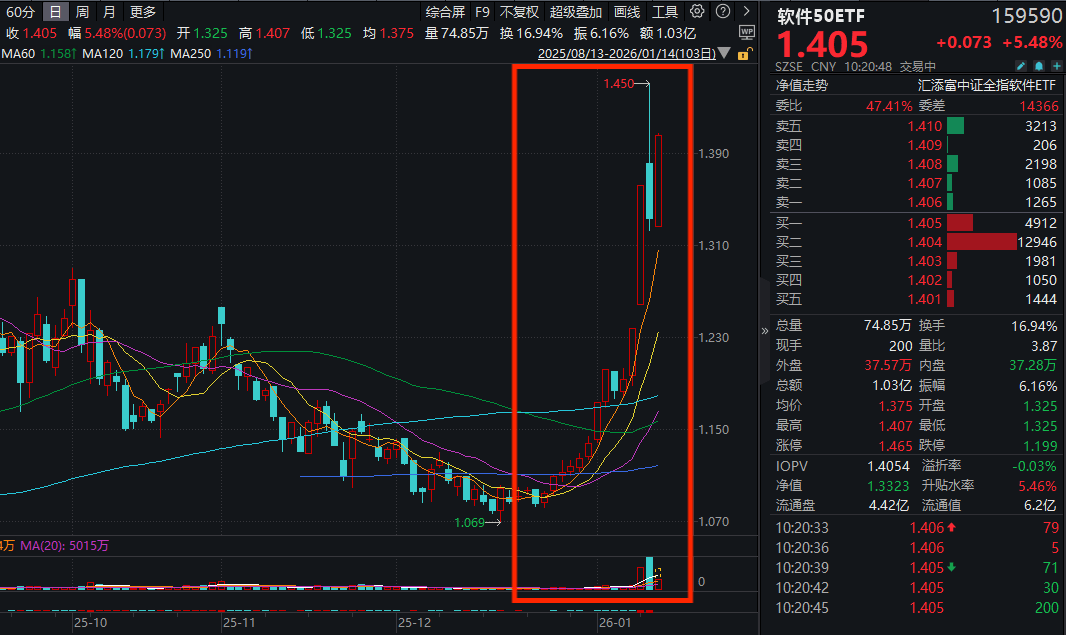
AI应用强势反弹,软件再度领涨!软件50ETF(159590)大涨超5%,两日大举揽金超2.7亿!GEO赛道持续爆火
Sou Hu Cai Jing· 2026-01-14 03:16
Group 1 - The core viewpoint of the news highlights the significant surge in the A-share software sector, with the Software 50 ETF (159590) experiencing a rise of over 5% and attracting more than 270 million yuan in investments over two days [1][4] - On January 13, a government action plan was released to promote the high-quality development of industrial internet platforms, aiming to cultivate over 450 influential platforms and achieve over 120 million industrial device connections by 2028, with a platform penetration rate exceeding 55% [3] - Major components of the Software 50 ETF saw substantial gains, including a rise of over 8% for Yonyou Network, over 7% for Tonghuashun and Zhongke Xingtu, and over 6% for 360 [4][5] Group 2 - The AI industry is experiencing a continuous increase in popularity, with significant advancements in capital, application, and technology. Notably, two leading general model companies, Zhipu and MiniMax, successfully listed on the Hong Kong Stock Exchange, reflecting strong market recognition for the AI sector [6] - The integration of AI into various fields is accelerating, with AI for Science emerging as a new research paradigm and the rise of Generative Engine Optimization (GEO) emphasizing high-quality content in model outputs [6] - Securities firms predict that 2026 will be a pivotal year for AI applications, driven by continuous improvements in model capabilities, decreasing computing costs, and accelerated monetization processes [7]




【IPO追踪】引入高通等基石投资者,龙旗科技今起招股
Sou Hu Cai Jing· 2026-01-14 03:05
Core Viewpoint - The recent performance of the new stock market has been strong, with companies like Zhaoyi Innovation, Biran Technology, and Zhiyu experiencing significant post-listing gains. Longqi Technology is set to launch its IPO in Hong Kong, following this trend [2]. Group 1: IPO Details - Longqi Technology plans to globally issue approximately 52.26 million H-shares, with 10% allocated for public offering in Hong Kong and 90% for international offering. There is an option for an additional 7.84 million shares under an over-allotment option, representing a 15% over-allotment ratio based on the base offering size [2]. - The maximum offer price is set at HKD 31 per share, with expected net proceeds of approximately HKD 1.52 billion if the over-allotment option is not exercised. The funds will be allocated as follows: 40% for expanding production capacity, 20% for R&D, 10% for marketing and customer expansion, 20% for strategic investments or acquisitions, and 10% for working capital [2]. Group 2: Subscription Period and Fees - The subscription period for Longqi Technology is from January 14 to January 19, 2026, with the listing on the Hong Kong Stock Exchange expected on January 22. The minimum investment for one board lot of 100 shares is HKD 3,131.26 [3]. Group 3: Institutional Interest - Longqi Technology's IPO has attracted significant interest from various institutions, including Qualcomm, Jiangxi Guokong, and others, with a total subscription amounting to approximately USD 56.5 million (or about HKD 440 million) [4]. Group 4: Company Overview - Longqi Technology is a leading global provider of smart products and services, offering a full range of solutions from product research and design to manufacturing and support. Its diverse product portfolio includes smartphones, AI PCs, automotive electronics, tablets, smartwatches, and smart glasses, catering to various sectors such as consumer electronics and IoT [5]. - According to Frost & Sullivan, Longqi ranks second globally in the consumer electronics ODM segment with a market share of 22.4%, first in the smartphone ODM segment with a market share of 32.6%, and among the top three in the tablet ODM segment [5]. - The company's revenue for the years 2022 to 2024 and the first three quarters of 2025 are projected to be RMB 29.34 billion, RMB 27.19 billion, RMB 46.38 billion, and RMB 31.33 billion, respectively, with adjusted net profits of RMB 620 million, RMB 672 million, RMB 565 million, and RMB 604 million [5].

智谱和MiniMax上市表现亮眼,百川跟Kimi却不慌?
Sou Hu Cai Jing· 2026-01-14 02:40
Core Insights - The recent IPOs of Zhipu and MiniMax mark a significant transition for China's AI industry from technology validation to commercialization, indicating a new phase of capital market engagement for the large model sector [3][5] - Both companies have shown strong market performance post-IPO, with Zhipu's market cap reaching approximately HKD 110 billion and MiniMax's exceeding HKD 1.2 trillion at their peaks [3][5] - The positive reception of these IPOs reflects a warming attitude towards tech companies in the Hong Kong stock market, suggesting a favorable environment for future tech listings [5][8] Company Performance - Zhipu raised HKD 43.48 billion and MiniMax HKD 55.40 billion during their IPOs, placing them in the upper tier of recent tech company listings in Hong Kong [5][8] - MiniMax's subscription amount reached HKD 2.533 billion, while Zhipu's was HKD 1.977 billion, indicating strong investor interest [8][12] - MiniMax's revenue for the first three quarters of 2025 was USD 5.343 million (approximately HKD 4.17 billion), with its market cap significantly exceeding its annual revenue [13][14] Market Dynamics - The IPOs of Zhipu and MiniMax are expected to help establish a more mature valuation framework for the Chinese large model industry, which has previously been characterized by uncertainty [15][26] - The performance of these companies will serve as a reference point for future valuations in the AI sector, potentially leading to a more structured approach to assessing technology capabilities and commercial value [15][26] - The current market sentiment suggests that companies with strong technological barriers and broad application scenarios will experience greater value realization opportunities [19][27] Competitive Landscape - Despite their strong IPO performances, both companies face significant competition in their respective fields, with MiniMax particularly challenged in the video generation and AI companionship sectors [18][19] - The competitive landscape includes established players like Kuaishou and ByteDance, which dominate the video generation market, and other AI companionship products that are gaining traction [18][19] - The ongoing success of Zhipu and MiniMax may influence other AI startups, prompting them to consider their own paths to IPO and commercialization [23][26] Future Outlook - The successful IPOs of Zhipu and MiniMax are likely to catalyze further developments in the AI sector, with potential implications for how resources are allocated between commercialization and technological advancement [26][28] - The market's response to these IPOs will be closely monitored, as it could either reinforce confidence in similar tech companies or prompt a reevaluation of strategic priorities within the industry [26][28] - Overall, the current momentum in the capital markets is seen as the beginning of a new chapter for the AI industry, with expectations for continued growth and innovation [28][30]
智谱和MiniMax上市表现亮眼,压力给到其他“小虎”?
Sou Hu Cai Jing· 2026-01-14 02:28
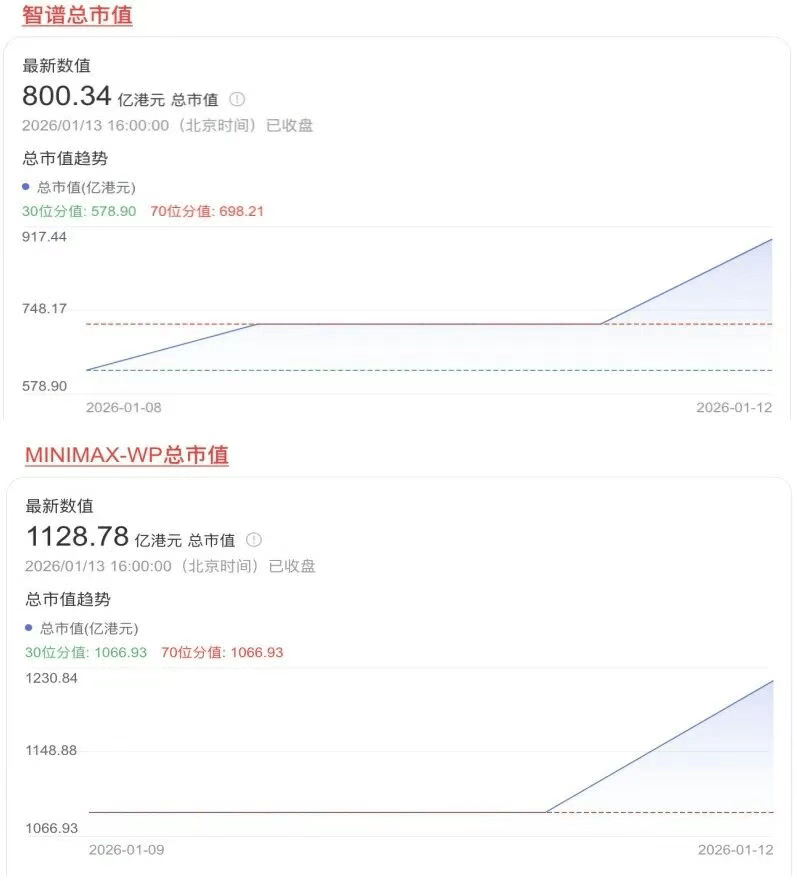
Core Insights - The successful IPOs of Zhipu and MiniMax mark a significant transition for China's AI industry from technology validation to commercialization, indicating a new phase of capital market engagement for the large model sector [1][3][21] - Both companies have shown strong market performance post-IPO, with Zhipu's market cap reaching approximately HKD 110 billion and MiniMax's exceeding HKD 1.2 trillion at their peaks [1][3] Company Performance - Zhipu's stock price increased by over 13% on its listing day, with a market cap of about HKD 579 billion, later peaking at over HKD 1.1 trillion before settling around HKD 800 billion [1][3] - MiniMax's stock surged nearly 110% on its first day, with a market cap surpassing HKD 1.05 trillion, later adjusting to approximately HKD 1.128 trillion [1][3] Market Sentiment - The IPOs reflect a warming attitude of the Hong Kong market towards tech companies, with both firms raising significant capital—Zhipu HKD 4.348 billion and MiniMax HKD 5.540 billion, placing them in the upper tier of recent tech IPOs [3][6] - The subscription amounts for the IPOs were substantial, with MiniMax attracting HKD 253.3 billion and Zhipu HKD 197.7 billion, indicating strong investor interest [6][10] Industry Dynamics - The current valuation of MiniMax, with a market cap significantly exceeding its annual revenue of approximately HKD 4.17 billion, suggests a positive market outlook for AI development in China [10] - Both companies represent different market strategies within the AI sector, with Zhipu focusing on G and B-end markets and MiniMax targeting C-end applications, showcasing the diverse paths of AI development in China [10][11] Future Implications - The long-term performance of Zhipu and MiniMax will serve as a reference point for the valuation framework of the Chinese large model industry, potentially leading to a more mature assessment of AI companies [11][21] - The successful IPOs may encourage other AI firms to pursue public listings, as seen with comments from other industry leaders regarding their future IPO plans [17][20]
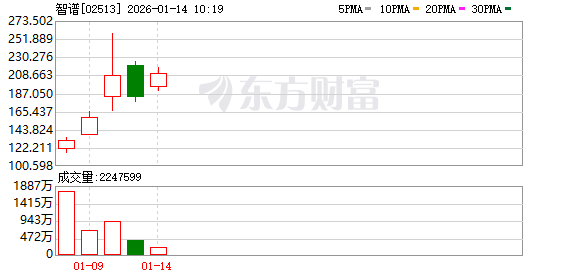
智谱高开超7%,联合华为开源首个国产芯片训练的多模态SOTA模型
Ge Long Hui· 2026-01-14 02:24
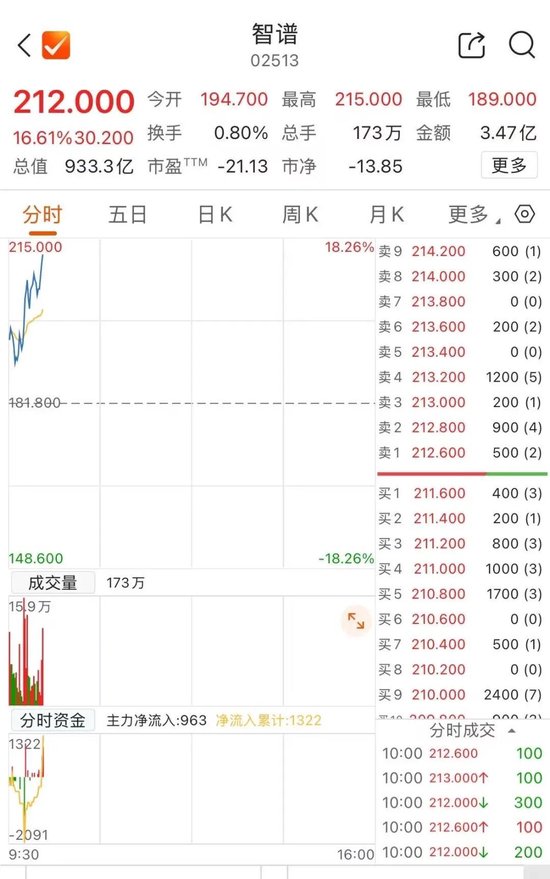
Core Viewpoint - The company Zhiyu (2513.HK) opened 7.1% higher at HKD 194.7 following the announcement of a collaboration with Huawei to launch a new generation image generation model, GLM-Image, which is the first state-of-the-art multimodal model fully trained on domestic chips [1] Group 1 - GLM-Image is based on the Ascend Atlas 800T A2 device and the MindSpore AI framework, completing the entire process from data to training [1] - The model employs an innovative "autoregressive + diffusion decoder" hybrid architecture, achieving a combination of image generation and language modeling [1] - This development represents an important exploration for Zhiyu towards a new generation of "cognitive generation" technology paradigm, exemplified by the Nano Banana Pro [1]
联合华为开源新模型,智谱涨超16%
Xin Lang Cai Jing· 2026-01-14 02:21
Core Viewpoint - The article highlights the launch of GLM-Image, a new open-source image generation model developed by Zhiyuan in collaboration with Huawei, which is the first SOTA multimodal model fully trained on domestic chips [1][9]. Group 1: Model Features and Innovations - GLM-Image is based on the Ascend Atlas 800T A2 device and the MindSpore AI framework, completing the entire training process from data to model [1][9]. - The model employs a hybrid architecture combining a 9 billion parameter autoregressive model and a 7 billion parameter DiT diffusion decoder, enhancing its ability to understand complex instructions and accurately render text [2][12]. - GLM-Image can adaptively handle various resolutions, natively supporting image generation tasks from 1024x1024 to 2048x2048 without the need for retraining [3][12]. Group 2: Performance and Applications - The model has achieved open-source SOTA levels in text rendering, demonstrating its capabilities in generating complex illustrations and diagrams with logical processes and textual explanations [6][15]. - In generating e-commerce images and multi-panel comics, GLM-Image maintains consistency in style and subject while ensuring high accuracy in text generation [8][17]. - The cost for generating an image using GLM-Image via API is only 0.1 yuan [17]. Group 3: Technological Significance - GLM-Image represents a significant exploration into the "cognitive generation" technology paradigm, marking a shift from traditional image generation to models that integrate world knowledge and reasoning capabilities [2][11]. - The model's development validates the feasibility of training high-performance multimodal generation models on domestic full-stack computing power [17].
联合华为开源新模型 智谱涨超16%
Shang Hai Zheng Quan Bao· 2026-01-14 02:18
Core Viewpoint - The collaboration between Zhipu and Huawei has led to the development of GLM-Image, a new generation open-source image generation model, which is the first SOTA multimodal model trained entirely on domestic chips [2][9]. Group 1: Model Development and Features - GLM-Image is based on the Ascend Atlas 800T A2 device and the MindSpore AI framework, completing the entire training process from data to model [2][8]. - The model employs an innovative architecture that combines a 9B autoregressive model with a 7B DiT diffusion decoder, enhancing its ability to understand complex instructions and accurately render text [5][8]. - GLM-Image supports image generation tasks at various resolutions, natively accommodating sizes from 1024x1024 to 2048x2048 without the need for retraining [5][8]. Group 2: Performance and Comparisons - In authoritative rankings for text rendering, GLM-Image has achieved open-source SOTA levels, outperforming several other models such as Seedream and Nano Banana Pro [6]. - The model excels in generating illustrations that involve complex logical processes and textual explanations, maintaining consistency in style and accuracy in text generation across various formats [7]. Group 3: Economic Aspects - The cost for generating an image using GLM-Image via API is only 0.1 yuan, showcasing its affordability and accessibility [8]. - The successful training of GLM-Image on domestic chips validates the feasibility of developing high-performance multimodal generation models on a fully domestic computing stack [9].