陕西煤业

Search documents
煤炭反内卷加码,详解供需影响
2025-08-06 14:45
Summary of Key Points from the Conference Call Industry Overview - The coal industry is experiencing increased regulatory scrutiny from the National Energy Administration aimed at stabilizing coal prices to support electricity prices and the overall economic environment [1][2][10] - The coal production in China is expected to see fluctuations due to regulatory measures and market dynamics, with a projected total annual output of 4.8 billion tons for 2025, reflecting a slight increase year-on-year [1][7] Core Insights and Arguments - The National Energy Administration's intervention in the coal industry is a response to low coal prices and excessive production, indicating a shift towards stricter regulations to ensure price recovery [2][10] - The average long-term electricity price has been reduced by 0.02 yuan, while coal prices have dropped significantly by approximately 250 yuan, which could lead to further reductions in electricity prices in 2026 if the trend continues [2] - The coal production in Xinjiang and Inner Mongolia is expected to decline in the latter half of 2025 due to the cancellation of freight subsidies and stricter regulatory oversight [1][5][6] - A specific case of Shanxi Coking Coal reducing working days from 320 to 276 days is noted, but this is not expected to become a widespread industry trend [3][4] Production and Demand Dynamics - National coal production reached a historical high of 440 million tons in late 2024 and early 2025, but has since seen a decline due to falling prices and regulatory measures [4][10] - The coal demand fluctuations are attributed to changes in electricity consumption patterns, with a notable increase in residential and tertiary sector electricity usage [11] - The impact of renewable energy development on thermal power demand is significant, with a negative growth rate observed in thermal power demand in early 2025 due to increased renewable installations [12][13] Future Outlook - The coal industry is expected to stabilize in the second half of 2025, with a projected monthly production decrease of about 20 million tons compared to June 2025, leading to a total of 240 million tons for the second half of the year [7][8] - The exit of the production guarantee policy is anticipated to have limited actual impact on coal production, as most unlicensed production capacity has already been phased out [8][9] - The market sentiment is shifting, with a recognition of the cyclical nature of the coal industry and potential for recovery as supply stabilizes and demand increases [10][13] Investment Opportunities - China Shenhua's recent acquisition plan reflects positive market sentiment towards state-owned enterprise reforms and is expected to enhance profitability as the industry recovers [2][16] - Recommended coal companies include Jinko, Shaanxi Coal, China Coal, Shenhua, and Yanzhou Coal, with specific recommendations for coking coal companies like Pingmei, Huaiyin, Lu'an, and Shanxi Coking Coal [17]

专家:反内卷背景下煤炭行业供需再平衡
2025-08-06 14:45
Summary of Coal Industry Conference Call Industry Overview - The coal industry is experiencing significant challenges, with revenue in the first half of 2025 reaching 1 trillion yuan and profits at 120 billion yuan, representing year-on-year declines of 20% and 50% respectively, with a loss ratio of 53.6% [1][3][4] - The current situation mirrors the industry's loss period of 2014-2015, where the loss ratio was approximately 80% [3] - Only a few large companies, such as Shenhua, China Coal, and Shaanxi Coal, are maintaining a break-even point, while the majority are operating at a loss [3][4] Key Points and Arguments - The National Energy Administration is leading a review of excess capacity to prevent a repeat of past capacity reduction processes, aiming to address market supply-demand imbalances [1][3] - There is a potential elimination of small backward production capacities of 300,000 tons and below, but the enforcement of this is expected to be more advisory than mandatory due to social and financial pressures [1][5] - Issues with supply contracts not paying replacement fees are significant, involving tens of millions to several hundred million tons, and stricter regulations are anticipated in 2025 [1][5] Production and Supply Dynamics - The total coal production for 2024 is projected at 4.78 billion tons, with 80% concentrated in four provinces, indicating a high risk of overproduction [1][6] - Major producers like the National Energy Group and China Coal Group have production figures of 327 million tons and 274 million tons respectively, with an estimated 20% overproduction risk translating to about 640 million tons [1][6] - The verification cycle for overproduction is approximately three months, with results expected by mid to late October [1][8] Demand and Price Outlook - Demand for electricity is expected to see slight growth, while steel and construction demand is declining, leading to a mixed demand scenario [1][15] - The overall supply-demand situation remains unsatisfactory, with limited changes on the supply side despite a reduction in imported coal [1][15] - If the overproduction verification policy is strictly enforced, a reduction of 100 to 200 million tons is anticipated, which could support a rebound in coal prices by approximately 100 yuan [2][17] Regulatory and Policy Measures - The government is exploring mechanisms for the exit of high-cost enterprises, potentially establishing an exit fund to facilitate transitions for companies leaving the market [18] - There is encouragement from the government for energy price increases to improve the profitability of coal enterprises, which is crucial for the industry's health [19] - The enforcement of the 276-day production system is not strictly monitored, but some companies continue to follow it to ensure worker welfare and control production rates [20] Additional Insights - The coal industry is under pressure to transition in light of carbon neutrality goals, necessitating a balance between profitability and sustainable practices [13] - The establishment of a credit system for long-term contracts is being pursued to enhance compliance and market stability [14] - The price of coking coal is viewed as a balancing point for the interests of power, coal companies, and local governments, with December 2024 prices seen as reasonable for all parties involved [21]
中证煤炭指数上涨2.24%,前十大权重包含美锦能源等
Jin Rong Jie· 2025-08-06 10:10
从中证煤炭指数持仓样本的行业来看,能源占比100.00%。 数据统计显示,中证煤炭指数近一个月上涨6.07%,近三个月上涨8.85%,年至今下跌7.58%。 资料显示,指数样本每半年调整一次,样本调整实施时间分别为每年6月和12月的第二个星期五的下一 交易日。权重因子随样本定期调整而调整,调整时间与指数样本定期调整实施时间相同。在下一个定期 调整日前,权重因子一般固定不变。特殊情况下将对指数进行临时调整。当样本退市时,将其从指数样 本中剔除。样本公司发生收购、合并、分拆等情形的处理,参照计算与维护细则处理。 从指数持仓来看,中证煤炭指数十大权重分别为:陕西煤业(9.8%)、中国神华(8.74%)、兖矿能源 (8.01%)、中煤能源(7.66%)、山西焦煤(7.07%)、潞安环能(5.75%)、美锦能源(4.81%)、淮 北矿业(4.67%)、华阳股份(4.51%)、平煤股份(4.22%)。 金融界8月6日消息,上证指数低开高走,中证煤炭指数 (中证煤炭,399998)上涨2.24%,报2042.16点, 成交额103.82亿元。 从中证煤炭指数持仓的市场板块来看,上海证券交易所占比83.88%、深圳证券交易所 ...





煤炭行业资金流出榜:陕西煤业、华阳股份等净流出资金居前
Zheng Quan Shi Bao Wang· 2025-08-06 09:43
Market Overview - The Shanghai Composite Index rose by 0.45% on August 6, with 24 out of 28 sectors experiencing gains, led by the defense and military industry at 3.07% and machinery equipment at 1.98% [1] - The coal industry ranked third in terms of daily gains, increasing by 1.89% [2] Fund Flow Analysis - The main funds in the two markets experienced a net outflow of 9.652 billion yuan, with seven sectors seeing net inflows [1] - The machinery equipment sector had the highest net inflow of 4.367 billion yuan, followed closely by the defense and military sector with a net inflow of 4.283 billion yuan [1] - The pharmaceutical and biological sector had the largest net outflow, totaling 9.049 billion yuan, followed by the telecommunications sector with a net outflow of 2.949 billion yuan [1] Coal Industry Performance - In the coal industry, 32 out of 37 stocks rose, while only 2 declined, despite a net outflow of 207 million yuan for the sector [2] - The top three stocks with the highest net inflow in the coal sector were Jin控煤业 with 64.7038 million yuan, followed by 潞安环能 with 42.5955 million yuan, and 山西焦煤 with 32.9535 million yuan [2][3] - The stocks with the largest net outflow included 陕西煤业 with 369.349 million yuan, 华阳股份 with 42.8841 million yuan, and 永泰能源 with 31.1223 million yuan [2]


今日44只个股突破年线
Zheng Quan Shi Bao Wang· 2025-08-06 08:44
| 证券代 | 证券简 | 今日涨跌幅 | 今日换手率 | 年线 | 最新价 | 乖离率 | | --- | --- | --- | --- | --- | --- | --- | | 码 | 称 | (%) | (%) | (元) | (元) | (%) | | 601989 | 中国重 工 | 10.04 | 4.24 | 4.72 | 5.15 | 9.17 | | 600661 | 昂立教 育 | 7.46 | 15.94 | 11.47 | 12.24 | 6.68 | | 002064 | 华峰化 学 | 4.05 | 0.72 | 7.45 | 7.70 | 3.39 | | 000949 | 新乡化 纤 | 5.37 | 6.37 | 3.99 | 4.12 | 3.37 | | 601225 | 陕西煤 业 | 5.62 | 1.05 | 20.73 | 21.43 | 3.36 | | 603596 | 伯特利 | 6.05 | 3.82 | 49.47 | 50.99 | 3.06 | | 002045 | 国光电 器 | 4.26 | 13.25 | 15.72 | 16.16 | 2 ...


煤炭开采板块8月6日涨1.65%,晋控煤业领涨,主力资金净流出3.27亿元
Zheng Xing Xing Ye Ri Bao· 2025-08-06 08:41
Group 1 - The coal mining sector increased by 1.65% on August 6, with Jin控煤业 leading the gains [1] - The Shanghai Composite Index closed at 3633.99, up 0.45%, while the Shenzhen Component Index closed at 11177.78, up 0.64% [1] - Key stocks in the coal mining sector showed significant price increases, with Jin控煤业 rising by 6.62% to a closing price of 14.50 [1] Group 2 - The coal mining sector experienced a net outflow of 327 million yuan from main funds, while retail investors saw a net inflow of 322 million yuan [2] - The trading volume for major coal stocks varied, with Shaanxi Coal and Jin控煤业 having notable trading volumes of 1.022 million and 521,400 shares, respectively [1][2] - The main fund inflows for Jin控煤业 amounted to 60.96 million yuan, representing 8.23% of its total trading volume [3]


红利资产震荡上扬,红利ETF易方达(515180)近10日“吸金”3亿元
Mei Ri Jing Ji Xin Wen· 2025-08-06 07:04
Group 1 - The core viewpoint of the article highlights the active performance of the coal sector and the overall positive trend in the dividend asset market, with the CSI Dividend Index rising by 0.7% [1] - Notable stocks include Ningbo Huaxiang, which increased by over 9%, Weifu High Technology, which rose by over 6%, and Shaanxi Coal and Chemical Industry, which gained over 5% [1] - The E Fund Dividend ETF (515180) has attracted nearly 300 million yuan in net inflows over the past 10 trading days, bringing its total size to approximately 9 billion yuan, making it the largest among similar ETFs [1] Group 2 - Huaxi Securities indicates that the current micro liquidity in the stock market is relatively abundant, and the positive feedback effect of "residents allocating funds to the market and the gradual rise of the stock market" is expected to strengthen [1] - The CSI Dividend Index consists of 100 stocks with high cash dividend yields, stable dividends, and certain scale and liquidity, with banking, coal, and transportation sectors accounting for over 55% of the index [1] - The management fee rate for the E Fund Dividend ETF (515180) is only 0.15% per year, which helps investors to cost-effectively allocate to dividend assets, and investors focusing on the long-term compounding value of dividends can reinvest annual dividends into this product to enhance the compounding effect [1]
主力个股资金流出前20:西藏天路流出9.14亿元、恒瑞医药流出6.17亿元



Jin Rong Jie· 2025-08-06 07:02
截至8月6日午后一小时,主力资金流出前20的股票分别为:西藏天路(-9.14亿元)、恒瑞医药(-6.17 亿元)、海光信息(-5.62亿元)、东信和平(-4.96亿元)、中际旭创(-3.91亿元)、陕西煤业(-3.35 亿元)、上纬新材(-3.09亿元)、天府文旅(-2.99亿元)、福日电子(-2.89亿元)、中银证券(-2.81 亿元)、工业富联(-2.68亿元)、江淮汽车(-2.68亿元)、寒武纪-U(-2.65亿元)、翰宇药业(-2.51 亿元)、宁德时代(-2.48亿元)、山河智能(-2.45亿元)、ST华通(-2.32亿元)、兴森科技(-2.24亿 元)、中科曙光(-2.10亿元)、仕佳光子(-2.06亿元)。 本文源自:金融界 作者:金股通 ...
煤炭板块震荡反弹 晋控煤业涨超7%
Mei Ri Jing Ji Xin Wen· 2025-08-06 06:29
Group 1 - The coal sector experienced a day of fluctuating rebounds on August 6, with notable increases in stock prices [1] - Jinko Coal Industry saw a rise of over 7%, while Shanxi Coal International and Shaanxi Coal Industry both increased by over 5% [1] - Other companies such as Huayang Co., Haohua Energy, Yanzhou Coal Mining, and Pingmei Shenma also reported significant gains [1]


中长期资金对低估值红利资产配置需求明确,国企红利ETF(159515)冲击3连涨
Xin Lang Cai Jing· 2025-08-06 06:10
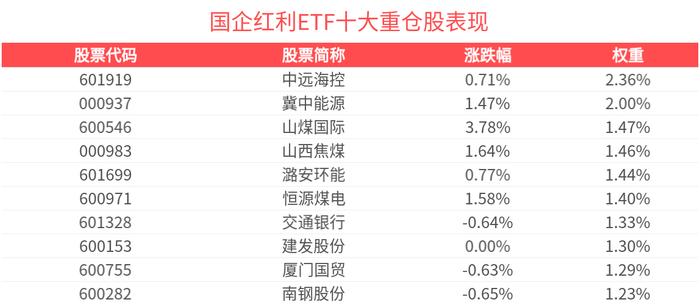
Core Viewpoint - The article discusses the performance of the China Securities State-Owned Enterprises Dividend Index and highlights the importance of stable dividend assets in the current market environment, suggesting a shift from style-driven to stock-driven investment logic in the dividend sector [1][2]. Group 1: Index Performance - As of August 6, 2025, the China Securities State-Owned Enterprises Dividend Index (000824) increased by 0.41%, with notable gains from constituent stocks such as Jinkong Coal Industry (601001) up 6.18%, Weifu High Technology (000581) up 4.99%, and Shaanxi Coal and Chemical Industry (601225) up 4.78% [1]. - The National Enterprise Dividend ETF (159515) rose by 0.35%, marking its third consecutive increase [1]. Group 2: Investment Insights - According to Kaiyuan Securities, the current market uncertainty necessitates a focus on high dividend yields, with stable dividend assets (like banks and public utilities) being more favorable than cyclical dividend stocks [1]. - Everbright Securities notes a transition in the investment logic of the dividend sector from style-driven to stock-driven, with high-quality stocks continuing to attract specific style funds [1]. - The banking sector has emerged as a highlight within high dividend stocks, frequently targeted by insurance and asset management companies, indicating a clear demand for undervalued dividend stocks [1]. Group 3: Index Composition - The China Securities State-Owned Enterprises Dividend Index comprises 100 listed companies selected for their high cash dividend yields, stable dividends, and sufficient scale and liquidity [2]. - As of July 31, 2025, the top ten weighted stocks in the index include COSCO Shipping Holdings (601919), Jizhong Energy (000937), and Lu'an Environmental Energy (601699), collectively accounting for 16.77% of the index [2].