平安银行

Search documents
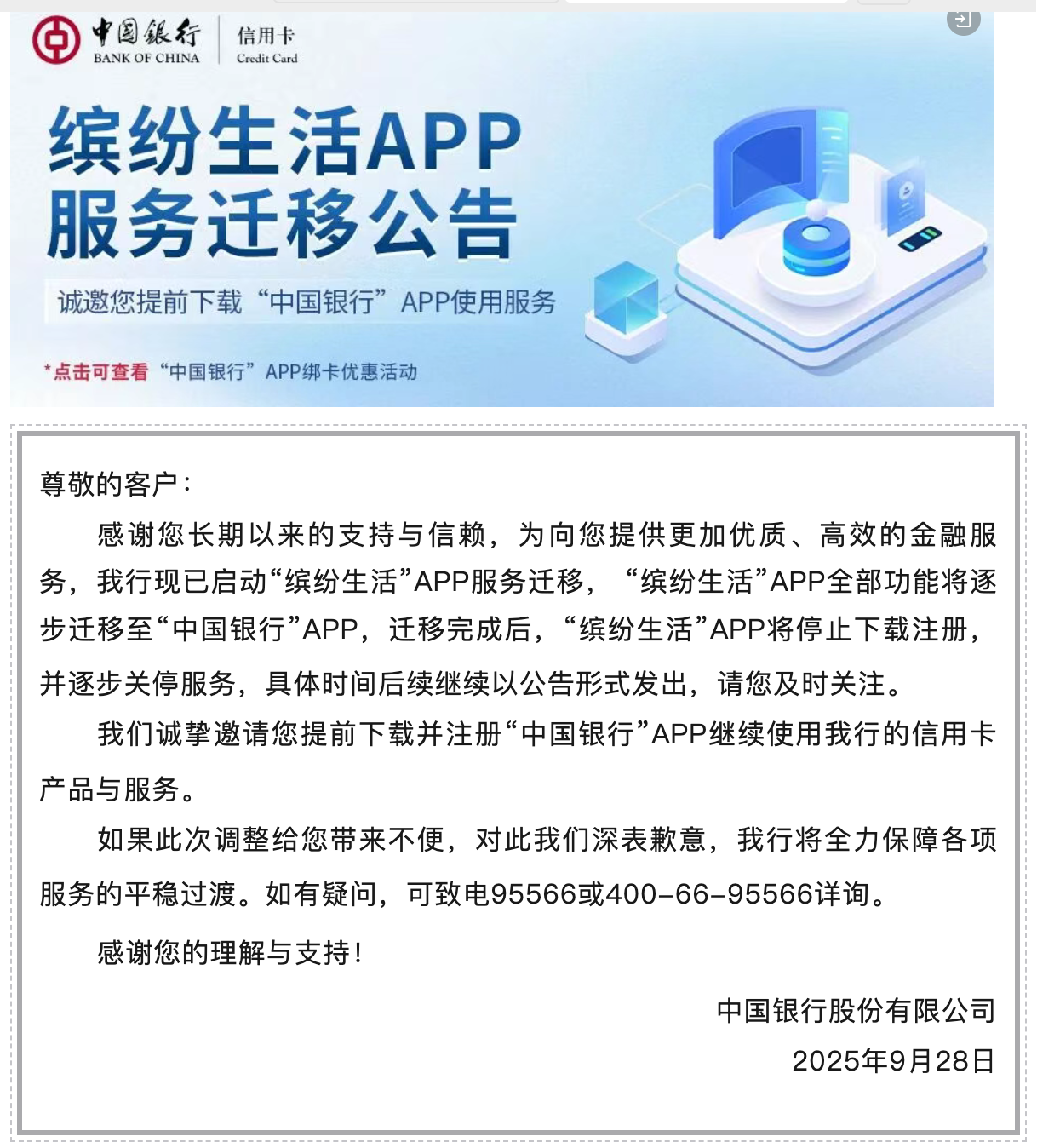
又一银行公告下架!信用卡APP正在渐次退场
Bei Ke Cai Jing· 2025-10-10 09:55
Core Viewpoint - The independent credit card apps of several banks, including China Bank, are being phased out in favor of integrating credit card services into their main banking apps, reflecting a broader trend in the industry towards consolidation and cost efficiency [2][3][4]. Group 1: Bank Actions - China Bank announced the shutdown of its credit card app "Bountiful Life," with all functions migrating to the main "China Bank" app, leading to the eventual discontinuation of the independent app [2][5]. - Other banks, such as Bohai Bank and Beijing Rural Commercial Bank, have also ceased operations of their independent credit card apps, indicating a collective shift in the banking sector [3][20]. - The trend of merging credit card functionalities into main banking apps is not isolated, as multiple banks have already taken similar actions over the past few years [3][21]. Group 2: Industry Insights - Experts suggest that the initial goal of independent credit card apps was to enhance customer engagement, but the results have been disappointing, leading to increased operational costs without significant user retention [3][22]. - The profitability pressure on credit card businesses has made maintaining independent apps economically unfeasible, prompting banks to consolidate services to reduce costs and improve efficiency [4][27]. - The decline in active users of credit card apps contrasts with the growth in mobile banking app usage, highlighting a shift in consumer behavior towards more comprehensive banking solutions [24][25]. Group 3: Market Trends - The credit card industry is experiencing a downturn, with a reported decrease of 34 million credit cards over the past year, reflecting broader economic challenges [30][34]. - Data from the central bank indicates a decline in the total number of credit cards and combined lending cards, dropping from a peak of 798 million to 715 million [30]. - Banks are now focusing on refining their strategies to retain existing customers and adapt to changing consumer spending habits, moving away from aggressive customer acquisition tactics [34][35].

股份制银行板块10月10日跌0.01%,招商银行领跌,主力资金净流出14.22亿元
Zheng Xing Xing Ye Ri Bao· 2025-10-10 08:46
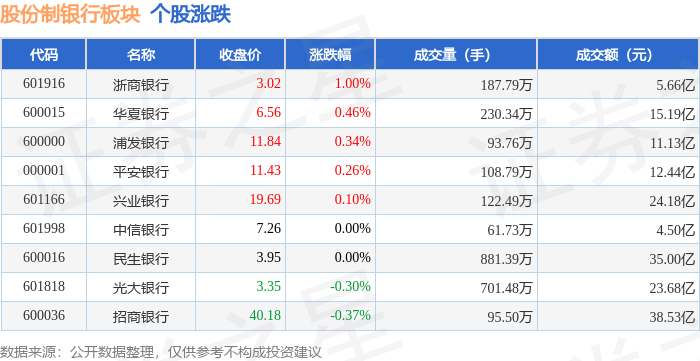
证券之星消息,10月10日股份制银行板块较上一交易日下跌0.01%,招商银行领跌。当日上证指数报收于3897.03,下跌0.94%。深证成指报收于 13355.42,下跌2.7%。股份制银行板块个股涨跌见下表: | 代码 | 名称 | 收盘价 | 涨跌幅 | 成交量(手) | 成交额(元) | | --- | --- | --- | --- | --- | --- | | 601916 | 浙商银行 | 3.02 | 1.00% | 187.79万 | 5.66亿 | | 600015 | 半夏银行 | 6.56 | 0.46% | 230.34万 | 15.19亿 | | 600000 | 浦发银行 | 11.84 | 0.34% | - 93.76万 | 11.13亿 | | 000001 | 平安银行 | 11.43 | 0.26% | 108.79万 | 12.44亿 | | 601166 | 兴业银行 | 19.69 | 0.10% | 122.49万 | 24.18亿 | | 666109 | 中信银行 | 7.26 | 0.00% | 61.73万 | 4.50亿 | | 600016 | 民生 ...




朗姿股份获1.5亿授信,子公司及实控人提供担保
Xin Lang Cai Jing· 2025-10-10 08:33
Core Viewpoint - The company, Langzi Co., has applied for a comprehensive credit limit of 150 million yuan from Ping An Bank's Beijing branch to meet operational funding needs [1] Group 1: Financial Guarantees - Langzi Medical Management, a wholly-owned subsidiary, provides joint liability guarantees for the company [1] - The controlling shareholder, Shen Dongri, and his spouse, Weng Jie, also provide unconditional joint liability guarantees for the company [1] - The total balance of external guarantees provided by the company and its subsidiaries amounts to 1.129 billion yuan, accounting for 40.51% of the audited net assets for the year 2024 [1] Group 2: Off-Balance Sheet Guarantees - The total balance of guarantees for entities outside the consolidated financial statements is 360 million yuan, representing 12.92% [1] - There are no overdue or litigated guarantees reported by the company and its subsidiaries [1] Group 3: Board's Assessment - The board of directors believes that the guarantees align with the interests of the company and its shareholders, posing no negative impact [1]

2025年10月9日黄金价格出炉,银行金条跌破900元一克
Sou Hu Cai Jing· 2025-10-09 16:41
Group 1 - The core difference between bank gold and jewelry gold lies in their pricing and purpose, with bank gold being investment-oriented and jewelry gold incorporating craftsmanship and brand premiums [2][4][6] - Current bank gold prices range from approximately 877.80 to 918.21 CNY per gram, while jewelry gold prices exceed 1000 CNY per gram, reflecting the added costs associated with jewelry [2][8] - Investment gold is suitable for those looking to preserve value, while jewelry gold represents emotional value and is often purchased for gifts or personal significance [4][6][10] Group 2 - The current gold price is stable yet high, influenced by factors such as the strength of the US dollar, Federal Reserve interest rate policies, and geopolitical situations [8][9][12] - Ordinary consumers should choose between investment gold for value preservation or jewelry gold for personal use, with recommendations to buy high-purity, simple designs if both purposes are desired [10][12] - The future outlook for gold suggests it will remain a preferred safe-haven asset, with prices likely to experience high-level fluctuations rather than drastic changes [12]

股份制银行板块10月9日跌0.25%,兴业银行领跌,主力资金净流出16.96亿元
Zheng Xing Xing Ye Ri Bao· 2025-10-09 09:03
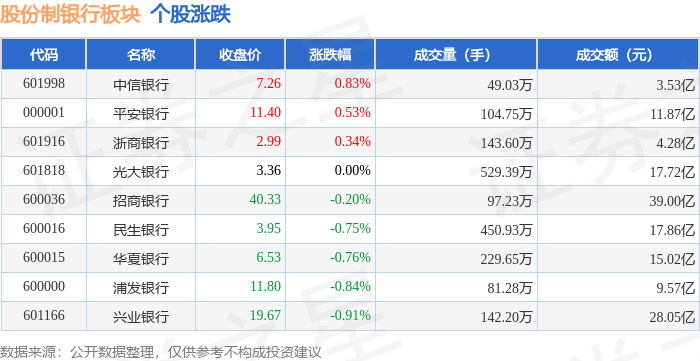
Core Viewpoint - The banking sector experienced a decline, with the share prices of major banks falling, particularly led by Industrial Bank, while the overall stock market showed positive growth [1] Group 1: Market Performance - On October 9, the share price of the banking sector fell by 0.25%, with Industrial Bank leading the decline [1] - The Shanghai Composite Index closed at 3933.97, up by 1.32%, and the Shenzhen Component Index closed at 13725.56, up by 1.47% [1] Group 2: Individual Bank Performance - The closing prices and performance of key banks are as follows: - CITIC Bank: 7.26, up by 0.83% - Ping An Bank: 11.40, up by 0.53% - Zheshang Bank: 2.99, up by 0.34% - Everbright Bank: 3.36, unchanged - China Merchants Bank: 40.33, down by 0.20% - Minsheng Bank: 3.95, down by 0.75% - Huaxia Bank: 6.53, down by 0.76% - Pudong Development Bank: 11.80, down by 0.84% - Industrial Bank: 19.67, down by 0.91% [1] Group 3: Capital Flow Analysis - The banking sector saw a net outflow of 1.696 billion yuan from major funds, while retail investors contributed a net inflow of 963 million yuan [1] - The capital flow for individual banks indicates: - Pudong Development Bank: Major net inflow of 20.68 million yuan, retail net outflow of 47.41 million yuan - CITIC Bank: Major net inflow of 8.90 million yuan, retail net inflow of 1.20 million yuan - Ping An Bank: Major net inflow of 1.22 million yuan, retail net outflow of 6.27 million yuan - Zheshang Bank: Major net outflow of 8.04 million yuan, retail net inflow of 15.78 million yuan - China Merchants Bank: Major net outflow of 1.79 billion yuan, retail net inflow of 2.16 million yuan - Minsheng Bank: Major net outflow of 28.60 million yuan, retail net inflow of 114 million yuan - Industrial Bank: Major net outflow of 40 million yuan, retail net inflow of 254 million yuan - Huaxia Bank: Major net outflow of 41.80 million yuan, retail net inflow of 18 million yuan - Everbright Bank: Major net outflow of 43.70 million yuan, retail net inflow of 23.60 million yuan [2]



平安好医生换帅:郭晓涛出任董事会主席 何明科任CEO
Zhong Guo Jing Ji Wang· 2025-10-09 07:58
Core Points - Ping An Good Doctor announced the resignation of Li Dou as Chairman, Executive Director, and CEO effective October 7, 2025 [1] - Guo Xiaotao has been appointed as the new Chairman effective October 7, 2025, and He Mingke will become the CEO and Executive Director on the same date [1] - Li Dou confirmed there are no disagreements with the board and his resignation will not affect the company's normal operations [1] Summary of Key Individuals - Guo Xiaotao, aged 53, joined Ping An Good Doctor as a non-executive director in March 2024 and has held various significant positions within Ping An Group since 2019 [2] - He has extensive experience in management roles across multiple companies, including serving as a partner at Boston Consulting Group [2] - He Mingke, aged 46, will join Ping An Good Doctor as CEO and Executive Director on October 7, 2025, bringing a wealth of experience from various industries including finance and healthcare [3] - He has held senior positions at notable companies such as Boston Consulting Group and Baidu [3]
消费贷“贴息”新政首月成效几何?有大行豪揽签约客户超60万户
Feng Huang Wang· 2025-10-09 05:20
Core Viewpoint - The "Consumer Loan Interest Subsidy Policy" implemented from September 1 has seen mixed responses from banks, with some reporting growth in consumer loan balances while others indicate minimal changes in application and issuance rates [1][3]. Group 1: Policy Implementation and Bank Responses - The new policy has been in effect for a month, with state-owned banks reporting a 30% year-on-year growth in consumer loan balances by the end of September [1][2]. - Some banks, including major state-owned banks, have signed over 600,000 clients for the subsidy service, indicating a proactive approach to promote consumer loans [2]. - However, many banks have not observed significant changes in consumer loan applications and issuances, with some citing a lack of expected high growth [3]. Group 2: Participation and Market Dynamics - Currently, only six major state-owned banks and twelve joint-stock banks are participating in the subsidy program, limiting its potential impact [4]. - There is a belief that involving more local banks could enhance the effectiveness of the policy, as some smaller banks may have better local market knowledge and relationships [4][5]. - Despite the competitive landscape, some banks are adopting a conservative approach to consumer loan issuance due to pressure from non-performing loans [8]. Group 3: Future Outlook and Challenges - The consumer loan sector is viewed as a critical area for banks, with expectations of increased lending in the fourth quarter and early next year [7]. - The competition among banks is intensifying, particularly as state-owned banks increase their lending, which poses challenges for mid-sized banks [8]. - Concerns have been raised regarding the proper use of consumer loans, with reports of potential misuse and the emergence of fraudulent activities [8].
恒生指数三连跌,A股开盘还有机会吗?
Ge Long Hui· 2025-10-09 03:59
恒生指数延续弱势,日线三连跌,截至收盘下跌0.48%。内房地跌幅居前,内银行、金融、国指ESG、 科技等紧随其后;恒生公用逆势收红。 内房地开盘后直线跳水,随后全天维持在低位弱势盘整,盘中一度大跌2.31%,截至收盘下跌1.33%。 其中龙湖集团大跌4.44%,中国海外发展下跌2.29%,华润万象生活、万物云、越秀地产、贝壳等多股 跌幅均在1%上方。 内银行延续弱势,截至收盘下跌0.8%。其中邮储银行大跌2.23%,工商银行、中国银行、农业银行、交 通银行、招商银行等股均小幅收跌;民生银行相对抗跌。 恒生公用探底回升,截至收盘微涨0.07%。其中香港中华煤气上涨0.44%,中电控股上涨0.23%,长江基 建集团上涨1%,新奥能源、华润电力、电能实业等股小幅收跌。 内容只是个人观点,仅供参考,不作为投资依据!欢迎关注交流,互相学习、共同探讨! ...

长盛基金管理有限公司关于旗下基金增加平安银行股份有限公司为销售机构并参加费率优惠活动的公告
Shang Hai Zheng Quan Bao· 2025-10-08 18:49
Core Points - Longsheng Fund Management Co., Ltd. has signed a sales agreement with Ping An Bank, allowing the bank to act as a sales institution for the company's funds starting from October 9, 2025 [1][5] - Investors will be able to purchase, redeem, and invest in the applicable funds through Ping An Bank from the specified date [1] - A promotional fee rate of 10% of the original subscription fee will be offered for fund purchases made through Ping An Bank's mobile banking, online banking, and physical branches [1][2] Applicable Funds - The specific funds that will be available for purchase through Ping An Bank are not detailed in the announcement but are referenced in related legal documents and announcements from the company [1] Fee Rate Promotion - The promotional fee rate will be effective from October 9, 2025, and will apply to transactions conducted through Ping An Bank [1] - The original subscription fee rates can be found in the relevant legal documents and the latest announcements from Longsheng Fund Management [1] Investor Consultation - Investors can consult specific business handling matters through Ping An Bank and Longsheng Fund Management's customer service hotlines or websites [3]
券商又有大动作了!集体加速AI布局,明天3900点稳了?
Sou Hu Cai Jing· 2025-10-08 17:46
Core Insights - The emergence of large models like DeepSeek has initiated a quiet AI revolution in the brokerage industry since early 2025, with a noticeable acceleration in AI deployment during the recent holiday period, leading to the launch of new features such as smart investment advisory and trading tools [1][3]. Group 1: AI Applications in Brokerage - Brokerages are transforming their apps from mere trading tools into comprehensive investment assistants, exemplified by Guotai Junan Securities' launch of the AI-driven app "Guotai Junan Lingxi," which integrates general large models with specialized models [1][3]. - Dongwu Securities has introduced a personalized AI service officer "AI Xiaoshuidi" in its self-developed "Xiucai APP," offering multi-turn dialogue investment advisory covering 13 dimensions, including market trends and data analysis [3][5]. - AI applications in brokerage services are diversifying, enhancing areas from wealth management to investor education, with firms like Huatai Securities and GF Securities actively integrating AI into their operations [5][9]. Group 2: Intelligent Investment Advisory - Intelligent investment advisory services have become one of the most mature AI applications in brokerage apps, allowing for tailored investment plans based on in-depth analysis of customer behavior and preferences [7][11]. - Guojin Securities' AI advisory system utilizes multi-dimensional user profiling to create customized investment strategies, providing real-time trading signals and visual prompts through its app [7][9]. Group 3: Operational Efficiency and Training - Brokerages are enhancing operational efficiency through AI, with some firms implementing intelligent front-office systems that automate tasks like business documentation and client verification, significantly reducing processing times [11][13]. - Employee training programs focused on AI are being established to improve staff's digital literacy and skills, ensuring that the workforce is equipped to leverage AI technologies effectively [5][11]. Group 4: Regulatory Developments - The China Securities Association has proposed new standards for the stability of information systems in the brokerage industry, emphasizing the integration of AI algorithms and big data analytics into stability management processes [14][16]. - The shift towards AI-driven decision-making in trading raises questions about the balance between algorithmic efficiency and human judgment in investment strategies [16].