大成基金

Search documents
基金销售新规落地:理财“加权益”与公募“强适配”时代开启
Zhong Guo Zheng Quan Bao· 2026-01-08 00:16
Group 1 - The core viewpoint of the news is that the newly released regulations on the management of sales fees for publicly offered securities investment funds have relaxed the redemption fee constraints for bond funds, which is expected to enhance the role of bond ETFs in liquidity management and trading for financial institutions [1][2] - The adjustment in redemption fees allows fund managers to set different standards for institutional investors who hold bond fund shares for more than thirty days, which is a significant change from the previous draft [2] - The fine-tuning of subscription fees, particularly the significant reduction in fees for index equity funds, is anticipated to increase the allocation of financial resources to equity funds [3] Group 2 - Financial institutions are expected to increase their allocation to equity funds, particularly broad-based index funds and low-volatility "fixed income plus" products, as a response to the new fee structures [1][3] - The collaboration between public funds and financial institutions is deepening, with public funds optimizing their product lines to better meet the changing allocation needs of financial resources [4][5] - The introduction of refined fixed-income product lines, such as credit bond products categorized by duration, aims to provide financial institutions with effective asset allocation tools [4][5]
理财“加权益”与公募 “强适配”时代开启
Zhong Guo Zheng Quan Bao - Zhong Zheng Wang· 2026-01-07 23:09
Group 1 - The core point of the news is the release of the formal version of the "Regulations on the Management of Sales Expenses for Publicly Raised Securities Investment Funds," which relaxes the redemption fee constraints for bond funds and refines the subscription fee rates [1][6] - Industry insiders believe that bond ETFs are expected to become important tools for liquidity management and tactical trading for wealth management institutions [1][6] - There is an anticipated increase in the allocation of wealth management funds towards equity funds, particularly broad-based index funds and low-volatility "fixed income plus" products [1][6] Group 2 - Despite the relaxation of redemption fee constraints, short-term bond funds are still expected to face redemption pressure due to strong trading attribute demands from bank wealth management [2][7] - The formal version allows fund managers to set different redemption fee standards for institutional investors holding bond fund shares for more than thirty days [2][7] - The previous redemption fee rules were a major concern for wealth management funds, as they required a holding period of over six months to avoid fees, which limited operational flexibility during market volatility [2][7] Group 3 - The refined adjustments in subscription fee rates, especially the significant reduction for index equity funds, are expected to lower the cost of allocating wealth management funds to equity funds [3][8] - The upper limits for subscription fees have been adjusted for different fund types, with passive index equity fund fees reduced from 0.8% to 0.3% [3][8] - Wealth management companies are likely to increasingly allocate assets to broad-based index funds and mixed funds as a common choice in the industry [3][8] Group 4 - The cooperation between public funds and wealth management institutions is deepening, with a focus on optimizing product lines to meet changing allocation demands [4][10] - Public funds are transitioning from providing standardized products to offering tailored, tool-based asset allocation solutions for wealth management institutions [1][4] - For example, Da Cheng Fund has launched a refined fixed income product line tailored for wealth management companies, addressing liquidity issues in credit bonds [10]
基金销售新规落地: 理财“加权益”与公募 “强适配”时代开启
Zhong Guo Zheng Quan Bao· 2026-01-07 22:21
Core Viewpoint - The newly released regulations on the management of sales fees for publicly offered securities investment funds have relaxed the redemption fee constraints for bond funds, which is expected to enhance the role of bond ETFs in liquidity management and trading for financial institutions [1][2] Group 1: Changes in Redemption Fees - The formal regulations allow fund managers to set different redemption fee standards for institutional investors holding bond fund shares for more than 30 days, which is a significant change from the previous draft [2] - The exemption clause for certain fund types, including ETFs and money market funds, remains in place, allowing fund managers to set redemption fees based on the investment characteristics of the products [2] Group 2: Shift in Fund Allocation - The adjustments in subscription fees, particularly the significant reduction for index equity funds, are expected to increase the allocation of financial institution funds to equity funds [3] - The upper limits for subscription fees have been refined, with passive index funds seeing a reduction from 0.8% to 0.3%, while some mixed funds have seen an increase [3] Group 3: Product Adaptation and Collaboration - The collaboration between public funds and financial institutions is deepening, with a focus on optimizing product lines to meet the changing allocation needs of financial institutions [4] - Companies are developing tailored fixed-income product lines, such as credit bond products categorized by duration, to provide effective asset allocation tools for financial institutions [5]
理财“加权益”与公募“强适配”时代开启
Zhong Guo Zheng Quan Bao· 2026-01-07 20:50
Core Viewpoint - The newly released regulations on the management of sales fees for publicly offered securities investment funds have relaxed the redemption fee constraints for bond funds, which is expected to enhance the role of bond ETFs in liquidity management and trading for financial institutions [1][2] Group 1: Changes in Redemption Fees - The formal regulations allow fund managers to set different redemption fee standards for institutional investors holding bond fund shares for more than 30 days, marking a significant change from the previous draft [1] - Despite the relaxation of redemption fees, short-term bond funds are still expected to face redemption pressure due to the high liquidity demands from bank wealth management products [1][2] Group 2: Adjustments in Subscription Fees - The formal regulations have refined the subscription fee rates, particularly lowering the rates for index equity funds, which is anticipated to increase the allocation of financial resources to equity funds [2][3] - The upper limits for subscription fees have been adjusted: active equity funds remain at 0.8%, mixed funds at 0.5%, bond funds at 0.3%, and passive index funds have been significantly reduced from 0.8% to 0.3% [2][3] Group 3: Shift in Investment Preferences - Financial institutions are likely to favor low-volatility "fixed income plus" funds and equity ETFs, as they seek to enhance their equity asset allocation through wide-based index funds and mixed funds [3] - The collaboration between public funds and financial institutions is deepening, with public funds increasingly tailoring products to meet the specific needs of wealth management companies [3]
乐普医疗股价跌5.02%,大成基金旗下1只基金重仓,持有13.93万股浮亏损失13.65万元
Xin Lang Cai Jing· 2026-01-07 05:47
资料显示,乐普(北京)医疗器械股份有限公司位于北京市昌平区超前路37号,成立日期1999年6月11 日,上市日期2009年10月30日,公司主营业务涉及医疗器械业务(含心脏病治疗产品、新型介入诊疗业 务、体外诊断试剂和医疗产品代理配送)、药品业务、移动医疗及医疗服务、海外业务。主营业务收入 构成为:医疗器械52.72%,药品33.16%,医疗服务及健康管理14.11%。 医服ETF(516610)基金经理为孙雨、郑少芳。 1月7日,乐普医疗跌5.02%,截至发稿,报18.53元/股,成交23.15亿元,换手率7.74%,总市值341.58亿 元。 从基金十大重仓股角度 数据显示,大成基金旗下1只基金重仓乐普医疗。医服ETF(516610)三季度减持800股,持有股数 13.93万股,占基金净值比例为2.66%,位居第八大重仓股。根据测算,今日浮亏损失约13.65万元。 医服ETF(516610)成立日期2021年4月29日,最新规模9188.77万。今年以来收益6.51%,同类排名 258/5488;近一年收益9.29%,同类排名3876/4192;成立以来亏损49.29%。 郑少芳累计任职时间2年188天, ...

华正新材股价涨5.03%,大成基金旗下1只基金重仓,持有43.16万股浮盈赚取107.04万元
Xin Lang Cai Jing· 2026-01-07 02:01
Group 1 - The core viewpoint of the news is that Huazheng New Materials Co., Ltd. has seen a stock price increase of 5.03%, reaching 51.82 CNY per share, with a total market capitalization of 7.36 billion CNY [1] - The company, established in March 2003 and listed in January 2017, specializes in the design, research and development, production, and sales of composite materials and products, including copper-clad laminates, insulation materials, and thermoplastic honeycomb panels [1] - The main revenue composition of the company includes copper-clad laminates at 77.57%, composite materials for transportation logistics at 7.75%, thermal conductive materials at 7.09%, functional composite materials at 3.83%, and others at 3.76% [1] Group 2 - From the perspective of fund holdings, Dachen Fund has a significant position in Huazheng New Materials, with its Dachen CSI 360 Internet + Index A fund reducing its holdings by 133,500 shares to 431,600 shares, representing 1.04% of the fund's net value [2] - The Dachen CSI 360 Internet + Index A fund was established on February 3, 2016, with a current scale of 788 million CNY, achieving a year-to-date return of 2.74% and a one-year return of 53.76% [2] - The fund manager, Xia Gao, has a tenure of 11 years and 36 days, with the fund's total asset size at 2.494 billion CNY and a best return of 230.73% during the tenure [3]

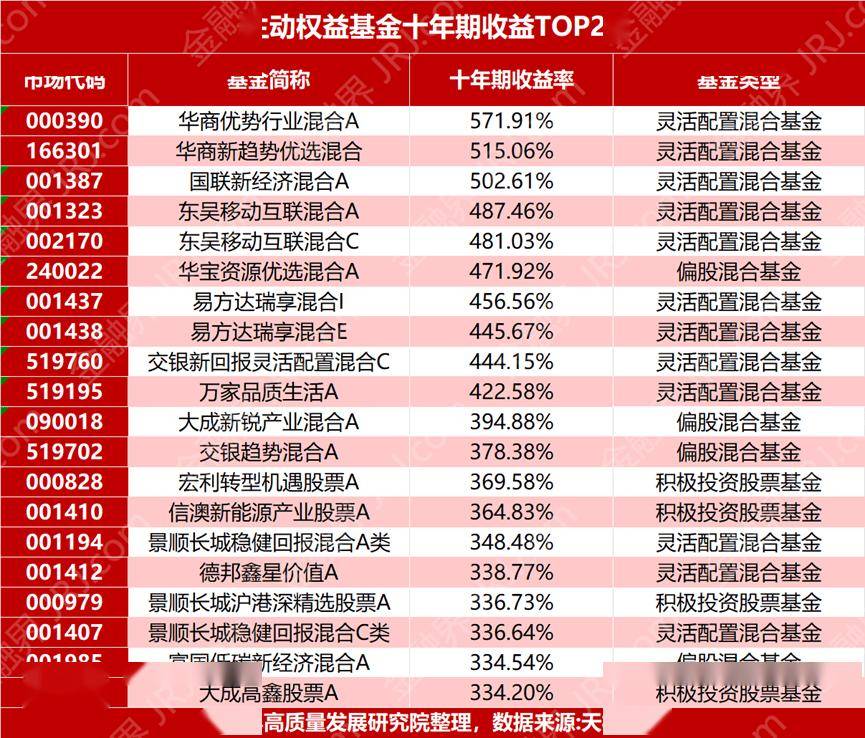
再度站稳4000点!十年主动权益基金最高暴赚近6倍,你的基金在榜吗?
Sou Hu Cai Jing· 2026-01-06 11:17
Core Insights - The Shanghai Composite Index has successfully returned to the 4000-point mark at the beginning of 2026, marking a significant start to the year with a trading volume of 2.3 trillion yuan, the most impressive opening in nearly three years [1] - Over the past decade, the A-share market has experienced structural changes, with traditional industries like real estate and petrochemicals losing influence, while technology sectors such as electronics and communications have seen substantial growth [1] - The top-performing active equity funds over the past ten years have been identified, showcasing their ability to provide stable long-term returns for investors [1] Fund Performance - The average return of active equity funds over the past decade reached 416%, with a performance threshold of 334% [2] - The top fund, Huashang Advantage Industry Mixed A, achieved a return of over 571%, indicating nearly sixfold returns for investors over ten years [2] - Among the top twenty performing active equity funds, 12 are flexible allocation mixed funds, while 4 are actively managed stock funds and 4 are偏股混合 funds [2] Fund Management Companies - The leading fund management company in terms of the number of products listed in the top-performing category is Invesco Great Wall, followed by Huashang Fund, Dongwu Fund, E Fund, and Da Cheng Fund, each having two or more products on the list [2]

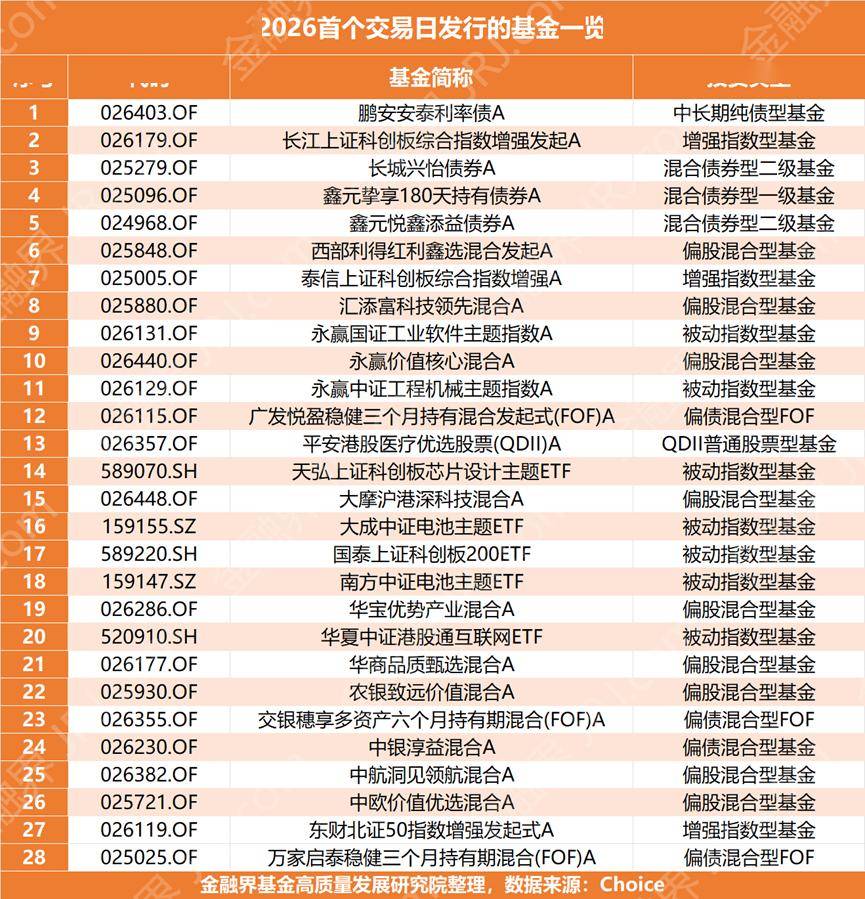
新年第一天28只新基金抢发!2025年谁家基金“卖得”最火?
Sou Hu Cai Jing· 2026-01-06 11:17
Core Insights - The first trading day of 2026 saw the launch of 28 new funds, marking the beginning of the year's fund sales [1] - The trend of active fund issuance continues from 2025, with a total of 46 new public funds expected to be launched in the week, predominantly equity funds [2][3] Fund Issuance Overview - In 2025, a total of 1,549 new funds were established, raising over 1.2 trillion yuan, making it the second-highest year in history for new fund issuance [3] - Equity funds, including stock and mixed funds, accounted for over 1,100 new funds and raised more than 620 billion yuan, representing over half of the total issuance [3] - Bond funds also performed well, with 263 new funds launched, raising nearly 444 billion yuan [3] - FOF products gained traction, with 89 new funds established, totaling over 84.5 billion yuan [3] Competitive Landscape - Leading fund management firms were particularly active in the issuance market in 2025, with E Fund launching 68 new funds, the highest in the industry [3] - Following closely, Fortune Fund launched 64 new funds, while Huaxia Fund and Huitianfu Fund each launched over 50 new products [3] - In terms of total established funds and asset scale, Huaxia Fund led with 73 new funds and approximately 100.7 billion yuan in net asset value, while E Fund ranked second with 84.5 billion yuan [3]

深科达股价涨5.07%,大成基金旗下1只基金重仓,持有63.08万股浮盈赚取94.62万元
Xin Lang Cai Jing· 2026-01-06 02:36
Group 1 - The core point of the news is that Shenzhen Deep Science and Technology Co., Ltd. (深科达) has seen its stock price increase by 5.07% to 31.10 CNY per share, with a total market capitalization of 2.938 billion CNY, and has experienced a continuous rise for 10 days [1] - The company specializes in the research, production, and sales of flat panel display production equipment, with its main business revenue composition being 49.90% from flat panel display equipment, 27.02% from semiconductor equipment, and 22.49% from core components [1] - The trading volume for the stock was 61.0497 million CNY, with a turnover rate of 2.14% [1] Group 2 - The top circulating shareholder of Deep Science is the Dazhong Fund, which has a fund named Dazhong CSI 360 Internet + Index A (002236) that entered the top ten circulating shareholders in the third quarter, holding 630,800 shares, accounting for 0.67% of circulating shares [2] - The Dazhong CSI 360 Internet + Index A fund has a total scale of 788 million CNY, with a year-to-date return of 1.81% and a one-year return of 51.14% [2] - The fund manager, Xia Gao, has been in position for 11 years and has achieved a best fund return of 230.73% during his tenure [2] Group 3 - The Dazhong CSI 360 Internet + Index A fund holds 630,800 shares of Deep Science, making it the sixth largest heavy stock in the fund, with a net value proportion of 1.07% [3] - The estimated floating profit for the fund from its investment in Deep Science is approximately 946,200 CNY, with no floating profit gained during the 10-day continuous rise [3]

加仓!
中国基金报· 2026-01-05 06:25
Core Viewpoint - On December 31, 2025, stock ETFs saw a net inflow of nearly 4.8 billion yuan, indicating a proactive investment strategy as funds positioned themselves for opportunities in 2026 [2]. Group 1: ETF Inflows - The total scale of all stock ETFs in the market reached 4.76 trillion yuan as of December 31, 2025, with a net inflow of 4.792 billion yuan on that day [4]. - Industry-themed ETFs led the inflows, totaling 5.967 billion yuan, with the semiconductor sector attracting 1.36 billion yuan and the robotics sector 1.09 billion yuan [4]. - Specific ETFs such as the E Fund Robotics ETF saw a net inflow of 320 million yuan, while the Huaxia Fund's robotics ETF exceeded 200 million yuan in inflows [4]. Group 2: Notable Inflows in Broad-based ETFs - The CSI A500 ETF had a net inflow of 2.77 billion yuan, while the Sci-Tech 50 ETF saw 1.12 billion yuan in inflows [5]. - Individual products like the Southern Fund's A500 ETF recorded a net inflow of 1.107 billion yuan, and the Huaxia Fund's A500 ETF also surpassed 1 billion yuan in inflows [5]. Group 3: Outflows from Broad-based ETFs - Broad-based ETFs experienced a significant net outflow of 369 million yuan on December 31, 2025, with a total scale decrease of 24.965 billion yuan [9]. - The top five ETFs with the largest outflows included the SSE 50 ETF with a net outflow of 2.15 billion yuan and the CSI 300 ETF with 1.53 billion yuan [9].