
Advantest

Search documents
高盛:半导体-投资者调研反馈及行业展望
Goldman Sachs· 2025-06-17 06:17
Investment Rating - The semiconductor/SPE sector has a positive investment rating with specific companies like Advantest, Disco, and Tokyo Electron rated as "Buy" [2][15][24]. Core Insights - Investor sentiment towards the semiconductor/SPE sector has improved, particularly due to strong demand for AI semiconductors, with back-end companies like Advantest and Disco gaining significant interest [3][4]. - The WFE market is expected to experience low single-digit growth in both CY25 and CY26, while memory investments (DRAM/NAND) are anticipated to grow at a higher rate [2][3]. Summary by Sections Investor Sentiment - Investor sentiment has shifted positively compared to earlier observations, driven by strong AI semiconductor demand and recent earnings reports from major players like Nvidia and Broadcom [3][4]. - There is a growing focus on micro-level factors rather than macroeconomic concerns, as many semiconductor products are currently exempt from US tariffs [4][7]. Company Highlights - Advantest is highlighted as a "Buy" due to potential upward revisions in guidance, while Disco is also rated "Buy" for its new growth drivers beyond existing technologies [2][8]. - Tokyo Electron is noted for its growth potential and is rated "Buy" as well [15]. Market Outlook - The WFE market is projected to grow at low single-digit percentages in CY25 and CY26, contrasting with higher growth expectations in memory investments [2][3]. - The discussions indicate a selective approach among investors, focusing on specific stocks rather than the overall sector [7]. Company-Specific Insights - Among mid/small-cap stocks, Tokyo Seimitsu is rated "Sell" due to stagnant profit margins, while JEOL and Ulvac are seen as undervalued with "Buy" ratings, pending market recovery confirmations [9]. - Kioxia Holdings is under observation for its competitive position in the enterprise SSD market and potential threats from competitors [8].
芯片可靠性挑战,何解?
半导体芯闻· 2025-06-10 09:52
Core Viewpoint - The semiconductor industry is redefining reliability standards as chips are increasingly deployed in harsh environments, necessitating advanced testing and validation methods to ensure performance under extreme conditions [2][17]. Group 1: Testing and Validation - The shift towards more complex applications requires manufacturers to validate performance under normal operating conditions rather than just extreme scenarios, starting from the wafer stage [2][3]. - System-Level Testing (SLT) is becoming essential for identifying early failure modes that traditional aging tests may miss, particularly under real-world operational stresses [3][4]. - Integrating SLT into testing processes allows manufacturers to make informed decisions early in the product lifecycle, enhancing reliability and performance [5][6]. Group 2: Reliability Prediction - Manufacturers are increasingly using data from the entire lifecycle of chips to predict and prevent failures, moving beyond traditional certification methods [7][9]. - The combination of optical inspection, embedded telemetry, and machine learning is crucial for predicting failure mechanisms and improving reliability [9][11]. - Real-time monitoring and feedback loops are essential for optimizing testing coverage and expected lifespan, particularly in high-reliability markets [12][14]. Group 3: Standards and Certification - Certification standards are evolving to reflect the complexities of modern semiconductor applications, with a trend towards convergence across different sectors [13][14]. - The integration of accelerated life testing and field telemetry feedback is enhancing the ability to validate performance under actual workload conditions [14][16]. - Continuous detection and adaptive testing are becoming increasingly important due to the high density and diversity of materials used in semiconductor packaging [16][17]. Group 4: Challenges in Harsh Environments - Chips used in harsh environments face significant thermal and mechanical stresses, making even minor measurement errors potentially catastrophic [15][16]. - Corrosion detection is gaining attention, especially for aerospace and industrial applications, where long-term exposure to moisture can lead to degradation [15][16]. - The need for ongoing monitoring and adaptive testing is critical to manage reliability in unpredictable operational conditions [16][17].


摩根士丹利:DeepSeek R2-新一代人工智能推理巨擘?
摩根· 2025-06-06 02:37
Investment Rating - The semiconductor production equipment industry is rated as Attractive [5][70]. Core Insights - The imminent launch of DeepSeek R2, which features 1.2 trillion parameters and significant cost efficiencies, is expected to positively impact the Japanese semiconductor production equipment (SPE) industry [3][7][11]. - The R2 model's capabilities include enhanced multilingual support, broader reinforcement learning, multi-modal functionalities, and improved inference-time scaling, which could democratize access to high-performance AI models [7][9][11]. - The development of efficient AI models like R2 is anticipated to increase demand for AI-related SPE, benefiting companies such as DISCO and Advantest [11]. Summary by Sections DeepSeek R2 Launch - DeepSeek's R2 model is reported to have 1.2 trillion parameters, a significant increase from R1's 671 billion parameters, and utilizes a hybrid Mixture-of-Experts architecture [3][7]. - The R2 model offers cost efficiencies with input costs at $0.07 per million tokens and output costs at $0.27 per million tokens, compared to R1's $0.15-0.16 and $2.19 respectively [3][7]. Industry Implications - The launch of R2 is expected to broaden the use of generative AI, leading to increased demand for AI-related SPE across the supply chain, including devices like dicers, grinders, and testers [11]. - The report reiterates an Overweight rating on DISCO and Advantest, which are positioned to benefit from the anticipated increase in demand for AI-related devices [11]. Company Ratings - DISCO (6146.T) is rated Overweight with a target P/E of 25.1x [12]. - Advantest (6857.T) is also rated Overweight, with a target P/E of 14.0x [15].

摩根士丹利:DeepSeek R2 可能即将发布-对日本SPE行业的影响
摩根· 2025-06-06 02:37
Investment Rating - The semiconductor production equipment industry is rated as Attractive [5] Core Insights - The imminent launch of DeepSeek R2, which features 1.2 trillion parameters and significant cost efficiencies, is expected to positively impact the Japanese semiconductor production equipment (SPE) industry [3][7] - The development of lightweight, high-performing AI models like DeepSeek R2 is anticipated to democratize access to generative AI, thereby expanding the market for AI-related SPE [11] Summary by Sections DeepSeek R2 Characteristics - DeepSeek R2 is reported to have 1.2 trillion parameters, with 78 billion active parameters and utilizes a hybrid Mixture-of-Experts architecture [3] - The input cost for R2 is $0.07 per million tokens, significantly lower than R1's $0.15-0.16, while the output cost is $0.27 compared to R1's $2.19 [3][7] - Enhanced multilingual capabilities and broader reinforcement learning are key upgrades in R2, allowing it to handle various data types including text, image, voice, and video [9][11] Market Implications - The anticipated launch of R2 is expected to boost demand for AI-related devices, including GPU and HBM, as well as custom chips and other AI devices [11] - The report reiterates an Overweight rating on DISCO and Advantest, which are expected to benefit from increased demand for AI-related devices [7][11] Company Ratings - Advantest (6857.T) is rated Overweight with a target price of ¥10,300 based on expected earnings peak [16] - DISCO (6146.T) is also rated Overweight with a target P/E of 25.1x based on earnings estimates [13]
金十图示:2025年05月15日(周四)全球主要科技与互联网公司市值变化


news flash· 2025-05-15 02:58
金十图示:2025年05月15日(周四)全球主要科技与互联网公司市值变化 | (S 艺电 | 383 | + -1.23% | 147.23 | | --- | --- | --- | --- | | Zscaler | 378 | + -0.22% | 244.45 | | Advantest | 369 | + -1.77% | 50.32 | | PNG Block | 359 | ↑ 0.57% | 58.5 | | HubSpot | 353 | + -0.33% | 670 | @ JIN10.COM 金十数据 | 一个交易工具 | DUUNIII . CUIII Adobe | 1702 | | 399.47 | | --- | --- | --- | --- | | 德州仪器 | 1701 | -0.46% | 187.34 | | | 1687 | -0.47% | 118.89 | | 高通 | 1679 | 1.08% | 152.98 | | 小米 והו | 1616 | 1 0.47% | 6.45 | | ≤ 索尼 | 1203 | 1.39% | 24.88 | | Shopi ...

【亚洲芯片股上涨】5月8日讯,日本东京威力科创(Tokyo Electron)上涨3%,Disco上涨6.5%,Screen上涨2.1%,Lasertec上涨3.6%,Advantest上涨3.9%。韩国海力士涨2.7%,三星电子涨1.7%,Wonik IPS涨2%,DB Hitek涨1.8%。隔夜费城半导体指数上涨1.7%,英伟达上涨3.1%。消息面,据知情人士透露,特朗普政府计划取消拜登时代的人工智能芯片限制。
news flash· 2025-05-08 00:34
金十数据5月8日讯,日本东京威力科创(Tokyo Electron)上涨3%,Disco上涨6.5%,Screen上涨2.1%, Lasertec上涨3.6%,Advantest上涨3.9%。韩国海力士涨2.7%,三星电子涨1.7%,Wonik IPS涨2%,DB Hitek涨1.8%。隔夜费城半导体指数上涨1.7%,英伟达上涨3.1%。消息面,据知情人士透露,特朗普政 府计划取消拜登时代的人工智能芯片限制。 亚洲芯片股上涨 ...


全球与中国半导体测试机市场现状及未来发展趋势(2025-2031)
QYResearch· 2025-05-07 09:06
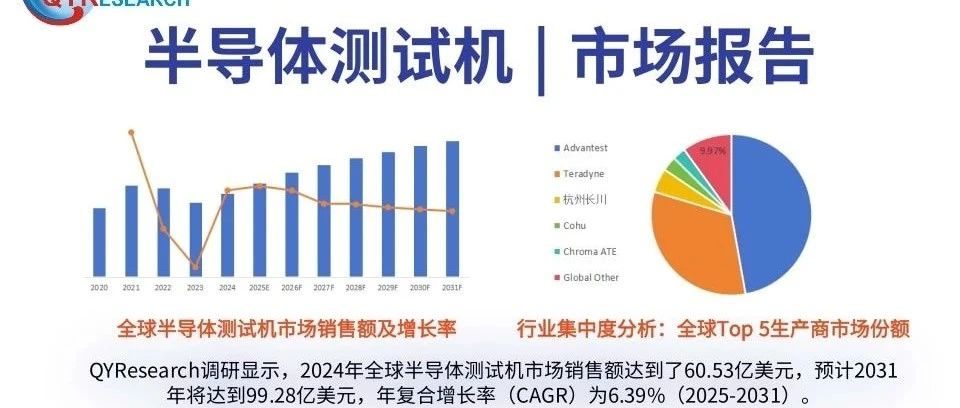
Core Viewpoint - The global semiconductor tester market is projected to grow from $6,053.36 million in 2024 to $9,927.50 million by 2031, with a CAGR of 6.39% [4]. Global Semiconductor Tester Market Overview - The semiconductor tester is essential for verifying the functionality, performance, and reliability of chips, with SoC testers holding a 52.23% market share [7]. - Major manufacturers include Advantest, Teradyne, and domestic companies like Hangzhou Changchuan and Beijing Huafeng, with the top five companies accounting for over 90% of the market [10]. - The Asia-Pacific region is the largest consumer market, accounting for over 78% of global sales, with China expected to grow from $1,782.97 million in 2024 to $3,734.76 million by 2031 [10]. Market Demand and Growth Drivers - The demand for semiconductor testers is driven by the increasing complexity and performance requirements of chips, particularly from packaging and testing companies, which account for 68.71% of the market [11]. - Key application areas include consumer electronics, automotive electronics, and AI, with rapid growth in smart driving and new energy vehicles driving the need for high-reliability testing equipment [11]. Industry Challenges - The semiconductor tester industry faces high technical barriers, requiring advanced signal processing and data transmission capabilities [11]. - High costs associated with core components like FPGA and ADC/DAC chips pose challenges for manufacturers [11]. - Geopolitical risks, particularly U.S. export controls on semiconductor equipment, significantly impact the global supply chain and Chinese market access [11]. Policy Analysis - The semiconductor tester industry is a focus for major economies, with the U.S. providing $52 billion in funding through the CHIPS Act to support domestic manufacturing and R&D [13]. - Europe plans to invest €43 billion in semiconductor R&D and production, while Japan is implementing policies to support domestic semiconductor industry upgrades [14]. - China is also promoting domestic semiconductor testing equipment development through its "14th Five-Year Plan" and investment funds [14].
金十图示:2025年05月01日(周四)全球主要科技与互联网公司市值变化




news flash· 2025-05-01 03:00
| Adobe | 1268 | | 374.98 | | --- | --- | --- | --- | | 小米 mi | 1585 | 1 4.4% | 6.4 | | AMD | 1581 | 1 1.34% | 97.35 | | S 索尼 | 1564 | 1 0.97% | 26 | | PDD Holdings (Pinduoduo) | 1498 | 1.36% | 105.57 | | 德州仪器 | 1454 | 1 0.4% | 160.05 | | Schneider Electric | 1382 | 1 0.47% | 230.97 | | Spotify | 1256 | 1 6.42% | 613.98 | | Palo Alto Networks | 1237 | 1 0.15% | 186.93 | | Shopify | 1230 | 3.96% | 95 | | y用材料 | 1224 | 0.78% | 150.71 | | 22 自动数据处理 | 1223 | 1 1.63% | 300.6 | | arm Arm Holdings | 1202 | + 2.15% ...

FormFactor(FORM) - 2025 Q1 - Earnings Call Transcript
2025-04-30 20:25
Financial Data and Key Metrics Changes - In Q1, revenues were $171.4 million, a decrease of 9.6% from Q4 and an increase of 1.6% year-over-year [16] - Non-GAAP gross margin for Q1 was 39.2%, down from 40.2% in Q4 [18] - Non-GAAP EPS for Q1 was $0.23, down from $0.27 in Q4 [23] - GAAP net income for Q1 was $6.4 million, or $0.08 per diluted share, compared to $9.7 million, or $0.12 per diluted share in Q4 [22] Business Line Data and Key Metrics Changes - Probe card segment revenues were $136.5 million in Q1, a decrease of 9.2% from Q4, driven by lower DRAM and Flash revenues [17] - Foundry and Logic revenues increased by 2.4% to $85 million in Q1, representing 49.8% of total revenues [17] - DRAM revenues were $48.9 million in Q1, down 22.8% from Q4, comprising 28.5% of total revenues [17] - Systems segment revenues were $34.8 million in Q1, a decrease from Q4, but expected to see moderate growth in Q2 [12][17] Market Data and Key Metrics Changes - The company anticipates double-digit sequential revenue growth in Q2, driven by demand from hyperscalers and investments in generative AI [5] - HBM probe card demand is expected to increase due to ongoing shipments for existing HBM3E designs and new HBM4 designs [8] - The company has seen a reduction in revenue from China due to tariffs and export controls, validating its decision to divest operations in that region [7] Company Strategy and Development Direction - The company is focusing on diversifying its customer base and product offerings, particularly in HBM and advanced packaging [38] - A recent acquisition of FICT Limited enhances the company's access to multilayer organic substrates, crucial for advanced foundry and logic probe cards [11] - The company aims to achieve $2 of non-GAAP EPS on $850 million of revenue, with a target gross margin of 47% [15][44] Management's Comments on Operating Environment and Future Outlook - Management noted that the current geopolitical and tariff environment creates uncertainty, impacting revenue and gross margins [5][6] - The anticipated growth in Q2 is not expected to be driven by tariff-related order acceleration, but rather by genuine demand increases [5] - The company is taking a cautious approach to capital investments in light of evolving geopolitical conditions [24] Other Important Information - The company generated free cash flow of $6.3 million in Q1, down from $28.8 million in Q4, primarily due to lower profitability [23] - A new two-year share repurchase program of $75 million has been approved by the Board of Directors [24] Q&A Session Summary Question: Impact of tariffs on revenue and margins - Management confirmed an estimated mid single-digit million dollar reduction in revenues due to tariffs, particularly affecting multinational customers outside free trade zones [29][30] Question: Customer dynamics and revenue contributions - A former top customer has returned to the list, indicating increased activity in the client PC space, which is expected to contribute positively to revenue [36][37] Question: DRAM business outlook - The growth in DRAM revenue is primarily driven by HBM, with expectations for continued strength in HBM3 and new contributions from HBM4 [41][42] Question: Systems sales and demand visibility - While visibility for individual orders is low, there is better long-term visibility for systems demand, particularly related to co-package optics [101]

FormFactor(FORM) - 2025 Q1 - Earnings Call Transcript
2025-04-30 20:25
Financial Data and Key Metrics Changes - In Q1, revenues were $171.4 million, a decrease of 9.6% from Q4 and an increase of 1.6% year-over-year [16] - Non-GAAP gross margin for Q1 was 39.2%, down from 40.2% in Q4 [18] - Non-GAAP EPS for Q1 was $0.23, down from $0.27 in Q4 [22] - GAAP net income for Q1 was $6.4 million, or $0.08 per diluted share, compared to $9.7 million, or $0.12 per diluted share in Q4 [21] Business Line Data and Key Metrics Changes - Probe card segment revenues were $136.5 million in Q1, a decrease of 9.2% from Q4, driven by lower DRAM and Flash revenues [17] - Foundry and Logic revenues increased to $85 million in Q1, a 2.4% increase from Q4, comprising 49.8% of total revenues [17] - DRAM revenues were $48.9 million in Q1, down 22.8% from Q4, representing 28.5% of total revenues [17] - Systems segment revenues were $34.8 million in Q1, a decrease from Q4, but moderate growth is expected in Q2 [12][17] Market Data and Key Metrics Changes - The company expects double-digit sequential revenue growth in Q2, driven by demand from hyperscalers investing in generative AI [4] - DRAM probe card revenue is expected to return to record levels in Q2, with growth in HBM applications [7] - The company anticipates a significant increase in revenues in Q2 to approximately $190 million, with growth across all major markets [25] Company Strategy and Development Direction - The company is focusing on diversifying its customer base and product offerings, particularly in HBM and advanced packaging [38] - The acquisition of FICT Limited enhances the company's access to multilayer organic substrates, crucial for advanced foundry and logic probe cards [11] - The company is taking a cautious approach regarding tariff impacts and is evaluating its manufacturing footprint and supply chain [5][6] Management's Comments on Operating Environment and Future Outlook - Management noted that the current geopolitical and tariff environment creates uncertainty, impacting customer supply chains and logistics [5] - The company expects continued growth in HBM and advanced packaging driven by generative AI adoption [14] - Management emphasized the importance of executing internal initiatives to achieve target gross margins of 47% at $850 million in revenue [44] Other Important Information - The company generated free cash flow of $6.3 million in Q1, down from $28.8 million in Q4, primarily due to lower profitability [22] - The company repurchased $22.1 million in shares during Q1 and has approved a new $75 million share repurchase program [24] Q&A Session Summary Question: Impact of tariffs on revenue and margins - Management confirmed an estimated mid single-digit million dollar reduction in revenues due to tariffs, primarily affecting multinational customers [29][30] Question: Customer dynamics and revenue potential - Management noted a resurgence in a key customer, indicating increased activity in the client PC space and a potential for continued strong activity [36][37] Question: DRAM revenue mix and growth expectations - All projected growth in DRAM is attributed to HBM, with steady demand in non-HBM applications [41] Question: Future of high bandwidth memory (HBM) - Management expects continued strong contributions from HBM3 and a transition to HBM4 in late 2025, with year-over-year growth anticipated [49][93] Question: Systems sales and demand visibility - Management indicated that while visibility for individual orders is low, broader trends in the systems business show positive demand, particularly for co-package optics [99] Question: Advanced probe cards and customer qualifications - Management confirmed ongoing qualifications for advanced probe cards with a major GPU manufacturer, indicating a strong relationship and multiple opportunities [68][70]