Manus

Search documents
别了,大模型;你好,Agent:读懂Meta收购Manus的范式转移
创业邦· 2026-01-03 10:22
Core Viewpoint - Meta's acquisition of Manus for billions of dollars highlights the shifting landscape of AI, emphasizing the need for practical applications over mere conversational capabilities [7][14][20]. Group 1: Manus's Journey and Team - Manus, founded in Wuhan and developed in Beijing, has transitioned to a Singapore-based company, showcasing a modern narrative of Chinese tech talent navigating geopolitical challenges [7][18]. - The core team of Manus, led by founder Xiao Hong and chief scientist Peak Ji, is characterized by exceptional engineering skills and insights into user behavior, rather than traditional academic AI backgrounds [8][10]. - Peak Ji's philosophy of "orthogonality" emphasizes building applications that leverage existing models rather than competing directly with them, leading to innovative solutions in AI [12]. Group 2: Technological Innovations - Manus distinguishes itself from traditional chatbots by developing an "Agent" capable of performing complex tasks, such as market research and data analysis, rather than just engaging in conversation [16]. - The company has created a virtual operating system that enhances AI capabilities, addressing limitations in memory and operational accuracy, which has proven to be a significant engineering success [16]. Group 3: Geopolitical and Economic Challenges - The decision to relocate Manus's headquarters to Singapore and lay off Chinese staff reflects the harsh realities of geopolitical tensions, particularly regarding access to critical technology and funding [18][19]. - Manus's shift away from China is driven by the need for advanced computing power and capital, which are increasingly restricted for Chinese companies due to U.S. export controls [19]. Group 4: Implications for the Chinese AI Industry - The acquisition of Manus by Meta signifies a loss for the Chinese AI sector, as talented engineers are compelled to contribute to foreign companies due to local constraints [22]. - Manus's success illustrates the potential of Chinese engineers to innovate independently, yet the current environment hampers the growth of local ecosystems and market opportunities [22][25].



这里还有8个“Manus”:1亿美元ARR,都是ToC
量子位· 2026-01-03 10:00
Core Insights - The article discusses the emergence of the "1 Billion ARR Club" in the AI sector, highlighting companies that have achieved significant annual recurring revenue (ARR) and their implications for the industry [1][3][4]. Group 1: Definition and Importance of ARR - ARR stands for Annual Recurring Revenue, representing stable, repeatable income generated by a product within a year [5]. - It reflects a critical question for AI companies: whether users are willing to pay for AI services long-term [6]. Group 2: Notable Companies in the 1 Billion ARR Club - Companies achieving over $1 billion ARR include: - Perplexity: $20 billion - ElevenLabs: $6.6 billion - Lovable: $6.6 billion - Replit: over $3 billion - Suno: $2.5 billion - Gamma: $2.1 billion - Character: over $1 billion - Manus: $500 million - HeyGen: over $500 million [7][8]. Group 3: Categories of Business Models - The companies can be categorized into five main business paths: 1. AI Search/Information Services (e.g., Perplexity) [12][13]. 2. Audio/Voice Infrastructure Products (e.g., ElevenLabs) [15][16]. 3. Vibe Coding/Development Tools (e.g., Replit and Lovable) [17][18]. 4. Content/Office Efficiency Tools (e.g., Gamma) [20][21]. 5. Generative Entertainment Content (e.g., Suno and HeyGen) [23][24]. Group 4: Trends and Market Dynamics - The shift from foundational models to consumer products is a significant trend, with the consumer (ToC) sector emerging as a new goldmine [9][30]. - The AI 2.0 era is characterized by high user tolerance for product iterations, allowing companies to receive rapid feedback and adjust quickly [32][37]. Group 5: Challenges and Considerations - Despite the growth, user stickiness is low, leading to potential churn as users switch to better products [34]. - AI-Native applications face unique cost structures, where each interaction incurs computational costs, necessitating a focus on sustainable revenue models [40][46]. - Companies must balance user growth with the costs of AI processing to ensure long-term viability [47][49]. Group 6: Strategic Acquisitions - Meta's acquisition of Manus illustrates the value of established AI products with proven user bases, as it allows Meta to leverage existing capabilities rather than developing new products from scratch [58][62]. - The acquisition not only brings a product but also a talented team capable of enhancing Meta's AI offerings across its platforms [66].

2026年,“一人公司”爆发,不被雇佣就不会“被裁”
3 6 Ke· 2026-01-03 06:10
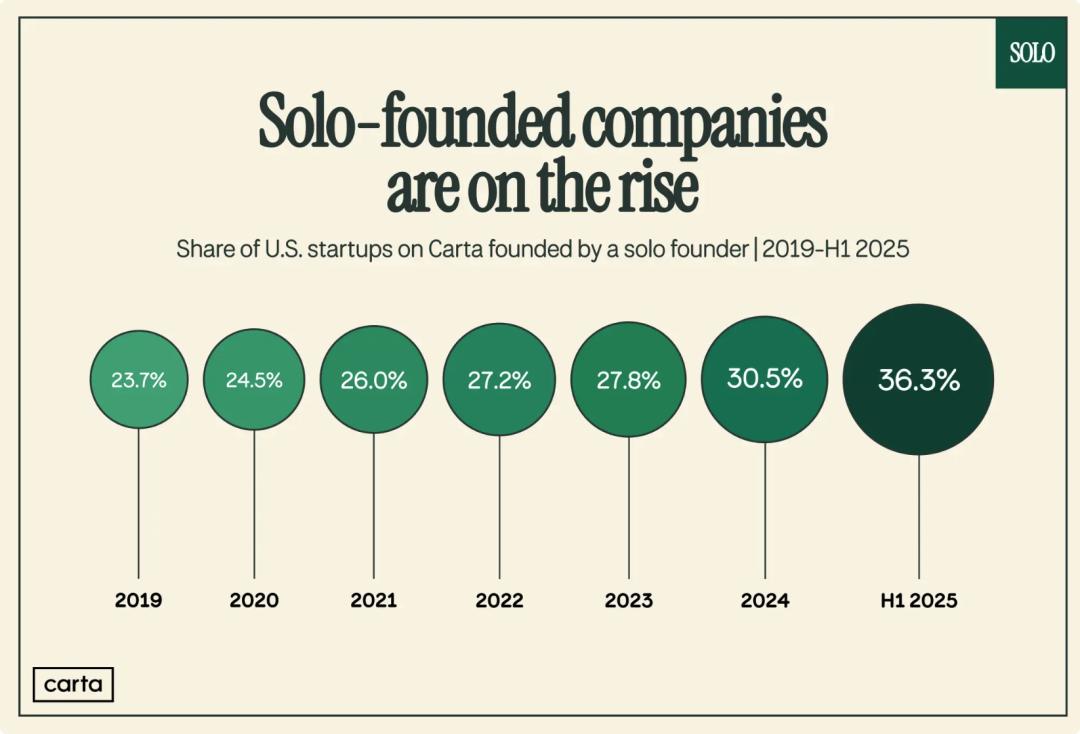
Core Insights - The rise of "one-person unicorn companies" is becoming a reality in the AI era, with predictions that individuals can establish companies valued at $1 billion [1][4] - Recent data shows that over one-third of new companies are founded by solo founders, increasing from 23.7% in 2019 to 36.3% in the first half of 2025, marking a 53% growth [1] Group 1: Definition and Characteristics of One-Person Companies - One-person companies are defined as businesses led by a single founder who utilizes AI and external resources to enhance their capabilities, rather than being limited to a single individual doing all tasks [5][6] - The traditional view of entrepreneurship, which emphasizes team formation and co-founders, is being challenged by the emergence of one-person companies [4][5] Group 2: Factors Contributing to the Rise of One-Person Companies - The capabilities of AI have expanded what a single individual can accomplish, making it feasible for one-person companies to thrive [9][10] - The cost of starting a business has significantly decreased, with 90% of one-person company founders reporting startup costs below $500, thanks to the availability of cloud computing and SaaS tools [13] - Successful examples of solo founders, such as Guillermo Rauch and Pieter Levels, are demonstrating the viability of this model, prompting investors to reconsider the necessity of co-founders [14] Group 3: Challenges and Considerations - While one-person companies offer independence, they also come with challenges such as loneliness and the burden of decision-making [20][30] - The traditional advantages of co-founders, such as risk-sharing and complementary skills, can be undermined by conflicts and misalignments, which are common in co-founder relationships [16][18] - The rise of one-person companies raises questions about the relevance of traditional organizational structures in the AI age, as AI can perform tasks that previously required teams [22][23] Group 4: Future Implications - The operational model of organizations is expected to evolve from hierarchical structures to dynamic networks of small teams and AI agents, allowing for greater efficiency and flexibility [26] - One-person companies are particularly suited for knowledge-intensive and creative fields, where individuals can leverage AI to create value independently [34]
Meta为何花10亿美金收购这家中国AI应用公司?
首席商业评论· 2026-01-03 05:02
Core Viewpoint - The acquisition of Manus by Meta for over $2 billion signals a significant shift in the AI landscape, highlighting Manus's rapid growth and potential as a leading AI application despite initial skepticism about its technology [4][10][18]. Group 1: Manus's Journey and Technology - Manus transformed from a controversial startup to a leading AI application, showcasing capabilities like automatic resume processing and candidate evaluation [5][6]. - The company claims to be the "world's first general-purpose AI agent," drawing comparisons to other successful AI products [5]. - Despite criticism regarding its technology being easily replicable, Manus demonstrated strong market traction with a monthly subscription model ranging from $20 to $200 [8][18]. Group 2: Financial Performance and Market Position - Manus achieved an Annual Recurring Revenue (ARR) of $125 million within just nine months, setting a record in the SaaS industry [10]. - It is one of only eight consumer AI companies globally with an ARR exceeding $100 million, indicating its rarity and value in the market [10]. - The acquisition by Meta marks one of the largest in the company's history, emphasizing the strategic importance of Manus in Meta's transition to an AI platform [11][12]. Group 3: Strategic Implications for Meta and the Industry - Meta's acquisition aims to integrate Manus's capabilities into its broader social and enterprise services, moving from a social network to an AI platform [12][13]. - The high valuation of Manus is expected to positively impact other AI agent companies, potentially reshaping market valuations [13]. - The competitive landscape in Silicon Valley is intensifying, with companies like OpenAI and Google also vying for talent and technology in the AI space [12][20].

2025A股11连阳收官,2026新政密集启幕丨一周热点回顾
Xin Lang Cai Jing· 2026-01-03 03:48
Group 1: Digital Currency Development - The People's Bank of China has introduced a plan to transition digital renminbi from a cash-based system to a deposit currency system, effective January 1, 2026 [1] - Digital renminbi wallets will now earn interest, marking a significant shift in its role from cash to deposits, which is expected to enhance liquidity within the banking system [2] Group 2: National Subsidy Policy for 2026 - The National Development and Reform Commission and the Ministry of Finance have clarified the scope and intensity of the 2026 national subsidy policy for replacing old consumer goods, focusing on four categories: automobile scrapping, automobile replacement, home appliances, and digital products [3] - The subsidy for automobiles will shift from fixed amounts to a percentage of the new car price, while home appliance subsidies will be reduced in both scope and percentage [4] Group 3: VAT Law Implementation - The implementation regulations for the VAT Law will take effect on January 1, 2026, maintaining the current VAT system framework and tax burden while enhancing clarity and operability [5] - New regulations will address key issues in VAT taxation, including the scope of taxable transactions and the rules for tax deductions [6] Group 4: A-Share Market Performance - The A-share market closed the year with significant gains, with the Shanghai Composite Index rising 18.41% for the year, marking its largest annual increase in six years [7] - The total market capitalization of A-shares reached a record high of nearly 109 trillion yuan, with notable performance in sectors like CPO, storage chips, and commercial aerospace [7] Group 5: Manufacturing PMI Recovery - The manufacturing PMI rose to 50.1% in December 2025, indicating a return to expansion after eight months below 50%, driven by improved market expectations and demand [8] - Large enterprises showed a notable recovery, with their PMI reaching 50.8%, while small enterprises remained below the critical threshold [8] Group 6: Precious Metals Market Volatility - Gold and silver prices experienced significant declines at the end of 2025, with gold futures dropping 1.02% and silver futures falling 9.36% due to increased margin requirements [11] - Throughout 2025, gold prices rose approximately 70% and silver prices surged around 150%, driven by speculative buying and macroeconomic factors [12] Group 7: Meta's Acquisition of Manus - Meta announced a multi-billion dollar acquisition of Manus, an AI startup, marking its third-largest acquisition to date, aimed at enhancing its AI capabilities [13] - The acquisition reflects the competitive landscape in AI, with Meta seeking to address gaps in productization and commercialization in the general intelligence domain [14]
2025A股11连阳收官,2026新政密启幕丨一周热点回顾
Di Yi Cai Jing· 2026-01-03 03:05
Group 1: Digital Currency Developments - The People's Bank of China has announced that digital RMB will start accruing interest, transitioning from a cash-based model to a deposit currency model by January 1, 2026 [1] - This change allows banks to pay interest on digital RMB wallet balances, enhancing liquidity within the banking system and potentially increasing user willingness to adopt digital RMB [2] Group 2: National Subsidy Policy for 2026 - The National Development and Reform Commission and the Ministry of Finance have clarified the "National Subsidy" policy for 2026, focusing on four categories: vehicle scrappage, vehicle replacement, home appliances, and digital products [3] - The subsidy for home appliances has been reduced from 12 categories to 6, and the subsidy rates for vehicles have shifted from fixed amounts to a percentage of the new vehicle price [3] Group 3: VAT Law Implementation - The VAT Law Implementation Regulations will take effect on January 1, 2026, maintaining the current VAT system framework while enhancing clarity and operability of the tax system [5][6] - The regulations address key issues in VAT collection and taxpayer rights, supporting the smooth implementation of the VAT Law [6] Group 4: Housing Tax Policy Changes - Starting January 1, 2026, individuals selling homes purchased for less than two years will pay a reduced VAT rate of 3%, down from 5%, effectively lowering transaction costs [7] - This adjustment is expected to alleviate financial pressure on homeowners and facilitate inventory reduction in the housing market [7] Group 5: A-Share Market Performance - The A-share market closed the year with the Shanghai Composite Index rising over 18%, marking its largest annual increase in six years, with significant contributions from sectors like CPO, storage chips, and non-ferrous metals [8] - The total market capitalization of A-shares reached nearly 109 trillion yuan, reflecting a robust market performance despite earlier volatility due to external factors [8] Group 6: Manufacturing PMI Recovery - The manufacturing PMI rose to 50.1% in December 2025, indicating a return to expansion after eight months below 50%, driven by improved production expectations and new orders [9][10] - Large enterprises showed significant recovery, while small enterprises continued to lag behind, suggesting a mixed outlook for the manufacturing sector [9] Group 7: Precious Metals Market Volatility - Gold and silver prices experienced a sharp decline at the end of December 2025, following significant increases throughout the year, with gold rising approximately 70% and silver 150% [11][12] - The volatility was attributed to increased margin requirements by exchanges, impacting speculative trading in the precious metals market [11] Group 8: Meta's Acquisition of Manus - Meta has announced a multi-billion dollar acquisition of Manus, an AI startup, marking its third-largest acquisition to date [13] - This acquisition aims to enhance Meta's capabilities in AI applications, although it reflects ongoing challenges in competing with other tech giants like OpenAI and Google [14]
Why Meta's +$2B AI Startup Acquisition Could Be a Huge Win
Yahoo Finance· 2026-01-02 21:32
Core Viewpoint - Concerns regarding uncontrolled AI spending have negatively impacted Meta Platforms, despite a significant stock increase earlier in the year. The company's forecast of higher spending in 2026 led to a sell-off, resulting in a 12% decline in stock value by year-end [2]. Group 1: Financial Performance and Stock Reaction - Meta's stock rose by 35% in 2025 but ended the year with a total return of only 13% due to spending concerns [2]. - Following the announcement of the acquisition of Manus, Meta's shares increased by 1.1%, contrasting with slight declines in the S&P 500 and tech sector, indicating a positive market reaction to the deal [3][6]. Group 2: Acquisition of Manus - Meta acquired AI startup Manus for over $2 billion, which develops general-purpose AI agents capable of executing complex tasks [3]. - Manus achieved $100 million in annual recurring revenue (ARR) within eight months of launching, marking a record growth rate for startups [4]. - The AI agent from Manus has created over 80 million virtual computers, demonstrating significant real-world application and task execution capabilities [5]. Group 3: Strategic Implications - The acquisition aligns with Meta's ongoing focus on AI investment, despite plans to cut spending in other areas like the Metaverse [3]. - The complementary nature of the solutions provided by Meta and Manus suggests a strong potential for success in their collaboration [6].
Manus deal should be incremental positive for Meta, says BMO Capital
Yahoo Finance· 2026-01-01 20:05
Group 1 - BMO Capital reiterated a Market Perform rating and a price target of $710 on Meta Platforms (META) following the announcement of the acquisition of AI agent startup Manus for approximately $2 billion [1] - Manus achieved a remarkable growth from $0 to $100 million in annual recurring revenue (ARR) within eight months, highlighting its effective monetization of AI [1] - The acquisition is expected to provide an incremental positive impact on Meta's projected $121 billion AI expenditure for 2026, which has not yet yielded the immediate return on investment seen by other hyperscalers [1]
成立不到3年,被Meta以逾20亿美元收购!Manus成为“AI时代中国创业新标杆”
Sou Hu Cai Jing· 2026-01-01 12:27
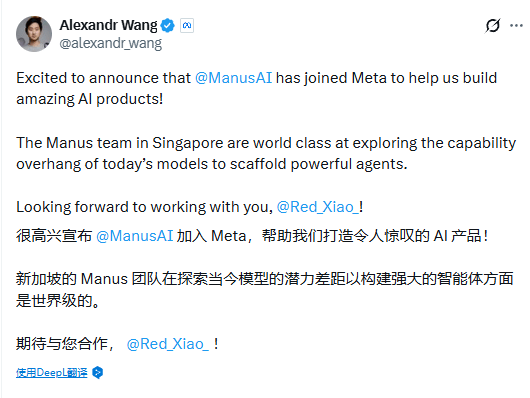
Meta以数十亿美元收购AI初创公司Manus,这是这家社交媒体巨头成立以来第三大收购交易,仅次于 WhatsApp和Scale AI。这笔交易标志着Meta在AI领域的激进投资策略进入新阶段,也为中国创业者在全 球AI竞赛中树立了新标杆。 据华尔街日报最新报道,Meta正以逾20亿美元收购Manus。周二,据《晚点LatePost》,Manus母公司 蝴蝶效应在被收购前正以20亿美元估值进行新一轮融资。整个收购谈判在极短时间内完成,前后不过十 余天。收购完成后,蝴蝶效应将保持独立运作,创始人肖弘将出任Meta副总裁。 随后,Meta首席人工智能官Alexandr Wang发推文称,欢迎Manus AI的加入。 CEO Red 肖弘也发声称,"这不仅仅是一次收购。它验证了我们一直以来努力构建的未来是真实存在 的,而且它的到来比任何人预期的都要快。" 公司第一款产品是浏览器AI插件Monica,提供大模型驱动的聊天、搜索、阅读、写作、翻译等功能。 尽管当时被指为"套壳"产品,但Monica成为中国AI行业少有的盈利产品。 2024年,90后连续创业者季逸超和产品经理张涛加入团队,共同开发出Manus。这款能够调 ...

扎克伯格出手!超20亿美元拿下中国纯AI应用公司,给创业者打强心针
创业家· 2026-01-01 10:07
Core Viewpoint - Meta's acquisition of Manus for over $2 billion highlights the significant value of pure AI applications, challenging the notion that innovation must stem from hardware-software integration [3][4][6][8]. Group 1: Acquisition Insights - Manus, a company established only three years ago, achieved a remarkable acquisition price, making it a focal point in the domestic AI startup community [4]. - The acquisition demonstrates that global giants like Meta are willing to pay high prices for innovative applications, even when they come from smaller, purely software-based companies [4][5]. - This event serves as a strong encouragement for Chinese entrepreneurs, indicating that substantial value can be derived from pure AI applications without the need for hardware [4][5][6]. Group 2: Industry Perspectives - Industry experts emphasize the importance of focusing on application innovation and targeting global markets, rather than being constrained by traditional models that prioritize hardware [5][7]. - The success of Manus illustrates that a Chinese team can create a product with global appeal, emphasizing the significance of talent and product strength in the AI sector [5][9]. - The acquisition sets a clear direction for future Chinese AI startups, suggesting that they should concentrate on application innovation and global market strategies by 2026 [9].