
中国人民银行

Search documents
跨境支付通全国首笔离境退税业务落地
Jin Rong Shi Bao· 2025-09-02 03:35
Core Insights - The introduction of the Cross-Border Payment System has significantly improved the efficiency and convenience of tax refund services for Hong Kong travelers, allowing them to receive refunds directly in their local bank accounts in Hong Kong [1][3]. Group 1: Cross-Border Payment System - The Cross-Border Payment System is a financial innovation jointly promoted by the People's Bank of China and the Hong Kong Monetary Authority, facilitating the interconnection of payment systems between mainland China and Hong Kong [1][3]. - This system allows for real-time tax refunds to be credited to Hong Kong bank accounts, enhancing the user experience for frequent travelers between the two regions [1][3]. Group 2: Tax Refund Services in Shenzhen - Shenzhen has become a leader in providing efficient tax refund services, with over 1,500 tax refund stores and 12 centralized refund points, making it the only city in China with comprehensive tax refund facilities across land, sea, and air [2]. - From January to July 2025, the sales of tax refund eligible goods in Shenzhen exceeded 584 million yuan, marking a 200% year-on-year increase, with "immediate refund" goods sales reaching 75.04 million yuan, up over 2,500% [2]. Group 3: Advantages of the New System - The new system offers four main advantages: simplified procedures, faster remittance, diverse currency options, and convenient consumption methods for travelers [3]. - Travelers can now choose to receive refunds in either RMB or HKD, eliminating the need for currency exchange and allowing for immediate use of funds through mobile payment platforms [3].
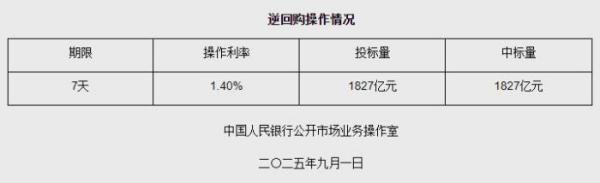
9月1日央行开展1827亿元7天期逆回购操作
Zhong Guo Xin Wen Wang· 2025-09-01 02:44
Core Viewpoint - The People's Bank of China conducted a reverse repurchase operation amounting to 182.7 billion yuan at a fixed interest rate of 1.40% on September 1, 2025 [1] Summary by Category Reverse Repo Operation Details - The operation involved a 7-day reverse repurchase agreement with an interest rate of 1.40% [1] - The total bidding amount was 182.7 billion yuan, which was also the amount awarded [1]

信用卡透支利率上下限拟取消
Nan Fang Du Shi Bao· 2025-08-31 23:15
Core Viewpoint - The People's Bank of China (PBOC) is seeking public opinion on amendments to the "Electronic Payment Guidelines (No. 1)" and other regulatory documents to enhance financial legal construction and improve the central bank's legal framework [2][3]. Group 1: Amendments to Electronic Payment Guidelines - The amendments include the removal of electronic payment transaction limits and the improvement of transaction dispute resolution regulations [3][4]. - Specific changes involve deleting previous transaction limits, such as the single transaction limit of 1,000 RMB and a daily cumulative limit of 5,000 RMB for individual customers [3][4]. - The guidelines were originally published in 2005, and the need for updates arises from the rapid development of the electronic payment industry, which has seen significant growth in transaction scale and complexity [4]. Group 2: Changes to Credit Card Regulations - The PBOC is also modifying the "Notice on Credit Card Business Matters," which includes the removal of upper and lower limits on credit card overdraft interest rates and certain disclosure requirements [5][6]. - The previous regulation set the upper limit for overdraft interest rates at 0.05% per day and the lower limit at 0.035% per day [5][6]. - The changes aim to provide more flexibility in pricing and allow issuing institutions to determine interest rates based on customer risk profiles, thus promoting consumer credit development [9][10]. Group 3: Expert Opinions - Analysts suggest that the original transaction limits were necessary due to the nascent state of electronic payments in 2005, aimed at ensuring security and orderly development of electronic banking and commerce [9]. - With the maturation of the credit card market and improved risk management systems, the previous regulations are seen as restrictive, hindering market vitality and innovation [10].

人民银行取消银行卡支付限额、信用卡利率上下限!对你我影响几何
Bei Jing Shang Bao· 2025-08-31 13:48
Core Viewpoint - The People's Bank of China has proposed significant changes to the regulatory framework governing electronic payments and credit card overdraft rates, aiming to enhance flexibility for financial institutions and better meet consumer needs in large transactions [1][10]. Electronic Payment Adjustments - The previous limits on electronic payment transactions, such as a single online payment cap of 1,000 yuan and a daily cumulative limit of 5,000 yuan for individuals, have been removed, allowing for larger transactions [3][4]. - This change signifies a shift from "small-scale convenience" to "full-scenario coverage," facilitating smoother fund transfers for significant purchases like real estate and cross-border transactions [3][4]. Credit Card Overdraft Rate Changes - The proposed removal of the upper and lower limits on credit card overdraft rates will grant banks greater pricing autonomy, enabling them to tailor interest rates based on individual customer credit profiles [6][7]. - The previous regulations, established in 2016, aimed to standardize the credit card market but have become outdated as the market has matured and competition has intensified [6][9]. Market Dynamics and Consumer Impact - The removal of transaction limits and interest rate caps is expected to stimulate consumer spending on larger items and increase the frequency of credit card usage, thereby revitalizing banks' electronic payment and credit card businesses [5][6]. - The credit card market has seen a decline in the number of cards issued, with a drop from 7.49 billion to 7.15 billion year-on-year, indicating a need for innovation and reform in the sector [8][9]. Regulatory Rationale - The People's Bank of China aims to strengthen financial legal frameworks and adapt to market developments, ensuring that regulations align with current business practices and consumer needs [10].

电子交易额度解绑、信用卡透支利率更灵活?央行新规征求意见
Nan Fang Du Shi Bao· 2025-08-31 09:44
Core Viewpoint - The People's Bank of China (PBOC) is seeking public opinion on proposed amendments to the "Electronic Payment Guidelines (First Edition)" and three other regulatory documents to enhance financial legal construction and improve the central bank's legal framework [2][6]. Group 1: Amendments to Electronic Payment Guidelines - The amendments include the removal of regulations on electronic payment transaction limits and the management of credit card overdraft interest rates [4][8]. - Specific changes involve deleting provisions that limit individual electronic payment transactions to a maximum of 1,000 RMB per transaction and a daily cumulative limit of 5,000 RMB [4]. - The guidelines will now encourage banks to handle disputes with customers promptly and responsibly, promoting mediation and arbitration as means to resolve conflicts [5][6]. Group 2: Credit Card Regulations - The PBOC will also remove the upper and lower limits on credit card overdraft interest rates, which were previously set at a maximum daily interest rate of 0.05% and a minimum of 0.035% [8][16]. - Other deletions include requirements for credit card issuers to disclose application conditions and product features, as well as the need to report interest rate adjustments to the PBOC [11][14]. - The changes reflect a shift towards market-driven pricing for credit card interest rates, allowing issuers to set rates based on customer risk profiles and creditworthiness [17].

速看李嘉诚预言又说中!我国手握“2套房”家庭,将注定3个结局
Sou Hu Cai Jing· 2025-08-30 15:05
Core Insights - The article discusses the evolving landscape of China's real estate market, particularly focusing on families owning multiple properties and the three distinct paths they may take in response to current market conditions [1][10]. Group 1: Current Market Conditions - As of 2025, there are approximately 37.8 million households in China owning two or more properties, facing significant choices due to changing market dynamics [1]. - The sales area of commercial housing in China is projected to decrease by 9.2% year-on-year in 2024, marking the lowest transaction volume in nearly seven years [1][3]. - The average debt ratio for multiple property households has surged to 67.3%, significantly higher than the national average [3]. Group 2: Diverging Paths for Households - About 42% of households with two properties are experiencing varying degrees of mortgage pressure, particularly those who purchased their second property around 2020 [3]. - Approximately 35% of multiple property households are proactively adjusting their asset allocation, selling non-primary residences to invest in more promising areas [4]. - Around 23% of these households are opting for a long-term holding strategy, often due to their strong financial position and risk tolerance [5]. Group 3: Influencing Factors - The changing demographic structure, with 19.7% of the population aged 65 and older, is reshaping housing demand, emphasizing the need for retirement and healthcare-oriented properties [9]. - Recent policy changes, including the expansion of property tax trials to 28 cities, are increasing the holding costs for families with multiple properties [9]. - Financial regulations are tightening, with stricter approval standards for loans on multiple properties, leading to higher average loan rates compared to first homes [9]. Group 4: Future Outlook - The article suggests that the real estate market is shifting towards a focus on housing as a necessity rather than an investment tool, indicating a need for families to reassess their property strategies [11][12]. - The evolving market dynamics reflect broader economic structural changes in China, with a push towards stable and healthy development in the real estate sector [10].

用好新增支农支小再贷款额度全力支持防汛救灾与灾后重建
Zheng Quan Ri Bao· 2025-08-30 13:53
Core Viewpoint - The People's Bank of China has added a new quota of 100 billion yuan for agricultural and small business re-loans, aimed at enhancing credit support for affected areas, particularly small and micro enterprises, individual businesses, and agricultural sectors in disaster-stricken regions [1][2]. Group 1: Financial Support Measures - The new re-loan quota is significant for flood relief and post-disaster reconstruction efforts in affected areas [1]. - Banks are encouraged to accurately assess the financing needs of different entities in disaster-affected regions by establishing detailed demand records [1][3]. - Optimizing credit approval processes is crucial, with banks urged to create dedicated service channels for disaster-affected clients to expedite loan processing [1][2]. Group 2: Product Innovation and Policy Adjustment - Banks should develop specialized credit products tailored to the needs of disaster-affected areas and utilize online processing to ensure rapid fund delivery [2]. - Adjustments to credit policies, such as setting aside special fund quotas and extending loan terms, are recommended to enhance the relevance and adaptability of credit supply [2]. Group 3: Collaboration and Oversight - Strengthening cooperation with government departments and other financial institutions is essential for effectively addressing the financing needs of key enterprises involved in disaster relief and reconstruction [2]. - Banks must enhance post-loan management and supervision to ensure that re-loan funds are used appropriately for flood relief and reconstruction, preventing fund misappropriation [2].
丁志杰:在全球经贸重构中把握大湾区金融开放新机
Sou Hu Cai Jing· 2025-08-30 07:15
Core Insights - The Guangdong-Hong Kong-Macao Greater Bay Area (GBA) is positioned as a key player in China's financial openness and international competitiveness amid global economic restructuring [1][3][4] Group 1: Financial Development and Globalization - The GBA should actively engage in high-level financial openness to establish benchmarks in international competition [1] - China is one of the biggest beneficiaries of globalization, with the current global economic fragmentation presenting new opportunities for the internationalization of the Renminbi [3] - China's robust foreign investment and foreign exchange reserves provide a strong foundation for promoting domestic currency settlement and a multipolar international monetary system [3] Group 2: Strategic Focus Areas for GBA - The GBA should emphasize collaborative competition among its cities to achieve win-win outcomes [4] - There is a dual focus on "bringing in" foreign investment and "going out" to enhance China's international standing [4] - Leveraging the GBA's geographical and institutional advantages is crucial for cultivating a globally influential international financial center [4] Group 3: Mission and Opportunities - The GBA has a significant role in building a strong financial nation and advancing China's modernization process [4] - It is essential to seize the opportunities presented by global economic restructuring to enhance financial openness and cooperation [4] - The GBA is expected to contribute significantly to the internationalization of the Renminbi and the overall development of China's financial sector [4]
人民币,好消息!
Sou Hu Cai Jing· 2025-08-30 05:33
Core Viewpoint - The People's Bank of China has renewed a bilateral currency swap agreement with the Reserve Bank of New Zealand, with a swap scale of 250 billion RMB, effective for five years, and extendable by mutual consent [1] Group 1: Agreement Details - The renewed currency swap agreement aims to deepen monetary and financial cooperation between China and New Zealand [1] - The agreement is expected to facilitate bilateral trade and investment [1] - The arrangement is also intended to maintain financial market stability [1]
人民银行:7月同业拆借加权平均利率1.45% 质押式回购加权平均利率1.46%
Bei Jing Shang Bao· 2025-08-29 12:03
Core Insights - The People's Bank of China released the financial market operation data for July 2025, indicating a positive trend in interbank lending and bond repurchase transactions [1] Interbank Lending Market - In July, the interbank lending market recorded a transaction volume of 9.8 trillion yuan, representing a year-on-year increase of 3.1% and a month-on-month increase of 16.6% [1] - The weighted average interest rate for interbank lending was 1.45%, showing a slight decrease of 1 basis point month-on-month [1] Bond Repurchase Market - The bond repurchase transactions totaled 175.3 trillion yuan in July, which is an 18.5% increase year-on-year and a 12.2% increase month-on-month [1] - Standard bond repurchase transactions on exchanges reached 57.4 trillion yuan, reflecting a year-on-year growth of 21.1% and a month-on-month increase of 13.5% [1] - The weighted average interest rate for pledged repos was 1.46%, down by 4 basis points from the previous month [1]