DeepSeek

Search documents
2025上半年大模型使用量观察:Gemini系列占一半市场份额,DeepSeek V3用户留存极高
Founder Park· 2025-07-09 06:11
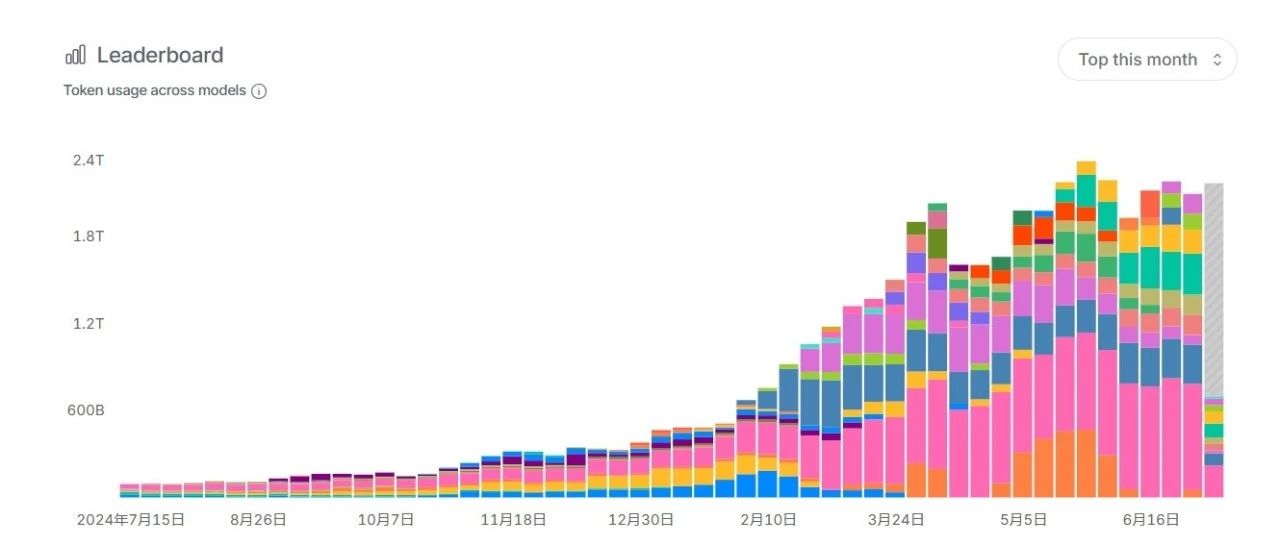
Core Insights - The article discusses the current state and trends of the large model API market in 2025, highlighting significant growth and shifts in market share among key players [1][2][25]. Token Usage Growth - In Q1 2025, the total token usage for AI models increased nearly fourfold compared to the previous quarter, stabilizing at around 2 trillion tokens per week thereafter [7][25]. - The top models by token usage include Gemini-2.0-Flash, Claude-Sonnet-4, and Gemini-2.5-Flash-Preview-0520, with Gemini-2.0-Flash maintaining a strong position due to its low pricing and high performance [2][7]. Market Share Distribution - Google holds a dominant market share of 43.1%, followed by DeepSeek at 19.6% and Anthropic at 18.4% [8][25]. - OpenAI's models show significant volatility in usage, with GPT-4o-mini experiencing notable fluctuations, particularly in May [8][25]. Segment-Specific Insights - In the programming domain, Claude-Sonnet-4 leads with a 44.5% market share, while Gemini-2.5-Pro follows [12]. - For translation tasks, Gemini-2.0-Flash dominates with a 45.7% share, indicating its widespread integration into translation software [17]. - The role-playing model market is fragmented, with small models collectively holding 26.6% of the share, while DeepSeek leads in this area [21]. API Usage Trends - The most utilized APIs on OpenRouter are primarily for code writing, with Cline and RooCode leading the way [25]. - The overall trend indicates a strong preference for tools that facilitate coding and application development [25]. Competitive Landscape - DeepSeek's V3 model has shown strong user retention and is favored over its predecessor, likely due to faster processing times [25]. - Meta's Llama series is declining in popularity, while Mistral AI has captured approximately 3% of the market, primarily among users interested in fine-tuning open-source models [25]. - X-AI's Grok series is still establishing its market position, and the Qwen series holds a modest 1.6% share, indicating room for growth [25].


AI六小虎,胜利大逃亡?
投中网· 2025-07-09 02:12
Core Viewpoint - The AI "Six Little Tigers" are facing unique challenges as they prepare for IPOs, with varying degrees of readiness and market conditions impacting their prospects [3][9]. Group 1: Market Dynamics - The AI landscape is evolving rapidly, with major players like Alibaba and ByteDance pushing the boundaries, forcing smaller companies to adapt quickly [4][20]. - The "Six Little Tigers" are experiencing pressure from larger firms, which have raised their valuations and created a challenging environment for smaller companies to secure funding or acquisitions [20][21]. Group 2: IPO Readiness - Two companies, Zhipu and MiniMax, are leading the charge towards IPO, while Moonlight is also reportedly preparing for a listing [7][9]. - Recent policy changes in Hong Kong and the Science and Technology Innovation Board have made it easier for early-stage tech companies, including AI firms, to go public [11][12][13]. Group 3: Individual Company Challenges - Baichuan Intelligence and Zero One Wanwu are showing signs of lagging behind, with difficulties in their IPO pursuits due to overexpansion and competition [15]. - Zhipu is seen as the most prepared for an IPO, having secured significant funding and a clear strategy, but faces uncertainties due to market conditions [16][17]. - MiniMax is focusing on overseas markets to boost revenue but risks being categorized as a software company, limiting its growth potential [17]. Group 4: Long-term Viability - The long-term success of the "Six Little Tigers" post-IPO will depend on their technological advantages, commercialization efficiency, and investor patience [27][28]. - Historical precedents from the "Four Little Dragons" in AI highlight the risks of failing to convert technological investments into profitable business models, with significant losses reported [29][30][31].

1 Market-Crushing AI Stock Is Closing in on a $4 Trillion Market Cap, and 1 Wall Street Analyst Thinks There Is Another 57% Upside
The Motley Fool· 2025-07-09 01:18
Core Insights - The AI sector is experiencing unprecedented interest, comparable to the internet boom, and is still in its early stages [1] - Some AI companies have reached multitrillion-dollar market caps, with one nearing $4 trillion, indicating significant growth potential in the next 12 months [2] Company Analysis: Nvidia - Nvidia is recognized as the leading player in the AI chip market, often referred to as the "chip king," and is seen as a prime investment opportunity in the AI space [3] - Despite facing challenges, including competition from DeepSeek and tariffs from the Trump administration, Nvidia's stock has increased nearly 15% this year, reaching a market cap of $3.86 trillion [5][6] - Loop Capital Analyst Ananda Baruah has set a price target of $250 for Nvidia, suggesting a potential market cap exceeding $6 trillion, driven by increased spending from major tech companies on AI infrastructure [7] - Major tech firms are expected to ramp up their AI-related infrastructure spending from 15% to over 50% by 2028, which will benefit Nvidia significantly [8] - Projected demand for AI factories could lead to Nvidia capturing a market opportunity worth between $450 billion to $900 billion in the coming years [9] - Nvidia's data center revenue is expected to more than double from $115 billion to $367 billion by fiscal year 2028, reinforcing its monopoly in critical technology [10] - The company is also venturing into robotics, with projections indicating a 344% revenue increase in this division by the early 2030s [10] Market Performance - Nvidia has delivered a remarkable 1,420% return over the past five years, showcasing its resilience and growth potential [11] - The stock currently trades at 37 times forward earnings, above its five-year average of approximately 34.3 times, indicating a high valuation [12] - Despite concerns about potential overearning and regulatory challenges in China, Nvidia's market leadership and pricing power suggest continued investment appeal [12][13]

这届主流媒体为何“热衷”监督娱乐圈?
Hu Xiu· 2025-07-09 00:11
Group 1 - The incident involving "DeepSeek apologizing to Wang Yibo for AI model violations" was falsely reported and gained traction on social media [1][2] - Fans manipulated the context and used a self-questioning mechanism to create misleading information, which was then spread to media outlets [5] - Traditional media's rapid conversion of entertainment news into trending topics has increased, leading to speculation about "heat suppression" tactics [7][9] Group 2 - Media organizations are undergoing systemic reforms, focusing on increasing follower counts and engagement metrics, effectively transforming into Multi-Channel Networks (MCNs) [10][11] - Major media groups in Guangdong have set ambitious KPI targets, such as the "50 people, 500,000" plan, aiming to cultivate high-profile content creators [12] - The competition among media outlets has intensified, with a focus on entertainment topics to drive traffic and meet performance targets [18][59] Group 3 - The rise of MCNs has led to a significant increase in the scrutiny of celebrities, with media now playing a crucial role in monitoring public figures [60][61] - The entertainment industry is experiencing heightened caution from production and brand partners when selecting collaborators, linking commercial value to perceived safety [61][62] - The pervasive media oversight creates a "glass house" environment for celebrities, where any misstep can lead to severe repercussions [62][63]
行业深度报告:AI驱动光铜共进,AEC等受益于高速短距连接需求
KAIYUAN SECURITIES· 2025-07-08 05:41
Investment Rating - The industry investment rating is optimistic (maintained) [1] Core Insights - The report highlights that copper interconnect technology has become a key factor in enhancing data center performance, with a growing market share due to its low cost and low power consumption advantages in short-distance connections [4][13] - The demand for high-speed copper cables is significantly driven by the AI boom, particularly with the increasing computational needs of data centers and the adoption of NVIDIA's GB200 solutions [22][41] - The report emphasizes the rapid growth of the AEC (Active Electrical Cable) sector, which is expected to achieve a compound annual growth rate (CAGR) of 45% from 2023 to 2028, indicating a robust market opportunity [26][84] Summary by Sections Section 1: Copper Interconnect Technology - Copper interconnect technology is crucial for improving data center performance, with various connection solutions available [13] - The report discusses the advantages of copper cables over fiber optics in specific applications, particularly in short-distance connections within data centers [17][18] Section 2: AI and Copper Cable Demand - The rise of generative AI models like ChatGPT has led to an exponential increase in computational power requirements, driving demand for copper interconnect solutions [22][29] - NVIDIA's GB200 architecture utilizes copper interconnects extensively, enhancing performance and reducing power consumption compared to previous solutions [41][50] Section 3: Data Center Growth and Copper Demand - Global data center energy consumption is projected to rise significantly, with copper interconnects offering low power consumption advantages [60][67] - The report notes that the increasing operational costs of data centers necessitate efficient transmission solutions, where copper interconnects provide a cost-effective alternative [63][67] Section 4: High-Speed Copper Cable Market - The high-speed copper cable market is characterized by strong internal and external demand, with diverse application scenarios [75][76] - The AEC supply chain is detailed, highlighting the importance of upstream components like chips and cables, and the involvement of major players in the industry [88][89] Section 5: Investment Recommendations - The report suggests focusing on leading companies in the copper cable connector industry, including Huafeng Technology, Ruikeda, and Lixun Precision, among others, which are well-positioned to benefit from the growing demand [6][75]




ICML 2025 | 清华、上海AI Lab提出专家级医学基准MedXpertQA,看o3、R1哪家强
机器之心· 2025-07-08 04:09
本文作者来自于清华大学和上海 AI Lab,通讯作者为清华大学丁宁助理教授和清华大学讲席教授、上海 AI Lab 主任周伯文教授。 论文已被 ICML 2025 接收,并且被 DeepMind MedGemma 采用为评估基准 。 | Metric | MedGemma 27B | Gemma 3 27B | MedGemma 4B | Gemma 3 4B | | --- | --- | --- | --- | --- | | MedQA (4-op) | 89.8 (best-of-5) 87.7 (0-shot) | 74.9 | 64.4 | 50.7 | | MedMCQA | 74.2 | 62.6 | 55.7 | 45.4 | | PubMedQA | 76.8 | 73.4 | 73.4 | 68.4 | | MMLU Med (text only) | 87.0 | 83.3 | 70.0 | 67.2 | | MedXpertQA (text only) | 26.7 | 15.7 | 14.2 | 11.6 | | AfriMed-QA | 84.0 | 72.0 | 52.0 | 4 ...

【产业互联网周报】华为盘古大模型被质疑抄袭;AI人才争夺加剧,DeepSeek在海外大举招聘人才;微软被曝将“AI使用量”纳入员工考核,直接挂钩绩效;设...
Tai Mei Ti A P P· 2025-07-08 03:37
Group 1 - Huawei's Pangu team announced the open-source release of the Pangu 7B dense and 72B mixture of experts models, but faced allegations of plagiarism from Alibaba's Tongyi Qwen-2.5 14B model, with a high similarity score of 0.927 in attention parameter distribution [2][3] - Huawei's Noah's Ark Lab responded that the Pangu Pro MoE model was developed and trained on its Ascend hardware platform and not based on other vendors' models [2] - An article published on GitHub by a self-identified member of Huawei's Pangu team claimed that the team fabricated technological breakthroughs and used competitor models for training [3] Group 2 - Tencent responded to user complaints about the new "AI search" feature in WeChat, clarifying that it integrates public information without using user privacy data [4][5] - Baidu announced its largest search business overhaul in a decade, allowing for over 1,000 characters in search queries and integrating AI writing and image generation capabilities [6] Group 3 - The 2025 Global Digital Economy Conference revealed a list of the top 100 talents in the AI field, with a significant representation of Chinese individuals [7] - DeepSeek is reportedly ramping up overseas recruitment, aiming to attract talent for positions focused on artificial general intelligence (AGI) [9] Group 4 - ByteDance has produced over 1,000 robots in two and a half years, with a long-term goal of achieving embodied intelligence [10] - Zhipu AI released and open-sourced the GLM-4.1V-Thinking series, a multimodal model with 9 billion parameters, demonstrating superior performance in various benchmark tests [10] Group 5 - Yonyou Network Technology submitted an H-share listing application to the Hong Kong Stock Exchange, marking a significant step in its internationalization strategy [14] - Wisdom Eye was included in KPMG's inaugural "China Health Technology Top 50" list for its innovative applications in healthcare AI [14] Group 6 - Baidu officially open-sourced the Wenxin large model 4.5 series, which includes various models with different parameter configurations [15] - DingTalk launched over 100 free templates for the e-commerce industry, integrating AI functionalities for various business needs [16] Group 7 - Siemens and other EDA companies confirmed the lifting of U.S. export restrictions on chip design software to China, allowing for renewed access to their technologies [17][18] - Trump announced new tariffs set to take effect on August 1, with rates potentially reaching up to 70% [19] Group 8 - Microsoft is set to lay off nearly 9,000 employees as part of a restructuring plan aimed at optimizing processes and reducing management layers [20] - Elon Musk's xAI company completed a $10 billion funding round to further develop its AI solutions and data centers [20] Group 9 - Google announced the global availability of its latest AI video generation model, Veo3, which significantly enhances video production capabilities [21] - CoreWeave became the first AI cloud service provider to deploy NVIDIA's GB300 NVL72 system, boasting high AI performance [22] Group 10 - Cursor apologized for a pricing communication issue regarding its Pro Plan and offered refunds to affected users [23] - Cursor's developer Anysphere hired two former executives from Anthropic to strengthen its leadership team [25] Group 11 - Microsoft is incorporating AI usage into employee performance evaluations, reflecting its commitment to integrating AI tools into daily operations [26] - Apple is considering using AI technologies from Anthropic or OpenAI for its Siri assistant, indicating a potential shift in its AI strategy [27] Group 12 - Meta established a new department called the "Meta Superintelligence Lab," recruiting several prominent figures from the AI industry [28] - Multiple European companies urged the EU to pause the implementation of the upcoming AI Act, citing concerns over its impact on innovation [29] Group 13 - Figma submitted its IPO application, aiming to list on the NYSE, following a previous failed acquisition attempt by Adobe [31] - Remark completed a $16 million Series A funding round to expand its online retail guidance services [32] Group 14 - Zhiyu Technology went public in Hong Kong, raising approximately 320 million HKD for research and international market expansion [37] - Domestic GPU company Sunrise raised nearly 1 billion RMB in funding to support its high-performance GPU development [38]




X @Avi Chawla
Avi Chawla· 2025-07-07 19:17
RT Avi Chawla (@_avichawla)Let's build a mini-ChatGPT app powered by DeepSeek-R1 (100% local): ...
DeepSeek 复盘:128 天后 ,为何迟迟推迟发布——SemiAnalysis
2025-07-07 15:45
Summary of DeepSeek's Impact on AI Market Industry Overview - The document discusses the AI industry, specifically focusing on DeepSeek, a Chinese large language model (LLM) that has recently launched its R1 model, which competes with OpenAI's offerings [4][7]. Key Points and Arguments 1. **Market Entry and Pricing Strategy** - DeepSeek R1 was launched at a competitive price of $0.55 input and $2.1 output, undercutting OpenAI's pricing by 80% [4][8]. - Despite initial market share growth, DeepSeek's user momentum has declined, indicating challenges in maintaining its competitive edge [8][9]. 2. **User Engagement and Traffic Trends** - After the launch, DeepSeek experienced a spike in consumer app traffic, but this growth has not sustained compared to other AI applications [8]. - Traffic for DeepSeek's own web browser has decreased, while third-party hosted instances of DeepSeek have seen a nearly 20x increase in usage [10][13]. 3. **Tokenomics and Performance Trade-offs** - DeepSeek's pricing strategy is influenced by its tokenomics, which involves trade-offs between latency, throughput, and context window size [17][19]. - The model's latency is a significant drawback, as users experience longer wait times for responses compared to competitors [22]. - DeepSeek's context window is smaller than that of competitors, limiting its effectiveness in complex tasks like coding [24]. 4. **Batching and Resource Allocation** - DeepSeek employs batching strategies to minimize costs, which results in higher latency and lower throughput for users [27][28]. - The company prioritizes internal research and development over user experience, focusing on achieving artificial general intelligence (AGI) [27]. 5. **Competitive Landscape** - Other AI providers, such as Anthropic and Google, are leveraging their compute resources to enhance user experience and performance, contrasting with DeepSeek's approach [29][30]. - Anthropic's recent developments in coding applications have outpaced DeepSeek, highlighting the competitive pressure in the AI market [30][41]. 6. **Future Prospects and Challenges** - There are rumors regarding delays in the release of DeepSeek's R2 model, attributed to export controls and operational changes within the company [54][55]. - Despite these challenges, DeepSeek continues to innovate, with recent updates showing improvements in coding performance [55][56]. Additional Important Insights - The document emphasizes the importance of compute resources in the AI industry, noting that companies like Amazon are investing heavily in AI infrastructure [37][38]. - The shift towards viewing tokens as a service rather than a bundled subscription model is gaining traction, with more companies emulating Anthropic's approach [44]. - The competitive dynamics in the AI market are rapidly evolving, with cost and user experience becoming critical factors for success [47][53].
繁荣之下,全是代价:硅谷顶级VC深入300家公司战壕,揭秘成本、路线、人才、产品四大天坑
AI科技大本营· 2025-07-07 08:54
Core Insights - The report titled "The Builder's Playbook" by ICONIQ Capital reveals the dual nature of the AI boom, highlighting both the rapid advancements and the significant challenges faced by builders in the AI space [1][2]. Group 1: Product Strategy - Builders in the AI sector must choose between being "AI-Native" or "AI-Enabled," with AI-Native companies showing a higher success rate in scaling [6][7]. - AI-Native companies have a 47% scaling rate, while only 13% of AI-Enabled companies have reached this stage [6]. Group 2: Market Strategy - Many AI-enabled companies offer AI features as part of higher-tier packages (40%) or for free (33%), which is deemed unsustainable in the long run [30][31]. - The report emphasizes the need for companies to develop telemetry and ROI tracking capabilities to justify pricing models based on usage or outcomes [38]. Group 3: Organizational Talent - Companies with over $100 million in revenue are more likely to have dedicated AI/ML leaders, with the percentage rising from 33% to over 50% as revenue increases [47][51]. - There is a high demand for AI/ML engineers (88%), with a long recruitment cycle of 70 days, indicating a talent shortage in the industry [54][56]. Group 4: Cost Structure - In the pre-launch phase, talent costs account for 57% of the budget, but this shifts dramatically in the scaling phase, where infrastructure and cloud costs become more significant [66][67]. - The average monthly inference cost for high-growth companies can reach $2.3 million during the scaling phase, highlighting the financial pressures associated with AI deployment [68][71]. Group 5: Internal Transformation - While 70% of employees have access to internal AI tools, only about 50% actively use them, indicating a gap between tool availability and actual usage [76][79]. - Programming assistants are identified as the most impactful internal AI application, with high-growth companies achieving a 33% coding rate assisted by AI [81][84].