
巨子生物

Search documents
巨子生物(02367.HK)连续4日回购,累计斥资5474.48万港元
Zheng Quan Shi Bao Wang· 2026-01-08 15:12
| 日期 | 回购股数(万股) | 回购最高价(港元) | 回购最低价(港元) | 回购金额(万港元) | | --- | --- | --- | --- | --- | | 2026.01.08 | 40.00 | 34.440 | 34.120 | 1371.06 | | 2026.01.07 | 40.00 | 34.680 | 34.300 | 1378.34 | | 2026.01.06 | 40.00 | 34.480 | 33.840 | 1366.93 | | 2026.01.05 | 40.00 | 34.280 | 33.740 | 1358.16 | (文章来源:证券时报网) 自1月5日以来公司已连续4日进行回购,合计回购160.00万股,累计回购金额5474.48万港元。 其间该股 累计上涨0.53%。(数据宝) 巨子生物回购明细 证券时报·数据宝统计,巨子生物在港交所公告显示,1月8日以每股34.120港元至34.440港元的价格回购 40.00万股,回购金额达1371.06万港元。该股当日收盘价34.400港元,下跌0.81%,全天成交额1.40亿港 元。 ...


BD交易与政策红利共振 医药板块2025年强势反弹
BambooWorks· 2026-01-08 10:21
Core Insights - The core viewpoint of the article emphasizes that the surge in innovative drug licensing and BD transactions has significantly driven the stock price explosion in the pharmaceutical sector, with total transaction amounts reaching $135.655 billion in 2025, marking a 161% increase from 2024 [1][4]. Group 1: Market Performance - The Hong Kong biopharmaceutical sector has rebounded strongly in 2025, with the Hang Seng Healthcare Index (HSHCI) rising by 76%, outperforming the Hang Seng Index and the overall A-share biopharmaceutical sector, which saw a 25.64% increase [1]. - Southbound capital inflow reached a record high of HKD 1.4 trillion in 2025, with healthcare sector holdings increasing by 125.51% to HKD 540 billion, providing substantial liquidity to the market [1][3]. Group 2: Structural Differentiation - The structural differentiation within the biopharmaceutical sector is becoming more pronounced, with companies that have First-in-Class or Best-in-Class pipelines and stable BD revenue sources being favored, while those reliant on single core projects face valuation pressures [3]. - The CXO sector also performed well in 2025, benefiting from ongoing investments in innovative drugs, while the medical device and supplies sector showed solid performance due to stable cash flows [3]. Group 3: Policy and Regulatory Environment - The policy environment has been continuously optimized, with 76 innovative drugs approved for market entry by the National Medical Products Administration in 2025, significantly surpassing the 48 approvals in 2024 [5]. - The introduction of the first version of the innovative drug commercial insurance catalog marks a shift to a dual protection system of basic medical insurance and commercial health insurance, enhancing clinical medication standards and overall industry R&D returns [6]. Group 4: Future Outlook - The explosive growth in BD transactions and active IPOs is injecting strong cash flow and confidence into the biopharmaceutical industry, with expectations for leading companies like BeiGene to achieve profitability in 2026 [5]. - However, challenges remain, including potential market pressure from a wave of unlocks post-IPO lock-up periods and stricter regulatory scrutiny on IPO applications [7].

巨子生物(02367.HK)1月8日耗资1371.06万港元回购40万股
Ge Long Hui· 2026-01-08 09:51
格隆汇1月8日丨巨子生物(02367.HK)公告,1月8日耗资1371.06万港元回购40万股,每股回购价34.12- 34.44港元。 ...
巨子生物(02367) - 翌日披露报表
2026-01-08 09:39
FF305 翌日披露報表 (股份發行人 ── 已發行股份或庫存股份變動、股份購回及/或在場内出售庫存股份) 表格類別: 股票 狀態: 新提交 公司名稱: 巨子生物控股有限公司 呈交日期: 2026年1月8日 如上市發行人的已發行股份或庫存股份出現變動而須根據《香港聯合交易所有限公司(「香港聯交所」)證券上市規則》(「《主板上市規則》」)第13.25A條 / 《香港聯合交易所有限公司GEM證券 上市規則》(「《GEM上市規則》」)第17.27A條作出披露,必須填妥第一章節 。 | 第一章節 | | | | | | | | | --- | --- | --- | --- | --- | --- | --- | --- | | 1. 股份分類 | 普通股 | 股份類別 | 不適用 | | 於香港聯交所上市 | 是 | | | 證券代號 (如上市) | 02367 | 說明 | | | | | | | A. 已發行股份或庫存股份變動 | | | | | | | | | | | 已發行股份(不包括庫存股份)變動 | | | 庫存股份變動 | | | | | 事件 | 已發行股份(不包括庫存股份)數 目 | | 佔有關事 ...
巨子生物(02367.HK)连续3日回购,累计回购120.00万股
Zheng Quan Shi Bao Wang· 2026-01-07 14:49
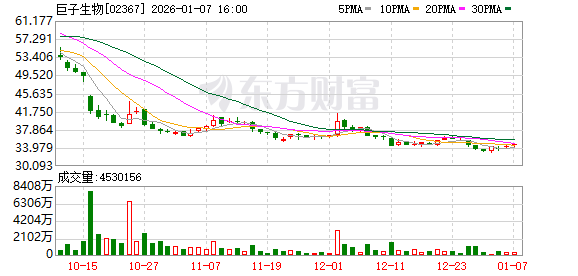
| 日期 | 回购股数(万股) | 回购最高价(港元) | 回购最低价(港元) | 回购金额(万港元) | | --- | --- | --- | --- | --- | | 2026.01.07 | 40.00 | 34.680 | 34.300 | 1378.34 | | 2026.01.06 | 40.00 | 34.480 | 33.840 | 1366.93 | | 2026.01.05 | 40.00 | 34.280 | 33.740 | 1358.16 | (文章来源:证券时报网) 自1月5日以来公司已连续3日进行回购,合计回购120.00万股,累计回购金额4103.43万港元。 其间该股 累计上涨1.34%。(数据宝) 巨子生物回购明细 证券时报·数据宝统计,巨子生物在港交所公告显示,1月7日以每股34.300港元至34.680港元的价格回购 40.00万股,回购金额达1378.34万港元。该股当日收盘价34.680港元,上涨1.17%,全天成交额1.56亿港 元。 ...
中国最会化妆的男富豪,一把套现15亿!什么信号?
Xin Lang Cai Jing· 2026-01-07 10:34
Core Viewpoint - The core management team of MAOGEPING, a leading Chinese cosmetics brand, has announced a significant share reduction, raising questions about the company's governance and future direction. Despite this, the stock price increased by 7.26% following the announcement, indicating market confidence in the brand's performance and potential [1][3][29]. Company Overview - MAOGEPING, known as the "first domestic cosmetics stock" in Hong Kong, has a family-dominated governance structure, with five out of six board members being relatives of the founder, MAO Ge Ping [3][4][5]. - The company plans to reduce its shareholding by 3.51%, equating to a potential cash-out of approximately 1.5 billion HKD, which has sparked discussions among investors regarding the motivations behind this decision [3][7][29]. Financial Performance - For the first half of 2025, MAOGEPING reported a revenue of 2.588 billion CNY, a year-on-year increase of 31.28%, and a net profit of 670 million CNY, up 36.11% [11][44]. - Despite the impressive revenue growth, there are signs of declining growth rates in revenue, net profit, and gross margins, with the average selling price of products dropping from 163.8 CNY to 157 CNY, indicating increased promotional pressures [11][44]. Market Context - The Chinese cosmetics market has seen significant growth, with total transactions exceeding 1 trillion CNY for two consecutive years. However, the growth rate is expected to slow to 2.8% in 2024, indicating a shift to a more stable growth phase [16][49]. - The competitive landscape is intensifying, with domestic brands gaining market share at the expense of international giants like L'Oréal and Estée Lauder, which have faced declining sales in China [16][51]. R&D and Marketing Strategy - MAOGEPING has a notably high sales expense to R&D investment ratio of 59.5, the highest among domestic brands, reflecting a strategy that prioritizes marketing over research and development [19][52]. - In the first half of 2025, R&D spending was only 15.257 million CNY, accounting for just 0.59% of total revenue, which is among the lowest in the top domestic brands [19][52]. Consumer Perception - Despite the brand's strong market position, there are increasing consumer complaints regarding product quality, which could pose risks to brand reputation and future sales [11][44][56]. - The brand's unique selling proposition lies in its integration of MAO Ge Ping's personal IP and the experiential aspect of its products, which has attracted a loyal customer base, although this model may also present risks if the founder's image falters [23][56].

巨子生物(02367.HK)1月7日耗资1378万港元回购40万股
Ge Long Hui· 2026-01-07 10:12
格隆汇1月7日丨巨子生物(02367.HK)公告,1月7日耗资1378万港元回购40万股。 ...
巨子生物(02367) - 翌日披露报表
2026-01-07 10:06
FF305 翌日披露報表 (股份發行人 ── 已發行股份或庫存股份變動、股份購回及/或在場内出售庫存股份) 表格類別: 股票 狀態: 新提交 公司名稱: 巨子生物控股有限公司 呈交日期: 2026年1月7日 如上市發行人的已發行股份或庫存股份出現變動而須根據《香港聯合交易所有限公司(「香港聯交所」)證券上市規則》(「《主板上市規則》」)第13.25A條 / 《香港聯合交易所有限公司GEM證券 上市規則》(「《GEM上市規則》」)第17.27A條作出披露,必須填妥第一章節 。 | 第一章節 | | | | | | | | | | --- | --- | --- | --- | --- | --- | --- | --- | --- | | 1. 股份分類 | 普通股 | 股份類別 | 不適用 | | | 於香港聯交所上市 | 是 | | | 證券代號 (如上市) | 02367 | 說明 | | | | | | | | A. 已發行股份或庫存股份變動 | | | | | | | | | | | | | 已發行股份(不包括庫存股份)變動 | | | 庫存股份變動 | | | | | 事件 | 已發行股份(不包括庫 ...
50家港股公司回购 腾讯控股回购6.36亿港元
Zheng Quan Shi Bao Wang· 2026-01-07 01:53
Summary of Key Points Core Viewpoint - On January 6, 50 Hong Kong-listed companies conducted share buybacks, totaling 19.62 million shares and an aggregate amount of 861 million HKD [1]. Group 1: Major Companies Involved in Buybacks - Tencent Holdings repurchased 1.003 million shares for 636 million HKD, with a highest price of 638.000 HKD and a lowest price of 626.500 HKD, bringing its year-to-date buyback total to 1.907 billion HKD [1]. - Xiaomi Group-W repurchased 3.85 million shares for 150 million HKD, with a highest price of 38.900 HKD and a lowest price of 38.860 HKD, accumulating a year-to-date buyback total of 299 million HKD [1]. - Genscript Biotech repurchased 400,000 shares for 13.67 million HKD, with a highest price of 34.480 HKD and a lowest price of 33.840 HKD, totaling 27.25 million HKD in year-to-date buybacks [1]. Group 2: Buyback Amounts and Quantities - The highest buyback amount on January 6 was from Tencent Holdings at 636 million HKD, followed by Xiaomi Group-W at 150 million HKD [1]. - In terms of buyback quantity, Xiaomi Group-W led with 3.85 million shares, followed by Jieli Trading and Weigao Group with 2 million shares and 1.5948 million shares, respectively [1]. Group 3: Additional Companies and Their Buybacks - Weigao Group repurchased 1.5948 million shares for 8.22 million HKD, with a highest price of 5.230 HKD and a lowest price of 5.010 HKD [1]. - Geely Automobile repurchased 423,000 shares for 749.94 million HKD, with a highest price of 17.810 HKD and a lowest price of 17.570 HKD [1]. - Other notable companies include Tsugami Machine Tool, which repurchased 150,000 shares for 511.53 million HKD, and China National Chemical Corporation, which repurchased 150,000 shares for 446.94 million HKD [1].



2025年中国胶原蛋白护肤品行业发展历程、政策汇总、产业链图谱、市场规模、竞争格局及发展趋势分析:CR5市场占有率达69.3%[图]
Chan Ye Xin Xi Wang· 2026-01-07 01:33
Core Viewpoint - The skincare consumption in China is shifting from basic hydration to functional care, with collagen skincare products becoming a core choice for consumers seeking anti-aging solutions. The market for collagen skincare products is projected to reach 31.6 billion yuan in 2024, growing by 21.5% year-on-year, with recombinant collagen products capturing a significant market share of 36% due to their high activity and low allergenicity [1][9]. Industry Overview - Collagen is a structural protein found in animals, primarily maintaining the stability of skin and connective tissues. Collagen skincare products aim to supplement skin collagen, improve barrier function, and enhance skin elasticity through topical application [2]. - Collagen skincare products can be categorized based on source (animal, plant, recombinant), form (masks, serums, creams), and function (hydrating, anti-aging, soothing) [2][3]. Development History - The development of China's collagen skincare industry has progressed through four stages: exploration, rapid growth, standardization, and technology leadership, transitioning from animal-derived to recombinant collagen and synthetic biology [4]. Market Policies - The Chinese government has implemented various regulations to enhance the quality and safety of the cosmetics industry, including collagen skincare products, promoting a shift towards standardized and high-quality development [5]. Industry Chain - The upstream of the collagen skincare industry includes suppliers of collagen, moisturizers, emulsifiers, and packaging materials. The midstream involves R&D and production, while the downstream consists of various sales channels, including retail and e-commerce [7]. - The primary consumer demographic for collagen skincare products is women, accounting for 86.2%, with the age group of 25-45 years making up over 80% of the market. Safety is the top concern for 80% of consumers [7][8]. Current Market Status - The market for collagen skincare products is expected to reach 31.6 billion yuan in 2024, with recombinant collagen products leading the market due to their advantages [9]. Competitive Landscape - The market concentration for recombinant collagen skincare products has increased, with the top five companies holding a 69.3% market share. Key players include Giant Bio, Proya, and Marubi, leveraging technology and product innovation to maintain market leadership [9][10]. - Giant Bio, established in 2000, focuses on high-tech skincare and holds 186 patents, leading in recombinant collagen technology with significant revenue and profit margins [10]. Future Trends - The future of the collagen skincare industry will see recombinant human-like collagen becoming mainstream, with advancements in synthetic biology and green manufacturing. Products will expand beyond hydration and anti-aging to include whitening, sensitivity, and barrier repair, with clear clinical data supporting efficacy [11].
