天弘基金

Search documents
ETF融资融券日报:两市ETF两融余额较前一交易日减少2.92亿元,广发中证港股通汽车ETF融资净买入达6568.77万元
2 1 Shi Ji Jing Ji Bao Dao· 2025-06-05 02:34
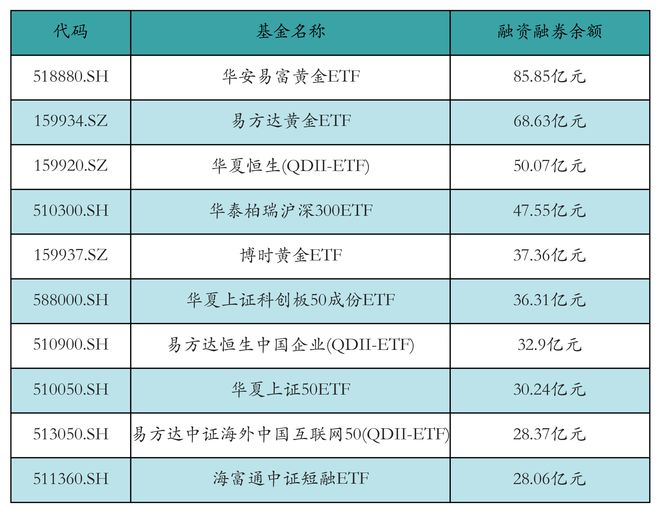
Market Overview - The total ETF margin balance in the two markets was 99.349 billion yuan, a decrease of 0.292 billion yuan from the previous trading day [1] - The financing balance was 94.04 billion yuan, down by 0.423 billion yuan, while the securities lending balance increased by 0.013 billion yuan to 5.309 billion yuan [1] - In the Shanghai market, the ETF margin balance was 65.746 billion yuan, a decrease of 36.8718 million yuan, with a financing balance of 61.15 billion yuan, down by 0.157 billion yuan [1] - The Shenzhen market's ETF margin balance was 33.603 billion yuan, a decrease of 0.256 billion yuan, with a financing balance of 32.89 billion yuan, down by 0.265 billion yuan [1] ETF Margin Balance - The top three ETFs by margin balance were: - Huaan Yifu Gold ETF (8.585 billion yuan) - E Fund Gold ETF (6.863 billion yuan) - Huaxia Hang Seng (QDII-ETF) (5.007 billion yuan) [2] - The top ten ETFs by margin balance included notable funds such as Huatai-PB CSI 300 ETF (4.755 billion yuan) and Bosera Gold ETF (3.736 billion yuan) [2] ETF Financing Buy Amount - The top three ETFs by financing buy amount were: - Huatai-PB Southern Dongying Hang Seng Technology Index (QDII-ETF) (717 million yuan) - Huaxia Hang Seng Technology (QDII-ETF) (603 million yuan) - GF CSI Hong Kong Innovative Medicine (QDII-ETF) (564 million yuan) [3][4] ETF Financing Net Buy Amount - The top three ETFs by financing net buy amount were: - GF CSI Hong Kong Stock Connect Automotive ETF (65.6877 million yuan) - Invesco Great Wall Nasdaq Technology Market Cap Weighted (QDII-ETF) (38.1823 million yuan) - Pengyang Zhongzai - 30-Year Treasury ETF (31.2453 million yuan) [5][6] ETF Securities Lending Sell Amount - The top three ETFs by securities lending sell amount were: - Southern CSI 1000 ETF (60.4149 million yuan) - Huatai-PB CSI 300 ETF (21.3547 million yuan) - Southern CSI 500 ETF (11.6216 million yuan) [7][8]

部分场外QDII基金放宽限购;超百亿资金涌向科创ETF丨天赐良基早参
Mei Ri Jing Ji Xin Wen· 2025-06-05 01:28
Group 1 - The core viewpoint of the news highlights the increasing trend of fund managers investing in newly launched floating rate funds, indicating a shift in investment strategies within the mutual fund industry [1][1]. - Xingsheng Global Fund announced a plan to invest 20 million yuan in its newly launched Xingsheng Global Hexi Mixed Securities Investment Fund, which is one of the first floating rate funds [1]. - China Europe Fund also reported a 10 million yuan investment in its floating rate fund, committing to hold the investment for no less than three years [1]. Group 2 - Hong Kong-themed ETFs have seen significant inflows this year, with a total increase of 85.674 billion yuan, representing a growth rate of 27.97%, bringing the total size close to 400 billion yuan at 391.962 billion yuan as of May 30 [2]. - The number of Hong Kong-themed ETFs with over 10 billion yuan in assets has increased from 8 at the end of last year to 11 by the end of May [3]. - The number of fund managers managing Hong Kong-themed ETFs with over 10 billion yuan has risen from 7 to 10, indicating a trend towards concentration in the market [3]. Group 3 - Some off-market QDII funds have relaxed their purchase limits, with Hai Futong's USD bond fund increasing its limit from 50,000 yuan to 30 million yuan [4]. - A total of 6 new QDII funds have been approved this year, primarily focusing on the Hong Kong stock market, including several ETFs targeting the Hang Seng Technology Index [4]. Group 4 - The issuance scale of ETFs has experienced a decline for four consecutive months, with May seeing a significant drop to 11.068 billion units, down from 34.014 billion units in January [5]. - In May, public fund managers focused on launching products related to digital economy, sci-tech innovation board, and free cash flow themes [6]. Group 5 - In May, there was a notable shift in ETF fund flows, with significant inflows into technology-related ETFs, particularly in sectors like semiconductors and defense, attracting over 20 billion yuan in net inflows [7]. - The top three ETFs attracting the most net inflows in May were Huaxia Sci-Tech 50 ETF, Guolian An Semiconductor ETF, and Jiashi Sci-Tech Chip ETF, with inflows of 4.931 billion yuan, 2.364 billion yuan, and 1.874 billion yuan respectively [8]. Group 6 - Qiu Yang has left his position as the manager of the Qianhai Kaiyuan Artificial Intelligence Mixed Fund due to internal adjustments, with the fund now managed by Wei Chun [9]. - As of the end of the first quarter, the A-class share of the fund managed by Qiu Yang had a scale of 688 million yuan, achieving a return of 14.19% during his tenure [9].
渠道大比拼!浮动费率基金中东方红核心价值提前结募,博时、兴证全球跟随自购
Sou Hu Cai Jing· 2025-06-05 01:27
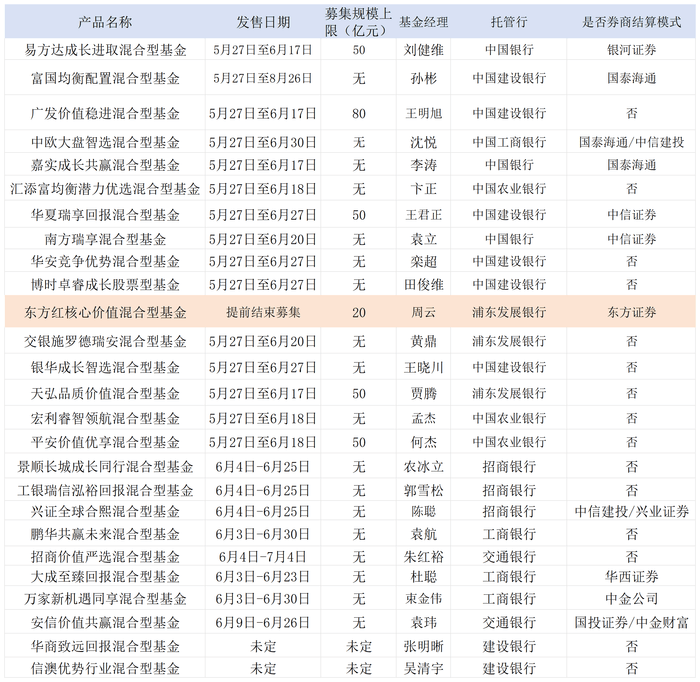
Core Insights - The first batch of 16 floating management fee rate funds has seen significant interest, with some products reaching their fundraising limits and ending their subscription early [1] - The Oriental Red Core Value Fund achieved a fundraising limit of 2 billion yuan, leading the pack due to strong customer service capabilities from distribution channels like Pudong Development Bank and Oriental Securities [1] - The shift in the public fund industry is moving from a focus on scale to a focus on returns, with only 6 out of 26 products setting fundraising limits [2] Fund Details - The Oriental Red Core Value Mixed Fund was the first to reach its fundraising cap of 2 billion yuan and will no longer accept new subscriptions from June 5 [1] - Other funds in the first batch include E Fund Growth Progress Mixed Fund with a cap of 5 billion yuan, and GF Value Steady Mixed Fund with a cap of 8 billion yuan [2] - As of June 4, the combined issuance of E Fund Growth Progress, GF Value Steady, and Harvest Growth Winning reached 760 million yuan [3] Market Dynamics - Following the Dragon Boat Festival, new floating fee rate products are being launched, indicating a competitive sales environment among distribution channels [6][7] - Institutions are increasingly investing their own funds into floating fee rate funds to demonstrate commitment to investors [9] - The China Securities Regulatory Commission has introduced a plan to promote high-quality development in public funds, emphasizing investor interests and performance-based fee structures [10]
5月份八成债基上涨 天弘弘丰增强回报上涨3%
Zhong Guo Jing Ji Wang· 2025-06-04 23:16
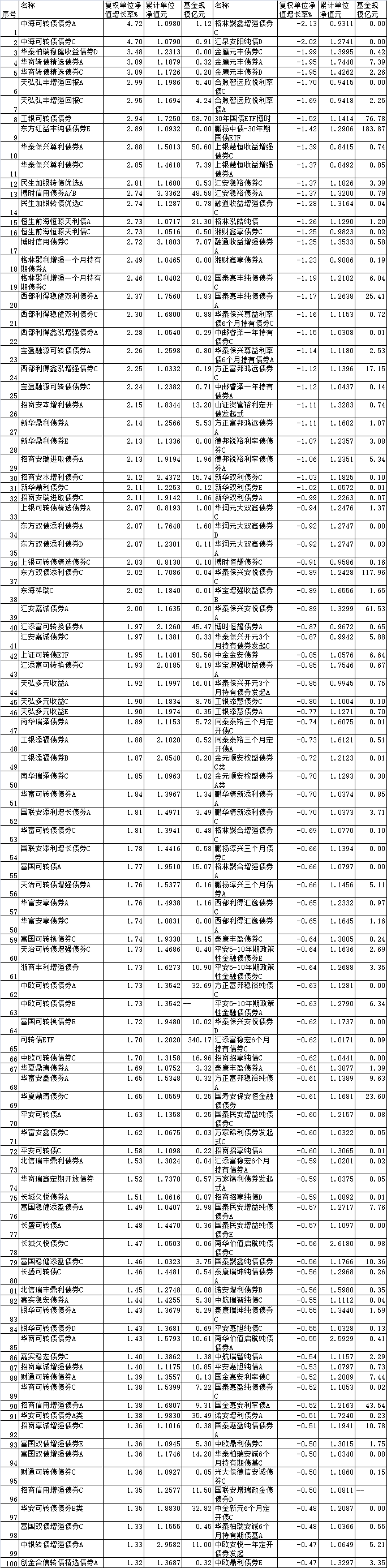
Group 1 - In May 2023, 80% of the 7,104 comparable bond funds reported positive performance, with 5,737 funds increasing in value [1] - The top-performing funds included Zhonghai Convertible Bond A and C, with increases of 4.72% and 4.70% respectively [1] - Huatai Baichuan Stable Income Bond D and Huashang Convertible Bond A and C followed closely with increases of 3.48%, 3.09%, and 3.09% [1] Group 2 - The fund manager of Huashang Convertible Bond, Zhang Yongzhi, has 14 years of experience, with 92.92% of the fund's total assets in bonds [2] - Tianhong Hongfeng Enhanced Return A and C, along with several other bond funds, also saw increases exceeding 2% in May [2] - The only two funds that experienced declines of over 2% were Green Ju Xin Enhanced Bond C and Hui Quan Anyang Pure Bond D, with declines of -2.13% and -2.02% respectively [2] Group 3 - Hui Quan Anyang Pure Bond's holdings are primarily in financial bonds, managed by experienced managers with a combined 16 years of experience [3] - Jin Ying Yuan Feng Bond C, A, and D, along with He Xu Zhi Yuan Xin Yue Interest Rate Bond C and A, also reported declines in May [3] - The top five holdings of Jin Ying Yuan Feng Bond include various convertible bonds and government bonds [3] Group 4 - He Xu Zhi Yuan Xin Yue Interest Rate Bond was established in March 2023, with its manager having nearly 16 years of public fund management experience [4] Group 5 - The performance data for the top 100 bond funds in May 2023 shows a range of returns, with Zhonghai Convertible Bond A leading at 4.72% and Green Ju Xin Enhanced Bond C at -2.13% [5][6]
创新浮动费率基金火热在售 公募管理人接连自购
Zheng Quan Shi Bao· 2025-06-04 17:35
Group 1 - The innovative floating fee rate funds have become a significant highlight in the fund issuance sector, with 19 products currently available, including those from Tianhong Fund and Bosera Fund [1] - Xingsheng Global Fund announced a plan to use its own capital of 20 million yuan to subscribe to the Xingsheng Global Heqi Mixed Fund, committing to a holding period of no less than 3 years, marking it as the only initiator fund among the first batch of innovative floating fee rate funds [1] - Bosera Fund and Tianhong Fund also announced their own investments in floating fee rate funds, indicating a trend where fund companies are investing their own capital to signal confidence in the long-term value of these products [1] Group 2 - The introduction of innovative floating fee rate products represents a milestone in the rapid development of the public fund industry, but it poses significant challenges to the traditional profit models of fund companies [2] - These products lack a lock-up period, requiring fund managers to stabilize their performance closely to the benchmark while managing a portion of their assets for enhancement, which presents strategic challenges for some active fund managers [2] - The need for real-time tracking of each fund share's holding period and return complicates the management fee calculation, necessitating enhanced operational management capabilities and robust data processing systems within fund companies [2][3] Group 3 - The absence of a lock-up period for innovative floating fee rate products significantly impacts accounting practices and management fee calculations for fund companies, requiring upgrades to existing valuation and accounting systems [3] - The cash flow of fund companies will also be affected, as management fees can only be determined upon client redemption, necessitating the pre-allocation of management fees exceeding 0.6%, which influences the cash flow dynamics [3]
自购暗藏“抄底密码”?浮动费率基金成新宠,公募扎堆操作有何玄机
Hua Xia Shi Bao· 2025-06-04 13:36
Core Viewpoint - The recent wave of self-purchases by major Chinese fund companies reflects their long-term confidence in the capital market, with amounts ranging from 10 million to 20 million yuan, particularly targeting floating fee rate funds [2][3]. Group 1: Fund Companies' Actions - Multiple leading fund companies, including Dongfanghong Asset Management and Bosera Funds, have announced self-purchases, with Dongfanghong committing 10 million yuan to its new floating management fee fund [3]. - Bosera Funds followed with a 20 million yuan self-purchase plan, indicating a positive outlook on equity products [3]. - Other companies like Xingzheng Global Fund and Zhongou Fund also participated, with commitments to hold investments for at least three years, showcasing a long-term investment strategy [3][4]. Group 2: Market Implications - The self-purchase actions are seen as a stabilizing force in the market, helping to avoid short-term speculative behaviors and reinforcing the bond between fund managers and investors [4][5]. - The self-purchases are particularly significant in the context of the recent issuance of floating fee rate funds, which are viewed as a major innovation in the industry [6]. Group 3: Strategic Considerations - The self-purchase trend is interpreted as a response to the need for "safeguarding" new fund launches, especially in a challenging market environment [6]. - Historical patterns suggest that self-purchase waves often coincide with market turning points, indicating institutional confidence in market bottoms [7]. Group 4: Investor Guidance - Investors are advised to analyze self-purchase behaviors critically, focusing on the proportion of self-purchase relative to fund size, the length of the lock-up period, and whether fund managers are also investing [8]. - While self-purchases can signal positive sentiment, they should not be the sole basis for investment decisions, as market trends are ultimately driven by fundamental factors [9].

持续上涨,谁是投资北交所的最佳工具?
北证三板研习社· 2025-06-04 13:10
Core Viewpoint - The article discusses the performance and investment opportunities in the North Exchange, particularly focusing on the North 50 Index and related investment products, highlighting the challenges and potential strategies for investors in the current market environment [1][2][4]. Group 1: North 50 Index Performance - The North 50 Index has shown strong performance, with a recent increase of 5.01% over the last seven trading days after a brief correction [1]. - The North 50 Index is noted as having the best upward elasticity among large-cap indices, making it difficult for individual investors to outperform it [2]. Group 2: Investment Products Analysis - There are currently 27 North 50 index funds available, with older funds (launched before September 24, 2022) showing an average growth rate of 122%, while newer funds have underperformed relative to the index [2][3]. - The maximum drawdown for these funds is generally around 30%, which is slightly better than the North 50's drawdown of 38.63% [3]. Group 3: Active Management Funds - Among actively managed funds, the "Hua Xia North Exchange Innovation Small and Medium Enterprises Selected Two-Year Open Mixed Fund" has shown significant excess returns with a drawdown controlled under 20% [4]. - The "CITIC Construction Investment North Exchange Selected Two-Year Open Mixed A" fund also demonstrated excellent excess returns and drawdown ratios [4]. Group 4: Market Conditions and Recommendations - Current market conditions suggest that both public active products and index products are not ideal for investing in the North Exchange, but index products may serve as a reasonable option if investors have confidence in the index itself [5]. - For investors lacking judgment capabilities regarding the North Exchange, seeking private equity products may offer more flexible terms compared to public offerings [5].

创业板收涨超1%!未来哪些新兴领域可能会主导市场
Quan Jing Wang· 2025-06-04 10:13
Group 1 - The core viewpoint is that emerging sectors such as artificial intelligence, smart manufacturing and robotics, and next-generation information technology are expected to drive growth in the ChiNext market [3][4]. - The weight of the pharmaceutical industry in the ChiNext has decreased from 30% to nearly 20% over the past 3 to 5 years, while the weight of the new energy sector has dropped from over 40% in August 2022 to just above 30% [3]. - The TMT (Technology, Media, and Telecommunications) sector has seen an upward trend in its weight within the ChiNext [3]. Group 2 - The artificial intelligence sector is rapidly evolving, with domestic AI computing power expected to develop quickly in the next one to two years. The domestic AI chip industry is becoming self-sufficient due to U.S. restrictions on AI chip exports [3]. - Major cloud service providers in China are projected to double their capital expenditures by 2025, which will catalyze the growth of domestic AI computing power [3]. - The cost of large AI models has significantly decreased, benefiting downstream applications in terms of revenue and cost [3]. Group 3 - The smart manufacturing and robotics sector is gaining attention, with rapid development in humanoid robots and related industries. The acceleration of domestic substitution in high-end manufacturing, such as semiconductor testing and precision manufacturing equipment, is expected to enhance domestic awareness [3]. - The new generation information technology sector, including quantum computing and 6G communication, is approaching practical applications as research progresses [4]. - 6G communication is anticipated to achieve integrated air and space capabilities, with related companies likely to emerge as significant players in the ChiNext market [4]. Group 4 - Tianhong's fund products, such as Tianhong CSI Artificial Intelligence (Class A: 011839, Class C: 011840) and Tianhong CSI Robotics ETF Link (Class A: 014880, Class C: 014881), closely track their respective indices, reflecting the overall performance of companies in the AI and robotics sectors [4].

浮动费率基金销售首周战报:单只销售额最高超15亿元,多家公募宣布自购
2 1 Shi Ji Jing Ji Bao Dao· 2025-06-04 08:51
Group 1 - The first batch of 16 floating rate funds was launched on May 28, with significant sales performance, particularly the Dongfanghong Core Value Mixed Fund, which surpassed 1.5 billion yuan in sales by June 3 [1] - Major contributions to the sales of the Dongfanghong fund came from its custodial bank, SPD Bank, and shareholder brokerage, Dongfang Securities, with initial sales reaching nearly 400 million yuan on the first day [1] - Other floating rate funds have also seen sales exceeding 100 million yuan, with sales performance closely linked to channel capabilities, as evidenced by the Tianhong Quality Value Fund, which also surpassed 400 million yuan in sales [1] Group 2 - The sales competition for floating rate funds is expected to remain strong into June, as several fund companies anticipate a surge in main client participation after the Dragon Boat Festival [2] - New floating rate funds are being launched, with 26 funds already filed for issuance, including Dachen Zhi Zhen Return and Wan Jia New Opportunities, which started issuing on June 3 [3] - Many public fund institutions are committing their own capital to invest in floating rate funds, such as Xingzheng Global Fund planning to invest 20 million yuan in its fund, and other firms like Bosera and Dongfanghong also announcing similar self-investments [3][4]


上半年逾2000亿资金借道ETF进场,这两个赛道普遍被机构看好
Sou Hu Cai Jing· 2025-06-04 07:47
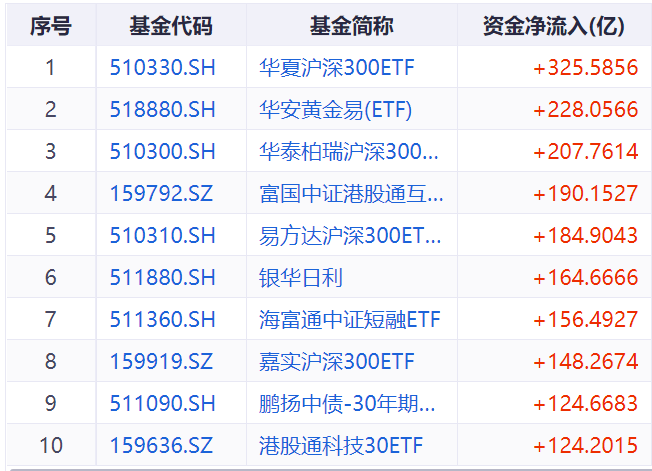
Group 1 - The overall market sentiment has improved since April 7, 2025, with significant capital inflow into equity ETFs, leading to a positive net subscription amount for the first half of the year [1][2] - Over 200 billion yuan has flowed into various types of ETFs, including stock, bond, cross-border, and commodity ETFs, with a notable focus on core broad-based ETFs [2][3] - The top three ETFs by net inflow from January to May 2025 include Huaxia CSI 300 ETF (+32.56 billion yuan), Huaan Gold ETF (+22.81 billion yuan), and Huatai-PB CSI 300 ETF (+20.78 billion yuan) [3] Group 2 - As of May 30, 2025, eight bond ETFs have surpassed 10 billion yuan in scale, with the top two being the Fortune 7-10 Year Policy Financial Bond ETF and the Hai Fudong CSI Short-term Bond ETF, both exceeding 40 billion yuan [4] - The A-share market is expected to experience upward fluctuations due to ongoing policy support and the influx of medium to long-term capital [4] Group 3 - The robotics sector is gaining attention, with the National Robotics Industry Index showing a year-to-date increase of 6.89%, outperforming the broader market [6][7] - The top three ETFs in the robotics sector by net inflow from January to May 2025 are Huaxia CSI Robotics ETF (+9.12 billion yuan), E Fund CSI Artificial Intelligence ETF (+8.31 billion yuan), and Tianhong CSI Robotics ETF (+4.29 billion yuan) [7][9] Group 4 - The Hong Kong stock market is attracting institutional funds, particularly in the technology sector, with significant net inflows into cross-border ETFs, including the Fortune CSI Hong Kong Internet ETF (+19.02 billion yuan) and the Industrial Bank National CSI Hong Kong Technology ETF (+12.41 billion yuan) [10][12] - The AI industry transformation and the narrative of domestic technology self-sufficiency are expected to continue driving interest in the Hong Kong technology sector [10]