
宁波银行

Search documents
宁波银行率先落地知识产权科技创新资产支持证券
Xin Hua Cai Jing· 2025-09-12 06:31
宁波银行有关负责人表示,本期科技创新资产支持证券是宁波银行推进金融赋能实体经济的一次生动实 践,是深入创新发展赋能新质生产力的有益探索。 (文章来源:新华财经) 新华财经北京9月12日电(记者吴丛司)记者12日从宁波银行获悉,由宁波银行独立主承销的"国联信托 股份有限公司2025年度第一期飞凤2号知识产权科技创新定向资产支持证券"10日成功缴款起息,发行金 额0.7亿元,期限370天。 本期资产支持证券是全国率先落地的知识产权科技创新资产支持证券,通过知识产权质押方式,为无锡 市新吴区军工智能、扬贺扬微电子、红旗印染、佳利达国际物流、意进隆科技、隆玛科技、安特源科技 和艾比德泵业8家优质科创企业提供了创新融资渠道,有效盘活企业知识产权33项,帮助民营企业降低 融资成本,后续募集资金将用于企业在集成电路、新能源、高端装备等领域的生产研发投入。同时,本 期资产支持证券由宁波银行同步创设CRMW,不再要求企业提供额外担保,减轻了企业融资负担。 ...

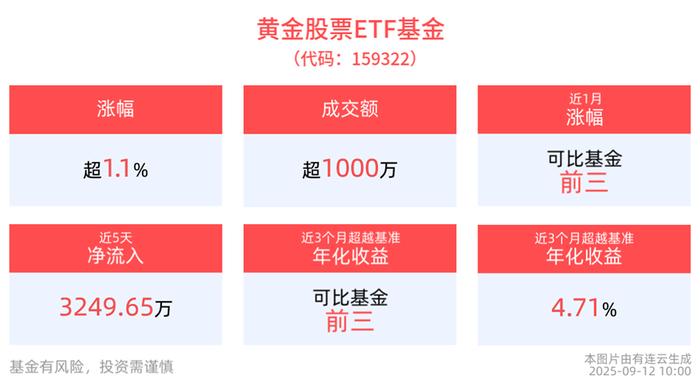
涨超2%!黄金股票ETF基金(159322)持续上行!
Xin Lang Cai Jing· 2025-09-12 02:22
Group 1 - The gold market has been performing exceptionally well, with prices reaching historical highs, driven by factors such as doubts about the Federal Reserve's independence and rising expectations for interest rate cuts [1][2] - As of September 11, over 100 billion yuan has been attracted to gold futures, with an increase of more than 17 billion yuan in September alone [1] - The recent surge in gold prices has led several banks, including Bank of China and Agricultural Bank of China, to adjust their precious metals business, including increasing investment thresholds and modifying trading rules [2] Group 2 - Gold prices have risen approximately 5% in September, reaching a record high of $3,674.27, surpassing inflation-adjusted records from 1980 [2] - The gold stock ETF has seen a net value increase of 52.47% over the past six months, ranking in the top 1.80% among comparable funds [5] - The gold stock ETF closely tracks the CSI Hong Kong and Shanghai Gold Industry Index, which includes 50 major companies involved in gold mining, refining, and sales [6]

在宁波银行工作怎么样?多维成长平台锻造未来翘楚
Jin Tou Wang· 2025-09-12 02:09
在金融行业的广阔版图中,宁波银行正以独特的姿态脱颖而出,吸引着众多怀揣梦想的专业人士。对于那 些渴望在金融领域一展身手的人来说,"在宁波银行工作怎么样?" 是一个备受关注的问题。在这里,工作 不仅是一份职业,更是一段充满机遇与挑战的成长旅程。 宁波银行深知员工是企业发展的核心动力,因此构建了全面且完善的培养体系。考虑到员工专业背景的 多样性,银行专门开设专业、系统的金融课程,帮助非金融经济专业的员工快速提升金融知识储备和专业 素养。各部门每年针对不同岗位员工开设专业课程,采用线上线下相结合的灵活学习方式,让员工能够充 分利用碎片时间,实现系统化的技能提升。从新员工入职,到普通员工的持续成长,再到向管理岗位的晋升, 每个层级都有明确的培养机制和针对性的课程。这种全方位、多层次的培养体系,为员工的职业发展提 供了清晰的方向和有力的支持,确保员工在职业生涯的每一个阶段都能得到充分的培养和发展。 积极工作氛围:领导关怀与同事协作共进 在宁波银行,积极向上的工作氛围浓厚。领导们平易近人,会定期与员工沟通交流,给予宝贵的建议和鼓励, 帮助员工解决工作和生活中的困惑。同事之间相处融洽,互帮互助,形成了良好的团队合作氛围。在 ...
倒计时!重磅来了
Zhong Guo Ji Jin Bao· 2025-09-12 01:08
Core Insights - The 2025 China Capital Market Development Forum will be held in Shanghai from September 16 to 17, focusing on the theme "Insight Value, Intelligent Creation Future" [1] - The forum aims to explore new paths for the high-quality development of China's capital market, emphasizing the service to the real economy, empowerment of technological innovation, and leading industrial transformation [1] - Key documents such as the "2025 Listed Company Value Management White Paper" will be released during the forum, showcasing the latest applications of AI technology in the industry [1] Industry Focus - The forum will concentrate on three main sectors: listed companies, the securities industry, and private equity funds, providing a high-end dialogue platform for stakeholders [1] - It is expected to serve as a bridge for resource linking and ecological co-construction among various participants in the capital market [2] Event Details - The forum is organized by China Fund News, with support from various financial institutions including China Merchants Securities, Ningbo Bank, and others [1]
倒计时!重磅来了
中国基金报· 2025-09-12 01:02
Core Viewpoint - The 2025 China Capital Market Development Forum will be held in Shanghai from September 16 to 17, focusing on the theme "Insight into Value, Intelligent Creation of the Future" [3][4]. Group 1: Forum Overview - The forum will gather nearly a thousand representatives from regulatory bodies, industry, and investment sectors to discuss new paths for high-quality development in China's capital market [4]. - Key areas of focus include listed companies, the securities industry, and private equity funds, aiming to enhance the capital market's service to the real economy, empower technological innovation, and lead industrial transformation [4]. Group 2: Key Events and Agenda - The forum will feature the release of the "2025 Listed Company Value Management White Paper" and showcase the latest applications of AI technology in the industry [4]. - The agenda includes opening speeches, thematic presentations, and roundtable discussions with notable speakers from various sectors, including finance and technology [6][10][14]. Group 3: Supporting Organizations - The forum is organized by China Fund News, with support from various financial institutions such as China Merchants Securities, Ningbo Bank, and others [4][19].

私行业务跑出加速度 成银行扩中收重要引擎
Zhong Guo Zheng Quan Bao· 2025-09-11 22:15
Core Insights - The private banking business has shown significant growth in both client numbers and assets under management (AUM), becoming a key driver for retail banking growth amid pressure on net interest margins [1][4]. Client Growth - Major state-owned banks have a strong advantage in private banking client numbers, with Agricultural Bank of China reporting 279,000 clients, an increase of 23,000 since the beginning of the year [2]. - China Construction Bank, Bank of China, and Bank of Communications reported private banking clients of 265,500, 216,900, and 102,600 respectively, while Postal Savings Bank had 41,400 clients, reflecting a growth of over 21% [2]. - Among joint-stock banks, China Merchants Bank leads with 182,700 clients, followed by Ping An Bank and CITIC Bank, both exceeding 90,000 clients [2]. - Several city commercial banks also reported impressive growth, with Ningbo Bank's private banking clients increasing by 20.27% to 30,000 [2]. AUM Growth - Private banking AUM growth outpaced overall retail AUM growth, with Agricultural Bank, Bank of China, China Construction Bank, and Bank of Communications reporting AUM of CNY 3.5 trillion, CNY 3.4 trillion, CNY 3.18 trillion, and CNY 1.39 trillion respectively, reflecting growth rates of 11.11%, 8.28%, 14.39%, and 7.20% [4]. - Joint-stock banks like Ping An Bank, CITIC Bank, and Industrial Bank reported private banking AUM exceeding CNY 1 trillion, with Minsheng Bank and Zheshang Bank showing AUM growth of over 10% [4]. Strategic Focus - Banks are increasingly focusing on deepening client service, with strategies tailored to high-net-worth individuals, such as China Construction Bank's integrated client management and Postal Savings Bank's innovative client activities [5]. - Future developments in private banking are expected to emphasize digitalization, service ecosystem integration, and global investment options, leveraging technologies like AI and blockchain for enhanced client service [6].
私行业务跑出加速度成银行扩中收重要引擎
Zhong Guo Zheng Quan Bao· 2025-09-11 20:17
Core Insights - The private banking business has shown significant growth in both client numbers and AUM (Assets Under Management), becoming a key driver for retail banking growth amid pressure on net interest margins [1][2][3] Client Growth - Major state-owned banks lead in private banking client numbers, with Agricultural Bank of China having 279,000 clients, followed by China Construction Bank with 265,500, and Bank of China with 216,900 [1] - China Construction Bank added 34,000 private banking clients in the first half of the year, while Postal Savings Bank saw a growth of over 21% in its client base [1][2] - In the joint-stock banks, China Merchants Bank leads with 182,700 clients, followed by Ping An Bank and CITIC Bank, each exceeding 90,000 clients [2] AUM Growth - Private banking AUM growth outpaces overall retail AUM growth, with Agricultural Bank of China reporting AUM of 3.5 trillion yuan, an increase of 11.11% from the beginning of the year [2][3] - Other state-owned banks also reported significant AUM growth, with China Construction Bank at 3.18 trillion yuan, reflecting a 14.39% increase [2][3] Business Strategy and Service Development - Banks are focusing on enhancing client services, with China Construction Bank integrating personal client management and supporting private entrepreneurs [3][4] - CITIC Bank is emphasizing tiered services for ultra-high-net-worth clients, while China Everbright Bank is targeting families, women, and business owners [4] - Future developments in private banking are expected to focus on digitalization, service ecosystem integration, and global investment opportunities [4]





用“真金白银”投票!银行股获股东高管密集增持
Guo Ji Jin Rong Bao· 2025-09-11 15:58
Core Viewpoint - There has been a notable increase in share buybacks by shareholders and executives of listed banks, reflecting confidence in future growth and long-term investment value [1][3][5] Group 1: Shareholder and Executive Buybacks - Since September, banks such as Huaxia Bank and Suzhou Bank have announced share buybacks by their shareholders and executives [1][3] - Huaxia Bank's executives completed a buyback plan ahead of schedule, acquiring 4.22 million shares for approximately RMB 31.9 million, exceeding the planned minimum by 6.34% [3] - Suzhou Bank's executives plan to buy back at least RMB 4.2 million worth of shares between September 8 and December 31 [3][4] Group 2: Market Recognition and Performance - At least 16 banks have received financial support from shareholders and executives this year, indicating a positive market response [1][6] - Over half of the 42 A-share listed banks reported positive growth in both revenue and net profit in the first half of the year, with many initiating mid-term dividends [6][5] - The China Banking Index rose by 15.6% in the first half of the year, with 41 out of 42 banks seeing stock price increases, and 29 banks achieving double-digit growth [6][5] Group 3: Future Outlook - Analysts suggest that the trend of capital flowing into the banking sector will continue, driven by the search for safety in a low-interest environment [7] - The demand for high-dividend, low-valuation bank stocks is expected to persist, supported by policies that enhance dividends and a stable fundamental outlook [7]
普惠金融“期中考“交卷:农行四项指标居首 中小行份额继续下降
2 1 Shi Ji Jing Ji Bao Dao· 2025-09-11 13:01
Core Insights - The share of inclusive finance business by large commercial banks continues to increase, while the market share of rural financial institutions is declining [1][2] - The transition of inclusive finance development in China is moving from "incremental expansion" to "high-quality development" [2][3] Summary by Sections Inclusive Finance Market Share - As of the end of Q2 2024, large commercial banks' inclusive micro-enterprise loans accounted for 45.11% of the total, while rural financial institutions' share dropped to 25.86% from 27.38% in Q1 2023 [1] - The average growth rate of inclusive micro-enterprise loans has been slowing down, with growth rates of 30.9%, 24.9%, 23.6%, 23.3%, and 14.7% from 2020 to 2024 respectively [1] Regulatory Changes - Recent regulatory documents emphasize the shift towards high-quality development, moving away from rigid quantity targets [2][3] - The 2023 and 2024 notifications from the financial regulatory authority focus on maintaining volume, stabilizing prices, and improving structure, with an added emphasis on quality in 2025 [2] Performance of Major Banks - Agricultural Bank of China leads in inclusive micro-enterprise loans with a balance of 3.82 trillion yuan, followed closely by China Construction Bank at 3.74 trillion yuan [4] - Agricultural Bank's loan balance growth rate is the highest among major banks at 18.50%, with other banks like Industrial and Commercial Bank of China and China Bank also showing strong growth [4][5] Client Base and Service Innovations - Agricultural Bank has the largest number of clients for inclusive micro-enterprise loans at 5.2084 million, reflecting a significant increase [5] - The bank is innovating its service offerings by leveraging AI technology and enhancing its online service platforms [6] Focus on Asset Quality - Many banks are prioritizing the improvement of asset quality for inclusive micro-loans, with specific strategies tailored to their client bases [8][9] - Agricultural Bank reported that its non-performing loan rates for inclusive loans are among the best in the industry, indicating effective risk management practices [11]
小微企业融资平台市场洞察:政策赋能与模式创新双轮驱动下的服务升级与增长空间头豹词条报告系列
Tou Bao Yan Jiu Yuan· 2025-09-11 05:06
Investment Rating - The report does not explicitly state an investment rating for the small and micro enterprise financing platform industry Core Insights - The small and micro enterprise financing platform industry is experiencing continuous expansion driven by policy support and market demand, with innovative service models emerging to address financing challenges [3][21] - The industry is characterized by a concentration of leading players, with a significant market share held by top companies, while smaller firms are adopting differentiated strategies to capture market share [20][23] - The transition towards the "drip irrigation" model is anticipated, as it aligns better with the financing needs of small and micro enterprises compared to traditional credit models [56][57] Summary by Sections Industry Definition - Small and micro enterprise financing platforms integrate resources from financial institutions, government, data technology, and industry ecosystems to provide customized financing solutions, addressing issues like information asymmetry and insufficient collateral [4] Industry Characteristics - The market is expanding rapidly, with the balance of inclusive small and micro loans reaching 32.9 trillion yuan by Q3 2024, a year-on-year increase of 14.5% [21] - Continuous product and service innovation is evident, with platforms like Drip Irrigation Group utilizing the Revenue-Based Financing (RBF) model to enhance service efficiency [22] - The competitive landscape shows a concentration of market share among leading firms, with state-owned banks holding 42.77% of the inclusive small and micro loan market [23] Development History - The industry has evolved through various stages, from initial support for small enterprises in the 1990s to the rapid development phase post-2000, and now to a high-quality development phase characterized by digitalization and green finance [24][30] Industry Chain Analysis - The industry chain consists of upstream funding sources, midstream financing service providers, and downstream small and micro enterprises, with a focus on addressing structural mismatches in financing needs [31][32] - Upstream funding is characterized by a dual structure of policy-driven and market-driven sources, with commercial banks being the primary funding providers [37] - Midstream service providers are leveraging technology to enhance risk assessment and improve service delivery, transitioning from traditional asset-based evaluations to cash flow-based assessments [43] Market Size and Growth - The small and micro enterprise financing platform industry has seen rapid growth from 2019 to 2024, driven by policy support, technological advancements, and improvements in the credit system [53] - The market is expected to continue expanding as new tools like digital currency and cross-border payment systems are introduced [54] Future Trends - The industry is shifting towards the Drip Irrigation model due to mismatches between traditional credit models and the financing needs of small enterprises, with a focus on real-time cash flow monitoring and digital infrastructure [56][58]
