OPPO

Search documents
OPPO法务部晒典型案例:零容忍造谣抹黑等违法行为
Feng Huang Wang· 2025-09-15 07:15
声明中还晒出部分典型案例,包括"利用人工智能(AI)技术篡改或虚构事实"、"断章取义、主观臆测 传播虚假信息"等。 针对以上违法行为,OPPO坚持零容忍立场,将坚决通过民事追责、行政举报及刑事控告等一切法定途 径,严肃追究相关侵权主体及直接责任人员的法律责任,切实维护本公司合法权益与企业声誉。 凤凰网科技讯 9月15日,OPPO法务部发表声明称,近期部分主体通过多个信息平台,蓄意发布涉及本 公司的不实信息,并通过抹黑产品质量、诋毁企业商业信誉、恶意贬损发展前景等手段,实施了一系列 侵权甚至违法行为。 ...
OPPO:已就多起涉及“商业诋毁与不正当竞争”等情形的案件依法开展维权并取得实效
Zheng Quan Shi Bao Wang· 2025-09-15 06:15
Core Viewpoint - OPPO's legal department has issued a statement addressing the recent spread of false information about the company, emphasizing a zero-tolerance policy towards such actions and outlining plans for legal recourse [1] Group 1: Legal Actions and Responses - OPPO has identified that certain entities are deliberately disseminating false information through various platforms, which includes defaming product quality and undermining the company's commercial reputation [1] - The company asserts that these actions violate national laws and regulations, constituting civil infringement and unfair competition, and may also breach relevant provisions of the Criminal Law [1] - OPPO is committed to pursuing all legal avenues, including civil accountability, administrative reporting, and criminal prosecution, to hold responsible parties accountable and protect its legal rights and corporate reputation [1] Group 2: Specific Cases and Outcomes - The company has taken legal action against multiple instances of "commercial defamation and unfair competition," "manipulation or fabrication of facts using AI technology," and "misrepresentation and subjective speculation in spreading false information" [1] - OPPO has reported achieving tangible results in its legal efforts, with some involved parties already facing legal consequences [1]
新iPhone不支持25W无线充,这真不赖苹果
3 6 Ke· 2025-09-15 00:40
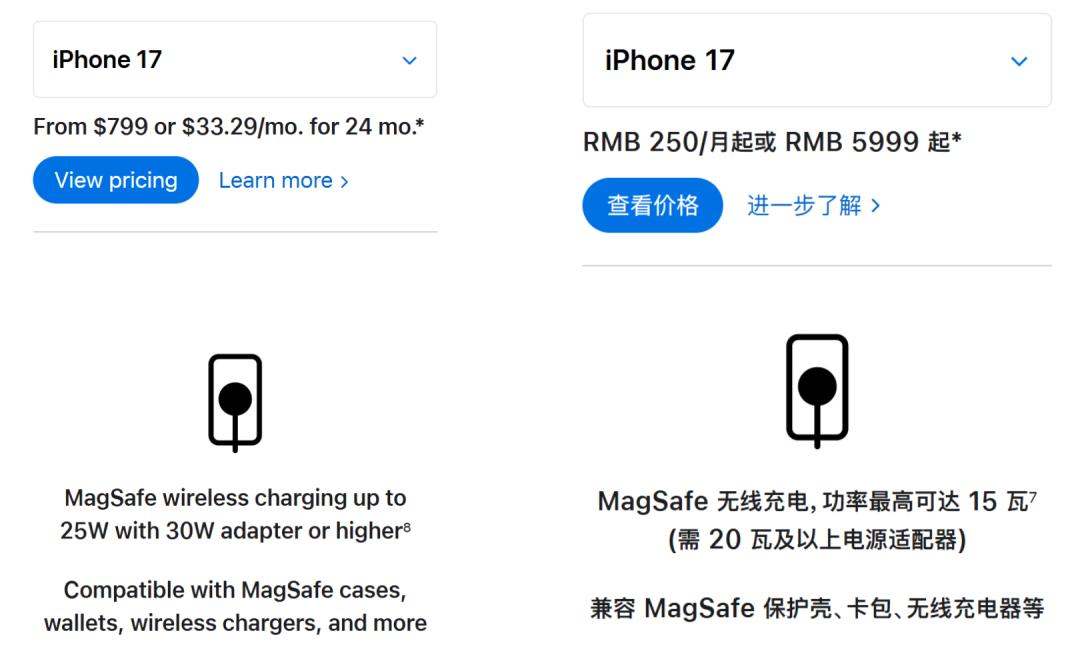
Core Viewpoint - The new iPhone 17 has different MagSafe charging power between the Chinese and international versions, with the Chinese version limited to 15W while the international version supports 25W due to compliance with the Qi2 25W standard [1][3][26]. Group 1: Charging Standards and Technology - The Wireless Power Consortium (WPC) released a new wireless charging standard, Qi2.2, in April, which supports a maximum power of 25W [8]. - The Qi2.2 standard includes two upgraded protocols: Magnetic Power Profile (MPP) for magnetic alignment and Active Alignment Profile (APP) for vehicle charging scenarios, enhancing the power output from 15W to 25W [19][20]. - The Qi2.2 standard has undergone rigorous testing, with a prototype achieving an input power of 24.22W while maintaining a maximum temperature of 37.6 degrees Celsius during charging [23]. Group 2: Market Implications and Manufacturer Responses - Domestic manufacturers are advancing wireless charging technology to nearly 100W, while international counterparts are still focused on 25W, highlighting a disparity in market focus [13]. - The lack of support for the Qi2.2 standard in China is attributed to regulatory issues, as the new standard operates at a frequency of 360kHz, which does not comply with recent regulations from the Ministry of Industry and Information Technology [25][26]. - Manufacturers like OPPO are hesitant to integrate magnetic components into their devices, opting instead for solutions that require compatible magnetic cases, which complicates the user experience [32][34]. Group 3: Future of Wireless Charging - The establishment of a universal wireless charging standard is deemed beneficial for user experience and industry health, despite current regulatory and design challenges [36][37]. - The industry is encouraged to pursue a common wireless fast charging protocol to enhance compatibility across brands, which would ultimately benefit consumers [36].


苹果iPhone Air掀手机“无卡化”浪潮? 业内人士:预计影响不大
Mei Ri Jing Ji Xin Wen· 2025-09-15 00:27
Core Viewpoint - Apple's launch of the iPhone Air, which only supports eSIM cards, is seen as a potential catalyst for the "cardless" mobile phone trend in China, although its impact may be limited due to market dynamics and competition from existing models [1][5][6]. Industry Summary - The three major telecom operators in China have indicated readiness to support eSIM technology but are awaiting regulatory approval to proceed with eSIM card services [1][4]. - The iPhone Air's introduction is viewed as a significant opportunity to promote eSIM adoption in China, despite the model's delayed release in the market [4]. - Industry analysts express skepticism about the iPhone Air's appeal, noting that it lacks certain features compared to other models in the iPhone series, which may limit its market success [5][6]. Company Summary - China Unicom, as the first operator to support eSIM for iPhones, has experienced a surge in interest, although the actual rollout of eSIM services is still pending regulatory confirmation [3][4]. - Other major smartphone manufacturers, including OPPO and vivo, are expected to release eSIM-compatible devices by the end of the year, indicating a gradual shift towards eSIM technology in the market [6][7]. - The introduction of eSIM technology may lead to increased competition among telecom operators, as it allows for easier switching between providers, although the current market dynamics suggest that factors like signal strength and pricing remain more influential in user decisions [8][9].

备案护航、场景深耕,AI深度赋能广东千行百业
Nan Fang Du Shi Bao· 2025-09-14 23:13
Core Insights - Artificial intelligence (AI) is rapidly integrating into reality, with Guangdong leading the way in China by completing 92 registrations for generative AI services, accounting for approximately 17% of the national total [2][3][4]. Policy and Regulation - The introduction of the "Interim Measures for the Management of Generative AI Services" in July 2023 established compliance requirements for the development and service of generative AI models in China [3]. - Guangdong's recent announcement of 14 new registered generative AI services highlights the province's proactive approach to regulatory compliance and innovation [3][4]. Industry Development - Since the introduction of the new regulations, Guangdong has seen a steady increase in the registration of generative AI models, with 60 models registered in 2023 alone [4]. - The province's AI core industry has surpassed 220 billion yuan, positioning it among the top in the nation, with over 1,500 core AI enterprises [10]. Ecosystem and Infrastructure - Guangdong has established 11 provincial-level AI industrial parks and is the only province with two national-level AI innovation application pilot zones, fostering a collaborative innovation environment [6]. - The province's AI development is supported by a robust ecosystem that includes both large enterprises and innovative startups, creating a dynamic landscape for AI advancements [10]. Application and Impact - Generative AI models in Guangdong are being applied across various sectors, including education, transportation, and manufacturing, demonstrating the technology's potential to enhance productivity and efficiency [8][9]. - The integration of AI into everyday life is evident with the introduction of AI assistants from major smartphone manufacturers and smart home appliance companies [7]. Technological Advancements - Guangdong leads the nation in AI invention patents, with over 140,000 granted, reflecting its strong focus on innovation and research [12]. - The province's high-performance computing capabilities are exemplified by the "Pengcheng Cloud Brain II," a domestically developed E-level intelligent computing platform [12]. Future Outlook - The ongoing development of AI in Guangdong is expected to contribute significantly to the broader Chinese AI landscape, with the region poised to become a global hub for AI innovation [13].

让“机器之眼”拥有3D视觉
Shen Zhen Shang Bao· 2025-09-14 22:34
Core Insights - The article highlights the leading position of the company in the 3D vision sensor market for service robots in China, driven by its comprehensive technology stack and partnerships with international giants like NVIDIA [2][6][10] Technology Barriers - The company has established a robust "full-stack technology research and development capability" in 3D vision perception, integrating various complex disciplines such as optics, mechanics, electronics, chip design, algorithms, and firmware development [2][3] - It has a wide-ranging technology layout covering six major areas: structured light, iToF, dToF, binocular, Lidar, and industrial 3D measurement [2] Product Performance - The Gemini330 series is designed for all scenarios, utilizing active infrared and passive natural light to address challenges like strong light and reflections, with a depth measurement range of 0.1 to 10 meters [4] - The company has developed proprietary production equipment and processes, enabling mass production of high-performance 3D vision perception products that meet stringent application standards [5] Market Positioning - The company maintains a leading market position in the Chinese service robot 3D vision sensor sector, serving numerous global clients including OPPO, Jabil, and China Mobile [6][10] - It has formed deep partnerships with industry leaders, integrating its products into NVIDIA's Jetson platform and collaborating with Microsoft and Ant Group for various applications [7][8][9] Financial Performance - The company reported a revenue of 360 million yuan in 2023, a year-on-year increase of 39.56%, with a significant improvement in net cash flow from operating activities, up 67.67% [10] - By the first half of 2025, revenue reached 435 million yuan, reflecting a 104.14% year-on-year growth, with a net profit of approximately 60 million yuan [10] Industry Outlook - The global 3D imaging and sensing market is projected to grow to $15 billion by 2025, with a compound annual growth rate of about 20% from 2019 to 2025 [11] - The 3D vision sensor market is expected to be a rapidly growing segment, driven by the increasing demand for intelligent hardware and the limitations of 2D imaging technology [12] Future Strategy - The company aims to enhance its core competitiveness in 3D vision perception through continuous innovation and product iteration, focusing on applications in embodied intelligence and 3D digitization [13] - With the expansion of smart terminal market demand and increased production capacity, the company is positioned to drive future profitability and business structure upgrades [14]


苹果iPhone Air掀手机“无卡化”浪潮?
Mei Ri Jing Ji Xin Wen· 2025-09-14 13:05
Core Viewpoint - The launch of Apple's new iPhone Air, which only supports eSIM cards, is seen as a significant step towards the adoption of eSIM technology in China, although the actual impact on the market remains uncertain [1][3][4]. Group 1: eSIM Technology and Market Dynamics - The three major telecom operators in China have indicated that they possess the necessary technology for eSIM cards and are awaiting regulatory approval to proceed [1][3]. - eSIM technology, initially proposed by Apple, allows for thinner devices and improved waterproofing, but its adoption in China has been cautious due to regulatory concerns and the interests of telecom operators [2][6]. - The introduction of eSIM cards could potentially enhance user convenience in switching operators, but the primary factors influencing user choice remain signal strength and cost-effectiveness of plans [7][8]. Group 2: Consumer Response and Product Positioning - The iPhone Air's appeal is questioned, as it lacks certain features compared to other models in the iPhone series, making its value proposition less attractive [4][5]. - Domestic smartphone manufacturers like OPPO and vivo are expected to release eSIM-compatible devices, with OPPO planning to launch its first models by the end of the year [5][6]. Group 3: Competitive Landscape and Regulatory Challenges - The introduction of eSIM technology may intensify competition among telecom operators, but concerns about user retention and potential security issues have led to a slowdown in eSIM adoption [6][7]. - The current telecom service ecosystem in China is well-established, and while eSIM cards could facilitate easier operator switching, they do not fundamentally change the existing dynamics of user retention and contract obligations [7][8].
2025年中国广告市场趋势洞察-CTR
Sou Hu Cai Jing· 2025-09-14 08:27
Market Growth Insights - The Chinese advertising market is entering a new phase characterized by "structural growth + experience-driven + value reconstruction" [1] - From January to July 2025, the advertising market showed structural growth, with significant contributions from entertainment, self-care, and technology sectors [1] - Notable increases in advertising spending were observed in personal health care (+283.4%), educational supplies (+158.0%), and footwear (+121.8%) [1][8] - The top five categories for brand growth included condiments (+28.6%) and laundry products (+24.6%), indicating resilience in these sectors [1][8] - New product promotion expenses accounted for over 40% in telecommunications and home appliance industries, with expectations of maintaining over 30% investment across most sectors in 2025 [1][10] Marketing Expression Upgrades - The shift from "single expression" to "multi-dimensional expression" is driven by the "experience economy," creating a feedback loop of "experience-resonance-viral" [2] - AI is enhancing emotional experiences in marketing, with over 50% of consumers using AI for purchasing decisions in categories like home appliances and electronics [2][12] - The report emphasizes the importance of brand value construction, noting that 57.8% of consumers prioritize brand over immediate effectiveness in decision-making [2] Cultural Experience and Engagement - Cultural experience activities are gaining popularity, with concert ticket sales reaching 1.393 billion yuan (+8.8%) in the first half of 2025, and advertising spending for concerts increasing by 58.8% [1][15] - Brands are leveraging immersive activities to enhance interaction with consumers, reflecting a new norm in cultural tourism consumption [1][15] AI and Brand Perception - The number of AI-related products and advertising expenditures surged by 442.8%, with 77% of consumers believing that AI elements enhance brand favorability [1][12] - The report suggests that brands should utilize AI effectively while increasing advertising investments to build long-term competitiveness and achieve sustainable growth [2]

iPhone Air在华发售延期,获批后将推动手机无卡化?业内人士:此机型略“鸡肋”,预计影响不大
Mei Ri Jing Ji Xin Wen· 2025-09-14 04:33
Core Viewpoint - Apple's launch of a new model that only supports eSIM cards is expected to drive the development of eSIM technology in China, despite existing regulatory and market challenges [1][7]. Group 1: eSIM Technology and Market Dynamics - The three major domestic telecom operators have indicated readiness to support eSIM technology but are awaiting regulatory approval to proceed [1][7]. - The introduction of eSIM technology is seen as a potential game-changer, allowing for thinner devices and improved waterproofing, but its adoption in China has been cautious due to regulatory concerns and operator interests [6][10]. - The iPhone Air, which exclusively supports eSIM, may not have strong market appeal compared to other models in the iPhone 17 series, which offer better specifications at lower prices [7][12]. Group 2: Consumer Behavior and Operator Strategies - User choice of telecom operators is primarily influenced by signal strength and the value of service plans, suggesting that eSIM technology may not significantly alter consumer behavior [3][10]. - Operators have strategies, such as contract phones, to maintain customer loyalty, which may mitigate the impact of eSIM on user retention [3][10]. - The potential for eSIM to facilitate easier switching between operators could intensify competition among telecom providers, although the current service ecosystem remains robust [10][12]. Group 3: Industry Responses and Future Outlook - Domestic manufacturers like OPPO and vivo are planning to release eSIM-compatible devices, with OPPO expecting to launch its first models by the end of the year [8]. - The overall market for eSIM technology in China is still developing, with low penetration rates and a lack of a comprehensive ecosystem compared to international markets [10][12]. - Analysts suggest that the future of eSIM technology may be more focused on mid-range devices, as manufacturers seek to balance features and affordability [12].

苹果新机再掀“无卡化”浪潮? 业内人士:机型略“鸡肋” 预计影响不大
Mei Ri Jing Ji Xin Wen· 2025-09-14 03:30
Core Viewpoint - Apple's launch of a new eSIM-only model, the iPhone Air, is seen as a significant step towards promoting eSIM technology in China, although its market appeal remains uncertain due to its reduced functionality compared to other models in the series [2][5]. Industry and Company Analysis - The three major domestic telecom operators have confirmed their readiness to support eSIM technology but are awaiting regulatory approval to officially launch eSIM services [2][5]. - Despite the technological maturity of eSIM, the cautious approach in the Chinese market is attributed to regulatory concerns and the interests of telecom operators [2][7]. - The iPhone Air's competitive positioning is questioned, as it lacks certain features compared to the iPhone 17 series, which offers better specifications at lower prices, potentially limiting its market appeal [5][6]. - Domestic manufacturers like OPPO and vivo are expected to introduce eSIM-compatible devices by the end of the year, indicating a gradual shift towards eSIM adoption [6]. - The introduction of eSIM technology may not significantly alter the competitive landscape among telecom operators, as factors like signal strength and plan affordability remain primary considerations for consumers [7][8]. - The eSIM technology, while promising for device design and functionality, faces challenges in user retention for telecom operators, as it allows easier switching between providers [7][10]. - The potential for eSIM to enhance the "number portability" process is acknowledged, but concerns about regulatory and technical hurdles persist [8][10].