曹操出行

Search documents
港股异动 | 曹操出行(02643)再涨近10% 公司收购耀出行和吉利商旅 拓展B端商旅出行赛道
Zhi Tong Cai Jing· 2026-01-16 03:25
Core Viewpoint - Caocao Travel (02643) has seen a nearly 10% increase in stock price following the announcement of two strategic acquisitions, which are expected to enhance its service offerings in the business travel sector [1] Group 1: Strategic Acquisitions - Caocao Travel plans to fully acquire Weixing Technology (Yaotong Travel) and Geely Business Travel, which will become wholly-owned subsidiaries upon completion of the transactions [1] - The CEO of Caocao Travel, Gong Xin, stated that the acquisitions will enable the company to create a comprehensive service chain for daily commuting, business reception, and travel management, thereby generating business growth in the B2B travel sector [1] Group 2: Market Position and Financial Performance - According to Guotai Junan Securities, Caocao Travel has established a leading capacity network and customized vehicle ecosystem in the Chinese travel market, currently holding the second-largest market share [1] - The company has been optimizing operational efficiency and the lifecycle costs of its vehicles, leading to a significant reduction in Non-GAAP net losses, indicating that a profitability turning point is approaching [1] - Caocao Travel is leveraging its relationship with Geely to actively invest in autonomous driving technology, positioning itself as a key player in the commercialization of this technology [1] - Overall, the company is entering a phase of reduced losses and increased efficiency alongside technological innovation, suggesting potential for upward valuation elasticity [1]
国泰海通证券:首予曹操出行“增持”评级 定制化驱动增长 智驾化定义未来
Zhi Tong Cai Jing· 2026-01-16 02:52
Core Viewpoint - Cathay Securities initiates coverage on Cao Cao Mobility (02643) with a "Buy" rating, highlighting its profitability through Total Cost of Ownership (TCO) optimization and potential for valuation increase due to its autonomous driving strategy backed by Geely [1] Group 1: Market Position and Financial Performance - Cao Cao Mobility holds the second-largest market share in China's ride-hailing market, with shares of 8.8% and 8.5% in core first and second-tier cities respectively [1] - The company is projected to achieve revenues of 14.657 billion RMB in 2024, with a year-on-year growth rate exceeding 35% for the past two years [1] - The gross margin has seen a "three-year consecutive jump," with profitability expected to reach 809 million RMB in 2024, and the company is anticipated to enter a phase of synchronized expansion in profitability and business scale by 2026 [1] Group 2: Cost Reduction and Differentiated Growth - The company has established a commercial moat centered around a "customized vehicle strategy," reducing TCO to approximately 0.5 RMB per kilometer [2] - As a part of Geely's ecosystem, the company benefits from stable low-cost production capacity and a high-density battery swap network, while also leveraging vast real-world data to enhance smart driving algorithms [2] - This "manufacturing + platform + data" internal closed-loop model provides significant advantages in operational efficiency, vehicle durability, and compliance risk management compared to traditional light-asset models [2] Group 3: Strategic Upgrades and Future Goals - The company is transitioning from the "N-cube" to the "F-cube" strategy, focusing on fully intelligent customized vehicles, autonomous driving, and automated operational systems [3] - With the technological support from Geely's "Thousand-Mile Smart Driving," the company plans to launch L4-level Robotaxi customized models by 2026 [3] - The company has set a global strategic goal of "Ten Years, Hundred Cities, Thousand Billion," indicating its ambition to reshape the industry's profitability ceiling through Robotaxi [3]

国泰海通证券:首予曹操出行(02643)“增持”评级 定制化驱动增长 智驾化定义未来
智通财经网· 2026-01-16 02:48
Core Viewpoint - Cathay Securities initiates coverage on Cao Cao Mobility (02643) with a "Buy" rating, highlighting its strong market position and growth potential driven by customized vehicle strategies and cost optimization [1] Group 1: Market Position and Financial Performance - Cao Cao Mobility holds the second-largest market share in China's ride-hailing sector, with shares of 8.8% and 8.5% in core first- and second-tier cities respectively [1] - The company is projected to achieve revenues of 14.657 billion RMB in 2024, with a year-on-year growth rate exceeding 35% for the past two years [1] - The gross margin has improved significantly, achieving a three-year consecutive increase, with profitability expected to reach 809 million RMB in 2024 [1] Group 2: Cost Optimization and Business Model - The company has established a competitive moat centered around a "customized vehicle strategy," reducing total cost of ownership (TCO) to approximately 0.5 RMB per kilometer [2] - As part of the Geely ecosystem, the company benefits from stable low-cost production capacity and a high-density battery swap network, enhancing operational efficiency and risk resilience [2] Group 3: Strategic Upgrades and Future Plans - The company is transitioning from the "N-cube" to the "F-cube" strategy, focusing on fully intelligent customized vehicles, autonomous driving, and automated operations [3] - Plans are in place to launch L4-level Robotaxi customized models by 2026, with a global strategic goal of "100 cities in 10 years, 100 billion" [3]
【行业深度】一文洞察2026年中国共享出行行业发展前景及投资趋势研究报告
Sou Hu Cai Jing· 2026-01-16 02:27
Core Insights - The shared economy model, leveraging internet technology and public consumption changes, is rapidly rising, significantly impacting various sectors including transportation and finance [2] - The shared mobility sector has seen a temporary decline in transaction volume due to the pandemic, but is now recovering, with a projected growth in transaction volume to 234.5 billion yuan in 2024, a year-on-year increase of 9.07% [2] - Future growth in shared mobility is expected to be driven by advancements in technology and policy improvements, integrating with autonomous driving and electric vehicles for smarter and greener transportation solutions [2] Shared Mobility Industry Overview - Shared mobility allows individuals to share vehicles without ownership, paying for usage based on their travel needs, encompassing services like ride-hailing and bike-sharing [3] - The industry is characterized by continuous innovation and expansion of service offerings, including various ride-hailing models [3] Development Background of Shared Mobility - The shared economy, centered around internet platforms, optimizes resource allocation and enhances efficiency, with shared mobility being a key component [5] - The market size of China's shared economy is projected to grow from 19.6 trillion yuan in 2015 to 44.6 trillion yuan by 2024, reflecting a compound annual growth rate of 9.57% [5] - By 2025, the market size is expected to reach approximately 48 trillion yuan, indicating robust growth potential for shared mobility sectors [5] Shared Mobility Industry Chain - The industry chain consists of three segments: upstream hardware suppliers (vehicle manufacturers, battery suppliers), midstream platform operators (service providers managing vehicle dispatch and operations), and downstream end-users utilizing the services [7] Ride-Hailing as a Key Component - Ride-hailing services provide convenient and flexible transportation options, especially during peak hours or in remote areas, becoming a preferred choice for users [9] - As of June 2025, the user base for ride-hailing in China is projected to reach 511 million, with a usage rate of 45.6%, indicating significant growth in user adoption [9]

截至2025年底全国共有395家网约车平台公司取得经营许可
Zhong Guo Xin Wen Wang· 2026-01-15 06:02
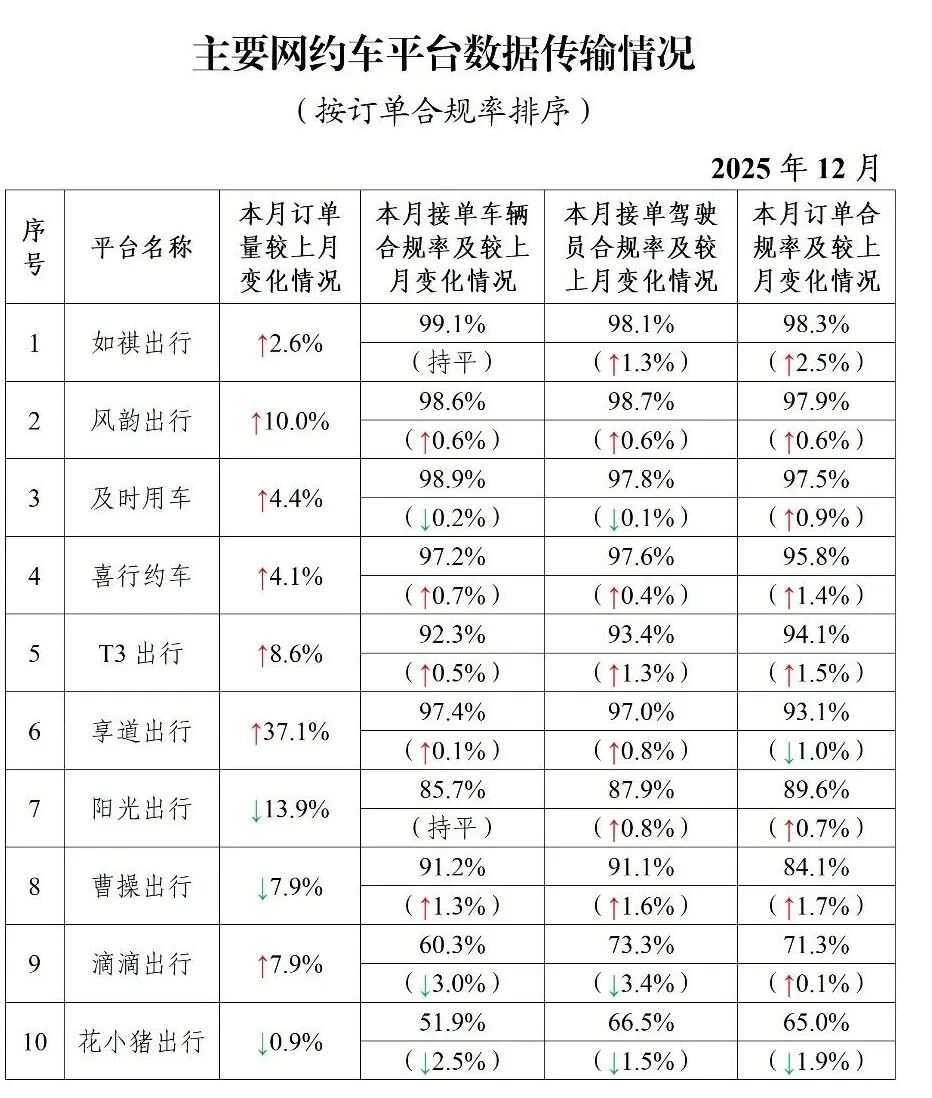
Core Insights - As of December 31, 2025, a total of 395 ride-hailing platform companies have obtained operating licenses in China, with an increase of one company from the previous month [1] Group 1: Order Volume and Compliance Rates - In December, the ride-hailing regulatory information system recorded a total of 9.63 billion orders [1] - The top 10 platforms by order compliance rate (the percentage of orders where both drivers and vehicles are licensed) are ranked as follows: Ruqi Travel, Fengyun Travel, Jishi Car, Xixing Car, T3 Travel, Xiangdao Travel, Sunshine Travel, Cao Cao Travel, Didi Travel, and Huaxiaozhu Travel [1] - The platforms with the highest growth in order compliance rates are Ruqi Travel, Cao Cao Travel, and T3 Travel, while Didi Travel (0.1%), Xiangdao Travel (-1.0%), and Huaxiaozhu Travel (-1.9%) saw the lowest growth [1] - Aggregator platforms, which provide services to passengers in collaboration with ride-hailing companies, completed 292 million orders, representing a month-on-month growth of 5.6% [1] - The compliance rates for aggregator platforms are ranked as follows: Huaxiaozhu Travel, Didi Travel, Gaode Dache, Baidu Dache, Tencent Travel, Ctrip Car, and Meituan Dache [1] Group 2: Compliance Rates in Major Cities - Among major cities, the order compliance rates are ranked from highest to lowest as follows: Xiamen, Guangzhou, Shenzhen, Chengdu, Hangzhou, Jinan, Chongqing, Nanjing, Qingdao, Ningbo, Fuzhou, Hefei, Nanchang, Nanning, Guiyang, Changchun, Tianjin, Changsha, Zhengzhou, Xining, Kunming, Shijiazhuang, Taiyuan, Dalian, Lhasa, Haikou, Hohhot, Wuhan, Urumqi, Lanzhou, Yinchuan, Shanghai, Xi'an, Harbin, Shenyang, and Beijing [2] - 26 cities, including Xiamen, Guangzhou, Shenzhen, Chengdu, Hangzhou, Jinan, Chongqing, Nanjing, Qingdao, Ningbo, Fuzhou, Hefei, Nanchang, Nanning, Guiyang, Changchun, Tianjin, Changsha, Zhengzhou, Xining, Kunming, Shijiazhuang, Taiyuan, Dalian, Lhasa, Haikou, and Hohhot, have compliance rates above 80% [2] - The cities with the highest growth in order compliance rates are Kunming, Jinan, and Hangzhou, while the cities with the lowest growth are Yinchuan (-2.7%), Hohhot (-4.0%), and Urumqi (-5.6%) [2]
交通运输部:网约车监管信息交互系统12月份共收到订单信息9.63亿单
智通财经网· 2026-01-15 02:25
Core Insights - The report indicates that as of December 31, 2025, there are 395 licensed ride-hailing platforms in China, with a slight increase of one platform from the previous month [1] - A total of 9.63 billion orders were processed in December, reflecting a significant operational scale in the ride-hailing industry [1] Group 1: Order Compliance Rates - The top three platforms by order compliance rate are: 1. Ruqi Mobility (如祺出行) at 99.1% 2. Fengyun Mobility (风韵出行) at 98.6% 3. Jishi Mobility (及时用车) at 98.9% [4] - The platforms with the highest growth in order compliance rates are Ruqi Mobility, Cao Cao Mobility (曹操出行), and T3 Mobility, while Didi Mobility (滴滴出行) showed minimal growth of 0.1% [1][4] - The platforms with the lowest compliance rate growth include Xiaohongshu Mobility (花小猪出行) at -1.9% and Xiangdao Mobility (享道出行) at -1.0% [1] Group 2: Major City Compliance Rates - The cities with the highest order compliance rates include Xiamen, Guangzhou, Shenzhen, and Chengdu, with 26 cities reporting compliance rates above 80% [2] - The top three cities with the highest growth in compliance rates are Kunming, Jinan, and Hangzhou, while Yinchuan, Hohhot, and Urumqi experienced the largest declines [2] Group 3: Order Volume Changes - Ruqi Mobility reported a 12.6% increase in order volume, while Fengyun Mobility saw a 110.0% increase, indicating strong growth among leading platforms [4] - Didi Mobility and Xiaohongshu Mobility both reported a 17.9% increase in order volume, but their compliance rates remain significantly lower compared to competitors [4][7]
上海推“模速智行”行动计划,自动驾驶产业有望迎来加速发展(附概念股)
Zhi Tong Cai Jing· 2026-01-15 01:09
Core Insights - Shanghai has launched the "Mosu Zhixing" action plan to promote high-level autonomous driving, focusing on technology innovation and industrial competitiveness [1][2] - The plan aims to establish public service platforms, including a digital twin training ground for autonomous driving, and expand the open area for autonomous driving to 2,000 square kilometers [1] - The initiative is expected to facilitate the demonstration of L3-level autonomous vehicles and promote their commercial application [2] Industry Development - Shanghai has been proactive in advancing the autonomous driving industry, with previous initiatives such as the 2022 implementation plan for smart connected vehicles and the issuance of road testing licenses for driverless vehicles in 2023 [2] - The action plan includes organized trials for L3-level autonomous taxis and aims to gradually scale up the production and application of L3 vehicles [2] - The demand for advanced autonomous driving components, such as chips and lidar, is anticipated to grow rapidly as the ecosystem expands [3] Company Progress - Several domestic companies, including Changan, BYD, and GAC, have made significant advancements in L3-level autonomous driving, with multiple models receiving road testing permits [4] - Companies like Huawei and GAC have developed solutions and vehicles capable of L3-level autonomous driving, indicating a shift in consumer preferences towards vehicles with advanced driving assistance features [4] - The formal implementation of L3-level autonomous driving regulations is expected to be a key catalyst for industry growth by 2026 [4] Market Opportunities - Companies such as Junsheng Electronics and Seres are actively engaging in strategic partnerships and product launches to enhance their positions in the autonomous driving market [5][6] - The introduction of new Robotaxi services by companies like Cao Cao Mobility marks a significant step towards the commercialization of autonomous driving solutions [6] - The collaboration between ZF and Horizon Robotics to develop L3-level systems is expected to lead to mass production by 2026, highlighting ongoing innovation in the sector [7]
上海推“模速智行”行动计划 自动驾驶产业有望迎来加速发展(附概念股)
Zhi Tong Cai Jing· 2026-01-15 00:14
Group 1 - Shanghai has launched the "Mosu Zhixing" action plan to promote autonomous driving technology innovation and its industrial competitiveness, with a focus on model-driven leadership and application demonstration [1] - The plan aims to establish public service platforms, including a digital twin training ground for autonomous driving, and expand the open area for autonomous driving to 2,000 square kilometers with over 5,000 kilometers of roads [1] - The action plan is expected to provide new support for the development of the autonomous driving industry, including organized smart taxi demonstration operations and pilot projects for L3 autonomous passenger vehicles [2] Group 2 - As of January 14, there are 7,767 companies related to intelligent driving in China, with the East China region accounting for 43.8% of these companies [3] - China holds 51,000 patents related to intelligent driving, with 85.9% being invention patents, indicating a significant growth in both companies and patents in the sector [3] - Nvidia has introduced an open-source AI model platform for autonomous driving, which is expected to enhance the capabilities of autonomous driving systems [3] Group 3 - Several domestic companies, including Changan, BYD, and GAC, have made substantial progress in the L3 autonomous driving field, with multiple models receiving road testing permits [4] - The formal implementation of L3 autonomous driving regulations is anticipated to be a key catalyst for industry development by 2026 [4] - Companies like Aichi Securities believe that automakers with advanced intelligent technology and supply chain control will benefit first from the commercialization of intelligent driving [2] Group 4 - Companies such as Junsheng Electronics and CAOCAO have entered strategic partnerships to develop L4 autonomous driving solutions and digital management platforms [5][6] - The launch of new models by companies like Seres and Leap Motor indicates a competitive landscape in the high-end user market for autonomous vehicles [6][7] - The collaboration between ZF and Horizon Robotics aims to develop L3 intelligent driving systems, with mass production expected in 2026 [7]
港股概念追踪 | 上海推“模速智行”行动计划 自动驾驶产业有望迎来加速发展(附概念股)
智通财经网· 2026-01-14 23:37
Core Insights - Shanghai is advancing its autonomous driving industry through the "Mosu Zhixing" action plan, aiming to transform technological innovation into industrial competitiveness [1][2] - The plan includes the establishment of public service platforms like digital twin training grounds and expands the autonomous driving open area to 2,000 square kilometers with over 5,000 kilometers of roads [1] - The action plan also promotes the orderly organization of smart taxi demonstration operations and the trial of L3 autonomous passenger vehicles [2] Industry Development - Shanghai has consistently pushed for the development of the autonomous driving industry, with previous initiatives such as the 2022 implementation plan for smart connected vehicles and the issuance of road testing licenses for driverless vehicles in 2023 [2] - The introduction of the action plan is expected to provide new support for the industry's growth, particularly in the commercialization of intelligent driving technologies [2] - The demand for advanced autonomous driving components like chips, lidar, and control systems is anticipated to grow rapidly as the ecosystem expands [3] Company Progress - Several domestic companies, including Changan, BYD, GAC, Dongfeng, SAIC, Geely, XPeng, and Li Auto, have made significant advancements in L3 autonomous driving, with multiple models receiving road testing permits [4] - Companies like Huawei and GAC have developed L3 solutions and are actively testing them in various cities, indicating a shift towards practical applications of autonomous driving technology [4] - The formal implementation of L3 autonomous driving regulations is expected to be a key catalyst for industry development by 2026 [4] Related Companies - Junsheng Electronics has signed a strategic cooperation agreement with Sien Intelligent Driving to develop L4 autonomous driving solutions [5] - Seres has launched multiple models, including the Aito M5 and M7, targeting the high-end user market with differentiated positioning [6] - Cao Cao Mobility is advancing its Robotaxi business with the launch of its autonomous driving platform, marking a significant step in operational integration [6] - Leap Motor has commenced nationwide deliveries of its Lafa5 model, which incorporates advanced AI and lidar systems [6] - Horizon Robotics and ZF are collaborating to develop an L3 intelligent driving system, expected to achieve mass production in 2026 [6]
2.9亿吞下吉利系两资产,曹操出行回避了正面战场?
3 6 Ke· 2026-01-14 11:13
Core Viewpoint - Caocao Travel (02643.HK) has announced its first major acquisition post-IPO, acquiring Geely's Yao Travel and Zhejiang Geely Business Services for a total of 290 million RMB in cash [1][2]. Group 1: Acquisition Details - The acquisition includes 100% of Yao Travel for 225 million RMB and all shares of Geely Business Services for 65 million RMB [6]. - Yao Travel focuses on high-end business travel and is a luxury travel brand launched by Mercedes-Benz and Geely, while Geely Business Services provides corporate travel management solutions [2][6]. - Following the acquisition, Mercedes-Benz will completely exit its equity structure in Yao Travel [2]. Group 2: Financial Performance - Caocao Travel reported a revenue of 9.456 billion RMB for the first half of 2025, a year-on-year increase of 53.5%, but incurred a loss of 495 million RMB, although the loss is narrowing [4]. - Yao Travel is projected to incur a cumulative after-tax loss of over 115 million RMB for 2023 and 2024 [6]. - Geely Business Services is expected to see a significant profit decline of 47.87% in 2024 compared to 2023, with an estimated after-tax profit of 23.3 million RMB [8]. Group 3: Strategic Direction - The acquisition signals Caocao Travel's commitment to expanding its B2B business travel segment, aiming to create a comprehensive "one-stop technology travel platform" [4]. - The company aims to achieve threefold synergy through the integration of the two acquired entities, enhancing product offerings and client conversion [8]. - The business travel market in China is projected to exceed 3.5 trillion RMB in 2025, with a compound annual growth rate of over 11% [9]. Group 4: Market Position and Challenges - Despite being among the top three ride-hailing platforms in China, Caocao Travel holds only 5-6% of the market share, with over 50% controlled by Didi [11]. - The company faces significant reliance on external aggregation platforms for traffic, with commission payments to these platforms rising from 3.2 billion RMB in 2022 to 10.4 billion RMB in 2024 [12]. - The increasing commission fees paid to aggregation platforms have raised concerns about the company's bargaining power and profitability [13]. Group 5: Future Prospects in Autonomous Driving - Caocao Travel is positioning autonomous driving as a long-term strategic focus, with plans to establish five operational centers globally and achieve a transaction volume of 100 billion RMB over the next decade [15][16]. - The global autonomous vehicle market is expected to grow significantly, with a projected market size of 15.23 billion USD by 2026 [15]. - The company is leveraging Geely's comprehensive support across various dimensions, including vehicle costs and technology, to build a competitive edge in the autonomous driving sector [17].