沪农商行

Search documents
从政策红利到民生实效 金融支持润泽银发经济
Shang Hai Zheng Quan Bao· 2026-01-13 23:40
Core Viewpoint - The recent joint issuance of measures by eight departments aims to cultivate the elderly care service industry and promote the silver economy, focusing on optimizing service supply, enhancing digital upgrades, and increasing support efforts [1] Group 1: Optimizing Supply Structure - The measures emphasize the need to optimize elderly care services and age-friendly product supply, promoting the expansion of convenient living circles and encouraging service institutions to integrate resources through chain operations [2] - Shanghai Rural Commercial Bank has established over 1,000 public service stations, achieving full coverage in 216 streets and towns in Shanghai, thereby injecting vitality into the "15-minute community life circle" [2] - The key to effective elderly care finance lies in "matching" services to needs rather than merely focusing on scale, with banks linking various sectors to create a platform for community-based services [2] Group 2: Technological Integration - The measures encourage technological innovation in elderly care, supporting the development of smart elderly care devices and enhancing user experience through shared services [4] - Shanghai Zhiai Nursing Station has developed an intelligent management system to improve efficiency and transparency in care services, supported by a loan from Agricultural Bank of China [4] - Digitalization is rapidly improving the efficiency of elderly care services, with banks exploring support for various high-tech products in the sector [5] Group 3: Cost Management - The high costs associated with elderly care services, including space, personnel, and equipment, pose significant challenges to sustainability [6] - In Suzhou, the transformation of metro station spaces into elderly care service areas is underway, supported by long-term financing from the National Development Bank [6] - Financial institutions are not only providing funding but also contributing to project planning, enhancing the sustainability of elderly care services [6] Group 4: Policy Recommendations - Experts suggest that addressing the high costs of elderly care requires enhanced cross-departmental collaboration, tax incentives, and improved long-term care insurance systems [7] - The measures provide financial institutions with diverse development opportunities, enabling deeper integration of financial services into community and elderly care scenarios [7] - The ongoing integration of financial resources into daily elderly care services is making the silver economy increasingly tangible and beneficial for the elderly [7]
养老金融 从政策红利到民生实效 金融支持润泽银发经济
Shang Hai Zheng Quan Bao· 2026-01-13 18:34
Core Viewpoint - The recent joint issuance of measures by eight departments aims to enhance the convenience, safety, and affordability of elderly care services, directly impacting the well-being and happiness of the elderly population [1] Group 1: Optimizing Supply Structure - The measures emphasize the need to optimize the supply of elderly care services and age-friendly products, promoting the expansion of convenient living circles and encouraging care institutions to integrate into communities [2] - Shanghai Rural Commercial Bank has established over 1,000 public service stations, achieving full coverage in 216 streets and towns in Shanghai, thereby enhancing the "15-minute community living circle" [2] - The key to effective elderly finance lies in matching services to needs rather than merely scaling up, with banks collaborating across various sectors to provide tailored services [2][3] Group 2: Technological Integration - The measures encourage technological advancements in elderly care, supporting the development of smart elderly care devices and enhancing user experience through shared services [4] - Shanghai Zhiai Nursing Station has implemented an intelligent management system to streamline operations, supported by a loan of 5 million yuan from Agricultural Bank of China [4] - Digitalization is rapidly improving the efficiency of elderly care services, with banks exploring support for various high-tech products in the sector [5] Group 3: Cost Management - The high costs associated with elderly care services, including space, personnel, and equipment, pose significant challenges [6] - In Suzhou, the transformation of 20 metro stations into elderly care service spaces is underway, supported by long-term financing from the National Development Bank [6] - Financial institutions are not only providing funding but also contributing to project planning to enhance sustainability [6] Group 4: Sustainable Development - Experts suggest that addressing the high costs of elderly care requires enhanced inter-departmental collaboration and financial support to stimulate demand and lower supply costs [7] - The measures open up diverse development opportunities for financial institutions, enabling deeper integration of financial services into community care scenarios [7]
农商行板块1月13日涨0.62%,渝农商行领涨,主力资金净流入5648.9万元
Zheng Xing Xing Ye Ri Bao· 2026-01-13 09:06
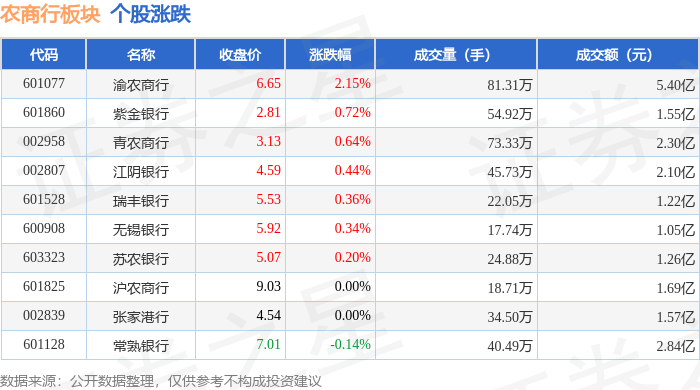
Core Viewpoint - The agricultural commercial bank sector experienced a rise of 0.62% on January 13, with Chongqing Rural Commercial Bank leading the gains, while the Shanghai Composite Index fell by 0.64% and the Shenzhen Component Index dropped by 1.37% [1] Group 1: Market Performance - Chongqing Rural Commercial Bank (601077) closed at 6.65, up by 2.15% with a trading volume of 813,100 shares and a transaction value of 540 million yuan [1] - Other notable banks included Zijin Bank (601860) with a closing price of 2.81, up by 0.72%, and Qingnong Bank (002958) at 3.13, up by 0.64% [1] - The overall trading volume for the agricultural commercial bank sector was significant, with total net inflow of main funds amounting to 56.49 million yuan [1] Group 2: Fund Flow Analysis - Main funds saw a net inflow of 17.50 million yuan into Chongqing Rural Commercial Bank, while retail investors experienced a net outflow of 47.08 million yuan [2] - Jiangyin Bank (002807) had a net inflow of 13.55 million yuan from main funds, but retail investors withdrew 8.41 million yuan [2] - The fund flow data indicates a mixed sentiment among retail and institutional investors, with main funds generally showing positive interest in several banks while retail investors were more cautious [2]





金价高企,银行挂钩黄金结构性存款走俏
Xin Lang Cai Jing· 2026-01-13 00:15
本报记者 彭 妍 外资银行则聚焦长期限、高收益赛道,瞄准高净值客户群体。例如,1月1日,星展银行推出保本类结构 性存款产品系列,挂钩黄金美元即期价格,年化收益范围1.5%至4.0%,期限12个月,最低认购金额1万 美元;1月7日,渣打银行推出挂钩SPDR黄金信托的结构性存款产品,非年化收益范围0%至5.0%,最低 认购金额5万元,投资期限18个月,该产品为涨跌双赢结构,到期100%本金保障,风险评级3级。 中国邮政储蓄银行研究员娄飞鹏对《证券日报》记者表示,银行密集推出挂钩黄金的结构性存款产品, 主要在于把握黄金避险情绪升温的市场窗口,更好服务客户投资理财需求,同时也提升自身零售AUM (资产管理规模)与中间业务收入,优化收入结构缓解净息差压力。 伴随投资热度攀升,相关风险提示同步升级,理性配置成为关键。娄飞鹏表示,对普通投资者而言,黄 金结构性存款兼具本金保障与潜在收益弹性,相较实物金、ETF或期货,门槛低、操作简便、风险可 控,是当前布局黄金的较优选择之一,但收益表现与金价走势紧密相关。若金价大幅上涨,可获得浮动 收益上限;若金价回调或滞涨,则可能仅获保底收益甚至接近零收益,具体取决于产品结构设计。 在产 ...
金银价格强势拉涨 相关ETF规模大增 银行“上新”挂钩黄金结构性存款
Shang Hai Zheng Quan Bao· 2026-01-12 18:58
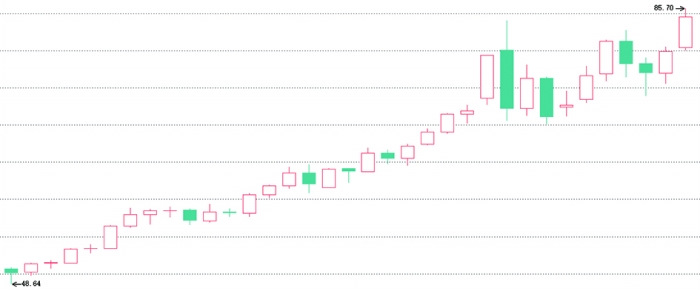
Core Viewpoint - The recent surge in gold and silver prices is driven by geopolitical factors, expectations of interest rate cuts by the Federal Reserve, and increased industrial demand, leading to a positive outlook for precious metals in the medium to long term [2][3][8]. Price Movements - As of January 12, gold reached a record high of $4610.68 per ounce, with a daily increase of over 2%, while silver rose more than 7% to surpass $85 per ounce, also setting a new historical record [2][3]. - International gold and silver futures hit historical highs of $4612.7 per ounce and $84.69 per ounce, respectively, with daily increases of 2% and 5% [3]. ETF Performance - Gold ETFs collectively rose, with the Guotou Silver LOF increasing by 7.11% [3]. - In the first seven trading days of 2026, gold ETFs saw net subscriptions exceeding 400 million shares, with the Huazhang Gold ETF approaching a scale of 100 billion yuan [3]. Institutional Insights - UBS Wealth Management raised its price forecast for gold, increasing target prices for March, June, and September 2026 from $4500 to $5000 per ounce, with a slight decline expected to $4800 by the end of 2026 [4]. - Analysts from various institutions express optimism about the long-term performance of gold and silver, citing a shift in investment logic towards strategic hedging against long-term structural risks [8][9]. Banking Sector Response - In response to high gold prices, banks are tightening risk management for gold-related businesses, raising the entry threshold for gold accumulation business to a balanced investment level [5][6]. - Several banks have launched structured deposits linked to gold, offering varying expected annual returns based on gold price fluctuations [6][7]. Industrial Demand - Increased demand for gold from central banks and industrial sectors such as photovoltaics, electric vehicles, and AI infrastructure is contributing to rising gold and silver prices [3][9].
金价高企 银行挂钩黄金结构性存款走俏
Zheng Quan Ri Bao· 2026-01-12 17:03
国内银行更注重短期灵活配置与低门槛,以吸引广泛投资者。例如,上海农商银行1月8日推出的鑫和系列产品挂钩伦敦 金,期限涵盖7天、14天、35天及91天,预期年化收益区间1.20%至1.65%;江苏银行无锡分行近期推出3个月与6个月两款挂钩 黄金的结构性存款,起存金额均为1万元,预期年化收益率分别为1%或1.89%或2.09%;招商银行"点金"系列产品期限覆盖7天 至181天,其中1月9日起售的"点金看涨三层区间周周存",根据黄金价格波动区间突破情况,提供1%或1.27%或1.47%的预期到 期年化收益率。 外资银行则聚焦长期限、高收益赛道,瞄准高净值客户群体。例如,1月1日,星展银行推出保本类结构性存款产品系列, 挂钩黄金美元即期价格,年化收益范围1.5%至4.0%,期限12个月,最低认购金额1万美元;1月7日,渣打银行推出挂钩SPDR黄 金信托的结构性存款产品,非年化收益范围0%至5.0%,最低认购金额5万元,投资期限18个月,该产品为涨跌双赢结构,到期 100%本金保障,风险评级3级。 本报记者 彭妍 2026年开年以来,金价高位震荡运行,黄金相关投资产品成理财市场"香饽饽"。记者采访获悉,多家中外资银行顺 ...
农商行板块1月12日跌0.14%,渝农商行领跌,主力资金净流出5928.29万元
Zheng Xing Xing Ye Ri Bao· 2026-01-12 09:04
Market Overview - The agricultural commercial bank sector experienced a decline of 0.14% on January 12, with Yunnan Agricultural Commercial Bank leading the drop [1] - The Shanghai Composite Index closed at 4165.29, up 1.09%, while the Shenzhen Component Index closed at 14366.91, up 1.75% [1] Individual Bank Performance - Zijin Bank closed at 2.79, with an increase of 0.72% and a trading volume of 386,600 shares, totaling a transaction value of 107 million yuan [1] - Su Nong Bank closed at 5.06, up 0.40%, with a trading volume of 204,900 shares, totaling 104 million yuan [1] - Ruifeng Bank closed at 5.51, up 0.36%, with a trading volume of 181,100 shares, totaling approximately 99.28 million yuan [1] - Qing Nong Bank closed at 3.11, up 0.32%, with a trading volume of 422,100 shares, totaling 131 million yuan [1] - Yunnan Agricultural Commercial Bank closed at 6.51, down 0.91%, with a trading volume of 690,100 shares [1] Capital Flow Analysis - The agricultural commercial bank sector saw a net outflow of 59.28 million yuan from institutional investors, while retail investors contributed a net inflow of 49.11 million yuan [1] - The table of capital flow indicates that Changshu Bank had a net inflow of 7.30 million yuan from institutional investors, while it faced a net outflow of 22.43 million yuan from speculative funds [2] - Yunnan Agricultural Commercial Bank experienced a net outflow of 21.20 million yuan from institutional investors, but a net inflow of 42.56 million yuan from speculative funds [2]


成都农商行给王晖的“硬任务”:上市、补短板、协同作战
阿尔法工场研究院· 2026-01-12 00:06
Core Viewpoint - The article discusses the significant transformation of Chengdu Rural Commercial Bank, which is set to become the first non-municipal rural commercial bank in China to exceed a total asset scale of 1 trillion yuan by the end of 2025, breaking the long-standing dominance of direct-controlled city banks in the rural credit system [4][5]. Group 1: Background and Context - The rural credit system in China has traditionally been dominated by banks from direct-controlled municipalities, but this is changing with Chengdu Rural Commercial Bank's entry into the "trillion club" [5]. - The bank's growth comes amid a backdrop of regional economic shifts and narrowing interest margins, raising questions about its ability to maintain stability and governance as it grows [6][7]. Group 2: Governance and Risk Management - Chengdu Rural Commercial Bank has faced a "triangle of impossibility" regarding capital replenishment, governance structure, and risk management, which has historically hindered many rural commercial banks [7][8]. - The bank underwent a significant governance restructuring after a tumultuous period under Anbang Insurance Group, which left it with various issues, including chaotic shareholding structures and uncontrolled related transactions [9]. Group 3: Financial Performance and Challenges - As of mid-2025, Chengdu Rural Commercial Bank reported a non-performing loan ratio of only 1.02% and a provision coverage ratio exceeding 441%, indicating strong risk management [11]. - However, its profitability lags behind peers like Chongqing Rural Commercial Bank and Shanghai Rural Commercial Bank, with a net profit of 6.009 billion yuan in the first three quarters of 2025, showing a single-digit growth rate [11][12]. Group 4: Strategic Direction and Leadership - The appointment of Wang Hui, a seasoned banking executive, as the new chairman is seen as a strategic move to accelerate the bank's IPO process and address its governance and operational challenges [16][17]. - The bank's future strategy will focus on "shortboard supplementation" and rapid progress towards an IPO, with an emphasis on overcoming historical issues related to its complex shareholding structure [17]. Group 5: Regional Financial Landscape - The article highlights the evolving role of Chengdu Rural Commercial Bank within the broader Sichuan financial ecosystem, where it complements the operations of Chengdu Bank and Sichuan Bank, each focusing on different market segments [18][19]. - This collaborative approach aims to avoid vicious competition within the region and enhance overall financial efficiency, particularly in the context of a challenging macroeconomic environment [20]. Group 6: Future Outlook - The next three to five years will be critical for Chengdu Rural Commercial Bank to validate its trillion-yuan asset scale, requiring a shift from mere size expansion to strengthening its operational capabilities through digital transformation and refined management practices [20][21]. - The bank's journey reflects broader themes in the Chinese financial system, including the need to balance scale with quality and to transition from a focus on size to a focus on value creation [23].
息差稳定预期加强
Xiangcai Securities· 2026-01-11 13:46
Investment Rating - The industry rating is maintained at "Overweight" [10][37] Core Insights - The central bank's 2026 work meeting emphasized a stable interest margin expectation, indicating a shift in focus from reducing financing costs to maintaining them at low levels [7][34] - The meeting highlighted the importance of enhancing financial services for high-quality economic development, directing funds towards key areas such as technological innovation and small and medium enterprises [7][34] - The credit market is showing signs of stabilization, with a shift from quantity to quality in credit issuance, and a reduction in the pace of loan rate declines [8][34] Summary by Sections Market Review - The banking index fell by 1.90%, underperforming the CSI 300 index by 4.69 percentage points [12] - The performance of various banking sectors showed declines, with large banks down by 2.94% and regional banks performing relatively better [12] Monetary Policy - The central bank's monetary policy will remain moderately accommodative, focusing on both counter-cyclical and cross-cyclical adjustments [7][34] - The emphasis will be on stabilizing corporate financing cost expectations and preventing significant interest rate fluctuations [7][34] Investment Recommendations - The report suggests focusing on state-owned banks with stable asset deployment and regional banks with growth potential, recommending specific banks such as ICBC, Bank of China, and others [10][37]




兴业证券:如何看待A股本轮开门红的结构与延续性?
智通财经网· 2026-01-11 10:36
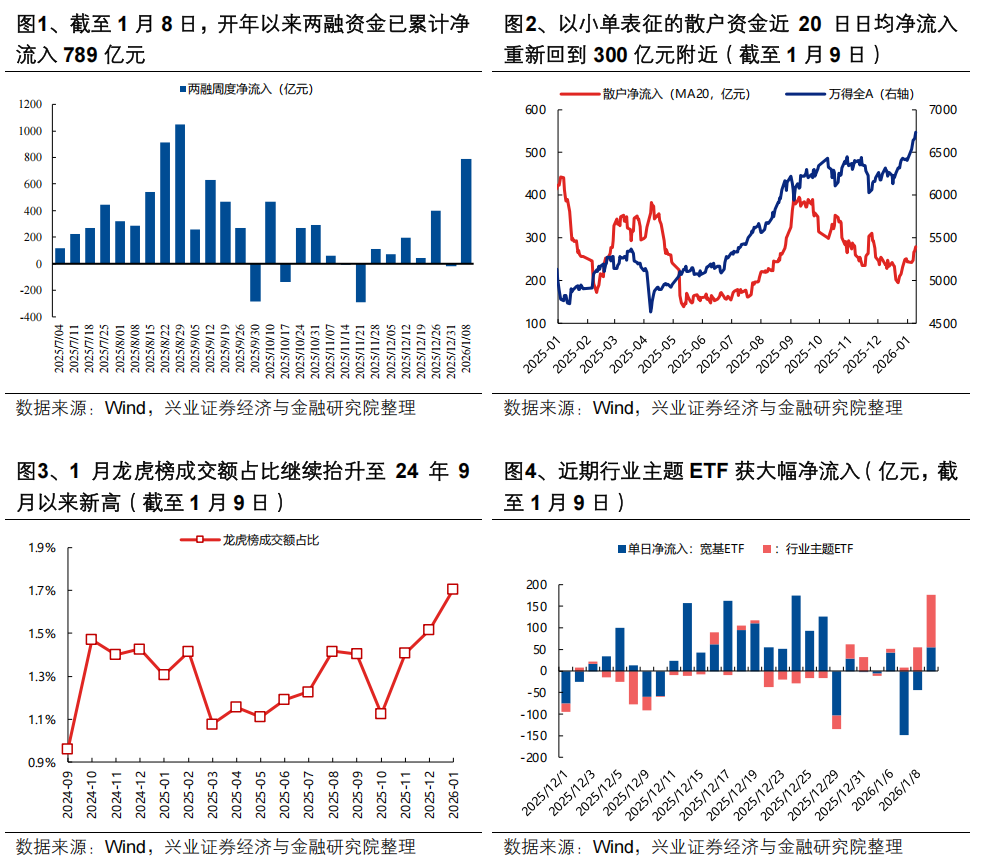
Core Viewpoint - The recent "opening red" in the A-share market reflects a favorable macroeconomic environment and abundant liquidity, which supports market risk appetite and attracts incremental capital inflow, creating a positive feedback loop between capital inflow and market rise [2][18]. Group 1: Market Dynamics - The A-share market has experienced a strong start with the Shanghai Composite Index breaking key levels and achieving a "sixteen consecutive days" rise, exceeding many investors' expectations [1][19]. - Historical data indicates that after a single-day trading volume exceeds 3 trillion yuan, there is typically at least a monthly-level market rally [19]. - Various types of trading funds have shown signs of accelerated entry, including a net inflow of 78.9 billion yuan in margin financing since the beginning of the year and a return of retail investor net inflow to around 30 billion yuan daily [2][5]. Group 2: Structural Characteristics - The inflow structure of different funds shows a strong consensus on key themes, primarily focusing on TMT (storage, AI applications), military industry (commercial aerospace), non-ferrous metals, new energy (controlled nuclear fusion), machinery (robots), and pharmaceuticals (innovative drugs, brain-machine interfaces) [5][36]. - The global stock market has also seen a strong start in 2026, driven by macroeconomic and industrial narratives, with A-shares reflecting similar trends [13][18]. Group 3: Future Directions - As companies begin to disclose annual reports, earnings will become a key factor driving market dynamics, leading to a structural adjustment where previously hot sectors face performance validation, while some low-performing sectors may attract new capital inflows [36]. - Industries with significant upward revisions in profit forecasts since November include technology (consumer electronics, computing), advanced manufacturing (new energy, military), cyclical sectors (building materials, non-ferrous metals), and consumer sectors (food processing, retail) [37][38].