宁波银行

Search documents
光大证券晨会速递-20250901
EBSCN· 2025-09-01 01:02
2025 年 9 月 1 日 晨会速递 分析师点评 市场数据 重点交流 【公用事业】盈利水平边际改善,同业竞争解决持续兑现——国网信通(600131.SH) 2025 年中报点评(买入) 公司发布 2025 年中报。2025 年上半年公司实现营收 35.25 亿元,同比-4.55%(调 整后);归母净利润 2.66 亿元,同比-11.01%(调整后)。我们预计公司 2025-2027 年归母净利润为 8.44/10.25/12.53 亿元,折合 EPS 分别为 0.70/0.85/1.04 元,对应 PE 为 26/21/18X。我们维持 "买入"评级。 总量研究 【宏观】8 月经济运行的三点特征——2025 年 8 月 PMI 点评 8 月制造业 PMI 小幅回升,非制造业活动加快扩张,关注三点特征:一是,尽管"抢 出口"效应消退,但受益于出口多元化、新兴市场需求提振影响,8 月出口动能趋稳, 叠加极端天气扰动减弱,制造业产需活动回升。二是,"反内卷"推动价格指数继续 回升,预计 8 月起 PPI 同比增速将步入上行通道。三是,受资本市场活跃、暑期出行 热度较高、信息服务活动扩张带动,8 月服务业景气度明显 ...
宁波银行(002142):业绩稳健高增 扩表动能强劲
Xin Lang Cai Jing· 2025-09-01 00:39
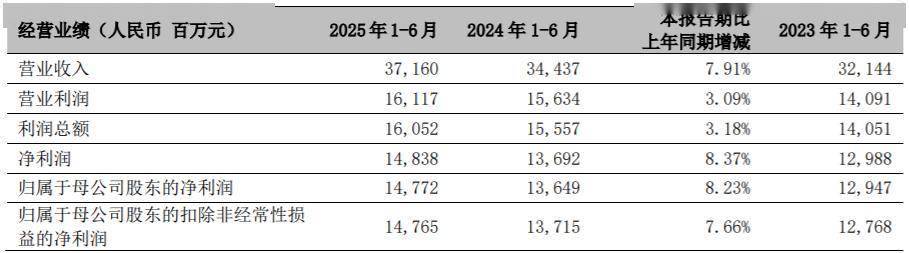
Core Insights - The company achieved robust revenue and profit growth in H1 2025, with operating income reaching 37.16 billion yuan, a year-on-year increase of 7.91%, and net profit attributable to shareholders at 14.77 billion yuan, up 8.23% [1] - The company's strong performance is attributed to robust asset expansion, narrowing interest margin decline, and optimized business costs [1][2] Financial Performance - In H1 2025, net interest income was 25.73 billion yuan, reflecting an 11.11% year-on-year growth, with Q2 showing a 10.63% increase [2] - The net interest margin for H1 2025 was 1.76%, down 10 basis points from 2024, but improved by 4 basis points from Q1 2025 [2] - Total loans reached 1,673.21 billion yuan by the end of June, a 13.36% increase from the beginning of the year, with corporate loans growing by 21.34% [2] - Total deposits amounted to 2,076.41 billion yuan, a 13.07% increase year-to-date, with corporate deposits up 15.44% and personal deposits up 6.66% [2] Wealth Management and Investment Income - Non-interest income for H1 2025 was 11.43 billion yuan, a 1.34% increase, with net commission income rising by 4.04% [3] - Investment income reached 8.38 billion yuan, a significant increase of 32.26%, despite a loss in fair value changes of 481 million yuan [3] Asset Quality and Risk Management - The non-performing loan ratio remained stable at 0.76%, with a coverage ratio of 374.16%, indicating strong risk mitigation capabilities [3] - The core Tier 1 capital adequacy ratio was 9.65%, slightly down by 19 basis points due to loan expansion consuming capital [3] Investment Outlook - The company has a strong competitive position in the economically developed Yangtze River Delta region, with a well-diversified profit center layout [4] - The narrowing interest margin decline and strong loan and deposit growth support stable performance, with a mid-term dividend plan enhancing investor returns [4] - The forecast for book value per share (BVPS) for 2025-2027 is 35.19, 38.52, and 43.12 yuan, corresponding to current price-to-book ratios of 0.80X, 0.73X, and 0.65X [4]

四大证券报精华摘要:9月1日
Xin Hua Cai Jing· 2025-09-01 00:01
Group 1: Technology Sector Performance - The technology sector in the A-share market has shown significant performance, with Industrial Fulian's market value surpassing 1 trillion yuan and the communication and electronics industries experiencing a monthly increase of over 20% [1] - Many technology companies reported impressive earnings in their semi-annual reports, reflecting the effectiveness of increased R&D investments [1][5] - The overall trend indicates that Chinese technology enterprises are solidifying their technological foundations, contributing to the economic transformation [1] Group 2: Overall Market Recovery - As of August 31, 5424 A-share companies disclosed their semi-annual reports, achieving a total revenue of approximately 34.9 trillion yuan, a year-on-year increase of 0.03% [2] - The net profit attributable to shareholders reached about 2.99 trillion yuan, marking a year-on-year growth of 2.45% [2] - A significant portion of companies, 2908, reported a year-on-year increase in net profit, indicating a recovery across various industries, including agriculture, steel, and electronics [2][3] Group 3: Mid-Year Dividend Trends - A record high of 810 companies announced mid-year cash dividend plans, with a total proposed payout of 6428.08 billion yuan, reflecting a year-on-year increase of 9.56% in dividend amounts [6] - Among companies with dividends exceeding 1 billion yuan, state-owned enterprises account for about 30% [6] - The banking sector has also seen a notable increase in mid-year dividends, with 17 banks disclosing dividend plans, including seven banks that are implementing dividends for the first time since their listings [7] Group 4: R&D Investment - A-share companies reported over 810 billion yuan in R&D investments in the first half of 2025, with several industries, including software development and biopharmaceuticals, showing high R&D intensity [12] - Six companies, including BYD and China Mobile, each invested over 10 billion yuan in R&D [12] Group 5: Mergers and Acquisitions Trends - The A-share market is witnessing a shift in mergers and acquisitions from "buying scale" to "acquiring technology," with a notable increase in transactions involving core technologies [11] - In 2025, there have been 21 merger and acquisition projects focused on core technologies, totaling 2.569 billion yuan [11]
江苏银行全面超越,城商行“一哥”易主
Bei Jing Shang Bao· 2025-08-31 14:55
Core Insights - The competitive landscape among city commercial banks in China has shifted, with Jiangsu Bank surpassing Beijing Bank to become the new leader in asset size [1][2][9] - Jiangsu Bank's asset total reached 4.79 trillion yuan, growing at a rate of 21.16%, while Beijing Bank's assets totaled 4.75 trillion yuan with a growth rate of 12.53% [2][3] - The rise of Jiangsu Bank reflects a broader trend of differentiation within the city commercial banking sector, which has formed a clear three-tier competitive structure [1][9] Asset Growth Comparison - Jiangsu Bank's asset growth has consistently outpaced that of Beijing Bank over recent years, narrowing the gap significantly from 2020 to 2024 [3][4] - By the end of 2024, Jiangsu Bank's assets reached 3.95 trillion yuan, with a year-on-year growth of 16.12%, compared to Beijing Bank's 4.22 trillion yuan and 12.61% growth [3] Financial Performance Metrics - In 2022, Jiangsu Bank achieved operating income of 70.57 billion yuan and net profit of 25.39 billion yuan, surpassing Beijing Bank's figures [4] - For the first half of 2025, Jiangsu Bank reported operating income of 44.86 billion yuan and net profit of 20.24 billion yuan, while Beijing Bank's figures were 36.22 billion yuan and 15.05 billion yuan, respectively [4] Business Strategy and Focus - Jiangsu Bank's growth is attributed to its deep integration with regional economic development, particularly in sectors like high-end manufacturing and infrastructure [5][6] - The bank has focused on specific customer segments and tailored financial services, moving away from a broad retail strategy [5][10] Competitive Landscape - The city commercial banking sector has seen a clear tiered structure, with Jiangsu Bank, Beijing Bank, Ningbo Bank, and Shanghai Bank forming the top tier, all exceeding 3 trillion yuan in assets [9] - The second tier includes banks like Nanjing Bank and Hangzhou Bank, while the third tier consists of smaller regional banks that are growing at slower rates [9] Future Directions - To remain competitive, city commercial banks must adopt differentiated strategies, focusing on local economic needs and enhancing their service offerings [10][11] - There is a need for banks to improve their capital bases and risk management practices to support sustainable growth [10][11]


金融中报观|江苏银行全面超越,城商行“一哥”易主
Bei Jing Shang Bao· 2025-08-31 14:37
Core Insights - Jiangsu Bank has surpassed Beijing Bank to become the largest city commercial bank in China, with total assets of 4.79 trillion yuan and a growth rate of 21.16% in the first half of 2025, compared to Beijing Bank's 4.75 trillion yuan and 12.53% growth rate [1][3][5] - The shift in leadership reflects a broader trend of differentiation within the city commercial banking sector, where 17 listed banks have formed a clear three-tier competitive structure [1][11] Group 1: Historical Context - Beijing Bank, established in 1996, held the top position in city commercial banks for many years, leveraging its geographical advantages and early market entry to grow from 354.22 billion yuan in 2007 to 4.75 trillion yuan [3][4] - Jiangsu Bank, founded later in 2007, has focused on regional economic development and retail banking, leading to significant growth in its asset scale [3][5] Group 2: Growth Trajectory - Jiangsu Bank's asset growth has accelerated in recent years, with total assets reaching 2.34 trillion yuan at the end of 2020, 2.62 trillion yuan in 2021, and 2.98 trillion yuan in 2022, ultimately surpassing Beijing Bank in 2025 [4][5] - In 2022, Jiangsu Bank achieved operating income of 70.57 billion yuan and net profit of 25.39 billion yuan, exceeding Beijing Bank's figures [5] Group 3: Business Strategy - Jiangsu Bank's rapid growth is attributed to its deep integration with regional economic development, particularly in sectors like smart manufacturing and new energy vehicles, which have generated strong deposit and credit demand [6][7] - The bank has shifted its focus from a broad retail strategy to targeting specific customer segments and industries, enhancing its competitive edge [7][11] Group 4: Financial Performance - As of mid-2025, Jiangsu Bank's corporate loans reached approximately 1.63 trillion yuan, with significant growth in manufacturing and infrastructure loans [7][8] - Retail deposits and assets under management (AUM) have also seen substantial increases, although credit card loan growth has declined [8] Group 5: Competitive Landscape - The city commercial banking sector is increasingly competitive, with Jiangsu Bank, Beijing Bank, Ningbo Bank, and Shanghai Bank forming the first tier, all exceeding 3 trillion yuan in assets [11] - Smaller banks are encouraged to adopt differentiated strategies and collaborate with larger institutions to enhance their market position [12][13]


超17家银行将派发2375亿“红包”,国有大行成绝对主力
Bei Jing Shang Bao· 2025-08-31 14:05
Core Viewpoint - The mid-term profit distribution plans of listed banks in A-shares for 2025 show a significant increase in total dividends, reaching 237.54 billion yuan, with state-owned banks being the primary contributors [2][3][4]. Group 1: Dividend Distribution Overview - Among 42 listed banks, 17 have announced their mid-term dividend plans for 2025, with a total dividend amount of 237.54 billion yuan [2][3]. - The six major state-owned banks contributed 204.66 billion yuan, accounting for 86% of the total dividends announced by the 17 banks [3][4]. - Industrial and Commercial Bank of China leads with a dividend of 50.40 billion yuan, followed by China Construction Bank and Agricultural Bank of China with 48.61 billion yuan and 41.82 billion yuan respectively [3][4]. Group 2: Factors Influencing Dividend Decisions - The ability of state-owned banks to distribute dividends is supported by their strong capital strength, stable profitability, and ample cash flow, allowing them to maintain high dividend payouts [4][9]. - The decision to distribute dividends is influenced by a balance of capital adequacy, business expansion needs, regulatory requirements, and shareholder return expectations [4][9][10]. - Some banks, such as Zhengzhou Bank and Qingdao Rural Commercial Bank, have explicitly stated they will not distribute dividends for the first half of 2025, citing performance pressures and capital replenishment needs [8][9]. Group 3: Trends in Dividend Distribution - The trend of increasing mid-term and quarterly dividends among listed banks has been noted since the introduction of the new "National Nine Articles" policy, which encourages multiple dividend distributions within a year [2][4]. - Several joint-stock banks, including CITIC Bank and Minsheng Bank, have announced their mid-term dividend plans, with CITIC Bank aiming for a dividend payout ratio of 30.7% [4][6]. - The distribution landscape shows a clear differentiation, with some banks actively pursuing dividends while others pause due to various operational challenges [8][9].




“红包群”扩大!超20家上市银行预告中期分红,7位新成员加入
券商中国· 2025-08-31 07:39
Core Viewpoint - The article highlights the significant increase in mid-term dividends announced by various A-share listed banks, reflecting their commitment to returning value to investors amid a strong performance in the banking sector in the first half of the year [1][2]. Summary by Sections Mid-term Dividends Announcement - As of August 30, at least 21 A-share listed banks have announced plans for mid-term dividends for 2025, with 17 banks disclosing specific dividend proposals [2]. - Notably, seven banks, including China Merchants Bank and Changshu Bank, are implementing mid-term dividends for the first time since their listings [2][4]. Dividend Details - The total cash dividend amount from the major state-owned banks (ICBC, ABC, CCB, BOC, CMB, and PSBC) is 204.657 billion yuan [2]. - ICBC leads with a dividend of 1.414 yuan per 10 shares, totaling 50.396 billion yuan [2]. - China Merchants Bank, known as the "King of Retail," has a dividend payout ratio of 35%, amounting to 26.226 billion yuan [2][5]. - Other banks like CITIC Bank and Ping An Bank have also confirmed their mid-term dividends, with CITIC Bank's total reaching 10.46 billion yuan and a payout ratio of 30.7% [2]. Implications of Mid-term Dividends - The implementation of mid-term dividends is seen as a response to the new "National Nine Articles" and related requirements from the China Securities Regulatory Commission, aimed at enhancing investor confidence and stabilizing stock prices [5]. - Experts emphasize that while increasing the frequency of dividends is beneficial, the focus should be on maintaining a balance between short-term payouts and long-term growth [5]. Market Outlook - Analysts from CITIC Securities note that the banking sector is experiencing a gradual improvement in performance, with expectations for continued positive trends in subsequent quarters [6]. - The sector is undergoing a net asset revaluation process, and while there is potential for recovery, the market may experience volatility without sustained inflows of investment funds [6].

宁波银行(002142):质量前瞻改善 中期分红落地
Xin Lang Cai Jing· 2025-08-30 16:38
Core Viewpoint - Ningbo Bank released its 25H1 semi-annual report, showing revenue, PPOP, and net profit growth rates of 7.9%, 11.8%, and 8.2% year-on-year, with increases of +2.3pct, +1.8pct, and +2.5pct compared to 25Q1 [1] Financial Performance - Revenue growth of 7.9%, PPOP growth of 11.8%, and net profit growth of 8.2% year-on-year [1] - Significant contributions from scale growth, lower cost-to-income ratio, and decreased effective tax rate, while net interest margin contraction, non-interest income decline, and provisioning were major drags [1] Capital and Dividends - As of the end of 25Q2, the core Tier 1 capital adequacy ratio was 9.65%, up 0.33% from 25Q1, benefiting from interest rate declines and increased OCI gains [1] - The company announced an interim cash dividend of 0.3 CNY per share, representing 13.41% of net profit attributable to shareholders [1] Asset Growth - As of 25H1, interest-earning assets and loans grew by 14.9% and 18.7% year-on-year, respectively [2] Loan Structure - The company shifted its customer base strategy, reducing retail loan scale while increasing infrastructure loans [3] - Personal loan scale decreased by 22.4 billion CNY compared to the beginning of the year, with corporate loans accounting for 89.1% of total loan growth [3] Provisioning and Asset Quality - As of 25Q2, the non-performing loan ratio was 0.76%, stable compared to the previous quarter, with a provisioning coverage ratio of 374%, up 4pct [3] - The company reported a non-performing loan generation rate of 1.05% for 25H1, a year-on-year decrease of 23bp [3] Non-Interest Income - Net fee and commission income grew by 4% year-on-year in 25H1, with a quarter-on-quarter increase of 5.4pct, driven by wealth management and asset management income [3] Tax Rate - The effective tax rate for 25H1 was 7.56%, down 4.43pct year-on-year, contributing positively to performance [3] Interest Margin - The net interest margin for 25H1 was 1.76%, narrowing by 4bp from 25Q1 [4] - Asset yield decreased by 47bp since the beginning of the year, while the cost of liabilities dropped by 27bp compared to 24A [4] Profit Forecast - The company expects net profit growth rates of 10.6% and 11.5% for 25 and 26, respectively, with EPS of 4.39 and 4.91 CNY per share [4] - Current stock price corresponds to PE ratios of 6.45X and 5.76X for 25 and 26, respectively, with a reasonable value of 33.31 CNY per share based on a 1.00x PB [4]
宁波银行上半年营收净利双增、非利息收入超百亿,62岁董事长陆华裕年薪275万
Sou Hu Cai Jing· 2025-08-30 15:05
Financial Performance - In the first half of 2025, the company achieved operating income of 371.60 billion RMB, representing a year-on-year increase of 7.91% [1] - The net profit attributable to shareholders of the parent company was 147.72 billion RMB, reflecting an 8.23% year-on-year growth [1] - Non-interest income amounted to 114.34 billion RMB, accounting for 30.77% of total operating income [1] Asset and Loan Metrics - As of June 30, 2025, the company's total assets reached 3.47 trillion RMB, an increase of 11.04% since the beginning of the year [2] - Total deposits were 2.08 trillion RMB, up 13.07% from the start of the year [2] - Total loans and advances amounted to 1.67 trillion RMB, marking a 13.36% increase year-to-date [2] - The non-performing loan balance stood at 12.688 billion RMB, with a non-performing loan ratio of 0.76% [2] - The provision coverage ratio was 374.16%, with a capital adequacy ratio of 15.21% [2] Leadership - The chairman of the company is Lu Huayu, who is over sixty years old and holds a master's degree [3] - Lu Huayu has held various positions in the Ningbo municipal government and has been the chairman of the company since January 2005 [3] Compensation - Lu Huayu's compensation from 2020 to 2024 was 2.90 million RMB, 2.95 million RMB, 2.95 million RMB, 2.75 million RMB, and 2.75 million RMB respectively [4] - The industry average compensation during the same period was lower than that of Lu Huayu, indicating a competitive compensation structure [4]
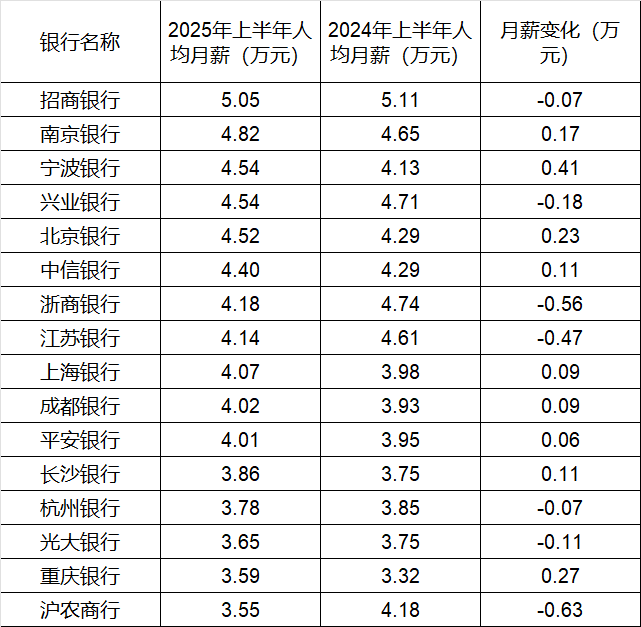
260万银行人,半年平均薪酬“曝光”,5家月薪超4.5万
Zhong Guo Ji Jin Bao· 2025-08-30 12:41
Core Insights - The average salary for bank employees in the first half of 2025 has slightly increased compared to the same period in 2024, with an average salary of 18.1 million yuan and an average monthly salary of 3.02 million yuan, reflecting a rise of approximately 1,300 yuan [2][4] - The salary trends show a balanced distribution, with about half of the banks increasing salaries while the other half decreased them [1][2] Salary Overview - The average monthly salary for major banks such as China Merchants Bank, Nanjing Bank, Ningbo Bank, Industrial Bank, and Beijing Bank exceeded 45,000 yuan in the first half of 2025 [1][2] - Specific monthly salaries for leading banks are as follows: China Merchants Bank at 50,500 yuan, Nanjing Bank at 48,200 yuan, and both Ningbo Bank and Industrial Bank at 45,400 yuan [2][3] Salary Changes - The salary changes for various banks from the first half of 2024 to the first half of 2025 are as follows: - China Merchants Bank: decreased by 700 yuan - Nanjing Bank: increased by 1,700 yuan - Ningbo Bank: increased by 4,100 yuan - Industrial Bank: decreased by 1,800 yuan - Beijing Bank: increased by 2,300 yuan [3] Employment and Compensation Strategy - The six major state-owned banks employ approximately 1.84 million people, accounting for over 70% of the total workforce in the banking sector [5] - State-owned banks are focusing on salary policies that favor grassroots employees, with initiatives to enhance compensation for those in county-level positions [5]