华为云

Search documents
古鳌科技20%涨停,金融科技ETF(516860)大涨3.50%,一季度中国云基础设施市场加速增长
Sou Hu Cai Jing· 2025-07-11 03:02
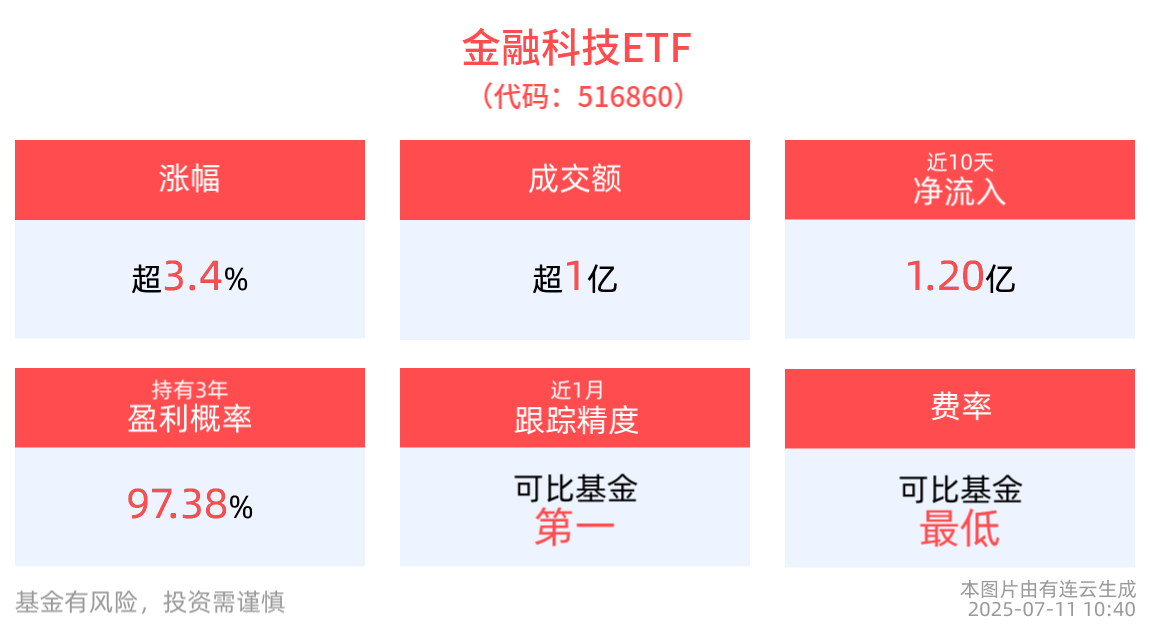
Group 1 - The core viewpoint of the news highlights the strong performance of the financial technology sector, with the China Securities Financial Technology Theme Index rising by 3.51% and key stocks like Guoao Technology and Anshuo Information seeing significant gains [3] - The Financial Technology ETF (516860) has shown a 4.08% increase over the past week, with a trading volume of 1.24 billion yuan and an active market turnover rate of 11.58% [3] - The State-owned Assets Supervision and Administration Commission (SASAC) emphasized the need to accelerate key core technology breakthroughs and promote innovation platform construction during a recent meeting [3] Group 2 - Canalys reported that spending on cloud infrastructure services in mainland China reached $11.6 billion in Q1 2025, marking a 16% year-on-year increase, with Alibaba Cloud holding a 33% market share [4] - The financial technology sector is increasingly integrating artificial intelligence, with domestic AI leaders focusing on core technology and industry application [4] - The latest scale of the Financial Technology ETF has reached 1.056 billion yuan [4] Group 3 - The Financial Technology ETF experienced a net outflow of 10.0653 million yuan recently, but has attracted a total of 120 million yuan over the past 10 trading days [5] - The ETF's net value has increased by 125.85% over the past year, ranking 3rd out of 2908 index stock funds [5] - The ETF has achieved a maximum single-month return of 55.92% since its inception, with an average monthly return of 10.60% [5] Group 4 - The Financial Technology ETF has a Sharpe ratio of 1.65 over the past year, indicating strong risk-adjusted returns [6] - The ETF has shown a relative drawdown of 0.44% compared to its benchmark this year, with the fastest recovery time among comparable funds [7] - The ETF's management fee is 0.50%, and its tracking error over the past month is 0.035%, the highest precision among comparable funds [7] Group 5 - The top ten weighted stocks in the China Securities Financial Technology Theme Index account for 51.2% of the index, with stocks like Dongfang Wealth and Tonghuashun leading the way [7]


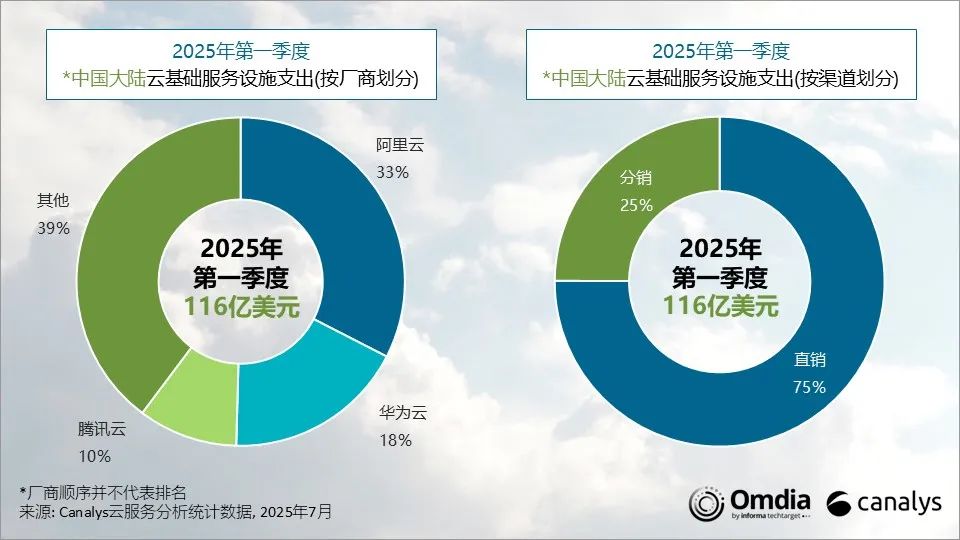
Canalys:一季度中国内地在云基础设施服务上的支出达到116亿美元 同比增长16%
智通财经网· 2025-07-11 02:24
Core Insights - The demand for AI is reshaping cloud computing applications, with organizations migrating AI workloads to the cloud and integrating AI capabilities into their data systems and business processes [2][3] - Major cloud vendors are exploring various strategic paths to bridge the gap between AI model capabilities and actual business needs, including open-sourcing AI models and developing AI agent platforms [2][3] Cloud Market Growth - In Q1 2025, spending on cloud infrastructure services in mainland China reached $11.6 billion, a year-on-year increase of 16%, driven primarily by AI-related demand [1] - The cloud services market is experiencing accelerated growth as enterprises expedite AI deployment, with a significant reliance on cloud-based GPU resources due to the high computational demands of large AI models [1] Market Share and Performance - Alibaba Cloud maintained its leading position in the mainland China cloud services market with a 33% market share, reflecting a 15% year-on-year growth, and its AI workloads have seen triple-digit growth for seven consecutive quarters [5] - Huawei Cloud, the second-largest cloud service provider, achieved an 18% revenue growth in Q1 2025, increasing its market share to 18% [6] - Tencent Cloud held a 10% market share in Q1 2025, facing short-term growth challenges due to internal resource prioritization affecting GPU supply [6][7] Strategic Developments - Alibaba Cloud has open-sourced its Qwen 3 model and launched a series of global expansion initiatives, including establishing an AI capability center in Singapore and new data centers in Malaysia and the Philippines [5] - Huawei Cloud introduced several AI technology updates, including the latest version of its foundational model suite "Pangu 5.5" and an enterprise-level AI agent development platform "ModelArts Versatile" [6] - Tencent Cloud upgraded its models and launched the "Tencent Cloud AI Agent Development Platform," enhancing its service capabilities in the Asia-Pacific market [7] Ecosystem and Collaboration - The importance of ecosystem partners is increasing as cloud vendors leverage open-source models and AI agent deployments to integrate AI capabilities with business value [3] - In Q1 2025, cloud service revenue driven by partnerships accounted for 25% of the overall market, with expectations for continued growth in this area [3]
一季度中国云基础设施市场加速增长
news flash· 2025-07-11 02:08
Core Insights - In Q1 2025, spending on cloud infrastructure services in mainland China reached $11.6 billion, representing a year-on-year growth of 16% [1] Company Market Share - Alibaba Cloud holds a 33% market share in the cloud services market in mainland China [1] - Huawei Cloud accounts for 18% of the market share [1] - Tencent Cloud has a 10% market share [1]

2025年第一季度,中国云基础设施市场加速增长,阿里云稳居第一,华为云与腾讯云加速AI布局
Canalys· 2025-07-11 01:52
Core Insights - The article highlights the significant growth in cloud infrastructure spending in mainland China, reaching $11.6 billion in Q1 2025, a 16% year-on-year increase, driven primarily by AI-related demand [1] - Major cloud vendors are increasing investments in AI infrastructure and model development to capitalize on this growth opportunity [1] - The article emphasizes the importance of partnerships and ecosystem collaboration in accelerating AI commercialization, with partner-driven cloud service revenue accounting for 25% of the overall market in Q1 2025 [1] Cloud Infrastructure Market Overview - In Q1 2025, Alibaba Cloud held a 33% market share in mainland China's cloud service market, followed by Huawei Cloud at 18% and Tencent Cloud at 10% [1] - The demand for AI capabilities is reshaping cloud computing applications, with organizations migrating AI workloads to the cloud and integrating AI into their data systems and business processes [1][2] - The ongoing iteration of AI large models is pushing AI capabilities towards more practical applications, prompting cloud vendors to explore various strategic paths [1] Vendor Strategies and Developments - Alibaba Cloud has fully open-sourced its Qwen 3 model and launched a series of initiatives to expand its global presence, including establishing an AI capability center in Singapore and a new data center in Malaysia [1][2] - Huawei Cloud has introduced several AI technology updates, including the latest version of its foundational model suite "Pangu 5.5" and an enterprise-level intelligent agent development platform "ModelArts Versatile" [2] - Tencent Cloud has faced temporary GPU supply constraints but has upgraded its models and launched the "Tencent Cloud Intelligent Agent Development Platform" to support rapid development and deployment of intelligent applications [2] AI Ecosystem and Collaboration - The article notes that the importance of ecosystem partners is increasing as AI productization accelerates, with both model open-sourcing and intelligent agent deployment driving the integration of AI capabilities with business value [1] - The collaboration among cloud vendors and partners is becoming a core driver of AI commercialization, with expectations for the partner-driven revenue share to continue rising [1]
“国家队”押注了一家AI“铺路人”
投中网· 2025-07-10 06:28
Core Viewpoints - The AI computing cloud industry is transitioning from technological exploration to a value explosion phase, with significant investments in infrastructure and operational costs [1][4] - The Chinese intelligent computing cloud market is experiencing explosive growth, with the infrastructure service market expected to reach 12.41 billion yuan in the second half of 2024, a year-on-year increase of 57.7% [2] - The emergence of "one degree of computing power" as a standardized measurement by companies like Nine Chapters Cloud is revolutionizing the billing model for AI services [3][20] Market Dynamics - The global GPU cloud market is projected to grow from $3.17 billion in 2024 to $47.24 billion by 2033, with a compound annual growth rate of approximately 35% [4] - Major players in the Chinese IaaS market include Alibaba Cloud with a 23% market share, followed by Huawei Cloud and Volcano Engine [2] - The traditional general-purpose computing services model is inefficient, leading to low resource utilization and high costs for small and medium enterprises [2] Company Insights - Nine Chapters Cloud, founded by Fang Lei, focuses on providing a comprehensive AI infrastructure platform, emphasizing the integration of big data and algorithms [6][8] - The company has completed multiple funding rounds, with significant investments from state-owned enterprises and venture capital, reflecting its potential in the AI infrastructure sector [10][15] - Nine Chapters Cloud's innovative approach includes a Serverless architecture and reinforcement learning to enhance computing efficiency, distinguishing it from traditional cloud service providers [20][21] Competitive Landscape - CoreWeave, a notable player in the vertical AI cloud market, has shown explosive revenue growth but remains in a loss-making position, highlighting the industry's rapid cash conversion potential [19][20] - Nine Chapters Cloud differentiates itself by focusing on specific AI training and inference needs, positioning itself as a "hidden champion" in the AI infrastructure space [22] - The valuation logic for Nine Chapters Cloud is expected to differ from that of general cloud giants like Alibaba Cloud, as it leverages its specialized technology and market depth [21][22]

千家客商云集 浙江濮院毛衫企业抱团亮出秋冬新品
Zhong Guo Xin Wen Wang· 2025-07-09 17:41
Core Insights - The fifth National (Autumn/Winter) Fashion Exhibition was held in the Puyuan Woolen Sweater Innovation Park, attracting over 2,000 merchants and showcasing new autumn and winter products from more than 100 enterprises [1][2] - Puyuan is recognized as the largest distribution center for woolen sweaters in China, with over 300 micro-enterprises focusing on fabric, style, and functional innovations [1][3] - The Innovation Park has achieved significant milestones, including 143 design patents and recognition of seven enterprises as "industry standard leaders" [1][2] Group 1: Industry Development - The Puyuan Woolen Sweater Innovation Park has been instrumental in fostering collaboration among micro-enterprises, leading to a doubling of customer engagement over the past three years [2] - The park's initiatives have garnered support from over 20,000 merchants nationwide, showcasing the resilience and cooperative spirit of small enterprises in a challenging economic environment [2][3] - The park's history dates back to 1976, marking the beginning of a significant industry evolution from a local market to a global presence [2] Group 2: Technological Integration - The integration of traditional craftsmanship with digital technology has significantly shortened design cycles and enabled flexible production capabilities [3] - The collaboration with Huawei Cloud aims to enhance the online exhibition and sales processes, reflecting a shift towards digital transformation in the industry [3] - The use of recycled wool yarn and solar energy in production highlights the industry's commitment to sustainability and environmental responsibility [3]
埃夫特继续出售巴西子公司股权 进一步优化资产结构
Zheng Quan Shi Bao Wang· 2025-07-09 13:10
Group 1 - The company announced the sale of a 22% stake in GME for €6 million (approximately RMB 50.38 million), reducing its ownership from 48.99% to 19.76% [1] - GME, primarily engaged in automotive industrial automation in Latin America, has been facing continuous losses, with projected revenues of €32.66 million and a loss of €6.23 million for 2024 [1] - The decision to divest is part of the company's strategy to focus resources, reduce operational costs, and optimize asset structure amid increasing uncertainties in the Brazilian market [1][2] Group 2 - The transaction is expected to help the company's subsidiary WFC implement a focused strategy, lower overall operational costs, and enhance asset structure while reallocating resources to the European market [2] - The company has seen a significant increase in robot shipments, with a projected growth of over 30% year-on-year in 2024, benefiting from its penetration in the electronics manufacturing and general industrial sectors [2] - The company is advancing plans to build a super factory, aiming for an annual production capacity of 50,000 high-performance industrial robots in the first phase and 100,000 upon full completion [3] Group 3 - The company is employing strategies such as "following customers abroad" and leveraging partnerships to penetrate international markets, with established operations in Southeast Asia, Europe, and South America [3] - A collaboration memorandum was signed with Huawei Cloud to focus on intelligent robotics product upgrades and ecosystem cooperation [3]

美团又又又投了一家「具身智能」公司|36氪独家
36氪· 2025-07-09 10:00
Core Viewpoint - The article discusses the recent strategic financing rounds of the embodied intelligence company "Xinghaitu," highlighting its significant growth and investment in the field of embodied intelligence, particularly in the context of the ongoing industrial revolution driven by AI [4][5]. Financing Overview - Xinghaitu has successfully completed A4 and A5 rounds of financing, raising over $100 million in total [4]. - The A4 round was led by Today Capital and Meituan Longzhu, with participation from various funds and existing shareholders, while the A5 round saw Meituan Longzhu and Meituan Investment leading the investment [5]. - The company has opted to label all financing in 2023 as part of the "A round series" due to the current stage of industry development, which is still focused on infrastructure building rather than large-scale application [5]. Investment Strategy - Meituan has been actively investing in the embodied intelligence sector, with previous investments in companies like Yushu Technology and Galaxy General [6]. - Xinghaitu's total financing scale for the A round series has reached nearly 1.5 billion RMB, with the latest round's valuation increasing by over three times since the beginning of the year [5]. Product Development - Xinghaitu is focusing on enhancing its "whole machine + intelligence" self-research capabilities, aiming to improve both software and hardware aspects, including the development of joint modules and production scale [5]. - The company has introduced the EFM-1 (Embodied Foundation Model-1), which integrates a large-scale visual language model with an action model to create a closed-loop decision-making process [8]. Technological Infrastructure - Xinghaitu has established a data platform (EDP) and is utilizing two different configurations of wheeled dual-arm robots for data collection in various environments [8][9]. - The company aims to provide a standardized infrastructure for global developers, facilitating the construction of a closed-loop system encompassing "body-data-model-application" [9]. Team Composition - The core team of Xinghaitu includes several AI and embodied intelligence algorithm scientists, as well as experienced professionals from the autonomous driving sector [11]. - The CEO, Gao Jiyang, has a strong academic background and extensive experience in computer vision, having previously worked at Waymo [11].

从“单点”到“生态”,百望股份如何编织AI生态网?
Tai Mei Ti A P P· 2025-07-09 09:34
Core Insights - The next phase of AI will focus on selling outcomes rather than just tools, representing a trillion-dollar opportunity as AI transitions from an efficiency tool to a cognitive partner [1] - Identifying suitable application scenarios is crucial for AI implementation, with smaller, granular scenarios being easier to deploy [2] - Companies like Baiwang are leveraging their industry know-how to explore AI applications across various sectors, enhancing operational efficiency and compliance [3][4] Group 1: AI Implementation and Industry Applications - The financial and tax sectors are particularly well-suited for AI due to their structured processes, with generative AI reshaping existing workflows [2] - Baiwang has significantly reduced the cost of invoice verification from 1-2 RMB to as low as 0.1 RMB using AI technology [2] - Baiwang is actively collaborating with various industries, including manufacturing and finance, to implement AI-driven solutions that enhance efficiency and decision-making [4][7] Group 2: Ecosystem Development and Strategic Partnerships - The evolution of AI requires a robust ecosystem, as no single company can cover the entire AI process from training to deployment [9][10] - Baiwang is forming strategic partnerships with leading cloud service providers and GPU chip manufacturers to enhance its AI capabilities [11][12] - The collaboration with companies like Alibaba Cloud and Mu Xi Technology aims to create a comprehensive AI ecosystem that integrates technology, data, and industry expertise [12][13] Group 3: Future Directions and Innovations - Baiwang is focusing on modular assembly of foundational capabilities to empower specific industry scenarios, transitioning from a tool supplier to an ecosystem enabler [8] - The company is developing a global compliance database and intelligent monitoring system to help clients navigate complex tax environments [6] - Baiwang's AI solutions are designed to provide end-to-end automation in compliance and risk management, showcasing the potential of AI to transform business operations [6][7]
企业数智化突围:雇佣“AI数智员工”军团
Sou Hu Cai Jing· 2025-07-09 03:44
Core Insights - The article discusses the unprecedented efficiency challenges faced by corporate marketing in the context of budget tightening and fragmented consumer attention, emphasizing the inadequacy of traditional marketing tools in dynamic market decision-making [2] - It highlights the evolution from traditional AI tools to AI Agents, which possess autonomous decision-making capabilities and can analyze data in real-time, thus providing a competitive edge [5][22] Group 1: AI Evolution - The article contrasts two types of AI in a restaurant setting: traditional AI, which merely executes tasks, and AI Agents, which proactively recommend and understand customer preferences, showcasing the shift from passive to active roles in marketing [5] - AI Agents are described as having a three-layer core engine: a sensory system for multi-dimensional perception, a decision engine for goal-driven task execution, and an action mechanism for real-world interaction [7][8][9] Group 2: Practical Applications - Case studies illustrate how AI Agents can transform marketing strategies, such as a dairy giant improving customer engagement through integrated data and automated marketing, and a government project utilizing AI Agents for economic analysis and ecosystem building [12][10] Group 3: Technological Foundation - The Tforce vertical model is highlighted as a specialized tool for marketing, capable of continuous evolution through reinforcement learning, which allows it to analyze past performance and optimize future strategies [14] Group 4: Marketing Paradigm Shift - The article outlines four fundamental changes driven by AI Agents: a leap in coverage from single tasks to full marketing workflows, an upgrade in decision-making based on real-time data, a transformation in user experience through personalized marketing, and a shift in marketing logic [16][19] Group 5: Strategic Actions for Companies - Companies are advised to take four key actions to implement AI Agents: upgrading infrastructure for data integration, piloting high-frequency scenarios for quick value realization, fostering human-machine collaboration, and establishing iterative mechanisms for continuous improvement [20][21]