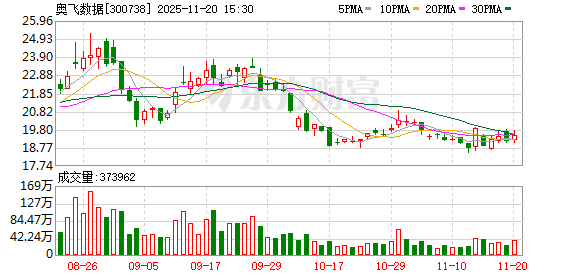
奥飞数据

Search documents
奥飞数据:拟向控股子公司提供不超5亿元财务资助并延期
Xin Lang Cai Jing· 2025-11-28 11:08
Core Viewpoint - The company announced a financial support plan for Aofei New Energy after its shareholding ratio decreased to 40.06% following a capital increase, which will result in a passive financial assistance situation [1] Financial Assistance Details - The company decided to provide financial assistance of up to 500 million yuan, effective until December 31, 2025 [1] - On November 28, 2025, the company agreed to extend this financial assistance for another year until December 31, 2026, with an interest rate of 5% [1] - As of the date of the verification opinion, the total balance of financial assistance provided by the company is 267.43 million yuan, accounting for 8% of the most recent audited net assets [1] - This matter is subject to approval by the shareholders' meeting [1]

奥飞数据(300738) - 关于奥飞转债2025年付息的公告
2025-11-28 11:05
关于奥飞转债 2025 年付息的公告 本公司及董事会全体成员保证信息披露的内容真实、准确和完整,没有虚假 记载、误导性陈述或者重大遗漏。 特别提示: 1、"奥飞转债"(债券代码:123131)将于 2025 年 12 月 3 日支付第四年利 息,每 10 张"奥飞转债"(每张面值为 100.00 元,10 张合计面值为 1,000.00 元) 利息为 18.00 元(含税); 2、债权登记日:2025 年 12 月 2 日(星期二); 3、除息日:2025 年 12 月 3 日(星期三); 4、付息日:2025 年 12 月 3 日(星期三); | 证券代码:300738 | 证券简称:奥飞数据 | 公告编号:2025-105 | | --- | --- | --- | | 债券代码:123131 | 债券简称:奥飞转债 | | 广东奥飞数据科技股份有限公司 5、本次付息期间及票面利率:计息期间为 2024 年 12 月 3 日至 2025 年 12 月 2 日,票面利率为 1.8%; 6、"奥飞转债"本次付息的债权登记日为 2025 年 12 月 2 日,截至 2025 年 12 月 2 日下午深圳证券交易 ...
奥飞数据(300738) - 国联民生证券承销保荐有限公司关于广东奥飞数据科技股份有限公司向控股子公司提供财务资助延期的核查意见
2025-11-28 11:04
国联民生证券承销保荐有限公司(以下简称"国联民生承销保荐"、"保荐人") 作为广东奥飞数据科技股份有限公司(以下简称"奥飞数据"、"公司")2022 年 向特定对象发行 A 股股票的保荐人,根据《证券发行上市保荐业务管理办法》《深 圳证券交易所创业板股票上市规则》《深圳证券交易所上市公司自律监管指引第 2 号——创业板上市公司规范运作》《深圳证券交易所上市公司自律监管指引第 13 号——保荐业务》等有关法律法规和规范性文件的要求,对奥飞数据向控股 子公司提供财务资助延期事项进行了审慎核查,具体情况及核查意见如下: 国联民生证券承销保荐有限公司 关于广东奥飞数据科技股份有限公司 向控股子公司提供财务资助延期的核查意见 一、财务资助延期事项概述 广东奥飞新能源股份有限公司(以下简称"奥飞新能源")通过增资扩股形 式引入新股东,该增资事项完成后,奥飞数据对奥飞新能源的持股比例由 51.00% 降至 40.06%,奥飞新能源仍系公司合并报表范围的控股子公司但持股比例不超 过 50%,致使公司因尚未收回对奥飞新能源的借款被动形成公司对奥飞新能源的 财务资助。 2024 年 12 月 27 日,公司召开第四届董事会第十四 ...
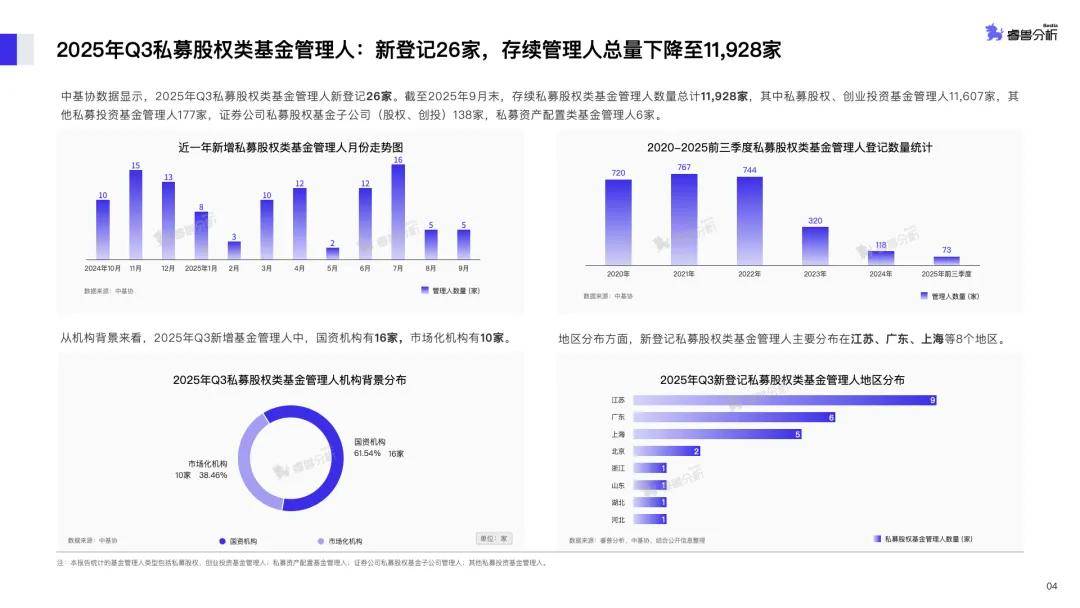
基金数量稳定增长,2025年Q3新备案1,366只私募股权类基金,披露认缴规模5,530.59亿人民币丨睿兽分析基金季报
创业邦· 2025-11-26 00:08
Core Insights - The article highlights the growth and trends in the private equity fund registration in China for Q3 2025, indicating a stable increase in the number of new funds and their total subscribed capital. Fund Registration Overview - A total of 1,366 new private equity funds were registered, with a disclosed subscribed capital of 553.06 billion RMB, reflecting a year-on-year increase of 14.42% [5][6] - The total number of active private equity fund managers decreased to 11,928 [5] Regional Performance - Zhejiang province led in both the number of new funds (298) and total subscribed capital (1,004.74 billion RMB), accounting for 37.47% of the national total [8][10] - Other notable regions include Guangdong and Jiangsu, with new fund numbers and capital of 555.91 billion RMB and 511.46 billion RMB respectively [10] Institutional Participation - A total of 990 institutions registered new private equity funds, with institutional participation increasing by 26.11% compared to the previous year [16] - Institutional Limited Partners (LPs) contributed over 90% of the fundraising, with state-owned LPs dominating the landscape [5][19] City Rankings - The top three cities for new fund registrations by number are Jiaxing (137), Qingdao (80), and Suzhou (72) [13] - Beijing, Shanghai, and Hangzhou ranked highest in terms of subscribed capital, collectively raising 1,040.81 billion RMB, which is 18.82% of the national total [14][15] LP Analysis - In Q3 2025, 1,242 state-owned LPs participated in fundraising, while 1,013 private LPs were involved, indicating a strong presence of institutional investors [19] - The average subscribed capital from institutional LPs was 1.87 million RMB, with personal LPs contributing a smaller share [19] Fundraising Dynamics - The fundraising activities were concentrated in regions like Zhejiang, Jiangsu, and Guangdong, with Zhejiang's institutional LPs leading in both frequency (369 times) and subscribed capital (825.43 billion RMB) [20][21] - The top ten active listed companies in terms of fund contributions included firms from sectors like renewable energy and healthcare, with significant percentages of their capital allocated to new funds [23]


英伟达800V架构重塑AI数据中心:31家产业链核心企业大起底
中关村储能产业技术联盟· 2025-11-25 06:22
Core Insights - The article discusses the significant energy demands of AI data centers, which can consume as much electricity as a small city, and highlights the need for advanced energy storage systems to manage power fluctuations effectively [2][4] - NVIDIA's recent release of the 800V DC architecture white paper indicates a shift towards integrating rapid-response energy storage systems in AI data centers, suggesting a potential explosive growth opportunity for the energy storage industry driven by AI [4][10] Group 1: Energy Architecture Evolution - The industry leaders, led by NVIDIA, have outlined a clear three-step evolution plan towards the 800V DC architecture for AI data centers [6] - The first step involves a transitional solution using "side-mounted power cabinets" to physically separate power modules from core computing areas [6] - The second step focuses on transitioning from a "distributed" to a "centralized" architecture [7] - The final step aims for a direct conversion from 10kV medium voltage AC to 800V DC using Solid State Transformers (SST) [9] Group 2: Hybrid Energy Storage Systems - To effectively manage power fluctuations, "hybrid energy storage" is identified as a necessary technological core, combining supercapacitors, high-rate batteries, and large-scale energy storage systems [10] - The new architecture requires advanced semiconductor technologies, such as silicon carbide (SiC) and gallium nitride (GaN), to meet the stringent demands of 800V high voltage [11] Group 3: Market Dynamics and Key Players - The surge in energy demand from AI and data centers has led to strategic competition among energy storage companies, including UPS suppliers and thermal management solution providers [16] - Major players in the energy storage market include: - **Sungrow Power Supply**: Actively developing power solutions for AI data centers, with plans to launch products by 2026 [19] - **Huawei**: Emphasizing energy digitalization for AI data centers, aiming for a secure, reliable, and low-carbon future [20] - **Kehua Data**: Focused on building data centers and HVDC solutions, with significant market presence [21][23] - **DuanDeng Co.**: Recognized as a "hidden champion" in data center energy storage, leading in battery shipments [24] - **Zhongtian Technology**: Engaged in lithium battery storage systems, with a strong production capacity [25] Group 4: Technological Innovations - The introduction of Solid State Transformers (SST) is highlighted as a revolutionary product that efficiently converts medium voltage AC to 800V DC, significantly reducing energy loss and saving substantial electricity annually for large data centers [11][12] - SSTs improve power quality and reduce the footprint of power systems, allowing for better space utilization in data centers [15] Group 5: Future Trends and Strategic Directions - The competition in the energy storage sector is shifting from hardware specifications to the intelligence of energy management systems, emphasizing the need for predictive capabilities and smart coordination among different energy storage units [15] - The article anticipates a transformation in business models, where the winners will be those who can provide integrated smart energy solutions rather than just hardware [15]


基金数量稳定增长,2025年Q3新备案1,366只私募股权类基金,披露认缴规模5,530.59亿人民币丨睿兽分析基金季报
Sou Hu Cai Jing· 2025-11-25 03:57
Core Insights - The private equity fund management sector has seen a decrease in the total number of active managers, now standing at 11,928, despite a stable growth in the number of newly registered funds [4][11] - A total of 1,366 new private equity funds were registered, with a disclosed subscribed capital of 553.06 billion RMB [4][5] - Zhejiang province leads in both the number of new funds (298) and total subscribed capital (1,004.74 billion RMB), significantly ahead of other regions [5][6] Fund Registration and Scale - In Q3 2025, 28 regions in China registered new private equity funds, with Zhejiang, Jiangsu, Guangdong, and Shandong accounting for 59.05% of the total funds disclosed [5][6] - The top three provinces by subscribed capital are Zhejiang (1,004.74 billion RMB), Guangdong (555.91 billion RMB), and Jiangsu (511.46 billion RMB), collectively representing 37.47% of the national total [5][6] City Rankings - The cities with the highest number of new registered funds in Q3 2025 are Jiaxing (137), Qingdao (80), and Suzhou (72) [7][8] - Beijing, Shanghai, and Hangzhou are the top three cities in terms of total subscribed capital, with amounts of 362.42 billion RMB, 353.01 billion RMB, and 325.38 billion RMB respectively, totaling 1,040.81 billion RMB, which is 18.82% of the national total [8][9] Institutional Participation - A total of 990 institutions registered new private equity funds in Q3 2025, marking a 26.11% increase compared to the same period last year [11] - Among these institutions, 77 registered three or more funds, accounting for 7.78% of the total, while 736 institutions registered one fund, making up 74.34% [11] LP Contribution Analysis - Institutional Limited Partners (LPs) contributed over 90% of the fundraising, with state-owned LPs dominating the landscape [13][14] - In Q3 2025, 1,242 state-owned LPs participated, contributing a total of 761.58 billion RMB, which is 44.74% of the total subscribed capital [14] Active Listed Companies - The most active listed companies in terms of fund participation include Xiehe New Energy, Haili Star, and Baofeng Energy, with significant contributions to various funds [18]
华为发布AI容器技术Flex:AI,国产算力再次突破
China Post Securities· 2025-11-24 05:50
Investment Rating - The industry investment rating is "Outperform the Market" and is maintained [1] Core Insights - The report highlights the launch of Huawei's AI container technology Flex:ai, which addresses the low utilization efficiency of computing power in the industry, currently averaging only 30% to 40%. Flex:ai enhances utilization by 30% through precise segmentation of GPU/NPU resources [4][5] - The report emphasizes the unique advantages of Flex:ai over Nvidia's Run:ai, particularly in virtualization and intelligent scheduling, which can optimize resource allocation for AI workloads [5][6] - The development of Flex:ai is seen as a significant step in strengthening domestic computing power capabilities, promoting a complete open-source ecosystem for AI tools [6][7] Summary by Sections Industry Overview - The closing index is at 5068.36, with a 52-week high of 5841.52 and a low of 3963.29 [1] Performance Analysis - The relative performance of the computer industry compared to the CSI 300 index shows fluctuations, with a notable decline of 13% from November 2024 to November 2025 [3] Key Developments - Huawei's Flex:ai is positioned to significantly improve AI cluster computing efficiency and reduce migration barriers for AI models, reinforcing the software capabilities in the domestic computing landscape [6][7] - The report suggests monitoring companies involved in AI containers and domestic computing power, including BoRui Data, Haohan Deep, and others [7]
中证1000增强ETF(159679)开盘涨0.93%
Xin Lang Cai Jing· 2025-11-24 01:39
Group 1 - The core point of the article highlights the performance of the Zhongzheng 1000 Enhanced ETF (159679), which opened with a gain of 0.93% at 1.194 yuan [1] - The top holdings of the ETF include companies such as Xingyuan Material, which rose by 2.07%, and Dajin Heavy Industry, which increased by 5.67% [1] - The fund's performance benchmark is the Zhongzheng 1000 Index return, managed by Guotai Fund Management Co., with a return of 18.32% since its inception on February 9, 2023, and a recent one-month return of -4.08% [1]



基金市场一周观察(20251117-20251121):股跌债分化,金融地产基金平均跌幅较小
CMS· 2025-11-23 07:32
1. Report Industry Investment Rating The provided content does not mention the industry investment rating. 2. Core Viewpoints of the Report - This week, the equity market declined across the board, with the large - cap value style being relatively resilient and the North - Star 50 index experiencing a significant decline. Among industries, the banking sector had the smallest decline, while the power equipment & new energy and comprehensive sectors had larger declines [1][2][6]. - The average return of all - market active equity funds was - 4.83%. Funds with better performance were heavily invested in the automobile and banking industries. Among industry - themed funds, financial and real estate funds had relatively leading average returns, while pharmaceutical sector funds had relatively lagging average returns [2][11]. - In the bond market, the interest - rate bond market declined, the credit - bond market rose, and the convertible - bond market declined. The average returns of short - term and medium - to - long - term bond funds were 0.02%, while the average returns of equity - linked bond funds and convertible - bond funds were negative [1][2]. - As of November 19, 2025, the average returns of low - risk, medium - risk, and high - risk FOF funds in the sample in the past week were - 0.43%, - 1.12%, and - 1.55% respectively [2]. - During the statistical period, the average declines of equity - oriented, index - type, other - type, and bond - type QDII funds were 2.96%, 3.45%, 1.89%, and 0.20% respectively. This week, REITs declined by an average of 1.20% [2]. 3. Summary According to Relevant Catalogs 3.1 Market Review - The equity market declined across the board this week. The Shanghai - Shenzhen 300 Index closed at 4454 points, down 3.77%; the Shanghai Composite Index closed at 3835 points, down 3.9%; the Shenzhen Component Index closed at 12538 points, down 5.13%; and the ChiNext Index closed at 2920 points, down 6.15%. In the Hong Kong stock market, the Hang Seng Index declined by 5.09% and the Hang Seng Tech Index declined by 7.18% [6]. - In terms of industries, the banking sector declined the least, by 0.87%, while the power equipment & new energy and comprehensive sectors declined by 9.41% and 9.47% respectively [9]. 3.2 Key Fund Tracking 3.2.1 Active Equity - **Fund Performance**: The average return of all - market funds in the sample this week was - 4.83%. Funds with better performance were heavily invested in the automobile and banking industries. Among industry funds, financial and real estate funds had relatively leading average returns, while pharmaceutical sector funds had relatively lagging average returns [11][12]. - **Position Estimation**: This week, the positions of common stock - type and partial - stock hybrid funds both decreased. Compared with the previous week, the position of common stock - type funds decreased by 0.31 percentage points, and that of partial - stock hybrid funds decreased by 0.05 percentage points. Actively managed partial - stock funds increased their allocation to consumption, finance, and cyclical sectors and reduced their allocation to stable and growth sectors [17]. 3.2.2 Bond - Type Funds - **Bond Market Performance**: The credit - bond market rose this week. The ChinaBond Total Wealth Index closed at 246.39, down 0.01% from last week; the ChinaBond Treasury Bond Index closed at 246.64, down 0.05% from last week; and the ChinaBond Credit Bond Index closed at 225.09, up 0.04% from last week. The convertible - bond market declined, with the CSI Convertible Bond Index closing at 482.94, down 1.78% week - on - week, and the trading volume was 318 billion yuan, a decrease of 31.316 billion yuan from last week [20][22]. - **Fund Performance Overview**: The average return of short - term bond funds this week was 0.02%, and the median was 0.03%; the average return of medium - to - long - term bond funds was 0.02%, and the median was 0.02%. The average returns of first - tier and second - tier bond funds were - 0.16% and - 0.77% respectively. The average return of partial - bond hybrid funds was - 1.1%, and the median was - 0.99%; the average return of low - position flexible - allocation funds was - 0.84%, and the median was - 0.67%. The average return of convertible - bond funds was - 2.41%, and the median was - 2.4% [25][27][29]. 3.2.3 FOF As of November 19, 2025, the average returns of low - risk, medium - risk, and high - risk FOF funds in the sample in the past week were - 0.43%, - 1.12%, and - 1.55% respectively [2][32]. 3.2.4 QDII During the statistical period, the average declines of equity - oriented, index - type, other - type, and bond - type QDII funds were 2.96%, 3.45%, 1.89%, and 0.20% respectively [2]. 3.2.5 REITs This week, REITs declined by an average of 1.20%. Among them, CICC Yizhuang Industrial Park REIT had a relatively high increase, rising 0.96% in the past week. China Asset Management CR Land Ucommune REIT had the highest liquidity, with a trading volume of 128.2851 million yuan in the past week [36][37].
奥飞数据:关于不提前赎回奥飞转债的公告
Zheng Quan Ri Bao· 2025-11-20 13:09
Core Points - The company announced that it will not exercise the early redemption rights for the "Aofei Convertible Bonds" during the specified period from November 21, 2025, to May 20, 2026 [2] - The board will reassess the situation and decide on the early redemption rights if the conditional redemption clauses are triggered again after May 20, 2026 [2] Summary by Categories - **Company Decision** - The board of directors has approved the decision not to redeem the "Aofei Convertible Bonds" early [2] - The company will not exercise the early redemption rights for the next six months [2] - **Future Considerations** - If the conditional redemption clauses are triggered again after May 20, 2026, the company will hold a board meeting to decide on the early redemption rights [2] - The company commits to fulfilling its information disclosure obligations as per relevant laws and regulations [2]