成都银行

Search documents
契合中长期资金配置方向?红利低波ETF(512890)交投活跃,近60个交易日吸金53亿元!
Xin Lang Cai Jing· 2025-12-18 04:35
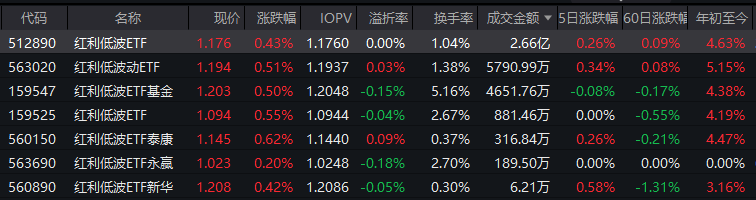
Core Viewpoint - The Hongli Low Volatility ETF (512890) has shown strong performance and investor interest, with significant net inflows and a solid historical return since its inception in December 2018 [1][5][12]. Fund Performance - The Hongli Low Volatility ETF (512890) recorded a price of 1.176 CNY, reflecting a 0.43% increase, with a trading volume of 2.66 billion CNY, making it the top performer among similar ETFs [3][6]. - Since its establishment, the fund has achieved a return of 133.84%, significantly outperforming its benchmark and ranking 77th among 502 products [12]. Fund Inflows - The fund has attracted substantial capital, with net inflows of 7.9 billion CNY over the last 5 trading days, 4.7 billion CNY over the last 20 days, and 53 billion CNY over the last 60 days, indicating strong investor confidence [1][8]. Holdings Performance - The top ten holdings of the Hongli Low Volatility ETF exhibited mixed performance, with notable movements including a 2.03% increase in Nanjing Bank and a 1.46% decrease in COFCO Sugar [4][10]. Regulatory Environment - The China Securities Regulatory Commission (CSRC) is promoting long-term capital investment strategies and enhancing market stability, which supports the growth of equity public funds and index investment [11]. - The new "National Nine Articles" policy clarifies requirements for listed companies regarding market capitalization management and dividend distribution, further supporting the low volatility dividend strategy [11].

关于发布2023—2024年度四川银行业履行社会责任工作示范单位名单的公告
Si Chuan Ri Bao· 2025-12-17 22:17
Core Viewpoint - The Sichuan banking industry is committed to implementing the spirit of the 20th National Congress of the Communist Party, focusing on five key areas: technology finance, green finance, inclusive finance, pension finance, and digital finance, to support high-quality economic development in Sichuan [1] Group 1: Industry Initiatives - Sichuan banking institutions are actively integrating into the new development pattern and enhancing their role in modern industrial construction, regional coordination, and safeguarding consumer rights [1] - The Sichuan Banking Association has initiated a social responsibility evaluation for the 2023-2024 period, recognizing 34 institutions for their exemplary social responsibility practices [1] Group 2: Recognized Institutions - Notable institutions recognized for their social responsibility include the China Development Bank Sichuan Branch and the Industrial and Commercial Bank of China Sichuan Branch, among others [1][2] - Categories of recognition include best inclusive finance institutions, best rural revitalization finance institutions, and best technology finance institutions, highlighting the diverse contributions of various banks [2]
又一消金公司,计划大规模增资
Zheng Quan Shi Bao· 2025-12-17 04:33
Core Viewpoint - Changyin 58 Consumer Finance plans to raise capital up to 1.55 billion yuan to enhance its capital strength and risk resistance capabilities, with the final amount subject to regulatory approval [1][2][3]. Group 1: Capital Increase Details - Changyin 58's registered capital will increase from 1.124 billion yuan to 1.945 billion yuan after the capital increase and share transfer [1][3]. - The shareholding of Changsha Bank will rise from 56.66% to 80.82%, while Beijing Wanglin and Tongcheng Holdings will see their shares decrease to 15.27% and 3.91%, respectively [3]. - The capital increase is priced at 1.8877 yuan per share, with Tongcheng Holdings planning to transfer 114 million shares to Changsha Bank for approximately 215 million yuan [2][3]. Group 2: Historical Context and Regulatory Changes - Changyin 58 was established in early 2017 with an initial registered capital of 300 million yuan, with Changsha Bank holding 51% [2]. - The company underwent a capital increase in 2019, raising its capital to 900 million yuan while maintaining the same shareholding structure [2]. - The revised "Consumer Finance Company Management Measures" will raise the minimum registered capital requirement from 300 million yuan to 1 billion yuan, effective March 2024 [2]. Group 3: Financial Performance - As of the end of last year, Changyin 58 had total assets of approximately 29.62 billion yuan, with a projected revenue of about 3 billion yuan and a net profit of 34 million yuan, reflecting a year-on-year decline of 7.6% and 95%, respectively [3]. - By the end of September this year, the company's asset scale expanded to over 34.6 billion yuan, with a net profit of 21 million yuan for the first three quarters [3]. Group 4: Industry Trends - At least seven other consumer finance companies have completed capital increases this year, indicating a trend towards strengthening capital bases across the industry [4][5][6]. - The regulatory environment is pushing companies to enhance their capital strength to meet new requirements, as seen in the recent issuance of the "Consumer Finance Company Regulatory Rating Measures" [7].

又一消金公司,计划大规模增资
证券时报· 2025-12-17 04:14
Core Viewpoint - Changyin 58 Consumer Finance plans to raise capital up to 1.55 billion yuan to enhance its capital strength and risk resistance, with the registered capital increasing from 1.124 billion yuan to 1.945 billion yuan after the capital increase and share transfer [1][4]. Group 1: Capital Increase Details - Changsha Bank announced a plan to invest up to 1.55 billion yuan in Changyin 58, with the final amount subject to regulatory approval [1][4]. - The capital increase will be priced at 1.8877 yuan per share, and after the completion, Changsha Bank's shareholding will rise from 56.66% to 80.82% [1][4]. - The remaining shareholders, including Tongcheng Holdings and Beijing Wanglin, will not participate in this round of capital increase [1][4]. Group 2: Historical Context - Changyin 58 was established in early 2017 with an initial registered capital of 300 million yuan, with Changsha Bank holding 51% [3]. - The company underwent a capital increase in 2019, raising its capital to 900 million yuan while maintaining the same shareholding structure [3]. - Following the release of the revised "Management Measures for Consumer Finance Companies," which raised the capital threshold to 1 billion yuan, Changyin 58 was the first to disclose a capital increase plan, raising its capital to 1.124 billion yuan in October 2024 [3]. Group 3: Financial Performance - As of the end of last year, Changyin 58 had total assets of approximately 29.62 billion yuan, with a revenue of about 3 billion yuan and a net profit of 34 million yuan, reflecting a year-on-year decline of 7.6% and 95% respectively [4]. - By the end of September this year, the company's asset scale expanded to over 34.6 billion yuan, with a net profit of 21 million yuan for the first three quarters [4]. Group 4: Industry Trends - In addition to Changyin 58, at least seven other consumer finance companies have completed capital increases this year, indicating a trend in the industry towards strengthening capital bases [6][8]. - The revised regulations and the new regulatory rating measures emphasize the importance of capital management, which will influence the operational scope of consumer finance companies [9].

金融力量与城市温度共融共生 成都银行获评“最具社会责任上市公司”
Mei Ri Jing Ji Xin Wen· 2025-12-16 12:20
Core Viewpoint - Chengdu Bank has been recognized as the "Most Socially Responsible Listed Company" at the 2025 14th Annual Development Conference for Listed Companies, highlighting its commitment to social responsibility and sustainable development [1] Group 1: Business Performance - For the first nine months of 2025, Chengdu Bank achieved an operating income of 17.761 billion yuan, a year-on-year increase of 3.01%, and a net profit attributable to shareholders of 9.493 billion yuan, up 5.03% year-on-year [3] - As of September 2025, total deposits reached 986.432 billion yuan, an increase of 100.573 billion yuan or 11.35% since the beginning of the year, while total loans exceeded 847.481 billion yuan, growing by 104.9 billion yuan or 14.13% [3] - The bank's total assets surpassed 1.38 trillion yuan, reflecting a steady growth of 10.81% since the start of the year, with a non-performing loan ratio of 0.68%, indicating strong asset quality [3] Group 2: Strategic Development - Chengdu Bank has established three major business pillars: government-finance cooperation, entity business, and individual financial liabilities, successfully becoming the first city commercial bank in the West to exceed 1 trillion yuan in asset scale in 2023 [2] - The bank is focusing on new strategic planning to explore growth drivers in areas such as entity business, retail asset management, wealth management, and international business [2] - The bank's commitment to social responsibility is integrated into its development strategy, emphasizing service to the real economy and enhancing public welfare [1][6] Group 3: Innovation and Technology - Chengdu Bank has been recognized for its financial technology capabilities, maintaining a leading position among city commercial banks in China, with over 5 million mobile banking users and 1.43 million monthly active users as of mid-2025 [10] - The bank has launched a "Ruin Garden Benefit Enterprise" financial initiative to support industrial parks, aiming to provide over 50 billion yuan in credit support by the end of 2025 [7] - The bank has also issued 3 billion yuan in green financial bonds, leading the market in green credit with a compound growth rate exceeding 90% [8] Group 4: Community Engagement and Social Responsibility - Chengdu Bank has actively engaged in community service, conducting over 800 volunteer activities in the previous year, benefiting more than 24,000 people [11] - The bank has implemented a comprehensive service model to support major projects and industrial upgrades, with significant credit investments in the Chengdu-Chongqing economic circle [6][12] - The bank's commitment to social responsibility includes promoting agricultural finance services and supporting rural revitalization projects [12]
小红日报 | 孚日股份涨停,标普红利ETF(562060)标的指数收涨0.17%
Xin Lang Cai Jing· 2025-12-16 01:04
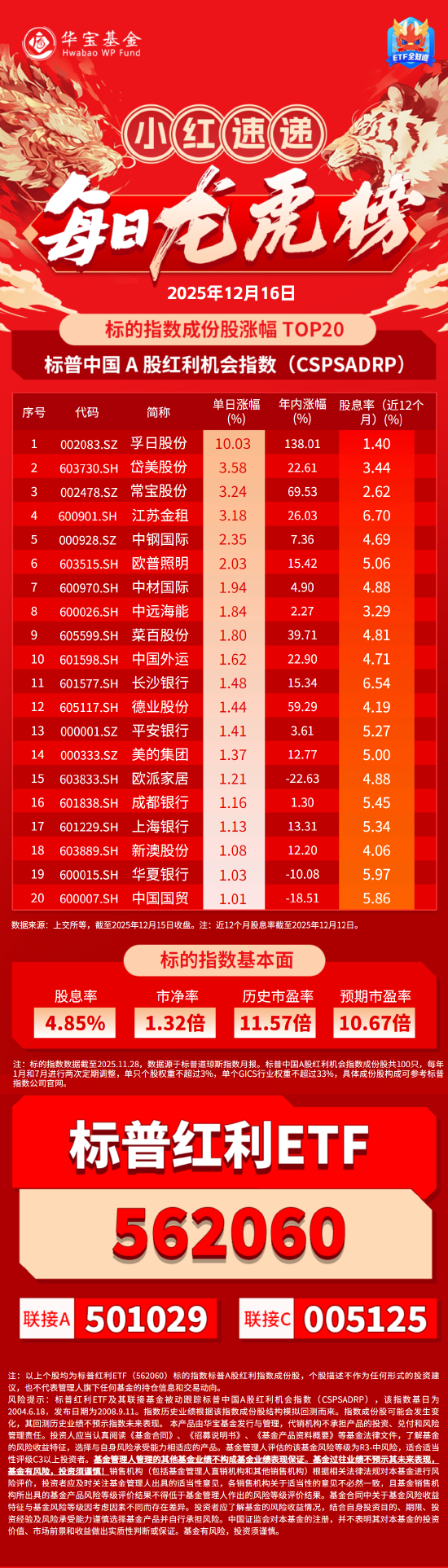
Core Insights - The article highlights the top 20 stocks in the S&P China A-Share Dividend Opportunity Index (CSPSADRP) based on their performance and dividend yield as of December 15, 2025 [1][4] Group 1: Stock Performance - The top-performing stock is LuRi Co., Ltd. (002083.SZ) with a daily increase of 10.03% and a year-to-date increase of 138.01% [1][4] - Dai Mei Co., Ltd. (603730.SH) ranks second with a daily increase of 3.58% and a year-to-date increase of 22.61% [1][4] - Changbao Co., Ltd. (002478.SZ) follows with a daily increase of 3.24% and a year-to-date increase of 69.53% [1][4] Group 2: Dividend Yields - Jiangsu Jinzhong (600901.SH) offers the highest dividend yield among the top 20 stocks at 6.70% [1][4] - Other notable dividend yields include Changsha Bank (601577.SH) at 6.54% and Huaxia Bank (600015.SH) at 5.97% [1][4] - The average dividend yield for the top 20 stocks varies, with several companies offering yields above 5% [1][4] Group 3: Additional Stock Insights - The performance of stocks like Midea Group (000333.SZ) shows a year-to-date increase of 12.77% despite a daily increase of only 1.37% [1][4] - Some stocks, such as Oppein Home Group (603833.SH), have experienced a year-to-date decline of 22.63% [1][4] - The data reflects a diverse range of performance and dividend strategies among the top stocks in the index [1][4]





韩文秀:将根据形势变化出台增量政策;部分银行启动消费贷贴息业务受理|每周金融评论(2025.12.8-2025.12.14)
清华金融评论· 2025-12-15 09:59
Core Insights - The article discusses the overall stability and progress of the national economy in November, highlighting key economic indicators and government policies aimed at boosting consumption and financial collaboration [4][8][12]. Group 1: Economic Performance - In November, the national economy continued to show a stable and progressive development trend, with significant growth in industrial production, particularly in equipment manufacturing and high-tech sectors [8]. - The total grain output for the year is expected to exceed 1.4 trillion jin, indicating a stable agricultural sector [8]. - The consumer price index (CPI) rose by 0.7% year-on-year in November, with a notable increase in food prices, particularly pork, which saw a decrease of 15.0% [14][15]. Group 2: Government Policies - The National Financial Supervision Administration has officially released the "Bank-Insurance Connection System Interface Specification" industry standard, which aims to enhance the efficiency of bank-insurance collaboration and reduce integration costs [10][11]. - The Ministry of Commerce, the People's Bank of China, and the Financial Regulatory Authority jointly issued a notice to strengthen the collaboration between commerce and finance, proposing 11 policy measures to stimulate consumption [12][13]. Group 3: Future Economic Outlook - Han Wenxiu indicated that in 2026, new incremental policies will be introduced based on changing circumstances, aiming to synergize existing policies to promote economic stability and growth [8][10]. - The Federal Reserve's recent decision to lower interest rates by 25 basis points is part of a broader strategy to address economic uncertainties and support the labor market [13].
消费贷贴息百日,更多地方性银行加入“地补”
Di Yi Cai Jing Zi Xun· 2025-12-14 15:06
Group 1 - The core viewpoint of the article highlights the implementation of the consumer loan interest subsidy policy, referred to as "financial national subsidy," which has been in effect for over a hundred days, showing increased bank lending but limited recovery in consumer credit demand [2][6] - Major state-owned and joint-stock banks have significantly increased their personal consumption loan issuance since September, with China Bank issuing 47.4 billion yuan in September alone, marking a 26.11% increase year-to-date [3][4] - Regional banks are also joining the initiative, raising loan limits to 500,000 to 1 million yuan, with some small banks offering up to 2 million yuan, promoting loans for various consumer purposes [4][5] Group 2 - Despite the increased loan limits, many banks maintain strict customer screening, with loans over 300,000 yuan primarily available to stable income groups, limiting the impact on broader consumer segments [5] - The overall demand for consumer loans remains weak, with a net decrease of 206 billion yuan in household loans in November, indicating a sluggish recovery in consumer credit [5][6] - The shift from "national subsidy" to "local subsidy" is evident as local governments begin to implement their own consumer loan interest subsidy policies, aiming to stimulate local consumption and activate regional markets [6][7]

消费贷贴息百日,更多地方性银行加入“地补”
第一财经· 2025-12-14 14:58
Core Viewpoint - The implementation of the consumer loan interest subsidy policy, referred to as "financial national subsidy," has been ongoing for over a hundred days, with banks increasing their lending pace, but the recovery in consumer credit demand remains sluggish [3][4]. Group 1: Bank Lending Dynamics - The new personal consumption loan interest subsidy policy, effective from September 1, aims to lower financing costs for residents and stimulate consumption [5]. - Major state-owned and joint-stock banks have significantly increased their personal consumption loan issuance since September, with China Bank issuing 47.4 billion yuan in September alone, marking a 26.11% increase year-to-date [5][6]. - Regional banks are also ramping up their consumer loan offerings, with some increasing loan limits to 500,000 to 1 million yuan, and even up to 2 million yuan in certain cases [6][7]. Group 2: Demand and Market Challenges - Despite the increased lending, the demand for consumer loans remains weak, with household loans only increasing by 533.3 billion yuan in the first eleven months, and short-term loans decreasing by 732.8 billion yuan [7][8]. - The overall consumer credit demand is constrained by a sluggish real estate market and slow recovery in income expectations, leading to a lack of willingness among residents to leverage [7][8]. Group 3: Transition from National to Local Subsidies - The policy is transitioning from a national subsidy to local subsidies, with various regions like Sichuan and Guizhou implementing their own consumer loan interest subsidy measures [9][10]. - Local subsidies are more targeted, focusing on local consumption and implemented through local banks, which aims to stimulate regional markets [10]. - The local subsidy approach is seen as a way to leverage limited fiscal resources to boost consumer spending and bank lending [10]. Group 4: Policy Direction and Future Outlook - The central government's focus remains on boosting resident consumption as a key macroeconomic strategy, with recent meetings emphasizing the need for financial institutions to support domestic demand [11].

【转|太平洋金融-银行深度】风格再平衡下的避风港:银行股四季度配置价值探讨
远峰电子· 2025-12-14 12:06
Core Viewpoint - The banking sector is expected to present new investment opportunities as market styles shift, with a high probability of a resurgence in bank stocks in Q4 2025, particularly favoring quality regional banks and high-dividend large banks [1][2][5] Market Style Shift - The current market exhibits a "technology strong, weight weak" seesaw effect, with the technology sector showing significant volatility and growth, while the banking sector has lagged behind, indicating a potential for recovery [8][10] - The banking sector's price-to-book (PB) ratio remains at historical lows of 0.6-0.8, contrasting with the high valuations of the technology sector [1][8] Policy Environment - The banking sector benefits from favorable policies, including a significant reduction in deposit rates, which lowers banks' funding costs and supports their interest margins [2][24] - As of September 30, 2025, the dividend yield for bank stocks reached 4.40%, significantly higher than the 2.79% yield of the CSI 300 index, indicating a strong income advantage for investors [2][24] Funding Environment - There is a structural shift in funding flows, with increased allocation of risk-averse and long-term funds towards bank stocks, enhancing their funding advantages [2][26] - The asset quality of banks is steadily improving, with non-performing loan ratios decreasing from 1.59% to 1.49% between Q1 2024 and Q2 2025, and the provision coverage ratio increasing from 204.54% to 211.97% [2][29] Performance Analysis - The banking sector has shown strong performance from the end of 2024 to mid-2025, with the Shenwan Banking Index rising by 13.10% in the first half of 2025, outperforming the broader market [16][19] - Quality regional banks like Jiangsu Bank have demonstrated significant profit growth, with a 8.84% increase in net profit year-on-year in Q3 2025, highlighting their operational resilience [5][59] Investment Strategy - The fourth quarter is expected to see a "performance differentiation and valuation rebalancing" pattern, with banks positioned as core investment targets due to their low valuations, improving fundamentals, and attractive dividend yields [74] - Large state-owned banks such as ICBC and CCB are recommended for conservative investors due to their stable high dividends and strong financial positions [63][74] - Regional banks like Chengdu Bank and Suzhou Bank are also highlighted for their growth potential and solid asset quality, benefiting from regional economic advantages [70][74]