
易方达基金

Search documents
从ETF入手,基金“名称雷同”难题迎来解决曙光
券商中国· 2025-11-23 04:12
"300ETF""50ETF基金"指什么? 根据近日下发的《上海证券交易所基金业务指南第1号——业务办理(2025年11月修订)》,基金简称包括扩 位简称和短简称,短简称长度不超过8个字节,扩位简称不得短于证券简称且不超过28个字节(本所为特殊标 识预留2个字节)。基金扩位简称应当取自基金名称,并与实际投资标的相符、含义清晰、指向明确,不产生 误导和歧义。 困扰基金业已久的基金"名称雷同"难题,迎来解决曙光。 近日,交易所发布修订版基金业务办理通知,对基金命名进行规范。本次规范针对的是ETF产品,对其命名提 出细致要求,包括命名规则和期限。存量ETF基金扩位简称,必须包含基金管理人,且需在2026年3月31日前 完成产品更名。从券商中国记者梳理来看,当前部分ETF简称过于简化,管理人信息缺失、指数指向不明,使 得ETF产品名字高度雷同。 除了ETF外,普通基金的命名雷同情况同样明显,既有频繁使用"价值""成长"等字眼命名情况,也有简称缺失 基金投资类型、管理人名称过于简化等情况。加上基金公司、银行、券商、互联网平台等多方主体使用,同一 只基金在不同平台上更是出现多种简称。分析人士对券商中国记者表示,随着基金数 ...

火速获批,增量资金来了
Zhong Guo Zheng Quan Bao· 2025-11-22 23:36
Core Viewpoint - On November 21, 16 hard technology-themed funds were approved, including the first batch of 7 AI ETFs, 3 chip ETFs, and 4 chip design ETFs, indicating strong regulatory support for the hard technology sector [1][3]. Group 1: Fund Approvals - A total of 16 hard technology-themed funds were approved on the same day, with multiple products from several fund companies, such as E Fund and GF Fund [1][3]. - Some products were approved on the same day they were submitted for review, indicating a streamlined approval process [3]. Group 2: Market Impact - The approval of these funds is expected to provide quality index investment tools for investors looking to participate in cutting-edge technology sectors [3][5]. - The recent volatility in the A-share technology sector, influenced by concerns over an overseas AI bubble, highlights the importance of these new funds in attracting more capital to innovative fields [3]. Group 3: Industry Trends - The newly approved products cover key areas such as AI and semiconductor industries, facilitating easier access for investors to the semiconductor supply chain [5]. - The ongoing expansion of hard technology fund offerings reflects a broader trend of fund companies increasing their focus on hard technology investments [6]. Group 4: Performance and Offerings - E Fund has launched various products, including the Sci-Tech 50 ETF and AI ETF, providing diverse investment options for both onshore and offshore investors [6]. - GF Fund has established a strong presence with 6 products focused on the Sci-Tech board indices, achieving significant performance with its Sci-Tech 100 Enhanced ETF, which has outperformed its benchmark [6].
火速获批!增量资金来了
Zhong Guo Zheng Quan Bao· 2025-11-22 14:17
Group 1 - On November 21, 16 hard technology-themed funds were approved, including the first batch of 7 AI ETFs, 3 chip ETFs, and 4 chip design ETFs, involving multiple fund managers such as E Fund, GF Fund, and Invesco Great Wall [1][2] - Some products were approved on the same day they were accepted, indicating a quick response from regulators to support the hard technology sector [2] - The approval of these funds reflects regulatory support for hard technology sectors, aiming to attract more capital into AI and innovation fields, thus providing strong capital support for cultivating new productive forces [2][3] Group 2 - The newly approved products cover cutting-edge fields like AI and chips, providing convenient tools for investors to precisely target the semiconductor industry [3] - Fund companies have been increasingly focusing on hard technology fund products, with E Fund and GF Fund launching various ETFs that cover broad-based, thematic, and style factor indices [3] - In terms of scale and liquidity, GF Fund's products, such as the Sci-Tech 50 ETF and AI ETF, rank among the top in their category, with the Sci-Tech 100 Enhanced ETF showing a year-to-date increase of 43.21%, outperforming the Sci-Tech 100 index's 37.83% increase [3]
官宣!银行系公募巨头,新总经理到任!
券商中国· 2025-11-22 09:42
Core Viewpoint - The appointment of Yang Fan as the new General Manager of ICBC Credit Suisse Asset Management marks a significant leadership change within the company, reflecting broader trends in the public fund industry where over 400 executives have changed roles this year [2][5]. Group 1: Leadership Changes - Yang Fan has been appointed as the General Manager of ICBC Credit Suisse Asset Management, with Zhang Hua as the Deputy General Manager, both of whom have extensive backgrounds in the Industrial and Commercial Bank of China (ICBC) [2][3]. - Yang Fan is the fourth General Manager in the 20-year history of ICBC Credit Suisse Asset Management, following the departure of the previous General Manager, Gao Chong, in August 2025 [3][4]. - The leadership changes at ICBC Credit Suisse Asset Management were approved by the company's board and reported to regulatory authorities [3]. Group 2: Industry Trends - Over 400 executives have changed roles in the public fund industry this year, with notable trends including the retirement of senior executives, restructuring in smaller fund companies, and fund managers stepping down from executive roles to focus on investment [5][6][7]. - The number of changes includes 96 chairpersons, 77 general managers, and 151 deputy general managers across 154 fund companies [5]. - The year 2025 has seen a concentration of retirements among fund executives, indicating a potential shift in management dynamics within the industry [6]. Group 3: Company Performance - As of September 30, 2025, ICBC Credit Suisse Asset Management manages 270 public funds and various pension and private asset management plans, with a total asset management scale exceeding 2.3 trillion yuan [4]. - The company leads the industry in pension business performance, with three-year cumulative returns of 10.89% for fixed-income portfolios and 10.67% for equity-inclusive portfolios [4]. - In the first half of 2025, ICBC Credit Suisse achieved a net profit of 1.745 billion yuan, ranking among the top in the industry [4].
超700亿资金借道ETF进场抄底,这些板块更是被主力连续买入
Mei Ri Jing Ji Xin Wen· 2025-11-22 06:36
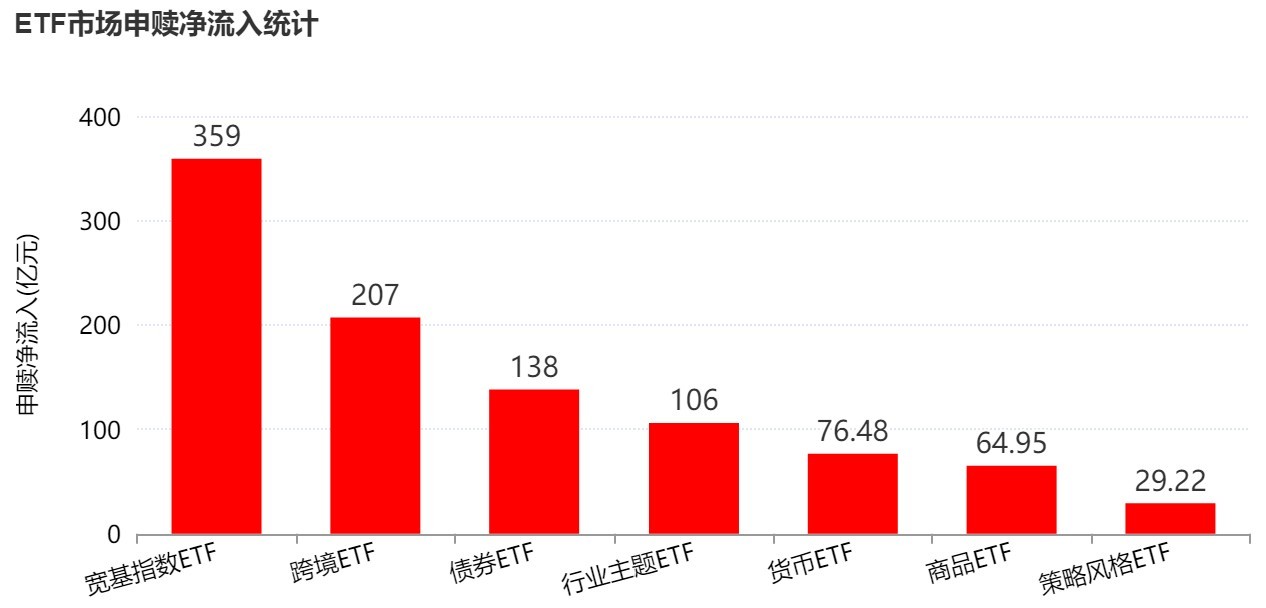
Group 1 - The core viewpoint of the article highlights that over 70 billion yuan has flowed into ETFs as investors seek to capitalize on market dips, particularly favoring sectors like artificial intelligence and robotics while selling off banking and chemical-related ETFs [1][10][11] Group 2 - In the past week, the total trading volume of the Shanghai and Shenzhen stock markets reached 9.23 trillion yuan, with the Shanghai index closing at 3,834.89 points, down 3.9%, and the Shenzhen index at 12,538.07 points, down 5.13% [2][12] - The net inflow into stock ETFs and cross-border ETFs amounted to 701.21 billion yuan, with broad-based index ETFs seeing a net inflow of 359 billion yuan [2][5] - The major broad-based index ETFs experienced a total net inflow of 223.26 billion yuan, with the CSI 500 ETF alone seeing a net inflow of 57.78 billion yuan [8][9] Group 3 - In terms of sector-specific ETFs, 48 funds saw net inflows exceeding 100 million yuan, with the Southern AI ETF, robotics ETF, and medical ETF attracting significant investments of 13.96 billion yuan, 13.46 billion yuan, and 9.11 billion yuan respectively [10][11] - Conversely, 20 sector-specific ETFs experienced net outflows exceeding 100 million yuan, with banking, chemical, and coal ETFs seeing reductions of 16.08 billion shares, 12.37 billion shares, and 7.75 billion shares respectively [10][11] Group 4 - The Southern AI ETF has seen its shares surpass 2 billion, marking a new high since its listing, driven by the rapid development of the artificial intelligence sector [10][11] - The robotics ETF has also reached a new high with over 25.3 billion shares, as the industry anticipates a significant growth cycle over the next decade [11] Group 5 - A total of 22 ETFs had trading volumes exceeding 10 billion yuan during the week, indicating strong market activity [12] - Upcoming listings include 5 new ETFs tracking sectors such as chemicals, home appliances, and Hong Kong stocks, which may attract investor interest [14][15]

限购,加码!
中国基金报· 2025-11-22 06:16
Core Viewpoint - The recent trend of performance-driven funds implementing purchase limits is primarily aimed at controlling fund size to maintain the effectiveness of investment strategies, reflecting a cautious approach to managing potential market risks and ensuring stable growth for investors [2][10]. Group 1: Fund Purchase Limits - On November 22, China Europe Fund announced that starting November 24, the daily purchase limit for four funds managed by Lan Xiaokang will be reduced to 500,000 yuan [4]. - This year, over 230 active equity funds have announced the suspension of large purchases or general purchases, with many of these funds showing strong performance and reaching new net asset value highs [10]. - The recent limits on fund purchases are a response to the significant structural characteristics observed in the A-share market, which have led to concentrated investor interest in high-performing funds [10]. Group 2: Fund Performance - As of November 20, the one-year performance of several funds managed by Lan Xiaokang, including China Europe Dividend Enjoyment A and China Europe Value Return A, showed returns of 38.93%, 30.24%, and 41.68%, all exceeding their performance benchmarks [6]. - Other high-performing funds, such as China Europe Small Cap Growth A and China Europe Digital Economy A, reported one-year returns of 57.39% and 126.55%, respectively, placing them among the top tier of similar funds [7]. - The trend of limiting purchases among high-performing funds indicates a cautious stance from fund managers regarding the potential for market overheating and valuation bubbles in specific sectors [10]. Group 3: Investment Strategy Insights - Lan Xiaokang emphasizes the need to adjust investment strategies in light of global changes, advocating for a balanced allocation between precious metals and quality Chinese assets over the next 3 to 10 years [6]. - The cautious approach to fund management reflects a broader industry trend where fund managers are increasingly focused on the stability of net asset values and the long-term profitability of their investors [10].

你恐慌我贪婪!超700亿资金借道ETF进场抄底 这些板块更是被主力连续买入
Mei Ri Jing Ji Xin Wen· 2025-11-22 05:59
Market Overview - The stock indices experienced a general decline this week, with the Shanghai Composite Index closing at 3834.89 points, down 3.9%, and the Shenzhen Component Index at 12538.07 points, down 5.13% [2][9] - Total trading volume in the Shanghai and Shenzhen markets reached 9.23 trillion yuan, with the Shanghai market accounting for 3.85 trillion yuan and the Shenzhen market 5.38 trillion yuan [2] ETF Fund Flows - A total net inflow of 701.21 billion yuan was recorded for stock ETFs and cross-border ETFs this week, with broad-based index ETFs seeing a net inflow of 359 billion yuan [2][6] - The ten largest broad-based index ETFs collectively saw a net inflow of 223.26 billion yuan, with the CSI 500 ETF receiving 57.78 billion yuan and both the ChiNext ETF and the CSI 300 ETF each receiving over 44 billion yuan [6][7] Sector Performance - In terms of sector-specific ETFs, artificial intelligence and robotics ETFs attracted significant capital, while bank and chemical-related ETFs faced substantial sell-offs [1][11] - Notably, the CSI 500 ETF had a net inflow of 64.29 billion yuan, and both the Sci-Tech 50 and ChiNext indices saw net inflows exceeding 55 billion yuan [7] Notable ETFs - The Southern ChiNext Artificial Intelligence ETF saw a substantial increase in shares, with a net inflow of 13.96 billion yuan and a total of 7.81 billion shares added [11][14] - The Robotics ETF also experienced strong demand, with a net inflow of 13.46 billion yuan and shares surpassing 253 billion, marking a new high since its launch [16][18] Market Sentiment and Future Outlook - Analysts suggest that the recent market fluctuations have sufficiently digested uncertainties, indicating limited downside potential for indices in the near term [9] - The ongoing global enthusiasm for technology investments, along with supportive policies and increased retail participation, is expected to sustain a slow bull market in A-shares [9][21] Upcoming ETFs - Five new ETFs are set to launch next week, focusing on sectors such as chemicals, home appliances, and Hong Kong stocks [22][23]
年内新成立FOF数量达79只 四季度迎来发行小高峰
Huan Qiu Wang· 2025-11-22 01:27
Group 1 - The core viewpoint of the news is the significant growth and popularity of FOF (Fund of Funds) products in the market, highlighted by the successful launch of E Fund's Ruiyi Ying'an 6-month holding mixed FOF, which raised 5.848 billion yuan with 24,688 valid subscriptions [1][3] - As of November 20, 2023, a total of 79 new FOF products have been established this year, accumulating an issuance volume of 65.728 billion units, surpassing the total issuance volume for 2023 and 2024 combined [3] - The issuance volume of FOF products has accelerated in the fourth quarter, reaching 25.893 billion units with 27 new products, significantly higher than the previous three quarters [3][4] Group 2 - The overall market size of FOF products has increased to 221.992 billion yuan, reflecting a growth of 70.13% since the beginning of the year, primarily driven by newly launched funds [3][4] - There are currently 12 FOF products still in the issuance process, with mixed-type FOFs dominating the market, and 28 fund managers have received approval for 37 new FOF products [4] - The overall net value growth rate of FOF products has exceeded 12% this year, with increasingly diversified underlying asset allocations catering to different risk preferences of investors [4]

指数化投资生态持续优化
Shang Hai Zheng Quan Bao· 2025-11-21 18:43
Group 1 - The market has seen a rapid increase in the number of ETFs, with 32 China Securities A500 ETFs established, and the scale of Huatai-PB China Securities A500 ETF reaching 25.697 billion yuan as of November 20, while some ETFs have scales below 10 million yuan [1] - The regulatory body encourages fund managers to develop ETF products based on market conditions and investor needs, advising against following trends and mass applications that could lead to poor fundraising and unstable operations [1] - The China Securities Regulatory Commission (CSRC) will implement measures such as batch registration and guiding reasonable initial scale settings to ensure orderly fundraising and listing of ETFs, preventing adverse market impacts [1] Group 2 - The rapid growth of ETF products has led to issues with similar names and low recognition, complicating investor decision-making [2] - The Shanghai Stock Exchange and Shenzhen Stock Exchange have issued guidelines for ETF naming conventions to enhance product identification, requiring names to include core investment elements and fund manager abbreviations by March 31, 2026 [2] - Industry participants have begun to respond, with several fund managers, including Dacheng Fund, changing ETF names to align with the new guidelines, improving product recognition [2] Group 3 - The standardization of ETF naming proposed by the exchanges aims to resolve investor identification challenges and promote industry standardization and regulation [3] - The company has already incorporated fund manager names into nearly 70 of its ETFs, enhancing product recognition and aiding investors in making informed decisions [3]
监管部门赋能ETF高质量发展 指数化投资生态持续优化
Shang Hai Zheng Quan Bao· 2025-11-21 18:43
Core Viewpoint - The development of high-quality ETFs in China is being actively promoted through regulatory optimizations and standardizations, which aim to enhance the investment ecosystem and address issues of product homogeneity and low recognition [1][2]. Group 1: Regulatory Optimizations - The China Securities Regulatory Commission (CSRC) has streamlined the ETF registration and listing process by removing the requirement for a no-objection letter from the stock exchange, allowing fund managers to apply directly for registration [2]. - The total scale of ETFs has surpassed 5.6 trillion yuan, and the recent reforms are expected to further invigorate the market [2]. - A rapid registration mechanism for stock ETFs has been established, aiming to complete registration within five working days from acceptance [2]. Group 2: Market Dynamics - In 2023, a record 328 new ETFs were established, with a total issuance scale of 253.33 billion yuan, marking the highest annual figures to date [4]. - The competitive landscape is intensifying, with multiple fund managers often launching similar innovative products simultaneously, leading to challenges in operational capacity [4][5]. - The head effect in ETFs indicates that larger funds attract more liquidity, while smaller funds may struggle to gain traction, as seen with the 32 existing 中证A500 ETFs, some of which have scales below 100 million yuan [4]. Group 3: Product Naming and Differentiation - The Shanghai and Shenzhen Stock Exchanges have revised their fund business guidelines to standardize ETF naming conventions, requiring names to include core investment elements and fund manager abbreviations [6][7]. - This change aims to improve product recognition and assist investors in making informed decisions, addressing the issue of similar product names in the market [6][7]. - Fund managers are encouraged to adopt differentiated strategies rather than following trends, to avoid issues related to oversaturation and underperformance in fundraising [5][7].