
科创板芯片ETF

Search documents
创新科技金融服务驱动“科技—产业—金融”良性循环|展望2026
Guo Ji Jin Rong Bao· 2025-12-31 13:36
Core Insights - The central theme of the articles emphasizes the importance of innovation-driven economic growth in 2026, particularly through the enhancement of technology financial services as a key focus of the Central Economic Work Conference [1] Group 1: Innovation in Technology Financial Services - The core objective is to establish a virtuous cycle connecting technology, industry, and finance, ensuring that financial resources are accurately matched to the development needs of hard technology enterprises throughout their lifecycle [2] - Key initiatives for 2026 include improving the intellectual property pledge financing mechanism, expanding the pilot scope of "investment-loan linkage" and "investment-insurance linkage," and fostering patient capital through the development of AIC equity investments and technology innovation bonds [2][8] Group 2: Financing Tools and Mechanisms - The articles highlight the need for innovative financing tools to support technology enterprises, including the establishment of a bond market "technology board" and the encouragement of technology companies to issue innovation bonds and asset-backed securities [4] - The focus is on making intellectual property pledge financing more accessible and effective, with efforts to standardize processes and introduce risk compensation mechanisms to alleviate banks' lending hesitance [4][6] Group 3: Patient Capital and Long-term Investment - The government aims to cultivate a "long money, long investment" ecosystem by establishing a national venture capital guiding fund with a 20-year duration, directing 70% of funds to seed and early-stage enterprises [12] - Measures to support hard technology enterprises include optimizing the listing review process, enhancing the inclusivity for unprofitable and high R&D companies, and promoting long-term capital investment [13][14] Group 4: Market Dynamics and Future Outlook - The articles suggest that the listing process for hard technology companies on the STAR Market will accelerate, with a focus on supporting enterprises with core technologies and clear commercialization paths while maintaining strict quality standards [14] - The emphasis will be on creating a favorable environment for genuine innovation while preventing "pseudo-innovation" from entering the market [14]
ETF 周报:上周 A500ETF净申购近 500 亿元,本周将新发行2只科创板芯片ETF-20251228
Guoxin Securities· 2025-12-28 14:04
- Last week, the median weekly return of stock ETFs was 2.75%[2][14] - Among broad-based ETFs, the median return of the CSI 500 ETF was the highest at 4.04%[2][14] - The median return of sector ETFs was highest for cyclical ETFs at 5.37%[2][20] - The median return of thematic ETFs was highest for new energy vehicle ETFs at 7.17%[2][20] - Last week, stock ETFs saw a net subscription of 356.34 billion yuan, with the total scale increasing by 1322.02 billion yuan[3][31] - Among broad-based ETFs, the A500 ETF had the highest net subscription of 493.22 billion yuan[3][31] - Among sector ETFs, consumer ETFs had the lowest net redemption of 5.80 billion yuan[3][33] - Among thematic ETFs, pharmaceutical ETFs had the highest net subscription of 4.08 billion yuan[3][33] - As of last Friday, the valuation percentiles of broad-based ETFs were as follows: SSE 50 ETF at 83.92%, CSI 300 ETF at 86.40%, CSI 500 ETF at 97.69%, CSI 1000 ETF at 95.55%, ChiNext ETF at 63.15%, and A500 ETF at 97.86%[38] - The valuation percentiles of sector ETFs were as follows: cyclical ETFs at 81.53%, large financial ETFs at 31.82%, consumer ETFs at 28.61%, and technology ETFs at 94.39%[39] - The valuation percentiles of thematic ETFs were as follows: military ETFs at 100.00%, photovoltaic ETFs at 99.84%, and chip ETFs at 96.13%[43] - The top 3 fund companies in terms of total scale of listed non-monetary ETFs were China Asset Management, E Fund Management, and Huatai-PineBridge Fund Management[54] - Last week, the financing balance of stock ETFs increased from 47.637 billion yuan to 47.882 billion yuan, while the securities lending balance decreased from 2.440 billion shares to 2.433 billion shares[46] - The top 10 stock ETFs with the highest average daily financing purchase amount included the STAR 50 ETF and the securities ETF[48][51] - The top 10 stock ETFs with the highest average daily securities lending volume included the CSI 1000 ETF and the CSI 300 ETF[52][53]
年末公募基金发行暖意浓 超百只产品角逐收官战
Zheng Quan Shi Bao· 2025-12-14 18:36
Group 1 - The overall public fund issuance data is positive, with 111 public funds currently in the issuance phase, indicating a concentrated issuance trend as the year-end approaches [1] - In November, a total of 191 new public funds were established, raising a total of 147.315 billion yuan, reflecting strong market activity [1] - Major fund companies are actively launching multiple products, with E Fund leading with 7 products, followed by Penghua Fund with 6 products, and others like Guotai Fund and China Merchants Fund also participating [1] Group 2 - Nearly 30% of the new products are passive index funds, covering hot market sectors such as the Sci-Tech Innovation Board and artificial intelligence, indicating a focus on trending investment themes [2] - There is a notable increase in enhanced index funds, showing continued institutional interest in quantitative strategies [2] - Over 40% of the funds are focused on low-volatility assets, reflecting a trend towards conservative investment strategies among institutions [2] Group 3 - There are currently 31 funds awaiting issuance, with a significant portion set to start fundraising in December 2025, indicating a forward-looking approach by fund companies [3] - Many companies are launching funds focused on the Hong Kong market and low-carbon economy themes, showcasing a strategic focus on emerging sectors [3] - The active year-end issuance reflects both the importance of year-end performance for fund companies and the strong demand from investors for quality fund products [3]
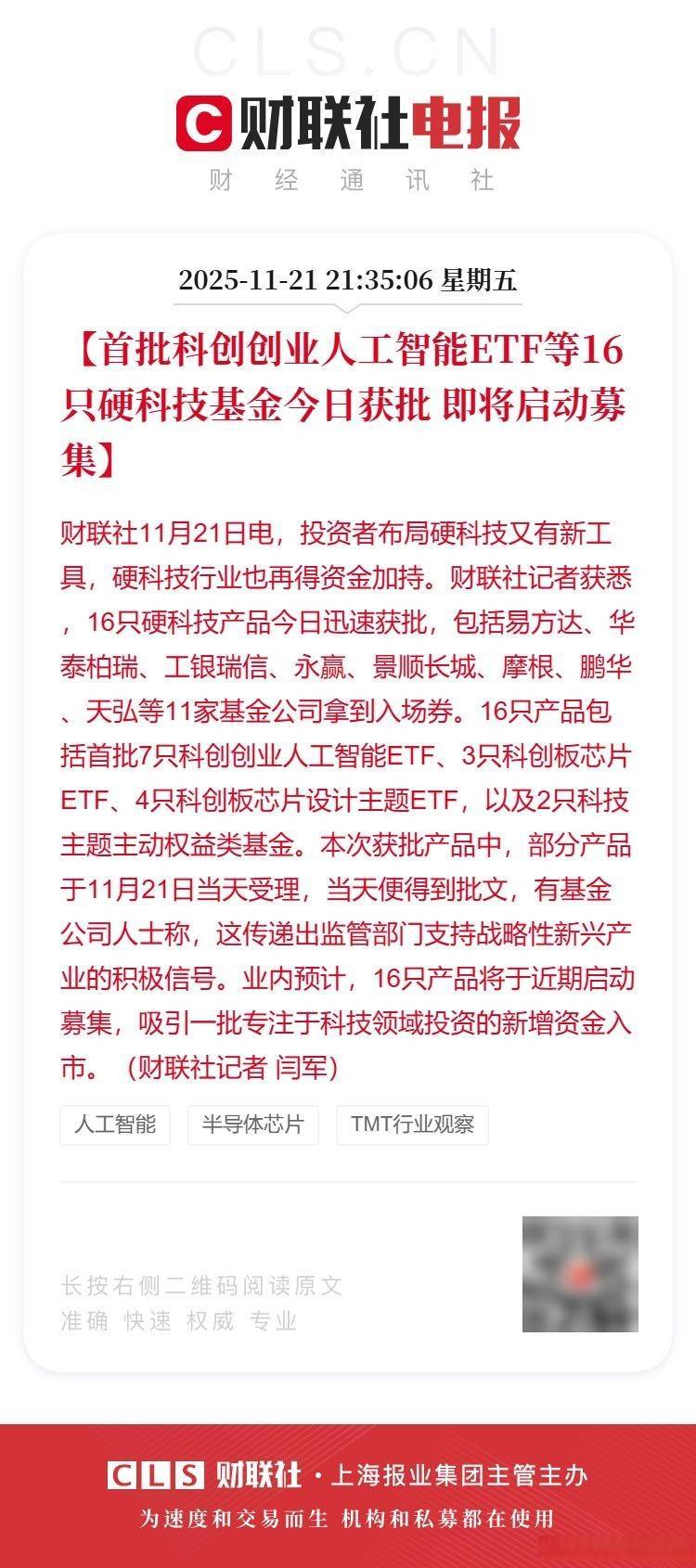
【首批科创创业人工智能ETF等16只硬科技基金今日获批 即将启动募集】财联社11月21日电,投资者布局硬科技又有新工具,硬科技行业也再得资金加持。财联社记者获悉,16只硬科技产品今日迅速获批,包括易方达、华泰柏瑞、工银瑞信、永赢、景顺长城、摩根、鹏华、天弘等11家基金公司拿到入场券。16只...
Sou Hu Cai Jing· 2025-12-13 10:57
Group 1 - The core viewpoint of the article is that 16 hard technology funds, including the first batch of 7 AI ETFs, have been approved and are set to attract new investments in the technology sector [1][4] - The approved products include 7 AI ETFs, 3 semiconductor ETFs, 4 chip design theme ETFs, and 2 actively managed technology theme equity funds [1] - The rapid approval of these funds on the same day they were submitted indicates a positive signal from regulatory authorities supporting strategic emerging industries [4] Group 2 - Industry insiders expect that these 16 products will soon begin fundraising, bringing in a significant amount of new capital focused on technology investments [1][4]


科技类ETF大战
Ren Min Ri Bao· 2025-12-08 10:38
Group 1 - The core viewpoint of the articles highlights a surge in the issuance of technology-focused ETFs, particularly those targeting the artificial intelligence (AI) sector, indicating a strong interest from public fund companies in this area [1][3][4] - Seven public fund companies have launched the first batch of "Double Innovation Artificial Intelligence ETFs," with one company ending its fundraising early due to reaching the 1 billion yuan limit [1][2][3] - The ETFs are designed to track the CSI Innovation and Entrepreneurship Artificial Intelligence Index, which includes 50 leading companies focused on AI technology development and its commercial applications across various sectors [3][4] Group 2 - A total of 19 new ETFs targeting the AI sector, including robotics and semiconductors, have been reported to the China Securities Regulatory Commission (CSRC) within a week, reflecting the growing trend in technology investments [2][3] - The influx of funds into these technology ETFs is expected to bring over 30 billion yuan in new capital to the AI and technology sectors if all funds reach their maximum fundraising targets [3] - Industry experts attribute the rapid growth in technology ETF offerings to supportive government policies, strong market performance, and a competitive landscape among fund companies [4][5] Group 3 - Investment managers express a strong belief in the long-term potential of AI, alongside other sectors such as semiconductors, biotechnology, and clean energy, viewing AI as a "golden track" for long-term investments [5][6] - Key investment opportunities within AI are identified as the computing power and algorithm sectors, with a particular focus on storage-related opportunities in the computing power segment [6] - Companies that can integrate AI into their business models to innovate products or services are also seen as valuable investment prospects [6]
大消息,“逆周期调节”,来了
3 6 Ke· 2025-12-01 23:59
Core Viewpoint - The regulatory body is implementing a counter-cyclical adjustment mechanism for fund product approvals to better protect investor interests, emphasizing a cautious approach towards new equity fund approvals amid high valuation benchmarks [1][2][7]. Fund Approval and Market Conditions - Regulatory scrutiny on new equity funds has increased, requiring that the performance benchmark index's rolling valuation over the last five years be below the 90th percentile and the last three months below the 80th percentile [2][3]. - Despite a bullish A-share market, fund companies are exercising restraint in launching new equity funds, with many setting initial fundraising caps at 2 billion to 3 billion yuan [1][4]. Fund Product Trends - Recent approvals have favored funds in sectors with relatively low valuations, such as healthcare, food, and consumer electronics, indicating a strategic focus on value [3][4]. - The approval of 16 hard technology products in mid-November reflects the regulatory body's timely response to market fluctuations, showcasing the effectiveness of the counter-cyclical adjustment mechanism [3][7]. Scale Management and Investor Experience - Fund companies are actively controlling the scale of new products, with many setting fundraising limits between 2 billion and 3 billion yuan, contrasting with the past trend of large-scale fund launches [4][5]. - Over 100 equity funds have announced restrictions on large subscriptions, with a focus on protecting existing investors and maintaining stable fund operations [5][6]. Regulatory Changes and Industry Transformation - The regulatory framework is shifting from a focus on scale to quality, with new performance evaluation metrics emphasizing long-term investment returns and investor experience [6][7]. - The implementation of counter-cyclical adjustment mechanisms is expected to enhance the capital market's resource allocation and support long-term investment strategies [7].
基金产品审批或启动逆周期调节!主动控制规模 不追求爆款
Zhong Guo Ji Jin Bao· 2025-12-01 13:24
Core Viewpoint - The regulatory body is implementing a counter-cyclical adjustment mechanism for fund product approvals to better protect investor interests, emphasizing a cautious approach towards new equity fund approvals amid high valuation benchmarks [1][2][6]. Group 1: Regulatory Actions - The approval process for new equity funds has become more stringent, with requirements for performance benchmarks to be below the 90th percentile for the last five years and the 80th percentile for the last three months [2][3]. - The regulatory framework encourages fund companies to focus on quality over size, promoting a rational and restrained approach during market highs and increasing counter-cyclical investments during market lows [2][6]. Group 2: Market Trends - Despite a bullish A-share market, fund companies are limiting the scale of new equity fund launches, with many setting initial fundraising caps at 2 billion to 3 billion yuan [1][4]. - A significant portion of newly established equity funds this year has set fundraising limits, with 57% of these caps below 3 billion yuan [5]. Group 3: Fund Management Practices - Fund companies are actively controlling the scale of new products and limiting large subscriptions for existing high-performing funds to protect investor interests and maintain stable fund operations [5][6]. - The focus is on aligning fund size with strategy capacity to avoid increased transaction costs and ensure a fair investment experience for all investors [5]. Group 4: Long-term Investment Ecosystem - The deepening implementation of the counter-cyclical adjustment mechanism is shifting the public fund industry from a focus on scale to one on quality, which is expected to attract more long-term capital and enhance investor satisfaction [7]. - Regulatory measures are designed to create a balanced approval rhythm that avoids excessive capital inflow into popular sectors while supporting key areas like hard technology during market corrections [7].
大消息!“逆周期调节”,来了
Zhong Guo Ji Jin Bao· 2025-12-01 12:49
Core Viewpoint - The approval of fund products is initiating a counter-cyclical adjustment mechanism to better protect investor interests under the guidance of the "Action Plan for Promoting High-Quality Development of Public Funds" [1][2] Group 1: Regulatory Adjustments - Regulatory scrutiny on new equity fund approvals has increased, particularly for those with high performance benchmarks, requiring recent five-year rolling valuations to be below the 90th percentile and three-month valuations below the 80th percentile [2][3] - The approval process is being optimized to maintain a rational and restrained approach during market highs while increasing counter-cyclical investments during market lows [2][6] Group 2: Fund Issuance and Management - Fund companies are exhibiting restraint in issuing new equity funds, with many setting initial fundraising caps at 2 billion to 3 billion yuan, contrasting with the past trend of launching large-scale funds [5][6] - Over 50% of the 1,045 new equity funds established this year have set fundraising limits, with 57% of these limits below 3 billion yuan [5] Group 3: Market Response and Strategy - The approval of new funds has focused on sectors with relatively low valuations, such as healthcare and consumer electronics, especially during periods of market volatility [3][4] - The industry is shifting from a focus on scale to quality, aiming to attract more long-term capital and enhance investor satisfaction through better fund management practices [7] Group 4: Performance Evaluation and Investor Experience - The regulatory framework has been restructured to emphasize fund performance over size and revenue, with new metrics introduced to evaluate fund managers based on investor service and experience [6][7] - The implementation of counter-cyclical adjustment mechanisms is expected to improve the overall investment experience for investors and stabilize the capital market [7]
大消息!“逆周期调节”,来了
中国基金报· 2025-12-01 12:47
Core Viewpoint - The approval of fund products is undergoing a counter-cyclical adjustment mechanism to better protect investor interests, with a more cautious approach towards new equity fund approvals due to high valuation benchmarks [2][4][11]. Group 1: Regulatory Adjustments - Regulatory scrutiny has increased for new equity funds, requiring that the performance benchmark index's rolling valuation over the last five years be below the historical 90th percentile and the last three months below the 80th percentile [5][6]. - The approval process has been optimized, with a focus on sectors with relatively low valuations, such as healthcare, food, and consumer electronics [5][6]. Group 2: Market Behavior and Fund Management - Despite a bullish A-share market, fund companies are exercising restraint in new equity fund launches, with many setting initial fundraising caps at 2 billion to 3 billion yuan [2][9]. - A significant number of new equity funds launched this year have set fundraising limits, with 57% of these limits below 3 billion yuan [9]. Group 3: Investor Experience and Fund Performance - The industry is shifting from a focus on scale to quality, aiming to enhance investor experience and long-term returns [11]. - Fund companies are implementing measures such as subscription limits and dynamic allocation to ensure fair investment experiences for all investors [9][11]. Group 4: Long-term Investment Ecosystem - The deepening implementation of the counter-cyclical adjustment mechanism is expected to attract more long-term capital into the public fund industry, enhancing investor satisfaction [11]. - The regulatory framework is evolving to emphasize long-term performance and investor returns, moving away from traditional metrics like scale and revenue [9][11].

首批双创人工智能ETF火爆发售,A股硬科技迎资金“大礼包”
2 1 Shi Ji Jing Ji Bao Dao· 2025-11-28 12:59
Core Viewpoint - The launch of the first batch of seven China Securities Innovation and Entrepreneurship Artificial Intelligence ETFs is expected to inject over 30 billion yuan into the A-share hard technology sector, reflecting strong market interest in AI-related investments [1][3]. Group 1: ETF Launch and Market Impact - The first batch of seven China Securities Innovation and Entrepreneurship Artificial Intelligence ETFs was approved on November 21 and will be available for subscription starting November 28, with varying fundraising periods from three days to two weeks [1]. - These ETFs are expected to bring in over 30 billion yuan in new funds, with some products already nearing their fundraising limits on the first day of sale [1][3]. - The ETFs will be listed on both the Shanghai and Shenzhen stock exchanges, contributing to the liquidity and trading activity in the AI sector [4]. Group 2: Characteristics of the Dual Innovation AI ETF - The ETFs track the China Securities Innovation and Entrepreneurship Artificial Intelligence Index, which includes 50 companies involved in AI across the Science and Technology Innovation Board and the Growth Enterprise Market [2]. - The index's unique selection criteria and comprehensive coverage of the AI industry chain, including foundational resources, technology, and applications, differentiate it from other AI ETFs [5]. Group 3: Performance and Market Trends - The China Securities Innovation and Entrepreneurship Artificial Intelligence Index has significantly outperformed other AI indices this year, with a year-to-date increase of 85.06% compared to lower gains from other indices [6]. - The rapid approval of various technology-themed ETFs indicates a growing trend among fund companies to focus on hard technology sectors, with multiple applications submitted for ETFs in robotics, semiconductors, and innovative drugs [8][9]. Group 4: Long-term Outlook for the Technology Sector - Despite recent volatility in the A-share technology sector due to concerns over an AI bubble, institutions remain optimistic about the long-term investment opportunities in the technology space, particularly in AI and semiconductor sectors [12]. - The ongoing development of AI infrastructure and expanding application scenarios are expected to provide substantial growth potential for the industry [12].