
OPPO

Search documents
苹果起诉跳槽至OPPO的前员工,涉窃取63份机密文件
Guan Cha Zhe Wang· 2025-08-23 07:38
Core Viewpoint - Apple has filed a lawsuit against former employee Chen Shi, accusing him of systematically stealing trade secrets before joining competitor OPPO, which could undermine Apple's innovation and competitive edge in wearable technology [1][2]. Group 1: Allegations Against Chen Shi - The lawsuit claims that Chen Shi accessed confidential documents related to Apple's health sensor technology before leaving the company to assist OPPO in developing competitive wearable devices [1]. - Chen Shi allegedly concealed his intention to join OPPO by stating he was returning to China to care for his elderly parents, while he was actually gathering sensitive information [2]. - It is reported that Chen Shi downloaded 63 confidential files just three days before his departure and transferred them to a USB drive [1][2]. Group 2: OPPO's Response - OPPO has stated that it respects the trade secrets of all companies, including Apple, and denies any wrongdoing regarding the allegations [3]. - The company has expressed its commitment to cooperating with legal proceedings to clarify the facts surrounding the case [3]. Group 3: Legal Implications - Apple is seeking an injunction to prevent Chen Shi and OPPO from using its confidential health sensor technology in their competitive products, emphasizing the potential harm to its business and innovation [2].



Chain-of-Agents: OPPO推出通用智能体模型新范式,多榜单SOTA,模型代码数据全开源
机器之心· 2025-08-23 04:42
Core Insights - The article introduces a novel agent reasoning paradigm called Chain-of-Agents (CoA), which enhances multi-agent collaboration and efficiency compared to traditional multi-agent systems (MAS) [2][6][36] - CoA allows for dynamic activation of multiple roles and tools within a single model, facilitating end-to-end multi-agent collaboration without complex prompt and workflow designs [6][36] Limitations of Traditional MAS - High computational costs due to frequent redundant communication and complex workflow designs [3] - Limited generalization ability requiring extensive prompt design and workflow configuration for new tasks [3] - Lack of data-driven learning capabilities, making it difficult to improve performance through task data [3] Advantages of CoA and AFM - CoA reduces communication overhead and supports end-to-end training, significantly improving system efficiency and generalization capabilities [6][36] - The Agent Foundation Model (AFM) demonstrates superior performance across nearly 20 complex tasks, achieving a 55.4% success rate on the GAIA benchmark with a 32B model [6][24] - AFM reduces reasoning costs (token consumption) by up to 85.5% while maintaining leading performance [6] CoA Architecture - CoA features a hierarchical agent architecture with two core components: role-playing agents (Thinking, Planning, Reflection, Verification) and tool agents (Search, Crawl, Code) [10][13] - The framework supports diverse agent reasoning and task execution types [10] Training Framework - A specialized CoA fine-tuning framework is developed to build AFM, involving task data collection, multi-agent capability distillation, supervised fine-tuning, and reinforcement learning [11][14] - Approximately 87,000 structured task-solving trajectories were generated for training [15] Experimental Validation - AFM models exhibit robust performance in multi-hop question answering (MHQA) tasks, achieving new benchmarks across various datasets [19][22] - In mathematical reasoning tasks, AFM-RL-32B achieved an average accuracy of 78.0%, outperforming existing models [26] Efficiency Analysis - AFM shows significant advantages in tool calling efficiency and reasoning costs, requiring fewer tool calls and lower token consumption per successful task [31][33] - The model's performance in test-time scaling is validated across multiple benchmarks, demonstrating robust generalization and reasoning capabilities [31] Future Directions - Potential exploration of dynamic role generation capabilities to enhance adaptability to unknown tasks [39] - Integration of cross-modal tool fusion to expand application scenarios beyond text-based tools [39] - Development of efficient memory mechanisms for long-term tasks to reduce repetitive reasoning costs [39]

谷歌的一个小调整,揭开了手机快充的真面目
Xin Lang Cai Jing· 2025-08-22 12:37
Core Viewpoint - The introduction of the Pixel 10 series by Google highlights the integration of hardware and AI technology, but the mandatory "Battery Health Assist" feature raises concerns about user experience and battery performance over time [1][5]. Group 1: Product Features - The Pixel 10 series includes AI features such as Magic Cue and Camera Coach, with the Pixel 10 Pro/Pro XL offering a "Pro Res Zoom" capability that allows for up to 100x zoom through intelligent image enhancement [1]. - The "Battery Health Assist" feature is designed to slow down battery aging by reducing the maximum voltage after 200 charging cycles, but this will lead to decreased battery life and fast charging capabilities over time [1][5]. Group 2: Battery Performance Comparison - The Pixel 10 series can maintain at least 80% battery health after 1000 charging cycles, while competitors like Samsung's Galaxy S25 can achieve this after 2000 cycles, and OPPO devices can do so after 1600 cycles [2]. - Assuming two full charge cycles per day, the Galaxy S25 can last approximately 33 months before reaching 80% battery health, whereas the Pixel 10 series may only last around 16 months, leading to noticeable battery performance degradation for users [3]. Group 3: Industry Implications - Google's approach to battery management reflects a broader industry trend where manufacturers may not fully disclose the implications of battery cycle counts and performance degradation over time [6]. - The inability to disable the "Battery Health Assist" feature may hinder the use of third-party batteries, as they likely do not have the capability to reset the system's battery cycle count [5][6].

ColorOS16部分信息被泄密,OPPO法务部:提供线索最高奖励50万
Xin Lang Ke Ji· 2025-08-22 09:06
Core Viewpoint - OPPO has initiated an investigation into unauthorized disclosures of its upcoming software product ColorOS16, which were leaked on various platforms, and is taking legal action against the individuals responsible [1] Group 1 - OPPO's legal department has reported unauthorized disclosures of information regarding ColorOS16 on platforms such as Coolapk, QQ groups, and Douyin [1] - The company is actively collecting evidence and will pursue legal responsibility for the leak [1] - OPPO is offering a reward of up to 500,000 yuan for credible tips related to the leaks, encouraging whistleblowers to come forward [1]

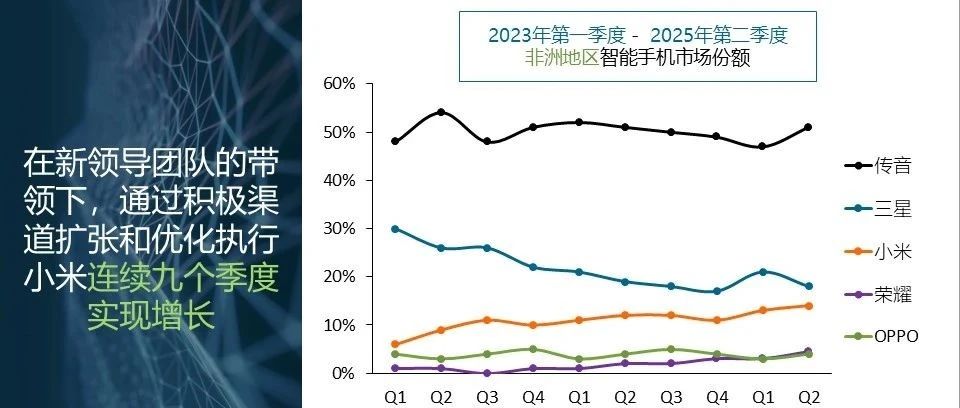
传音非洲智能手机份额51%居首,小米连续9季度增长
Xin Lang Ke Ji· 2025-08-22 06:27
Core Insights - The African smartphone market saw a year-on-year increase of 7% in Q2 2025, with a total shipment of 19.2 million units, making it one of the best-performing regions globally [1][2] - Demand for ultra-low-cost smartphones under $100 surged by 38% in Q2 2025, contributing to a decrease in average selling prices since 2023 [1] Company Performance - Transsion maintained its leading position with a 6% growth, holding a 51% market share, significantly ahead of competitors [1][2] - Samsung ranked second with an 18% market share, showing a slight increase from the previous year [2] - Xiaomi achieved a remarkable 32% growth, securing a 14% market share and marking its ninth consecutive quarter of growth [1][2] - Honor experienced a substantial growth rate of 161%, while OPPO and Realme faced declines of 11% and 17%, respectively [2] Market Strategy - Xiaomi is focusing on expanding its presence in Africa, having established operations in 16 countries, including Egypt, South Africa, Nigeria, Morocco, Algeria, and Kenya [1]


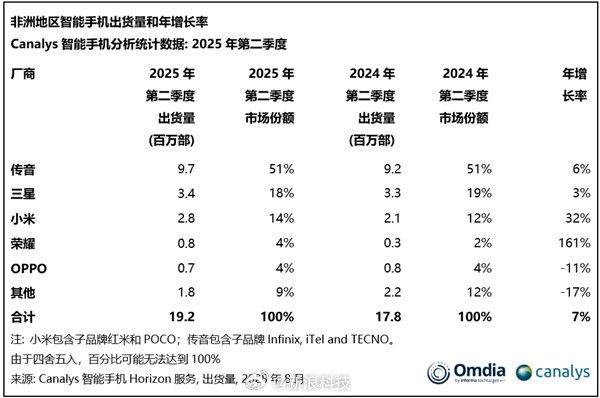
Canalys:第二季度非洲智能手机市场实现稳健增长 出货量达到1920万部
Zhi Tong Cai Jing· 2025-08-22 02:53
Core Insights - The African smartphone market is experiencing robust growth, with a year-on-year increase of 7% in Q2 2025, reaching a shipment volume of 19.2 million units, making it one of the best-performing regions globally [1][6] - Key markets such as Egypt, Nigeria, and South Africa are driving this growth due to easing inflation pressures and improved currency stability, enhancing consumer purchasing power [1][2] Regional Performance - Egypt leads the North African market with a 21% year-on-year growth, supported by local production capabilities meeting high demand during the Eid al-Fitr promotional season [2] - Nigeria rebounded by 10% due to inflation easing and a stable naira, while South Africa saw a 2% increase, with 5G smartphone shipments surging by 63% [2] - Kenya showed resilience with a slight decline of 2%, whereas Algeria and Morocco faced declines of 27% and 7% respectively due to weak demand and stricter import restrictions [2] Market Dynamics - Demand for ultra-low-cost smartphones is reshaping the African market, with models priced under $100 experiencing a 38% surge, leading to a decrease in average selling prices [4] - Transsion maintained its leading position with a 6% growth, while Xiaomi saw a significant 32% increase, capturing a 14% market share [4][7] - Samsung's market presence expanded through localized distribution and retail, achieving a 3% growth, while Honor's sales surged by 161% due to successful entry and mid-range models [4][7] Future Outlook - The African smartphone market is projected to grow by 3% in 2025, outpacing the overall sluggish global market amid rising component costs [6] - The rural market is becoming a new competitive focus, driven by limited traditional banking services, which is promoting mobile payments and digital services [6] - The region is transitioning from a consumer market to a production and assembly base, with countries like Egypt and Ethiopia leading the way in establishing local supply chains [6]
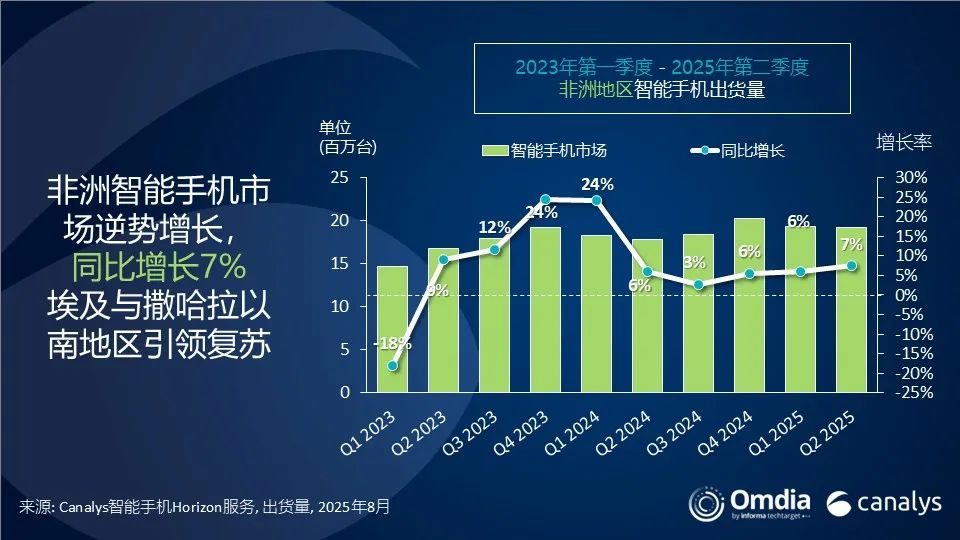
2025年第二季度,非洲智能手机市场增长7%,连续九个季度保持增长,传音稳固“非洲机王”的地位,小米持续增长,荣耀增幅最大
Canalys· 2025-08-22 02:32
Core Insights - The African smartphone market is projected to grow robustly, with a year-on-year increase of 7% in Q2 2025, reaching 19.2 million units, making it one of the best-performing regions globally [1][7] - The growth is driven by improved consumer purchasing power due to easing inflation in key markets like Egypt, Nigeria, and South Africa, with a forecasted compound annual growth rate (CAGR) of 2.1% from 2025 to 2029 [1][6] Market Performance - Egypt leads the North African market with a 21% year-on-year growth, supported by local production capabilities to meet demand during the festive season [4] - Nigeria rebounded by 10% due to stabilized currency and inflation relief, while South Africa saw a modest 2% growth, with a significant 63% increase in 5G smartphone shipments [4] - Smaller markets like Kenya showed resilience with a slight decline of 2%, whereas Algeria and Morocco faced declines of 27% and 7% respectively due to weak demand and stricter import regulations [4] Manufacturer Insights - Demand for ultra-low-cost smartphones under $100 surged by 38%, leading to a decrease in average selling prices [3] - Transsion maintained the top position with a 6% growth, holding a 51% market share, while Samsung grew by 3% to capture 18% of the market through localized distribution and affordable models [3][7] - Xiaomi experienced a significant 32% growth, achieving a 14% market share, while Honor's sales surged by 161%, driven by popular entry and mid-range models [3][7] - OPPO faced an 11% decline but is restructuring and expanding its retail presence in Egypt [3] Future Outlook - The African smartphone market is expected to grow by 3% in 2025, outpacing the overall sluggish global market amid rising component costs [6] - The rural market is becoming a new competitive focus, with limited traditional banking services driving the adoption of mobile payments and fintech [6] - Local production and the rise of digital finance are anticipated to lead Africa into a new phase of sustainable growth, establishing it as a critical testing ground for global brands [6]
二手手机回收巨头闪回科技,三战港交所冲刺IPO
Sou Hu Cai Jing· 2025-08-21 18:30
Core Viewpoint - The company Flashback Technology is attempting its third IPO in Hong Kong, highlighting its significant role in the second-hand mobile phone recycling market despite facing financial challenges and pressure from investors [1][3][4]. Company Overview - Flashback Technology specializes in second-hand mobile phone recycling and sales, achieving an annual revenue of nearly 1.2 billion yuan [1]. - Founded in 2016 by Liu Jianyi and Gao Zibin, the company received initial funding of 4 million yuan and later secured investments from Xiaomi and Shunwei Capital in 2018, which helped expand its market reach [1]. Business Model - The company connects brands, platforms, and channels on one end while directly engaging consumers on the other, offering "trade-in" services that streamline the recycling process [1]. - Collaborations with major brands like Xiaomi, Huawei, OPPO, vivo, and JD.com allow Flashback Technology to provide recycling services at their retail stores and e-commerce platforms [1]. Market Position - According to Frost & Sullivan, Flashback Technology has become the largest offline trade-in mobile phone recycling service provider in China as of 2023 [3]. - The company's growth trajectory is evident, with revenue increasing from 750 million yuan in 2021 to 1.297 billion yuan in 2024 [3]. Financial Challenges - Despite rapid expansion, the company has accumulated losses exceeding 300 million yuan, with a gross margin of only 4.8% in 2024, significantly lower than its peers [3]. - The company faces mounting pressures from inventory turnover, standardization costs, and promotional expenses, which are eroding profits [3]. Funding and Investment Risks - Flashback Technology has been entangled in capital betting since its inception, with each funding round tied to specific timelines that link the company's survival to market conditions [3]. - Previous failed IPO attempts have intensified pressure, and another failure could trigger redemption clauses, leading to significant financial strain given the company's limited cash reserves against nearly 800 million yuan in redemption liabilities [3][4]. Future Outlook - The upcoming IPO is critical for the company's survival, as successful listing could provide necessary funds to alleviate debt and facilitate business transformation [4]. - The outcome of this IPO attempt will be pivotal in determining the company's future trajectory and financial stability [4].

外媒:为什么印度需要中国?
Xin Lang Cai Jing· 2025-08-21 15:21
Group 1 - India's industrial ambitions increasingly rely on acquiring technology from China, with nearly $48 billion in electronic and electrical equipment imported from China in 2024, highlighting India's dependence on Chinese components for smartphone and telecom network assembly [1] - The Indian pharmaceutical industry also imports a significant portion of its active pharmaceutical ingredients from China, indicating a broader reliance on Chinese technology and materials [1] - India is particularly dependent on China for rare earth magnets, which are crucial for achieving its goals in electric vehicles, renewable energy, and consumer electronics [1] Group 2 - In critical technology areas such as electric vehicle batteries and clean energy storage, India requires Chinese technological capabilities and expertise, as domestic technology is insufficient and alternatives are scarce [1] - Major Indian conglomerates are exploring partnerships with Chinese companies, with notable examples including Gautam Adani's discussions with BYD for potential battery manufacturing collaboration and JSW's agreements with Chinese automotive firms for electric vehicle technology [1] - India is also a significant market for Chinese smartphone manufacturers, with approximately 156 million smartphones imported and sold in 2024, providing substantial market opportunities for companies like Xiaomi, Vivo, and OPPO [1][2] Group 3 - As the world's third-largest automotive market, India sold around 4.3 million passenger vehicles in 2024, making it an important target market for Chinese automotive manufacturers [2] - This collaboration benefits Chinese companies by providing access to one of the fastest-growing consumer markets globally [2]
折叠屏手机逐渐从高端向主流消费群体渗透
Zheng Quan Shi Bao Wang· 2025-08-21 14:16
Core Insights - The foldable smartphone market is maturing, with decreasing prices and increasing adoption among mainstream consumers [1][2] - Honor has launched the Magic V Flip 2, featuring advanced specifications and a competitive price point, indicating a shift towards affordability in foldable devices [1] - The global foldable smartphone shipment is projected to grow at a compound annual growth rate (CAGR) of 49.48%, reaching 102 million units by 2027, with China expected to see significant growth [1][2] Industry Trends - Foldable smartphones are becoming a key innovation in consumer electronics, transitioning from high-end to mainstream markets [1] - The hinge and flexible screen technologies are critical areas of innovation, with major players like Huawei and Samsung leveraging self-developed hinge technology for competitive advantage [1] - The foldable smartphone hinge market is expected to reach a value of $1.2 billion by 2025, with hinge costs accounting for approximately 5%-8% of the bill of materials (BOM) per device [2] Competitive Landscape - Apple's entry into the foldable smartphone market is anticipated to enhance market penetration, with expectations of a rise in foldable smartphone penetration from 1.6% in 2025 to over 3% by 2027 [2][3] - The focus will shift towards manufacturing efficiency, cost control, and supply chain integration as Apple aims to differentiate its offerings in a more stable market [3] - Suppliers that can manage technology, production capacity, and price flexibility will be key beneficiaries in the upcoming growth cycle [3]