
大智慧

Search documents
要有“舍小取大”的大智慧
Xin Hua Ri Bao· 2026-02-04 21:46
Core Insights - The article discusses the transformation of the traditional tourism model in the context of the Dangkou Ancient Town, emphasizing the shift from a ticketed "scenic area" to a free-access "street area" to revitalize cultural tourism [1][2][3] Group 1: Transformation of Tourism Model - The cancellation of entrance fees at Dangkou Ancient Town represents a fundamental shift in development strategy, moving from a passive approach of waiting for visitors to an active strategy of inviting them [1] - The reopening of Dangkou as a free-access area led to a significant increase in visitor numbers, demonstrating that charging fees can act as a barrier rather than a protective measure [1] - By 2025, revenue from cultural and handmade products in Dangkou is projected to grow by 50% year-on-year, indicating the effectiveness of transforming the tourism focus from mere sightseeing to immersive consumer experiences [1] Group 2: Evolving Visitor Expectations - Modern tourists seek immersive experiences rather than just superficial visits, with a preference for "slow travel" and genuine interactions [2] - The unique charm of ancient towns lies in their authentic local life and historical narratives, which should be preserved rather than artificially recreated [2] - Differentiation in the tourism market is crucial, with a focus on local culture, historical significance, and unique activities to meet the increasingly segmented demands of visitors [2] Group 3: Community Engagement and Economic Impact - The transformation from "scenic area" to "street area" fosters community involvement, with local residents becoming active participants in tourism development rather than being displaced [3] - Residents are investing in hospitality and retail businesses, contributing to the local economy and sharing in the benefits of tourism growth [3] - The implementation of a free-access policy enhances the sense of community and participation among locals, leading to a more sustainable and inclusive economic model [3]

A股炒股软件股拉升,同花顺、指南针涨超2%
Jin Rong Jie· 2026-02-04 06:57
Group 1 - The A-share market saw a rise in stock trading software companies, with Tonghuashun and Zhinanzhen increasing by over 2% [1] - Other companies such as Dazhihui and Dongfang Caifu also experienced gains, rising nearly 2% [1]

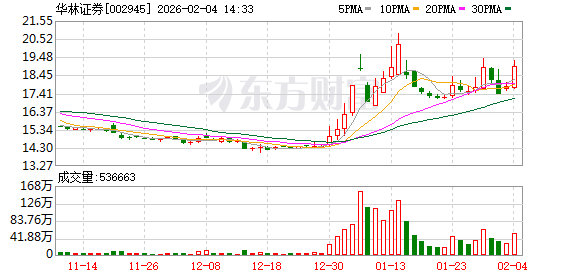
A股金融股异动拉升,华林证券涨超8%
Mei Ri Jing Ji Xin Wen· 2026-02-04 06:32
每经AI快讯,2月4日,A股金融股异动拉升,华林证券涨超8%,赢时胜、指南针、银之杰、大智慧、 东方财富等纷纷冲高。 (文章来源:每日经济新闻) ...


涉个人信息使用违规,大智慧、中山证券等金融类App被通报
Nan Fang Du Shi Bao· 2026-02-03 13:18
Core Viewpoint - The National Cybersecurity Incident Response Center has identified 72 mobile applications that illegally collect and use personal information between December 26, 2025, and January 20, 2026 [1] Group 1: Financial Apps Involved - Several financial apps are among the 72 identified, including Zhongshan Securities, Dazhihui, Guotai Junan Futures, and Wenkang Futures [2][3] - Dazhihui has the highest number of violations, totaling six specific issues related to user consent and privacy policy transparency [4] Group 2: Specific Violations of Dazhihui - The app failed to clearly prompt users to read the privacy policy upon first use and used default consent mechanisms [4] - The privacy policy did not adequately detail the purposes, methods, and scope of personal information collection [4] - Dazhihui did not inform users about third parties receiving their personal information without explicit consent [4] - The app lacked effective features for users to correct, delete personal information, or cancel their accounts [5] - There was no easy way for users to withdraw consent for personal information collection [5] - The app did not have specific rules for handling personal information of minors and did not obtain parental consent [5] Group 3: Regulatory Attention on Financial Apps - Financial apps, particularly brokerage apps, have been under increasing regulatory scrutiny, with multiple apps being named for violations in 2025 [6] - The Shanghai Communications Administration reported several brokerage apps, including Shenwan Hongyuan and Dongfang Securities, for similar issues [6] - Legal experts emphasize the need for enhanced user identity verification and transaction monitoring to protect user rights in financial apps [6]
五矿期货、大智慧、中山证券等72款APP违法违规收集使用个人信息被通报
Xin Lang Cai Jing· 2026-02-03 05:48
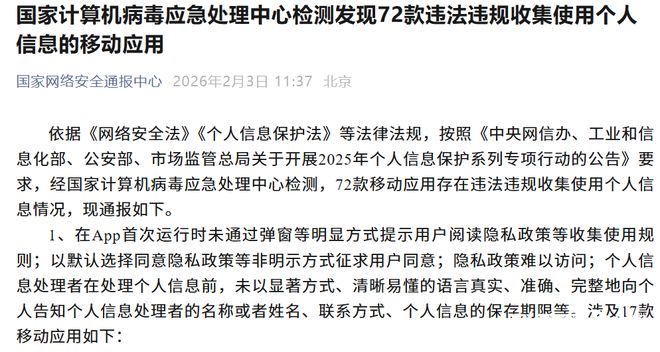
Core Viewpoint - The National Cybersecurity Center has reported that 72 mobile applications are found to be in violation of personal information protection laws, highlighting significant issues in user consent and data handling practices. Group 1: User Consent Issues - 17 mobile applications failed to clearly inform users about privacy policies and data collection practices at the first run of the app, using default consent methods instead [1] - 34 mobile applications did not specify the purposes, methods, and scope of personal information collection in their privacy policies [2] - 17 mobile applications provided personal information to third parties without user consent or proper notification [3] Group 2: Data Collection Practices - 5 mobile applications began collecting personal information without obtaining user consent first, or continued to collect data despite user refusal [4] - 9 mobile applications did not provide effective means for users to correct, delete personal information, or cancel their accounts [5] - 3 mobile applications failed to process complaints and requests for personal rights in a timely manner [6] Group 3: User Rights and Security Measures - 22 mobile applications did not offer users a straightforward way to withdraw consent for data collection [7] - 25 mobile applications lacked adequate security measures such as encryption or anonymization of personal data [8] - 1 mobile application continued to display ads after the user closed the page, disrupting normal usage [9] Group 4: Sensitive Information Handling - 4 mobile applications processed sensitive personal information without obtaining separate user consent [6] - 6 mobile applications did not have specific rules for handling personal information of minors, failing to obtain parental consent [10] Group 5: Privacy Policy Compliance - 4 mobile applications were found to have no privacy policy at all [10] - 33 out of 71 previously reported applications still exhibited issues upon re-evaluation, leading to their removal from distribution platforms [10]
违法违规收集使用个人信息 72款移动应用被通报
Yang Shi Wang· 2026-02-03 03:54
Core Viewpoint - The National Cybersecurity Center has reported that 72 mobile applications are found to be in violation of personal information protection laws, highlighting significant issues in user consent and data handling practices. Group 1: User Consent Issues - 17 mobile applications failed to clearly inform users about privacy policies and data collection practices at the first run of the app [1] - 34 mobile applications did not specify the purposes, methods, and scope of personal information collection in their privacy policies [2] - 17 mobile applications provided personal information to third parties without user consent or proper notification [3] Group 2: Data Collection Practices - 5 mobile applications collected personal information without obtaining user consent or continued to collect data after users declined [4] - 9 mobile applications did not provide effective mechanisms for users to correct, delete personal information, or cancel their accounts [5] - 3 mobile applications failed to process complaints and requests for personal rights in a timely manner [6] Group 3: User Rights and Security Measures - 22 mobile applications did not offer users a straightforward way to withdraw consent for data collection [7] - 25 mobile applications lacked adequate security measures such as encryption or anonymization of personal data [8] - 1 mobile application continued to display ads after the user closed the page, disrupting normal usage [9] Group 4: Compliance with Regulations - 4 mobile applications were found to have no privacy policy at all [10] - 33 out of 71 previously reported applications still exhibited issues upon re-evaluation, leading to their removal from distribution platforms [10]
国家计算机病毒应急处理中心检测发现72款违法违规收集使用个人信息的移动应用
Xin Lang Cai Jing· 2026-02-03 03:51
Core Viewpoint - The National Cybersecurity Center has reported that 72 mobile applications are found to be in violation of personal information protection laws, highlighting significant issues in user consent and data handling practices. Group 1: User Consent and Information Collection - 17 mobile applications failed to clearly inform users about privacy policies and data collection practices at the first run, using default consent methods instead [1] - 34 mobile applications did not specify the purposes, methods, and scope of personal information collection in their privacy policies [2] - 17 mobile applications did not inform users about third-party data sharing, failing to obtain separate consent for such actions [3] - 5 mobile applications collected personal information without user consent or continued to collect data despite user refusal [4] Group 2: User Rights and Data Management - 9 mobile applications did not provide effective mechanisms for users to correct, delete personal information, or cancel their accounts [5] - 3 mobile applications failed to process complaints and requests within promised timeframes, lacking a convenient mechanism for users to exercise their rights [6] - 22 mobile applications did not offer users a straightforward way to withdraw consent for data collection [7] Group 3: Data Security and Sensitive Information - 25 mobile applications did not implement adequate security measures such as encryption or anonymization [8] - 4 mobile applications processed sensitive personal information without obtaining separate consent from users [9] - 6 mobile applications did not have specific rules for handling personal information of minors, failing to obtain parental consent [10] Group 4: Advertising and Marketing Practices - 2 mobile applications used automated decision-making for marketing without providing options for users to opt-out or reject targeted advertising [6] - 1 mobile application continued to display ads after the user closed the page, disrupting normal usage [9] Group 5: Privacy Policy Compliance - 4 mobile applications were found to have no privacy policy at all [10] - 33 out of 71 previously reported applications still exhibited issues upon re-evaluation, leading to their removal from distribution platforms [10]
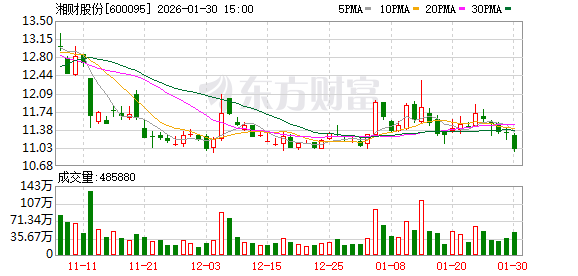
湘财股份:2025年净利同比预增266.41%~403.81%
Mei Ri Jing Ji Xin Wen· 2026-01-30 10:07
Core Viewpoint - Xiangcai Co., Ltd. (600095.SH) expects a significant increase in net profit attributable to shareholders for the fiscal year 2025, projecting between 400 million to 550 million yuan, representing a year-on-year growth of 266.41% to 403.81% [2] Group 1: Financial Performance - The anticipated profit growth is primarily driven by the overall upward trend in the domestic capital market [2] - Xiangcai Securities has seen substantial growth in its brokerage, credit, investment advisory, and proprietary trading businesses [2] - The company has also benefited from a significant reduction in financial expenses compared to the previous year [2] Group 2: Subsidiary Performance - The company’s associate, Dazhihui, has notably reduced its losses, contributing positively to the overall financial outlook [2]

湘财股份:2025年全年净利润同比预增266.41%—403.81%
2 1 Shi Ji Jing Ji Bao Dao· 2026-01-30 10:03
Core Viewpoint - The company expects a significant increase in net profit for the year 2025, with projections ranging from 400 million to 550 million yuan, representing a year-on-year growth of 266.41% to 403.81% [1] Financial Performance - The projected net profit attributable to shareholders, excluding non-recurring gains and losses, is expected to be between 350 million and 450 million yuan, indicating a year-on-year increase of 54.00% to 97.99% [1] - The substantial growth in net profit is attributed to the overall upward trend in the domestic capital market, leading to increased trading activity [1] Business Operations - The company's wholly-owned subsidiary, Xiangcai Securities, has actively seized market opportunities and optimized asset allocation, resulting in significant performance growth in brokerage, credit, investment advisory, and proprietary business [1] - The company anticipates a substantial reduction in losses from its associate company, Shanghai Dazhihui Co., Ltd. [1] - Continuous optimization of the company's capital structure has led to a decrease in financial expenses compared to the previous year [1]
业绩集体高增 上市券商成A股“绩优生”
2 1 Shi Ji Jing Ji Bao Dao· 2026-01-29 23:06
Core Viewpoint - The A-share brokerage sector is experiencing significant profit growth, with 17 listed brokerages reporting an average net profit of 5.85 billion yuan for 2025, reflecting a year-on-year increase of 92.92% [1] Group 1: Performance of Leading Brokerages - Four leading brokerages, including CITIC Securities and Guotai Junan, are expected to report net profits exceeding 10 billion yuan, driven by resilience in self-operated, wealth management, and investment banking sectors [2] - Shenwan Hongyuan anticipates a net profit of 10.1 billion to 11.1 billion yuan for 2025, marking a year-on-year growth of 61.59% to 77.59% [2] - Guotai Junan expects a net profit of 27.53 billion to 28.01 billion yuan, representing a year-on-year increase of 111% to 115% [3] Group 2: Performance of Smaller Brokerages - Among smaller brokerages, Guolian Minsheng reported a net profit of 2.01 billion yuan, a staggering increase of approximately 406% [5] - Other smaller brokerages, such as Huaxi Securities and Hongta Securities, also showed strong performance with net profit growth exceeding 50% [5] - However, companies like Guorong Securities and Zhongshan Securities faced significant declines in net profit, highlighting a disparity in performance within the sector [6] Group 3: Market Conditions and Valuation - Despite strong earnings, brokerage stock prices have remained stagnant, indicating a mismatch between profitability and valuation [7] - The A-share brokerage index rose by 4% in 2025, while the CSI 300 index increased by 18%, suggesting potential for valuation recovery [8] - Analysts predict that the brokerage sector still holds strategic allocation value, with expectations for significant valuation recovery [8] Group 4: Future Outlook - The sector is expected to benefit from favorable policies aimed at stabilizing growth and boosting the capital market, alongside a conducive liquidity environment [9] - The current low valuation levels present opportunities for defensive rebounds, with recommendations to focus on strong leading brokerages and those with competitive advantages in wealth management and proprietary trading [10]
