
Disco

Search documents
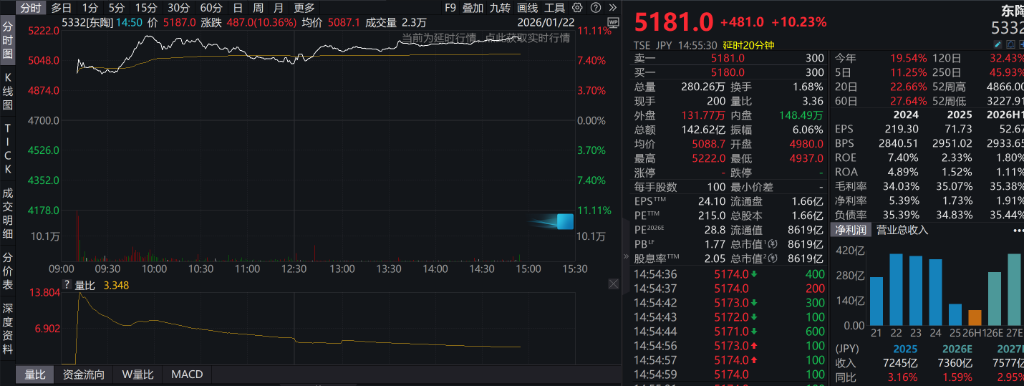
存储NAND紧俏,卫浴大牌Toto大涨!
Hua Er Jie Jian Wen· 2026-01-22 06:23
Core Insights - The AI boom is reshaping global supply chains, benefiting companies like Toto, known for its bathroom fixtures, due to its semiconductor materials business [1] - Goldman Sachs upgraded Toto's rating, citing increased demand for its electrostatic chucks used in NAND storage chip manufacturing as AI infrastructure expands [1][2] - Toto's stock surged by 11%, marking its largest increase since February 2021, reflecting the significant impact of AI data center expansion on upstream supply chains [1] Company Overview - Toto has been a key player in the semiconductor and display supply chains for decades, with new business areas accounting for 42% of its total revenue for the fiscal year ending March 2025 [2] - The electrostatic chuck, produced by Toto since 1988, is crucial for fixing silicon wafers during chip manufacturing, helping to control temperature and prevent contamination [2] Market Dynamics - Major tech companies like Meta Platforms and Amazon are investing billions in AI service data centers, leading to a widespread shortage of semiconductor products [3] - This surge in demand has prompted global storage chip manufacturers, including SK Hynix, Samsung, and Kioxia, to expand production, directly increasing demand for products from upstream suppliers like Toto [3] Industry Trends - Toto is not the only Japanese consumer goods giant benefiting from the chip boom; companies like Ajinomoto and Kao have also established semiconductor-related businesses [4] - The rise in Toto's stock coincided with a broader rebound in AI-related stocks, indicating investor interest in undervalued assets that can benefit from the global competition in computing power [4]

半导体-投资者反馈:多数看涨(尤其前端 SPE),但也警惕短期风险收益比_ Semiconductors_ Investor feedback_ Many bullish, especially on front-end SPE, but caution also on near-term risk-reward
2026-01-19 02:29
Summary of Conference Call on Japan Technology: Semiconductors Industry Overview - The focus of the conference call was on the semiconductor industry, particularly front-end and back-end equipment manufacturers, as well as NAND memory producers [1][2]. Key Points Discussed Front-End Equipment - Investor sentiment is bullish on front-end semiconductor equipment (SPE) makers, with expectations for double-digit growth (over 10%) in the wafer fabrication equipment (WFE) market for both calendar years 2026 and 2027 [2]. - The outlook for the WFE market has improved significantly, with previous expectations for CY26 growth being in the mid-single-digit range [2]. - Investors are showing considerable interest in small- and mid-cap stocks like Ulvac and JEOL, which are currently lagging behind larger companies [2]. Back-End Equipment - Demand for AI-related equipment remains strong, particularly for Advantest, but investor expectations for FY3/27 are already high, aligning closely with estimates [3]. - For Disco, there is skepticism regarding significant increases in shipment levels from the current quarterly level of approximately ¥110 billion, leading to lower expectations for FY3/27 earnings [3]. - Interest in Tokyo Seimitsu is noted, but many investors believe that substantial margin improvements are necessary for the share price to rise further [3]. NAND Market - Many investors are optimistic about Kioxia Holdings, despite the Neutral rating, with expectations for a sharp price increase in Q4 FY3/26 due to rising server demand amid limited supply [4]. Investment Ratings and Price Targets - **Tokyo Electron**: Buy, with a target price of ¥43,000, driven by growth prospects in DRAM investment [8]. - **Disco**: Buy, target price of ¥64,000, based on multiple growth drivers [9]. - **Ebara**: Buy, target price of ¥5,200, expecting CMP-led earnings growth [9]. - **Ulvac**: Buy, target price of ¥8,400, with expectations for orders to exceed forecasts [9]. - **Advantest**: Neutral, with a target price of ¥22,800, facing high investor expectations [9]. - **Kioxia Holdings**: Neutral, target price of ¥11,400, with volatile capacity utilization trends [9]. - **Tokyo Seimitsu**: Sell, target price of ¥8,700, requiring significant semiconductor order growth for price improvement [9]. Risks and Considerations - Risks for companies include potential slowdowns in AI-related demand, tightening of export controls, and fluctuations in customer capital expenditure appetite [9]. - The semiconductor industry faces challenges such as prolonged inventory adjustments and competitive pressures from Chinese manufacturers [9]. Conclusion - The semiconductor industry is experiencing a positive shift in investor sentiment, particularly for front-end equipment manufacturers, while caution remains regarding valuations and potential risks in the back-end and NAND markets [1][2][4].
半导体设备:台积电业绩的联动影响-资本开支指引强劲利好半导体设备厂商_ Semiconductor Capital Equipment_ TSMC results read-across_ Stronger capex guidance positive for SPE makers
2026-01-16 02:56
Summary of TSMC Earnings Call and Implications for Japanese SPE Makers Company and Industry Overview - **Company**: TSMC (Taiwan Semiconductor Manufacturing Company) - **Industry**: Semiconductor Capital Equipment (SPE) Key Points from the Earnings Call Current Business Environment - TSMC highlighted that AI demand is the primary driver of semiconductor demand growth, with major customers starting to see tangible earnings contributions from AI investments [2][4] - The company revised its 5-year outlook for AI-related sales to a compound annual growth rate (CAGR) of mid- to high-50%, an increase from the previous mid-40% CAGR forecast [2] Capital Expenditure (Capex) Outlook - TSMC's capex for 2025 is projected at **US$40.9 billion**, with **US$11.5 billion** allocated for the fourth quarter, exceeding the previous guidance of **US$40 billion to US$42 billion** [3] - For 2026, TSMC anticipates capex between **US$52 billion and US$56 billion**, with 70-80% allocated for advanced processes, 10% for specialty processes, and 10-20% for advanced packaging and other applications [3] - The company is accelerating capacity expansion in Taiwan and the US due to strong demand, indicating that cumulative capex over the next three years could significantly exceed the **US$101 billion** invested in the past three years [3] Implications for Japanese SPE Makers - The 2026 capex guidance of **US$52 billion to US$56 billion** surpasses both internal forecasts of **US$46 billion** and investor expectations of around **US$50 billion**, which is seen as positive for various SPE companies, particularly those with high sales exposure to TSMC [4] - Specific recommendations include maintaining Buy ratings on companies such as Ebara, Disco, and Tokyo Electron, which are expected to benefit from the increased capex focused on advanced processes and packaging [4] Additional Important Information - The earnings call reflects a strong outlook for the semiconductor industry, particularly driven by AI demand, which may lead to increased investment opportunities in related sectors [2][4] - The capex figures indicate a robust commitment from TSMC to expand its capabilities, which could have a ripple effect on suppliers and related industries, particularly in Japan [3][4]

把握全球增长机遇-AI 在亚洲供应链的更广泛深度渗透_ Seizing the Global Growth Opportunity_ A broader and deeper AI presence in the Asian supply chain
2026-01-13 02:11
Summary of Key Points from the Conference Call Industry Overview - Focus on the Asia technology (hardware) sector, particularly the AI supply chain, as a priority investment area for 1H26 due to its significant influence on earnings growth amid concerns over smartphone/PC demand and auto production recovery [2][12] Core Themes and Stock Recommendations 1. **AI Supply Chain Investment**: - Emphasis on investing in the AI supply chain, which is expected to drive earnings growth despite potential slowdowns in other sectors [2][12] - Anticipation of clearer benefits from AI for earnings in 2026, with no signs of slowdown heading into 2027 [12] 2. **Under-the-Radar AI Themes**: - Five notable themes identified: 1. **Power Consumption**: Opportunities in power supply, power rack products, capacitors, and power semiconductors. Companies to watch include Delta Electronics, Panasonic HD, Murata Mfg., Taiyo Yuden, and Renesas Electronics [6][25] 2. **Data Transmission**: Advancements in large-scale data transmission technologies, with companies like Fujikura and Mitsubishi Electric highlighted [6][25] 3. **Niche Components**: Price stabilization and increases in demand for components like MLCCs and substrates, with key players including Murata Mfg. and SEMCO [6][25] 4. **Physical AI Integration**: Companies like Hitachi and Mitsubishi Electric are leading in embedding AI into industrial applications [6][27] 5. **Software/Services Disruption**: Generative AI's potential to improve productivity in Japan's software industry, with Fujitsu and NEC as key players [6][27] 3. **High-Profile Sub-Sectors**: - Continued growth in foundry, memory, semiconductor production equipment, AI servers, and edge AI, with recommended stocks including TSMC, Samsung Electronics, and Hon Hai [30][31] Market Dynamics and Risks - **Top-Down Risks**: - Concerns regarding valuations, implementation risks, over-investment, monetization challenges, and funding sources, particularly with emerging players in the market [13] - **Bottom-Up Perspective**: - Fundamentals differ from the IT bubble of 2000, with a larger scale and longer timeline for AI infrastructure development, and sound supply chain management in Asian hardware [14][16] Technological Advancements - **Power Consumption Trends**: - Significant rise in power consumption for AI servers, with expectations for voltage increases to 800V and beyond, creating business opportunities for power-related products [33][38] - **Data Transmission Innovations**: - Transition to higher communication speeds (800-1.6Tbps) and co-packaged optics (CPO) expected to enhance industry value [58][59] Conclusion - The Asia technology sector, particularly the AI supply chain, presents substantial investment opportunities driven by technological advancements and evolving market dynamics. Key players and themes are positioned to benefit from these trends, while investors should remain cautious of potential risks associated with rapid market changes.
日本科技 - 半导体设备:AI 需求强劲下上调高盛目标价;重点推荐东京电子、荏原制作所、迪思科、优贝克-Japan Technology_ Semiconductor Capital Equipment_ Adjust GSe_TPs amid strong AI demand; highlight Buy ratings on Tokyo ElectronEbaraDiscoUlvac
Goldman Sachs· 2026-01-07 03:05
Investment Ratings - The report assigns Buy ratings to Tokyo Electron, Ebara, Disco, and Ulvac, while Kokusai Electric and Lasertec are rated Neutral, and Screen Holdings and Tokyo Seimitsu are rated Sell [2][4][21]. Core Insights - Strong demand for semiconductor capital equipment is driven by AI applications, particularly in memory and advanced logic sectors, leading to a positive outlook for 2026 [1]. - Earnings estimates for semiconductor capital equipment (SPE) companies have been revised upward due to increased forecasts for AI server units and TSMC's capital expenditures [1]. - The report highlights a 7% average increase in 12-month target prices for the covered companies [1]. Company Summaries Tokyo Electron - Rated Buy, expected to benefit from increased investment in memory, especially DRAM [2]. - Target price raised to ¥43,000 from ¥38,000, representing a 15% upside from the current price [21]. Ebara - Rated Buy, poised to gain from the rise in CMP layers in advanced logic and TSMC's capital expansion [2]. - Target price increased to ¥5,200 from ¥5,000, indicating a 28% upside [21]. Disco - Rated Buy, expected to benefit significantly from generative AI semiconductor packaging, particularly with silicon bridge technology [9]. - Target price raised to ¥62,000 from ¥61,000, reflecting a 14% upside [21]. Ulvac - Rated Buy, seeing strong orders from China and Taiwan foundries alongside increased memory investment [2]. - Target price increased to ¥8,400 from ¥7,700, indicating a 12% upside [21]. Kokusai Electric - Rated Neutral, with expectations of a V-shaped earnings recovery due to high exposure to memory, but limited benefits from TSMC's investment in advanced technologies [3]. - Target price raised to ¥5,000 from ¥4,400, reflecting a 14% downside [21]. Lasertec - Rated Neutral, with limited near-term order benefits from the adoption of new products [3]. - Target price increased to ¥27,000 from ¥24,000, indicating an 18% downside [21]. Screen Holdings - Rated Sell, with expectations of limited profit margin improvements due to low exposure to memory and declining sales to emerging customers [4]. - Target price raised to ¥13,300 from ¥12,200, reflecting a 17% downside [21]. Tokyo Seimitsu - Rated Sell, with profit margins expected to remain capped due to high material costs [11]. - Target price increased to ¥8,700 from ¥8,500, indicating a 26% downside [21].
Japan's Topix gauge touches record high on easing debt concerns
The Economic Times· 2025-12-26 07:31
Market Performance - The Topix index reached an all-time intraday high of 3,436.75 before closing at 3,423.06, up 0.2% [1][4] - The Nikkei index rose 0.7% to close at 50,750.39, marking a 2.5% gain for the week and projecting a 26% surge in 2025 [4] Economic Factors - Easing concerns about Japan's debt have positively impacted the stock market [4] - The Japanese government approved a record budget for the next fiscal year, balancing proactive fiscal policy with debt management [4] - Benchmark Japanese government bonds (JGBs) gained slightly as expectations for restrained debt issuance helped yields retreat from a 26-year peak [4] Stock Movements - On the Nikkei, there were 104 advancers and 117 decliners [3][4] - The largest gainers included Sapporo Holdings, up 2.5%, and Disco, up 2.4% [4] - The largest losers were Sumitomo Electric Industries Ltd, down 4.4%, and Mitsui Kinzoku, down 3% [4] Analyst Insights - Maki Sawada, an equities strategist at Nomura Securities, noted that the downward movement in interest rates may be contributing positively to the Japanese stock market [1][4] - Attention is now on whether the Nikkei can close above the 51,000 mark with only three business days remaining [1][4]

半导体生产设备技术月报(2025 年 12 月)-Investor Presentation-Semiconductor Production Equipment Tech Monthly Dec 2025
2025-12-24 02:32
Summary of Semiconductor Production Equipment Industry Insights Industry Overview - The semiconductor production equipment industry in Japan is currently viewed as attractive, with a confirmed entry into a recovery phase for front-end equipment [8][10][21]. Key Companies and Upgrades - **Tokyo Electron (TEL)** and **Kokusai Electric** have been upgraded to an Overweight (OW) rating due to increasing inquiries for equipment from foundries and DRAM makers [8][10]. - Other companies highlighted include **Advantest**, **Disco**, **Ebara**, **SCREEN Holdings**, and **Ulvac**, which are also positioned favorably in the market [10][21]. Market Trends - There has been a significant increase in equipment inquiries from foundries and DRAM manufacturers since mid-November 2025, driven by additional investments in AI semiconductors and supply shortages in DRAM [8][10]. - Demand for back-end equipment remains strong, while front-end equipment, which had been weak, is showing signs of recovery [10][21]. Specific Developments - **Micron Technology** plans to invest approximately ¥1,500 billion to construct a new fab in Hiroshima for next-gen HBM chips, which is expected to benefit front-end equipment makers like Tokyo Electron, Ebara, SCREEN HD, and Kokusai Electric [22]. - The transition to 12-inch SiC wafers is anticipated to drive revenue growth for Disco's KABRA systems and Ulvac's deposition equipment, particularly as demand from Chinese EV makers recovers [12][21]. Technological Innovations - Advancements in 3D-DRAM technology, as confirmed by Kioxia Holdings, could lead to significant changes in the DRAM semiconductor production equipment market, benefiting companies like Tokyo Electron, Ebara, and Kokusai Electric [14]. - The collaboration between Advantest and Tokyo Seimitsu on die-level probers aims to improve yield rates in IC packages, indicating a shift towards more complex testing methods [30]. Government Support and External Factors - The Japanese government is providing substantial support to Rapidus, aiming to mass-produce advanced semiconductors, with investments expected to reach ¥1 trillion by the end of F3/27-28 [26]. - Potential US government approval for H200 exports to China could increase demand for Japanese semiconductor production equipment, particularly benefiting back-end equipment makers like Advantest and Disco [24]. Conclusion - The semiconductor production equipment industry in Japan is poised for growth, driven by increased demand for advanced technologies and government support. Key players are strategically positioned to capitalize on these trends, with significant investments and technological advancements expected to shape the market landscape in the coming years [8][10][21][22].
半导体设备_2025 年日本半导体展:设备厂商 2026 年前景向好_ Semiconductor Capital Equipment_ Semicon Japan 2025_ A promising year ahead for equipment manufacturers in 2026
2025-12-23 02:56
Summary of Conference Call Notes Industry Overview - **Industry**: Semiconductor Capital Equipment - **Event**: Semicon Japan 2025, held from December 17-19 - **General Outlook**: Strong demand for equipment, particularly in memory and advanced logic applications, with expectations of promising business conditions for equipment manufacturers heading into 2026 [1] Key Companies and Insights Tokyo Electron (8035.T, Buy) - **New Products**: Introduced new coater/developer (LITHIUS Pro DICE) and batch deposition system (EVAROS) - **Productivity**: LITHIUS Pro DICE offers higher productivity and reduced customer cost of ownership compared to previous models - **Wafer Processing**: EVAROS increases wafer processing capacity by approximately 60%, processing up to 200 wafers at a time [15] Disco (6146.T, Buy) - **New Models**: Launched three new laser saw models, including two ablation-type and one stealth dicing model - **Productivity**: New models show improved productivity and capability to process unique shapes - **Equipment Update**: Introduced a fully automatic grinder for 300 mm wafers, the first update in 23 years [2] Ebara (6361.T, Buy) - **Productivity**: Latest CMP model, F-REX300XA, offers high productivity with competitive advantages in metrology technology - **Growth Areas**: Anticipates growth in plating equipment for advanced packaging applications, particularly CoWoS - **Adoption**: Memory manufacturers are beginning to use Ebara's bevel polishing equipment in pre-wafer bonding processes [3] Ulvac (6728.T, Buy) - **Market Uptake**: Increased demand for sputtering equipment in front-end-of-line processes, transitioning to Gate-All-Around generation - **Panel-Level Packaging**: Developing solutions for panel-level packaging sputtering equipment, leveraging technology from FPD applications - **Order Momentum**: Strong orders from Chinese customers for metal hard mask processes and increasing orders from global memory makers [9] Advantest (6857.T, Neutral) - **Product Focus**: Showcased test solutions for optoelectronic integrated devices and DRAM, including a new automation tool developed with EDA vendors - **Development**: Joint development of a die-level prober with Tokyo Seimitsu, with potential results emerging in 2H3/27 [10] Kokusai Electric (6525.T, Neutral) - **Product Adoption**: Emphasized the adoption of high value-added products but did not announce new products at the event - **Market Conditions**: Current semiconductor orders are tracking in line with guidance, with expectations for gradual earnings growth [4][12] SCREEN Holdings (7735.T, Sell) - **Growth Drivers**: Anticipates growth in cleaning equipment due to increased needs in wafer bonding processes and shifts in memory device systems - **New Technology**: Introduced the DW-3100 direct imaging system, achieving a line/space resolution of less than 1 micrometer [14] Lasertec (6920.T, Neutral) - **Product Evaluation**: New ACTIS A200HiT model is under evaluation by multiple customers, with expectations to book at least one order in FY6/26 [11] Tokyo Seimitsu (7729.T, Sell) - **Product Compatibility**: All main products are compatible with panel-level packaging, with expectations for orders to exceed previous quarters [12] Price Targets and Risks - **Disco**: Target price of ¥61,000, risks include slowdown in AI-related demand and semiconductor capex downcycle [16] - **Ebara**: Target price of ¥5,000, risks include increasing competition from Chinese manufacturers [16] - **Ulvac**: Target price of ¥7,700, risks include cooling of FPD capex and lower profit margins [16] - **Tokyo Electron**: Target price of ¥38,000, risks include further export restrictions and valuation pressures [16] Conclusion The semiconductor capital equipment industry is poised for growth, driven by strong demand in memory and advanced logic applications. Key players like Tokyo Electron, Disco, and Ebara are introducing innovative products that enhance productivity and meet evolving customer needs. However, potential risks such as market slowdowns and competitive pressures remain critical considerations for investors [1][16]
全球与中国SIC晶圆研磨砂轮市场投资价值及发展趋势预测报告2026-2032年
Sou Hu Cai Jing· 2025-12-01 22:25
Group 1: Market Overview - The SIC wafer grinding wheel market is categorized into different product types, including metal-bonded, resin-bonded, and ceramic-bonded wheels [2][3] - The market is projected to experience significant growth from 2020 to 2031, with sales trends analyzed for various product types and precision levels [2][3] Group 2: Sales Trends - Global sales revenue for SIC wafer grinding wheels is expected to show a growth trend from 2020 to 2031, with specific CAGR values provided for different product types and applications [9][10] - The sales volume and revenue for different applications, such as precision optics and semiconductors, are also forecasted to increase during the same period [9][10] Group 3: Regional Analysis - The report includes a detailed analysis of SIC wafer grinding wheel production and sales trends across major regions, including North America, Europe, China, Japan, Southeast Asia, and India [4][5] - The production capacity, output, and market share for each region are projected from 2020 to 2031, highlighting the competitive landscape [4][5] Group 4: Manufacturer Analysis - Key manufacturers in the SIC wafer grinding wheel market are analyzed, including their production capacities, sales volumes, and revenue from 2020 to 2025 [4][5] - The report provides insights into the market positions of leading manufacturers and their product specifications, applications, and recent developments [5][6] Group 5: Industry Trends - The SIC wafer grinding wheel industry is characterized by evolving manufacturing technologies and supply chain dynamics, with an emphasis on upstream raw material supply and downstream customer analysis [8][9] - The report discusses the industry's growth opportunities and driving factors, as well as the competitive intensity and market concentration among top manufacturers [9][10]

亚太地区 - 新加坡亚太峰会要点及半导体设备与传统存储行业更新-Asia Pacific-Singapore AP Summit Takeaways & Updates on SPE and Old Memory
2025-11-25 05:06
Summary of the Conference Call on Greater China Technology Hardware and Semiconductor Production Equipment Industry Overview - **Industry Focus**: Greater China Technology Hardware and Semiconductor Production Equipment (SPE) [6][12] - **Market Environment**: The SPE market outlook has shown both positive and negative trends, with a strong demand for AI-related devices and a sluggish inquiry for certain equipment types [9][12]. Key Points Positive Developments - **DRAM Demand**: There is a growth in demand for High Bandwidth Memory (HBM), highlighting a front-end capacity shortage [9][12]. - **Samsung's Investments**: Samsung's Taylor plant may resume logic investments, indicating a potential increase in production capabilities [9][12]. - **TSMC Expansion**: TSMC is considering expanding its N3 production capacity in Taiwan, which could enhance its competitive position [9][12]. - **Utilization Rates**: SPE makers in the US are noting improving utilization rates, suggesting a recovery in production efficiency [9][12]. - **AI Device Demand**: Strong demand for AI devices is benefiting back-end processes, with foundry capital expenditures looking positive in North America and Taiwan [12]. Negative Developments - **CIS Equipment Inquiries**: There is a sluggish inquiry for Camera Image Sensor (CIS) equipment, indicating potential challenges in that segment [9][12]. - **Investment Postponements**: Two Chinese DRAM firms have postponed some investments, and multiple NAND makers have also delayed their investment plans [9][12]. - **SCREEN Holdings and Kokusai Electric**: SCREEN Holdings missed its first half targets for fiscal year 2026, and Kokusai Electric lowered its full-year guidance, reflecting challenges in the market [12]. Financial Performance Overview - **Earnings Announcements**: Various companies in the SPE sector have reported their earnings, with Disco showing a significant year-on-year increase in sales and operating profit [11][12]. - **Guidance Adjustments**: Advantest raised its fiscal year 2026 guidance substantially, while Disco indicates a brighter outlook for the future [12]. Investment Focus - **Target Companies**: The focus remains on companies like Disco and Advantest, which are expected to benefit from the strong demand for AI devices [12]. - **Upgrades**: SCREEN Holdings was upgraded to an "Overweight" rating, suggesting a belief that the negatives affecting the company have played out [12]. Risks and Considerations - **Market Risks**: There are risks associated with sluggish global demand for electronics and a longer replacement cycle for smartphones, which could prolong corrections in the semiconductor and SPE markets [34][40]. - **Trade Tensions**: Ongoing US-China trade tensions may restrict equipment exports, impacting the overall market dynamics [42]. Conclusion The conference call highlighted a mixed outlook for the Greater China Technology Hardware and SPE sectors, with strong demand for AI-related devices countered by investment delays and market uncertainties. Companies like Disco and Advantest are positioned well for growth, while others face challenges that could impact their performance in the near term.