味精

Search documents
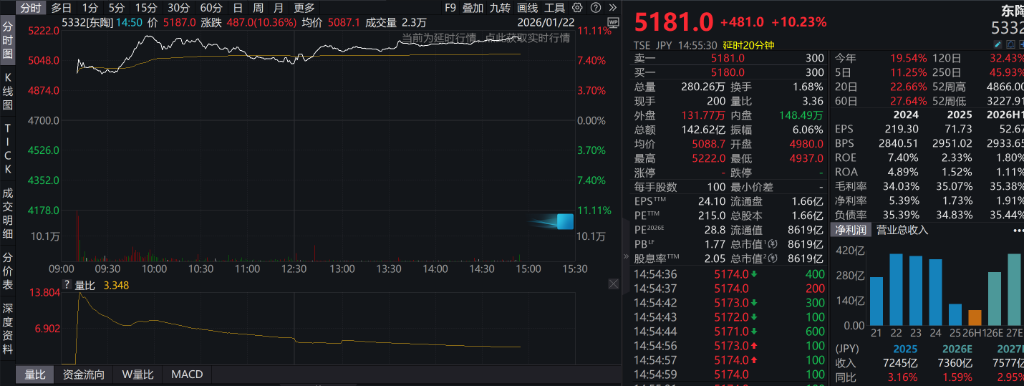
存储NAND紧俏,卫浴大牌Toto大涨!
Hua Er Jie Jian Wen· 2026-01-22 06:23
Core Insights - The AI boom is reshaping global supply chains, benefiting companies like Toto, known for its bathroom fixtures, due to its semiconductor materials business [1] - Goldman Sachs upgraded Toto's rating, citing increased demand for its electrostatic chucks used in NAND storage chip manufacturing as AI infrastructure expands [1][2] - Toto's stock surged by 11%, marking its largest increase since February 2021, reflecting the significant impact of AI data center expansion on upstream supply chains [1] Company Overview - Toto has been a key player in the semiconductor and display supply chains for decades, with new business areas accounting for 42% of its total revenue for the fiscal year ending March 2025 [2] - The electrostatic chuck, produced by Toto since 1988, is crucial for fixing silicon wafers during chip manufacturing, helping to control temperature and prevent contamination [2] Market Dynamics - Major tech companies like Meta Platforms and Amazon are investing billions in AI service data centers, leading to a widespread shortage of semiconductor products [3] - This surge in demand has prompted global storage chip manufacturers, including SK Hynix, Samsung, and Kioxia, to expand production, directly increasing demand for products from upstream suppliers like Toto [3] Industry Trends - Toto is not the only Japanese consumer goods giant benefiting from the chip boom; companies like Ajinomoto and Kao have also established semiconductor-related businesses [4] - The rise in Toto's stock coincided with a broader rebound in AI-related stocks, indicating investor interest in undervalued assets that can benefit from the global competition in computing power [4]

刘润年度演讲2025:进化的力量(演讲全文)
吴晓波频道· 2025-10-27 00:29
Core Viewpoint - The annual speech emphasizes the need for businesses to shift from opportunistic thinking to long-term problem-solving in the face of economic challenges, highlighting the importance of addressing real difficulties rather than merely seeking trends [9][11][12]. Group 1: Economic Challenges - The current economic environment is characterized as an "adjustment period," where many businesses face significant difficulties, leading to a collective struggle for survival and growth [9][18]. - Specific industries, such as the restaurant sector, have seen a 24.2% decrease in business-related dining and a 7.7% drop in average spending per customer, resulting in a reduction of restaurant lifespan from over two years to just 15 months [20]. - The birth rate in China has halved over seven years, impacting industries related to maternal and infant care, leading to a cascading effect on various sectors as fewer children are born [22][23]. Group 2: The Concept of "Great Migration" - The "Great Migration" is introduced as a necessary strategy for businesses to adapt and thrive amidst challenges, akin to how wildebeests migrate for survival [24][26][32]. - Companies must embrace change and seek new opportunities rather than remain stagnant in competitive markets, which are likened to overpopulated ecosystems where resources are scarce [31][32]. - Successful examples of this migration include a restaurant that enhances emotional value for customers and a baby stroller company that pivoted to producing pet strollers in response to changing consumer demographics [46][55]. Group 3: Avoiding Category Rigidity - Category rigidity is identified as a significant barrier to innovation, where businesses become too focused on existing products and fail to adapt to new consumer needs [58][61]. - The example of a fish farmer who successfully increased the price of a common fish by addressing new consumer demands illustrates how businesses can escape category rigidity by redefining their value propositions [63]. - The concept of "value reordering" is introduced, where consumers are becoming more selective about their spending, leading to a dual behavior of cutting costs in essentials while splurging on non-essentials [110][124]. Group 4: Consumer Behavior Insights - Recent consumer behavior indicates a complex landscape where individuals are cutting back on essential spending to indulge in non-essential purchases, reflecting a psychological shift rather than a straightforward economic decline [128][129]. - The phenomenon of "value reordering" suggests that consumers are recalibrating their spending priorities, influenced by external pressures and a desire for control over their financial situations [132][133].
《进化的力量》刘润2025年度演讲六大核心迁徙体系精炼(附演讲全文)
首席商业评论· 2025-10-26 04:34
Core Viewpoint - The article emphasizes the necessity for businesses and individuals to undergo "migration" in response to the systemic "drought" in ecological niches, which is characterized by the end of growth opportunities and increased competition. This migration involves abandoning old advantages and moving towards new demands, capabilities, markets, organizations, and technological orders [4][5][6]. Group 1: Overall Framework - The speech is structured into eight major parts, focusing on six critical migrations that determine whether a business can survive and grow: category migration, value migration, model migration, overseas migration, intelligent migration, and demographic migration [4][6]. - The overarching theme is that in an environment of "ecological drought," businesses must strategically migrate to survive and rebuild growth [4][5]. Group 2: Major Migrations 1. Category Migration - Category rigidity arises from excessive optimization of old demands and slow responses to new demands. Innovation requires redefining problems rather than merely improving existing solutions [6][8]. - A methodology for category migration includes stopping current practices, redefining the problem, and addressing new demands [6][8]. 2. Value Migration - The consumption landscape is shifting towards a "value reordering" era, where consumers exhibit frugality in some categories while being generous in others, indicating a shift from pure price sensitivity to emotional and meaningful consumption [8][9]. 3. Model Migration - As product life cycles end, core capabilities can still migrate and create new value. The key to successful migration lies in capability assessment, market scanning, and model validation [10][11]. 4. Overseas Migration - In increasingly crowded domestic markets, "going overseas" serves as a systematic migration strategy, offering new market opportunities and validating capabilities on a global stage [15][16]. 5. Intelligent Migration - AI and smart technologies are not merely tools but cognitive extensions that redefine human-machine collaboration, altering efficiency and business models [16][17]. 6. Demographic Migration - Changes in population dynamics, such as declining birth rates and aging populations, serve as long-term demand reshapers, impacting various industries [18][19]. Group 3: Practical Recommendations - Companies should conduct capability assessments, identify three unique capabilities, and explore new applications for these capabilities in adjacent industries [19][20]. - Businesses are encouraged to view overseas expansion as a means to amplify capabilities rather than a short-term revenue fix [20][21]. - The article suggests designing emotional touchpoints and small satisfactions to enhance customer loyalty and word-of-mouth [21][22]. Group 4: Conclusion and Action Items - The conclusion stresses that when ecological conditions are harsh, migration is preferable to mere competition. The six core migrations are essential for businesses to survive and grow [22][23]. - Immediate actionable items for companies include conducting a "river crossing meeting" to reassess priorities, performing capability inventories, and experimenting with both functional and emotional product lines [25][26].