Mellanox

Search documents
以色列,重塑全球芯片版图
半导体芯闻· 2025-09-28 09:47
Core Viewpoint - Israel has transformed from a "startup nation" to a global semiconductor powerhouse, playing a crucial role in reshaping the global chip landscape, with around 200 semiconductor companies and an annual export exceeding $10 billion, accounting for 5% of the national export [1][3]. Historical Development - The pivotal year for Israel's semiconductor industry was 1964 when Motorola established the first semiconductor R&D center in Israel, laying the foundation for the industry [3]. - Over the next decade, major companies like Microsoft and National Semiconductor entered Israel, enhancing local technological capabilities and establishing manufacturing facilities [3][4]. - The 1980s to 2000s marked a significant growth period, highlighted by Intel's development of the 8088 processor in 1984, which became a key component in the rise of the global PC industry [4]. Local Innovations - Israeli companies have made significant contributions, such as Galileo Technology's development of the first true flash file system in 1990, which revolutionized storage devices [5]. - Mobileye's introduction of the first ADAS-specific processor in 2004 established Israel as a leader in automotive technology, culminating in its acquisition by Intel for $15.3 billion [6]. Key Industry Players - Major global companies like Intel have played a significant role in Israel's semiconductor landscape, establishing R&D centers and manufacturing facilities that integrate local talent and technology into global supply chains [9]. - Mobileye's trajectory exemplifies the successful transition from R&D to commercialization, with its technology being widely adopted in the automotive industry [10]. - Other notable companies include Mellanox, acquired by NVIDIA for $6.9 billion, and Habana Labs, acquired by Intel for approximately $2 billion, both enhancing their respective parent companies' capabilities in AI and data center technologies [11][12]. Emerging Technologies - Israel's semiconductor industry is well-positioned to capitalize on emerging technologies such as AI, with the generative AI chip market projected to reach $125 billion by 2024 [30]. - The rise of edge computing and IoT aligns with Israel's strengths in sensor and edge computing chip development, presenting opportunities for commercialization in various sectors [30]. Competitive Advantages - Israel's semiconductor industry benefits from a strong local ecosystem supported by multinational companies, high R&D investment (4.3% of GDP), and a vibrant startup culture with around 70 semiconductor startups raising $5.5 billion [28][29]. - The education system emphasizes engineering and technology, producing a skilled workforce that supports innovation and aligns with global industry standards [28]. Future Outlook - The future of Israel's semiconductor industry will depend on its ability to leverage opportunities while addressing challenges such as talent retention, geopolitical risks, and competition from other regions [32][33]. - By focusing on its strengths in design and R&D, Israel can enhance its position as a "technology innovation node" in the global semiconductor landscape, particularly in AI and edge computing [33].


以色列,重塑全球芯片版图
半导体行业观察· 2025-09-28 01:05
Core Viewpoint - Israel has transformed from a "startup nation" to a global semiconductor powerhouse, playing a crucial role in reshaping the global chip landscape [1][2]. Group 1: Historical Development - The establishment of Motorola's semiconductor R&D center in Israel in 1964 marked the beginning of the country's semiconductor industry [3]. - The entry of major tech companies like Microsoft and National Semiconductor in the 1970s helped build a robust industry framework, transitioning Israel from a pure R&D hub to a base with both R&D and manufacturing capabilities [3][4]. - The 1980s to 2000s saw significant breakthroughs, including Intel's development of the 8088 processor, which became a key component in the rise of the global PC industry [4]. Group 2: Key Players and Innovations - Israeli companies have made notable innovations, such as Galileo Technology's development of the first true flash file system in 1990, which revolutionized storage devices [5]. - Mobileye's introduction of the first ADAS-specific processor in 2004 established it as a leader in the automotive semiconductor sector, culminating in its acquisition by Intel for $15.3 billion [6][9]. - Other significant acquisitions include Mellanox by NVIDIA for $6.9 billion and Habana Labs by Intel for approximately $2 billion, enhancing their respective positions in data center and AI chip markets [11][12]. Group 3: Competitive Advantages - Israel's semiconductor industry benefits from a strong local ecosystem supported by multinational companies, high R&D investment (4.3% of GDP), and a vibrant startup culture with around 70 semiconductor startups raising $5.5 billion [30][31]. - The education system emphasizes engineering and technology, producing a skilled workforce that supports the industry's growth [30]. Group 4: Opportunities and Challenges - Emerging technologies like AI chips and IoT align well with Israel's existing technological capabilities, presenting growth opportunities [33]. - However, challenges such as talent retention, geopolitical risks, and increasing global competition pose significant threats to the industry [34][36]. Group 5: Future Outlook - The future of Israel's semiconductor industry hinges on its ability to leverage existing strengths while addressing challenges, with potential for growth in AI and edge computing sectors [36][37]. - Strategies to enhance talent retention, diversify supply chains, and focus on design and R&D rather than full-scale manufacturing will be crucial for maintaining its competitive edge [37].
英伟达,钱太多?
半导体芯闻· 2025-09-24 10:47
如果您希望可以时常见面,欢迎标星收藏哦~ 过去几天,英伟达登上头条的原因,并不是它卖出了多少芯片,而是它能开出多大的支票。上周晚 些时候,公司宣布将向陷入困境的芯片制造商英特尔投资 50 亿美元。随后在周一,又传出消息 称,英伟达计划在未来几年向 OpenAI 投资 最高 1000 亿美元。 这个数字尤其惊人,因为就在三年前,英伟达每年的自由现金流还只有区区 60 亿美元出头。但人 工智能的狂热及其引发的"军备竞赛",让英伟达不仅成为全球市值最高的公司,还成为"现金储备 最深"的科技巨头之一。 根据 FactSet 数据,英伟达在过去四个季度中创造了 720 亿美元自由现金流,本财年预计将接近 1000 亿美元。这一规模超过了除苹果之外所有超大市值科技公司的今年预期自由现金流。 然而,如何花掉这笔巨款并非易事。英伟达在过去四个季度回购了近 500 亿美元的股票,并在近 期又追加了 600 亿美元的回购计划。公司在过去两年中将研发投入翻了一番,但依旧难以追上爆 炸式的销售增长。过去四个季度,英伟达的研发费用仅占营收的 9%,而此前五个财年的年均比例 为 22%。 用 现 金 去 收 购 一 家 大 型 公 司 ...

Huang Breaks Silence On Beijing Move Targeting Nvidia AI Chips
Yahoo Finance· 2025-09-19 03:30
Core Viewpoint - Nvidia's stock has shown recovery after facing challenges due to a potential ban on its AI chips in China, with CEO Jensen Huang addressing these issues directly [1][2]. Group 1: China Business Challenges - Reports indicate that China's Cyberspace Administration has banned companies like ByteDance and Alibaba from purchasing Nvidia's RTX Pro 6000D chips, specifically designed for the Chinese market [3]. - Nvidia's operations in China have been disrupted multiple times, with the U.S. government already imposing restrictions on high-end AI chip exports, including the H100 and A100, due to national security concerns [3]. - Despite a previous arrangement with the U.S. government allowing Nvidia to secure export licenses in exchange for a portion of sales, the company has advised analysts to exclude China from its financial forecasts [4]. Group 2: Financial Impact - Nvidia generates approximately 20-25% of its revenue from China, highlighting the significance of this market to the company's overall financial health [5]. - The company is currently facing an antitrust investigation by China's State Administration for Market Regulation regarding its $6.9 billion acquisition of Mellanox, which adds to the regulatory pressures it faces in the region [5]. Group 3: Continued Investment in AI - Despite challenges in China, Nvidia remains optimistic and is investing £11 billion ($15 billion) into AI infrastructure in the U.K., indicating a commitment to expanding its AI capabilities [6].
Nvidia CEO says he's 'disappointed' after report China has banned its AI chips
CNBC· 2025-09-17 12:29
Core Insights - Nvidia CEO Jensen Huang expressed disappointment over China's reported ban on Nvidia's AI semiconductors, including the H20 chip, which affects major companies like ByteDance and Alibaba [2] - Huang indicated that Nvidia's contributions to the Chinese market have been significant, but geopolitical tensions between the U.S. and China are influencing the company's operations [2][6] - Nvidia has advised financial analysts to exclude China from their forecasts due to the uncertainty stemming from U.S.-China discussions [2][3] Company Developments - The U.S. government previously imposed restrictions on Nvidia's AI chip exports to China, citing national security concerns, which included the H20 chip [2][3] - A deal was struck between President Trump and Huang in August, allowing Nvidia to receive export licenses in exchange for 15% of H20 sales in China going to the U.S. government [3] - Nvidia is currently facing an anti-monopoly investigation in China regarding its acquisition of Mellanox, a company specializing in network solutions [4] Investment and Market Importance - Nvidia announced a £11 billion ($15 billion) investment in U.K. AI infrastructure, alongside other U.S. tech giants making similar multibillion-dollar investments [5] - Despite the geopolitical challenges, Huang emphasized the importance of the Chinese AI sector, describing it as large and vibrant, and reaffirmed Nvidia's commitment to support both the Chinese government and U.S. government [5][6]
China's Nvidia probe claims the chipmaker broke antitrust law
CNBC Television· 2025-09-15 17:56
Nvidia uh becoming the latest pawn in the US China trade negotiations. Christina Partzene has more on that layer in tech check. Christina Leslie.Well, China's market regulator announced this morning that Nvidia violated anti- monopoly law. But this is more than just about antirust. It's also about leverage.Beijing launched this probe in December, just one week after Washington unveiled tougher chip export controls and conveniently announced the quote violation today as US China trade negotiators just finish ...

Nvidia caught in trade tensions
CNBC Television· 2025-09-15 16:02
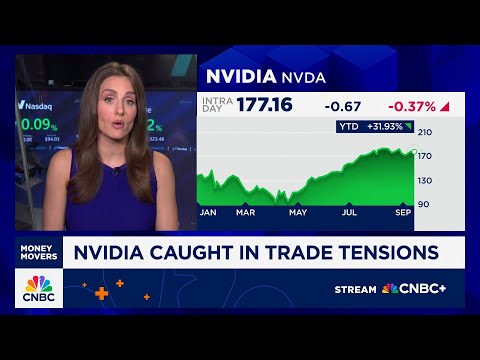
US China trade talks now facing even higher stakes after Chinese regulators announced today that Nvidia violated one of its antitrust laws with its 2020 acquisition of Melanox. Our Christina parts Nevos has more on that in today's tech check. They're going back a ways on this one.KP. >> Yeah, they are. So, five years.Well, China's market regulator, like you said, announced this morning that Nvidia violated anti- monopoly law. But this isn't really about antitrust. It's about leverage.Beijing launched this p ...
China Finds Nvidia Violated Antitrust Law in Chip Deal Probe
Yahoo Finance· 2025-09-15 08:45
Core Viewpoint - China has determined that Nvidia Corp. violated anti-monopoly laws, increasing pressure on the U.S. amid sensitive trade negotiations [1] Company Summary - Nvidia's shares declined by 2.6% in pre-market trading following the announcement of the violation [1] - The company has previously acknowledged scrutiny from Chinese regulators, who required Nvidia to continue supplying local companies to gain regulatory approval for its acquisition of Mellanox [1] - Nvidia completed the acquisition of Mellanox, a networking technology firm, in 2020 [1] Industry Summary - The ruling by China's State Administration for Market Regulation highlights ongoing tensions in U.S.-China trade relations, particularly in the technology sector [1]
一桩收购,成就4万亿英伟达(NVDA.US)
智通财经网· 2025-09-07 07:07
Core Insights - The focus of attention after NVIDIA's Q2 earnings report is on whether the company's revenue can justify its rapid market capitalization growth, with the network business emerging as a significant growth driver [1] - The network segment, marked as "network," contributed more than 16.1% to NVIDIA's overall revenue, with a 46% quarter-over-quarter increase and nearly doubling year-over-year, reaching $7.25 billion in Q2 alone [1] - The acquisition of Mellanox is highlighted as a pivotal move, with the network business now generating an annual operating revenue of $25 billion to $30 billion, a remarkable figure for a segment previously seen as a secondary player [1][2] Revenue Contribution - The network business's revenue surged to $7.25 billion in Q2, significantly exceeding the acquisition cost of Mellanox, which was $6.9 billion [1][2] - This growth indicates that the network segment is becoming a critical component of NVIDIA's overall financial performance, contributing substantially to its valuation [1] Technological Advancements - NVIDIA's Spectrum-XGS platform addresses challenges such as latency and enables multiple data centers to operate as a unified system, enhancing the company's capabilities in the network domain [3][4] - The technology breakthrough from the acquisition of Mellanox allows geographically distant data centers to function as a single entity, facilitating the creation of large-scale AI factories [3] Strategic Importance of Mellanox - The acquisition of Mellanox is described as one of the most significant mergers in the industry, with its InfiniBand technology being crucial for high-performance computing and AI applications [6][15] - Mellanox's technology is essential for achieving the data processing speeds required for AI, as emphasized by Eyal Waldman, the founder of Mellanox [6][17] Future Infrastructure Developments - NVIDIA plans to deploy 576 GPUs in a single rack, necessitating significant infrastructure expansion to support this scale [11] - The company is focusing on integrating optical connections into switches to reduce power consumption and increase GPU capacity within data centers [13][14] Market Position and Growth - NVIDIA's strategic investments and acquisitions, particularly in Israel, have positioned it as a leader in the semiconductor industry, with a workforce of over 5,000 employees in its Israeli R&D centers [17] - The company's market capitalization has soared from $93 billion to $4 trillion, largely attributed to its successful bets on AI and the integration of Mellanox's technologies [16][17]
一桩收购,成就4万亿英伟达
半导体行业观察· 2025-09-07 02:06
Core Insights - The article emphasizes that NVIDIA's success is significantly attributed to its acquisition of Mellanox, which has become a crucial driver for its transformation into a $4 trillion chip giant [1][17] - The network business, particularly through the Spectrum-XGS platform, is highlighted as a low-key engine propelling NVIDIA's growth, with revenue contributions far exceeding initial expectations [1][3] Group 1: Financial Performance - NVIDIA's network business revenue surged 46% quarter-over-quarter and nearly doubled year-over-year, reaching $7.25 billion in the second quarter [1] - The annual operating revenue for this segment is projected to be between $25 billion and $30 billion, showcasing its significant growth from being a secondary component to a flagship business [1] Group 2: Strategic Acquisitions - The acquisition of Mellanox for $6.9 billion is credited with enabling NVIDIA to enhance its network capabilities, which are essential for AI workloads [1][4] - Mellanox's technology, particularly InfiniBand, is recognized as a foundational element for high-performance computing and AI applications, facilitating the necessary data processing speeds [5][12] Group 3: Technological Advancements - The Spectrum-XGS platform addresses challenges such as latency and connectivity, allowing multiple data centers to operate as a unified AI super factory [3][4] - NVIDIA's focus on integrating optical engines into switches aims to reduce power consumption and increase GPU capacity within data centers [14][15] Group 4: Industry Context - The article discusses the competitive landscape, noting that organizations like UAlink are forming alliances to challenge NVIDIA's dominance in the AI and computing space [3] - The increasing scale of data centers, with projections of GPU counts reaching hundreds of thousands, underscores the growing importance of network infrastructure in AI applications [9][12]