Rokid

Search documents
集福、停车、当导游……一副眼镜,正在打开AI的「生活副本」
3 6 Ke· 2026-02-05 02:18
Core Viewpoint - The integration of AI glasses into daily life is transforming traditional practices, such as the collection of blessings during the Chinese New Year, into a seamless and interactive experience, showcasing the potential of AI technology in enhancing user engagement and convenience [1][3][5]. Group 1: AI Glasses and User Experience - The use of AI glasses for collecting blessings allows users to effortlessly scan for "福" characters and receive rewards, indicating a shift towards a more intuitive and engaging interaction with technology [1][3]. - The collaboration with popular cultural IPs, such as "王者荣耀" and "乡村爱情," enhances the experience by turning the real world into a large-scale interactive game, further integrating AI technology into everyday activities [5]. - The GPASS technology framework supports this new experience by enabling seamless interactions and connections between users and the AI system, marking a significant advancement in the application of AI glasses [5][13]. Group 2: Practical Applications of AI Glasses - AI glasses can simplify everyday tasks, such as parking fee payments, by allowing users to interact with the system through voice commands, thus streamlining the payment process and reducing hassle [8][10]. - The integration of health management features into AI glasses allows users to receive real-time health advice and information, enhancing the utility of the device in daily life [10][12]. - In the tourism sector, AI glasses can serve as personal guides, providing information and navigation assistance, which exemplifies their potential to transform user experiences in various contexts [12][18]. Group 3: Market Trends and Future Outlook - The AI glasses market is on the verge of significant growth, with projections indicating a 370% year-over-year increase in sales for AI smart glasses, highlighting the rapid acceleration of this technology [19]. - By 2026, AI glasses are expected to reach a critical point of widespread adoption, driven by advancements in hardware and the development of a robust software ecosystem that enhances user experience [21]. - Companies like Rokid and others are preparing for this market shift by optimizing their hardware and leveraging GPASS technology to create a comprehensive service framework, positioning themselves for success in the emerging AI glasses landscape [21].


特斯拉最新人形机器人2026年底前启动量产;三星SDI2025年第四季度持续亏损丨智能制造日报
创业邦· 2026-02-03 03:09
Group 1 - Tesla's third-generation humanoid robot is set to be unveiled, with an expected annual production capacity of 1 million units by the end of 2026, as the Fremont factory's Model S/X production line will be converted for this purpose [2] - Rokid is collaborating with a leading domestic large model company to develop a new generation of AI glasses driven by generative AI and AI agents, with current daily sales of approximately 1,200 units [2] - Samsung SDI reported a continued loss in Q4 2025, with a net profit of 207.8 billion KRW (approximately 142.4 million USD) for Q4 2024, and an operating loss of 299.2 billion KRW, which is an increase from the previous year's loss [2][3] Group 2 - VinFast plans to accelerate its expansion into Southeast Asia, targeting markets such as the Philippines, Indonesia, India, Thailand, and Malaysia, with plans to establish hundreds of retail outlets by 2027 [2]


2500亿美元!SpaceX收购xAI;千问App投入30亿开启春节攻势;小鹏全球首款AI汽车正式开启海外大规模发运丨邦早报
创业邦· 2026-02-03 00:09
Group 1 - Qianwen App announced an investment of 3 billion to launch a Spring Festival campaign, integrating with Alibaba's ecosystem including Taobao, Damai, Feizhu, and Hema, set to go live on February 6 [2] - Tencent's internal communication addressed concerns regarding the Yuanbao "Spring Festival Red Packet" sharing, emphasizing that the design allows for "no-threshold" receipt, distinguishing it from malicious marketing practices [3][3] - SpaceX acquired xAI for $250 billion, based on a recent funding round that valued xAI at $230 billion, highlighting the significant financial movements within the AI sector [3] Group 2 - Waymo raised $16 billion in its latest funding round, achieving a valuation of $126 billion, nearly doubling in less than two years, indicating strong investor confidence in autonomous vehicle technology [8] - Snowflake entered a $200 million partnership with OpenAI to integrate advanced AI models into its cloud data platform, reflecting the growing reliance on AI for data insights [9] - Tesla announced the upcoming mass production of its humanoid robot by the end of 2026, with an expected annual output of 1 million units, showcasing advancements in robotics [9] Group 3 - Mercedes-Benz adjusted the suggested retail prices of some models by approximately 10%, aiming to improve cash flow for dealers [15] - Zhijidongli completed a $200 million Series B financing round, with participation from various notable investors, indicating strong interest in the company's growth potential [15] - National Semiconductor's 2nm production capacity has been fully booked, with major tech companies planning to utilize this advanced technology in upcoming products [12]


2026前沿科技趋势:塑造自己的下一个版本
3 6 Ke· 2026-01-30 09:58
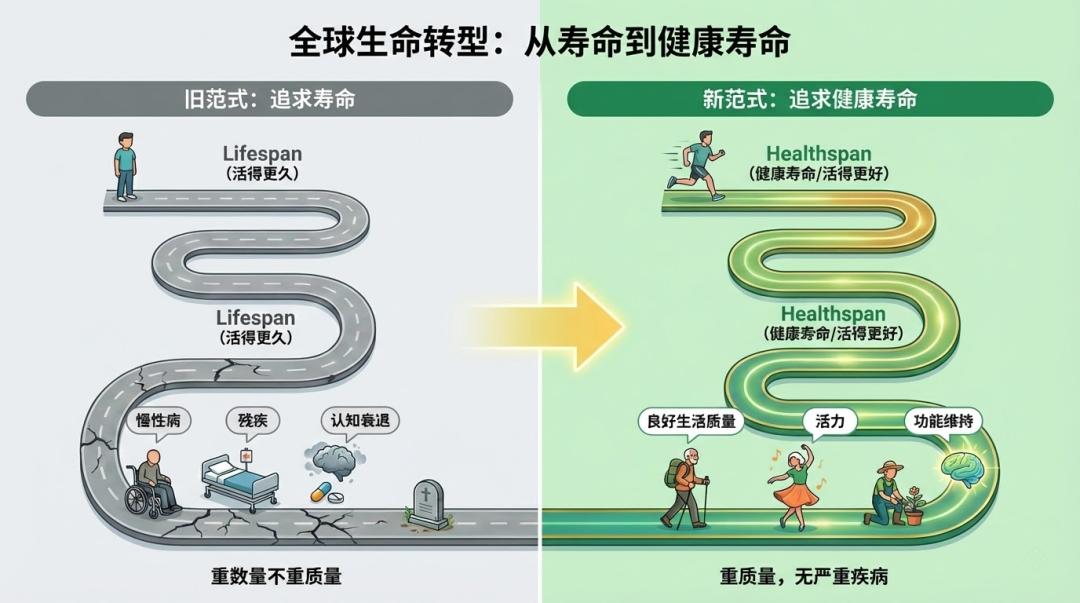
Group 1 - The rapid evolution and application of artificial intelligence and cutting-edge technologies are causing societal adaptation challenges, leading to feelings of uncertainty among people [1][2] - The focus of technological advancement should be human-centered, with an emphasis on shaping a better future through technology by 2030 [2] Group 2 - The "third transformation" of human life aims to extend healthy lifespan rather than just lifespan, with significant implications for global health and economy [3][5] - Human life expectancy has doubled over the past century, but the growth rate has significantly slowed down, with some regions experiencing stagnation or decline [4] - By 2030, the quality of life is projected to be a major focus, with non-communicable diseases potentially costing the global economy up to $47 trillion if not addressed [5] Group 3 - Advances in gene therapy and artificial intelligence are expected to play crucial roles in extending healthy lifespan, with technologies like CRISPR and AI enhancing medical capabilities [9][17] - Clinical breakthroughs in preventive gene therapy and RNA therapies are showing promise in treating chronic diseases effectively [10][12] - Epigenetic reprogramming is emerging as a potential method to reverse aging, with ongoing research aiming for clinical trials by 2026 [15] Group 4 - Artificial intelligence is set to enhance medical efficiency and understanding of human health, with applications in drug development, disease screening, and personal health management expected to yield significant results by 2030 [17][18] - AI is accelerating drug development processes, reducing timelines from years to months, and improving the success rates of new treatments [18][19] Group 5 - The development of exoskeleton technology is enhancing human physical capabilities, with applications in medical rehabilitation, industrial safety, and personal use expected to expand significantly [24][25] - Innovations in exoskeletons are making them more adaptable and user-friendly, with advancements in sensor technology and materials [28][30] Group 6 - The eVTOL market is projected to grow significantly, with advancements in battery technology and noise reduction strategies being critical for its acceptance and integration into urban transportation [31][32] - The evolution of drones into autonomous aerial robots is enhancing their capabilities for both consumer and industrial applications [34] Group 7 - The development of brain-computer interfaces (BCIs) is transforming the treatment of neurological conditions and enhancing human capabilities, with both invasive and non-invasive technologies showing promise [51][54] - BCIs are moving from experimental to standard treatment options for conditions like paralysis, with significant advancements in technology and regulatory approval processes [52][53]
2026前沿科技趋势:塑造自己的下一个版本
腾讯研究院· 2026-01-30 08:18
Core Insights - The article emphasizes the rapid evolution and application of artificial intelligence and cutting-edge technologies across various fields, urging a human-centered approach to technological advancement [3][4][5]. Group 1: Human Life's "Third Transformation" - Extending Healthy Lifespan - Human life expectancy has doubled over the past century, with significant improvements attributed to public health, antibiotics, and vaccines [7]. - Recent research indicates a dramatic slowdown in the growth rate of life expectancy, with the average increase dropping to below 0.25 years per decade in the last 30 years [8]. - A shift is occurring from merely extending lifespan to enhancing healthspan, which is the period of life spent in good health, with potential economic implications of up to $47 trillion in costs from non-communicable diseases by 2030 [9]. Group 2: Programmable Life - Gene Therapy - Gene therapy is moving towards optimizing the "life code," with advancements in CRISPR technology and delivery systems expected to mature by 2030 [11]. - Clinical breakthroughs in preventive gene therapy, such as Verve Therapeutics' treatment for cardiovascular disease, show promising results with significant reductions in LDL-C levels [12]. - The success of personalized CRISPR therapy in curing a fatal metabolic disease in a patient highlights the potential of gene therapy [14]. Group 3: Health Planning - AI Enhancing Medical Efficiency - AI is set to revolutionize drug development, disease screening, and personal health management by 2030, significantly reducing the time and cost associated with traditional drug development [21]. - AI combined with multi-omics technology is facilitating faster and more accurate disease screening, with notable advancements in cancer detection [23]. - Aging clock technology is evolving, enabling precise monitoring of aging processes and identifying underlying causes of aging [25]. Group 4: Enhancing Physical Capability - Exoskeleton Technology - Exoskeleton technology is advancing to enhance human physical capabilities, with applications in medical rehabilitation, industrial safety, and personal use [30]. - In the medical field, exoskeletons are evolving from mere mobility aids to intelligent devices that promote neurological recovery [31]. - Consumer-grade exoskeletons are expected to become popular for outdoor activities, significantly improving mobility for users [32]. Group 5: Flying Technology - eVTOL Development - The eVTOL market is projected to reach $41 billion in China by 2040, with significant advancements in battery technology expected to triple flight ranges [37]. - Noise reduction technologies are being explored to enhance social acceptance of eVTOLs, with strategies like "noise corridors" being implemented [38]. - The evolution of drones into aerial robots is enhancing capabilities in both consumer and industrial applications, with significant advancements in autonomous operations [40]. Group 6: Brain-Machine Interfaces - A New Era of Interaction - Brain-machine interfaces (BCIs) are transitioning from experimental therapies to standard treatment options for conditions like paralysis, with companies like Neuralink leading the way [61]. - Non-invasive BCIs are emerging, allowing for enhanced human-computer interaction, with applications in consumer technology [63]. - The integration of BCIs with AI could redefine human-AI collaboration, raising ethical considerations regarding privacy and data protection [64].

Song Dynasty Charm & Spring Festival Cheer: China's Hangzhou Welcomes Year of the Horse
Globenewswire· 2026-01-28 17:09
Group 1 - The Chinese Lunar Year of the Horse is approaching, symbolizing vitality and journeys, making Hangzhou a popular destination for spring outings [1] - Hangzhou is home to three World Heritage Sites and has a rich cultural history, making it an ideal place to experience ancient Chinese aesthetics and traditional Spring Festival culture [2] - A cultural campaign to celebrate the Year of the Horse has been launched in Hangzhou, running from January 23 to March 4, featuring various events and activities for visitors [3][6] Group 2 - The campaign includes artistic installations, such as a bronze horse by artist Zhu Bingren, and over 70 murals that combine Song patterns with horse motifs [4] - The "Capture Your Hangzhou" charity campaign offers free family photos in scenic areas, with over 100 events showcasing local highlights [5] - The Rokid AR glasses provide a virtual tour experience, featuring multilingual translation and smart navigation, enhancing the exploration of Wuyue Kingdom culture [7] Group 3 - Five themed routes are available for visitors, including Zen experiences and leisurely tours, along with a Spring Festival Bazaar showcasing local crafts and delicacies [8]
佰维存储:公司ePOP系列产品目前已被Meta、Google、小米、阿里等国内外知名企业应用于其AI/AR眼镜、智能手表等智能穿戴设备上
Jin Rong Jie· 2026-01-27 08:32
Core Viewpoint - The company has established a strong competitive position in the AI edge storage market, with its ePOP series products being utilized by several prominent companies in the AI/AR glasses and smart wearable devices sector [1] Group 1: Product Applications - The company's ePOP series products are currently being used by major companies such as Meta, Google, Xiaomi, Alibaba, and others in their AI/AR glasses and smartwatches [1] - The company is actively expanding its customer base in the AI glasses segment [1]

未知机构:华福大科技海外字节AI眼镜悄悄进村产业链买哪些-20260127
未知机构· 2026-01-27 01:55
【华福大科技&海外】字节AI眼镜"悄悄进村",产业链买哪些? 行业情况:出货量从1000w(2025年)增至3000w(2026年),远期10亿。 25年10m,其中meta-rayban有7m,显示款里面meta、rokid、雷鸟均卖了差不多20-30w,生命周期预计50w估计明年 就迭代新的产品,阿里夸克是去年底的爆款,到现在还缺货。 相关标的: 行业情况:出货量从 【华福大科技&海外】字节AI眼镜"悄悄进村",产业链买哪些? 据媒体报道,字节跳动旗下的AI眼镜敲定了"春节前后"的时间节点。 但不同于小米、阿里等大厂的高举高打,字节此次将采取"悄悄滴进村"的策略。 字节量价:预计非显示版生命周期10w台,下半年显示版100w+,预计非显示版1500元左右,下半年显示版2500元 左右 据媒体报道,字节跳动旗下的AI眼镜敲定了"春节前后"的时间节点。 但不同于小米、阿里等大厂的高举高打,字节此次将采取"悄悄滴进村"的策略。 字节量价:预计非显示版生命周期10w台,下半年显示版100w+,预计非显示版1500元左右,下半年显示版2500元 左右 龙旗科技(标签感最强独家代工,150元)/康耐特光学(主业和消费 ...
中国,造出全球80% AI眼镜
创业邦· 2026-01-26 04:09
Core Insights - The article emphasizes that China has become a dominant player in the AI glasses industry, controlling over 80% of the global supply chain [5][6][26] - The rapid innovation and manufacturing capabilities in China have allowed for significant advancements in AI glasses technology, making them a key player in the global market [16][30] Industry Overview - AI glasses are viewed as the next generation of computing devices, with China leading in the supply chain and production [6][8] - Key components such as chips and optical modules are primarily produced in China, with optical modules accounting for over 40% of the cost and chips over 30% [10][13] Technological Advancements - Chinese companies have made significant breakthroughs in optical waveguide technology, which is crucial for AI glasses [11] - Companies like JBD and Zhizhi Technology have developed advanced Micro LED and optical components that are lightweight and energy-efficient [11][13] Market Dynamics - The integration of the supply chain in China has led to reduced costs for AI glasses, with prices dropping from over 10,000 yuan to around 1,999 yuan [26] - The market for AI glasses is expected to grow significantly, with predictions of a compound annual growth rate of 55.6% over the next five years [30] Competitive Landscape - Major Chinese brands are emerging in the AI glasses market, with companies like TCL, XREAL, and Rokid showcasing innovative products at international tech exhibitions [27][29] - The article highlights that Chinese manufacturers are not only producing but also innovating, moving from a role of OEM to becoming leaders in the industry [17][24]

Las gafas Rokid Ai ya están disponibles a nivel mundial
Prnewswire· 2026-01-24 16:18
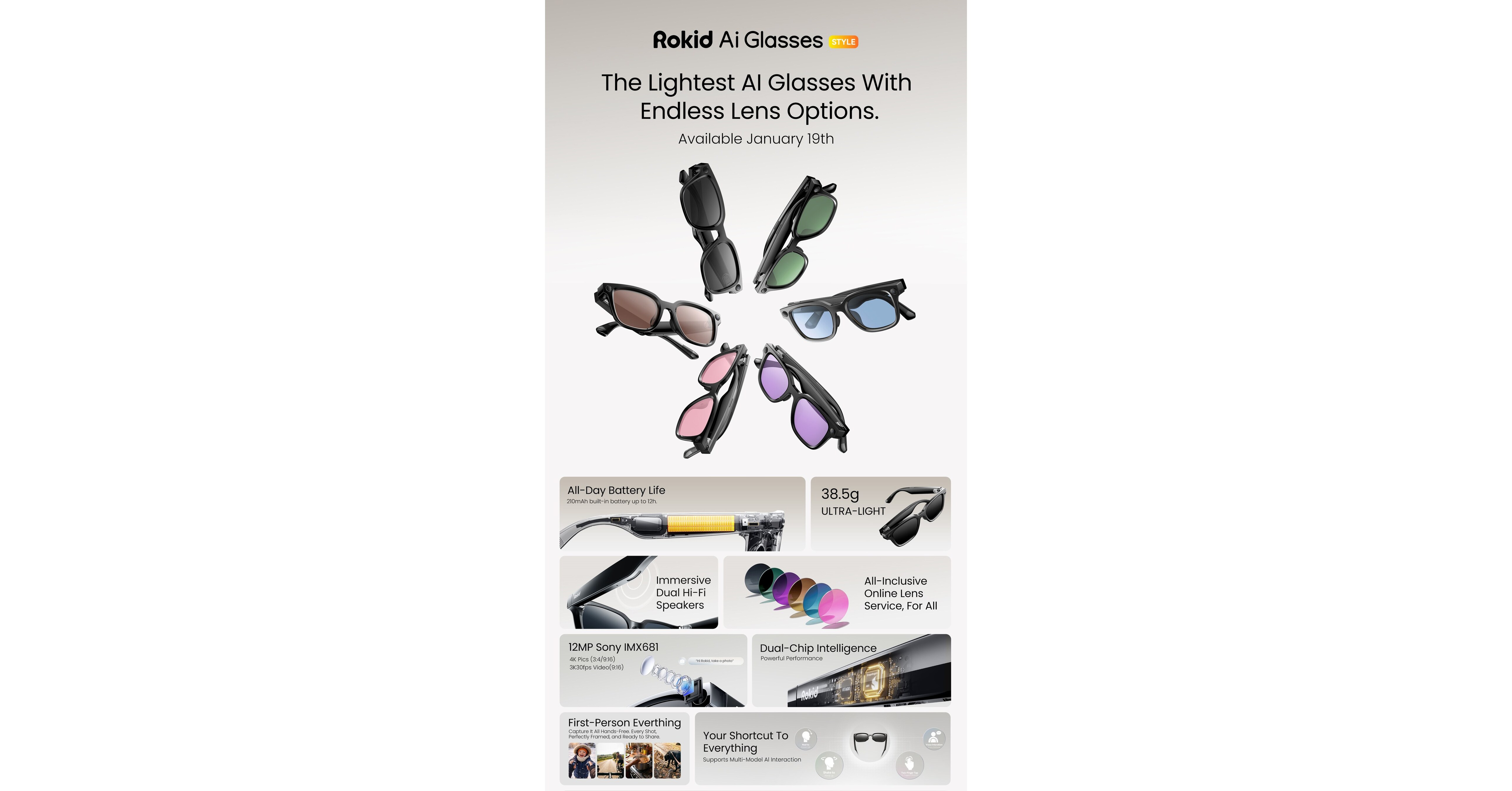
Core Insights - Rokid has officially launched the Rokid Ai Glasses Style, the world's first lightweight smart glasses with an open AI ecosystem, priced starting at $299 [1][2] - The glasses weigh 38.5 grams and offer up to 12 hours of daily use and 24 hours on standby, making them one of the lightest and most comprehensive AI glasses available [2] - Rokid aims to position glasses as the primary interface for AI interaction, moving away from smartphones as the dominant terminal [3][4] Product Features - The Rokid Ai Glasses Style features an open AI ecosystem, allowing access to multiple AI services and models, which supports the development of localized and vertical applications [6] - The glasses include a dual-chip architecture with NXP RT600 and Qualcomm AR1, voice interaction in 12 languages with translation capabilities, and multimodal AI interaction [8] - Users can upload their prescriptions online to receive customized lenses within 7 to 10 days, accommodating a wide range of vision corrections [9] Pricing and Availability - The initial price for the Rokid Ai Glasses Style is $299, with a premium package available for $398 that includes photochromic prescription lenses [10] - The glasses are available for purchase on Rokid's official website and Amazon, with additional color options launching in March 2026 [10] - Rokid is also implementing a "Leave No One Behind" initiative, offering $20 subsidies for visually impaired users globally [10] Company Background - Founded in 2014, Rokid is a global pioneer in augmented reality and AI, focusing on integrating AI into everyday life through user-centric smart glasses [11] - The company operates one of the largest XR and AI developer communities worldwide, with over 20,000 registered developers [7]