存储设备

Search documents
异动盘点0401 | TCL电子涨超12%,航空股集体反弹;POET Technologies大涨16.93%,大型科技股普涨
贝塔投资智库· 2026-04-01 04:00
Group 1: Company Performance - Sunny Optical (02382) reported an annual revenue of approximately 43.23 billion RMB, a year-on-year increase of 12.9%, and a net profit attributable to shareholders that grew by 71.9%, with a final dividend of 1.206 HKD per share, totaling around 1.301 billion HKD, achieving a dividend yield of about 25%, a recent high [1] - TCL Electronics (01070) saw a rise of over 12% after announcing a framework agreement with Sony to establish a joint venture, acquiring 51% of the new company and fully purchasing Sony's subsidiary in Malaysia for 75.399 billion JPY (approximately 3.781 billion HKD) [1] - Cambridge Technology (06166) reported a revenue of approximately 4.8234 billion RMB for 2025, a year-on-year increase of 32.07%, and a net profit of about 263 million RMB, up 58.08%, with a proposed cash dividend of 0.28 RMB per share [3] - HaiXi New Drug (02637) reported a revenue of approximately 582 million RMB for 2025, a year-on-year increase of 24.79%, and a net profit of about 177 million RMB, up 30.09%, with earnings per share of 2.55 RMB [4] Group 2: Market Trends - Aluminum stocks continued to rise, with China Aluminum (02600) up 4.09%, Nanshan Aluminum International (02610) up 3.83%, and China Hongqiao (01378) up 3.22%, following substantial production cuts from two Middle Eastern aluminum companies, which announced a 20% reduction in output by 2026 [2] - Semiconductor stocks rebounded, with companies like Lanqi Technology (06809) rising by 8.12% and Zhaoyi Innovation (03986) by 5.31%, driven by a strong performance in the South Korean market where Samsung Electronics and SK Hynix saw significant gains [2] - The aviation sector experienced a collective rebound, with China National Aviation (00753) up 6.13% and China Eastern Airlines (00670) up 6.88%, influenced by geopolitical developments in Iran [4] Group 3: Strategic Partnerships - Elysium AI (03696) surged over 10% following a significant partnership with Eli Lilly, granting Eli Lilly exclusive sales rights to a GLP-1 diabetes drug developed using Elysium's AI technology, with an upfront payment of 115 million USD and a total potential value of up to 2.75 billion USD [3]



DDR 5,开始崩了?
半导体芯闻· 2026-03-30 10:36
Core Viewpoint - The recent significant price drop in DDR5 memory in both domestic and international markets indicates a potential shift in supply and demand dynamics, influenced by technological advancements and market reactions [1][2][3]. Group 1: Domestic Market Trends - In late March, the price of mainstream 16GB DDR5 memory in the domestic market fell from 1000 yuan to around 700 yuan, while 32GB kits dropped by 27% from 3000 yuan to 2200 yuan within a month [1]. - A wholesale dealer reported a drastic price drop, with a single day seeing a decline of over 100 yuan for a popular 16GB memory module, attributing the decline to reduced demand as prices had risen too high [1]. - Sales volume for memory products has reportedly decreased by over 60% compared to the period before November last year [1]. Group 2: International Market Dynamics - In the U.S., major e-commerce platforms like Amazon and Newegg have seen DDR5 memory prices drop significantly, with some products experiencing price reductions of up to 29% [2]. - The introduction of Google's TurboQuant memory compression technology has raised concerns about a potential sharp decline in AI-related memory demand, impacting major memory manufacturers like Micron and Western Digital [2]. - Morgan Stanley argues that the market is overlooking the economic principle that efficiency improvements can lead to overall growth, suggesting that reduced costs in AI memory could spur new applications and increase demand [2]. Group 3: Technological Impact and Future Outlook - TurboQuant primarily optimizes inference caching and has limited impact on HBM (High Bandwidth Memory), which is crucial for AI training [3]. - The three major DRAM manufacturers (Samsung, SK Hynix, Micron) are likely to continue focusing on high-margin data center and HBM products, keeping supply tight for conventional DDR products aimed at smartphones and PCs [3]. - The recent price drop in DDR5 is viewed as a short-term reaction by spot traders to technological changes rather than a fundamental shift in market supply and demand [3]. Group 4: European Market Insights - In Germany, the average price of 20 DDR5 memory products decreased by 7.2% in March, with some products seeing reductions of up to 10% [5]. - Despite the recent price drops, DDR5 memory prices remain significantly higher than last year, with an average increase of 308% compared to July of the previous year [5]. - SSD prices have increased by 3.4%, while graphics card prices have decreased by 3.4% [5].

DDR5崩盘!商家疯狂抛售!
国芯网· 2026-03-30 04:32
Core Viewpoint - The recent sharp decline in DDR5 memory prices is attributed to panic selling by large stockpilers and a significant drop in market demand, with sales down over 60% compared to pre-November last year [2][4]. Group 1: Price Decline - DDR5 memory prices have experienced a drastic drop, with reports indicating a decrease of over 100 yuan in a single day for mainstream 16G memory sticks [4]. - The decline is primarily driven by a combination of panic selling from stockpilers and an extreme weakness in demand, as non-essential consumers have postponed purchases due to previous price hikes [4]. Group 2: Market Dynamics - The market is currently facing a supply-demand imbalance, with stockpilers who previously hoarded memory now selling off their inventory at any cost to mitigate losses [4]. - The lack of sufficient buying capacity in the market has exacerbated the downward pressure on prices, leading to a further decline in memory prices [4]. Group 3: Future Outlook - Industry analysts predict that memory prices will continue to decrease over time, although the duration of this trend is uncertain [4]. - The introduction of Google's TurboQuant memory compression algorithm, which can reportedly reduce cache memory usage to one-sixth of its original size while improving performance eightfold, may also impact future demand for memory products [4][5].
协创数据(300857) - 2026年03月24日投资者关系活动记录表(2025年度业绩说明会)
2026-03-25 03:53
Group 1: Company Performance and Financial Outlook - The company achieved a revenue of approximately 12.236 billion yuan in 2025, a year-on-year increase of 65.13% [34] - The net profit attributable to shareholders was 1.164 billion yuan, up 68.32% compared to the previous year [34] - The net profit after deducting non-recurring gains and losses reached 1.135 billion yuan, reflecting a growth of 69.07% year-on-year [34] - The company expects to maintain a healthy cash flow and has a robust order backlog, indicating stable business operations [18][20] Group 2: Market and Competitive Landscape - The company reported that 50.60% of its revenue in 2025, amounting to approximately 6.191 billion yuan, came from overseas markets [20] - The company is positioned as the second-largest domestic smart storage equipment manufacturer globally, according to Frost & Sullivan [18] - The company emphasizes its differentiated competitive advantages in various segments, including computing services, data storage, and server remanufacturing [27] Group 3: Strategic Initiatives and Future Plans - The company is focusing on enhancing its high-performance optical communication module R&D and product layout, targeting high-speed, low-latency, and energy-efficient technologies [10][30] - Plans include continuous investment in computing infrastructure and the development of embodied AI applications [11] - The company aims to strengthen its market presence in smart storage and intelligent IoT systems, with a commitment to expanding its global market share [30] Group 4: Risk Management and Response to Market Challenges - The company has implemented a diversified supply chain strategy to mitigate risks associated with increased tariffs due to the US-China trade tensions [2][3] - It has established a dedicated policy research team to monitor trade policy changes and ensure flexibility in response to uncertainties [3] - The company is committed to transparent communication with investors and has a structured market value management plan to enhance shareholder value [5][25] Group 5: Product Development and Technological Advancements - The company reported a significant revenue increase of 169.25% in its server remanufacturing business, achieving approximately 2.575 billion yuan in 2025 [33] - The company is actively developing AI-powered products, including the Dreamworld AI glasses, which are progressing towards market launch [19] - The company is focusing on the compatibility of its computing infrastructure with domestic alternatives, ensuring a robust supply chain [26]
NAS:“AI”为翼,破圈前行
GOLDEN SUN SECURITIES· 2026-03-13 07:04
Investment Rating - The report rates Ugreen Technology as a "Buy" with projected EPS of 1.11 in 2024, increasing to 3.60 by 2027 [8]. Core Insights - The consumer-grade NAS industry is projected to reach a size of $540 million in 2024, with a CAGR of 31% from 2021 to 2024, indicating strong growth potential despite its smaller market size [2][18]. - The competitive landscape shows traditional players like Synology and QNAP as market leaders, while emerging brands like Ugreen are rapidly gaining market share, with Ugreen expected to become the top consumer-grade NAS brand by 2025 [3][24]. Summary by Sections Product Definition - NAS (Network Attached Storage) is defined as a file-specific storage device that operates 24/7, allowing continuous data access for effective collaboration [11]. - The main components of NAS include a CPU, network interface, storage drives, and an operating system, which collectively enable various functionalities such as data management and remote access [11]. Industry Overview - The NAS market is characterized by high growth rates and strong profitability, with traditional players like QNAP showing high gross margins of 56.3% and net margins of 19.8% [21]. - Ugreen's gross margin for smart storage was reported at 28.1%, indicating significant room for improvement [21]. Competitive Landscape - The competitive dynamics reveal that established brands like Synology and QNAP dominate the market, while newer entrants like Ugreen and Extreme Space are rapidly increasing their market presence [24]. - By 2025, Ugreen is projected to capture 20.6% of the global consumer-grade NAS market in terms of shipment volume [24]. Supply and Demand Analysis - The core demand for NAS revolves around data storage and management, with software capabilities being a critical driver of product competitiveness [34]. - The potential market for NAS is substantial, with estimates suggesting future sales could reach between 19.4 million to 32.7 million units, given the right market conditions [39]. Product Dynamics - Ugreen's product strategy focuses on "hit products," with significant sales contributions from key models like DH4300 and DXP4800, which together account for a large portion of their sales [49]. - The report emphasizes the importance of software capabilities and user-friendliness in driving consumer adoption of NAS products [58]. Future Outlook - The integration of AI into NAS products is expected to transform them into smart home data centers, enhancing their functionality and market appeal [48]. - Ugreen's upcoming AI NAS products are anticipated to open new price points and market segments, with pre-sale prices ranging from $999 to $1,559 [45].
“养龙虾”热度持续上升,AI+NAS加速破圈
2026-03-11 08:11
Summary of the Conference Call on NAS and Open Cloud Industry and Company Involved - The conference call focused on the NAS (Network Attached Storage) industry and its integration with Open Cloud technologies, particularly in the context of AI applications. Core Points and Arguments 1. **Rising Interest in Open Cloud and NAS** - The recent surge in interest around Open Cloud technologies is creating opportunities for NAS to evolve beyond traditional storage solutions into smart home management centers [2][3][4]. 2. **AI NAS Technology Architecture** - The discussion included a breakdown of the AI NAS technology architecture, emphasizing the importance of high-performance hardware and an open software ecosystem to drive industry growth [4][16][17]. 3. **Advantages of NAS Over Traditional PCs** - NAS offers lower data migration costs and 24/7 operational capabilities, making it a more efficient platform for deploying AI agents compared to traditional PCs [9][11][12][14]. 4. **Government Support for AI NAS** - Local governments, such as those in Shenzhen and Wuxi, are promoting the use of AI NAS as a deployment platform for AI agents, indicating a supportive policy environment [7][8]. 5. **Market Evolution of NAS** - The NAS market has transitioned from serving small businesses to becoming accessible for consumer use, with significant advancements in user-friendliness and functionality over the past decade [25][27]. 6. **Potential Risks** - Risks include the pace of AI agent model iterations, rising raw material costs, and increasing market competition, which could impact the growth of the NAS sector [33][34]. 7. **Future of NAS as a Smart Home Hub** - NAS is positioned to become a central hub for smart home devices, integrating storage and computing capabilities, which could enhance its adoption in households [35][36]. 8. **AI Applications and Ecosystem Development** - The development of AI applications for NAS, such as AI photo management and security systems, is expected to expand, enhancing the overall utility of NAS devices [39][40]. Other Important but Possibly Overlooked Content 1. **Consumer Awareness and Adoption** - There is a noted lack of consumer awareness regarding AI NAS compared to established products like Mac mini, which may hinder broader adoption [28][29]. 2. **Long-term Vision for NAS** - The long-term vision for NAS includes transforming it into a comprehensive AI data center for homes and small businesses, leveraging high-performance computing and localized data privacy [32]. 3. **Investment in R&D** - Significant investments in research and development are being made by leading companies to enhance the operational systems of AI NAS, indicating a competitive landscape focused on innovation [21][22]. 4. **Market Dynamics** - The competitive dynamics within the NAS market are shifting, with established players needing to maintain their technological edge while new entrants seek to capitalize on emerging opportunities [30][31]. This summary encapsulates the key discussions and insights from the conference call, highlighting the evolving landscape of the NAS industry and its integration with AI technologies.
绿联科技20260303
2026-03-04 14:17
Summary of Ugreen Technology Conference Call Company Overview - **Company**: Ugreen Technology - **Industry**: NAS (Network Attached Storage) and AI technology Key Points Product Launch and Features - Ugreen plans to launch the AINAS series in H1 2026, featuring high-performance chips like Arrow Lake, targeting high-end notebook specifications as of early 2026 [2][3] - The AINAS product line will include a base model starting at $600 and a Pro version priced between $1,200 and $1,300, maintaining competitive pricing against Synology's consumer products [2][3] - The AI NAS will have a memory starting at 32GB, with Pro versions defaulting to 64GB and a maximum option of 128GB, utilizing Intel's Ultra series chips [3] AI Integration and Software Capabilities - The AI solution will focus on edge model fine-tuning, addressing privacy-sensitive scenarios for content-level search and information extraction [2] - Current AI capabilities include content-based search for photos and detailed content extraction from documents like Word and PDF, primarily serving personal and small business data needs [3][4] Market Strategy and Target Audience - Ugreen aims to extend its business to small and medium-sized enterprises (SMEs) by optimizing hardware and software permissions, avoiding competition with large distributed storage providers [2][6] - The company plans to enhance its product offerings for SMEs, focusing on data security and account permissions, with expectations of launching relevant products in the future [6] Financial Projections - Profit forecasts indicate approximately 700 million yuan for 2025 and an expected profit of 950 million to 1 billion yuan for 2026, with a valuation of less than 30 times earnings for 2026 [3][10] - Revenue and profit are projected to maintain mid-double-digit growth rates [3][10] Competitive Landscape - Ugreen differentiates itself from traditional NAS manufacturers like QNAP and Synology by enhancing consumer experience through software and AI capabilities, while maintaining a significant price advantage [7][8] - Traditional competitors focus more on enterprise solutions, with QNAP generating over 80% of its revenue from the enterprise sector [7] Channel Development and Ecosystem - Ugreen has been establishing offline channels in North America since Q3 2025, with a focus on ramping up sales in 2026 [9] - The AI capabilities are tightly integrated with hardware, as existing DXP series cannot support the edge models due to insufficient processing power [9] Challenges and Opportunities - The current trend shows users prefer storing data on mobile or PC, but there is a growing need for centralized storage solutions as data volume increases [5] - The integration of AI capabilities is expected to enhance the usability of NAS systems, driving higher penetration rates in the market [5] Pricing and Market Position - Recent price adjustments have occurred due to upstream supply chain costs, but Ugreen's NAS business continues to grow, maintaining a competitive edge against Synology's pricing [10] - The AI NAS pricing aligns closely with Synology's four-bay consumer products, ensuring a strong market position [10]
闪迪股价下跌 西部数据计划出售持股
Xin Lang Cai Jing· 2026-02-18 00:58
Group 1 - Western Digital is seeking to monetize approximately $3.09 billion worth of stock from its spun-off entity, SanDisk, through a stock resale [1] - The company plans to conduct a debt-for-equity swap before the issuance is completed, using the proceeds to further reduce debt [1][2] - CFO Kris Sennesael indicated that the company holds 7.5 million shares of SanDisk and intends to liquidate these shares before the one-year anniversary of the spin-off [2] Group 2 - The stock price of SanDisk fell by 1.6% in after-hours trading, while Western Digital's stock saw a slight increase [2] - Analyst Amit Daryanani noted that this transaction represents a significant acceleration in Western Digital's deleveraging efforts, potentially leading to a net cash position over time [2] - The transaction could enhance capital allocation flexibility, allowing the company to prioritize stock buybacks, dividends, or strategic reinvestments [2][3] Group 3 - SanDisk's stock has surged over 1,500% since its spin-off from Western Digital last February, with a nearly 150% increase in 2026 alone, ranking first among S&P 500 constituents [3] - Western Digital's stock has increased by 65%, ranking third in the same period [3] - Daryanani believes that the buyback could drive earnings per share growth of 4% to 6% in the near to medium term [3]

硬盘还得涨!西数CEO:2026年HDD产能已售罄,消费级业务仅占5%
Sou Hu Cai Jing· 2026-02-15 14:25
Core Insights - Western Digital's HDD production capacity has been sold out for 2026, as confirmed by CEO Irving Tan, indicating strong demand in the current market where memory and storage prices are rising significantly [1][3] - The company has secured new formal purchase orders with its top seven customers, including long-term agreements extending to 2028, which are likely from major tech companies investing in data centers [3] - Western Digital is focusing on developing products that meet enterprise customer needs, capitalizing on the rapid construction of large-scale data centers [3][4] Financial Performance - Cloud business revenue constitutes 89% of total revenue, while consumer business revenue is only 5%, highlighting a significant disparity in focus and profitability between the two segments [4] - The shift in focus towards B2B operations has led to a neglect of consumer-level products, as the company prioritizes the more lucrative data center market [4] Market Dynamics - The demand for high-capacity HDDs has surged due to the needs of data centers, reversing the trend where HDDs were losing ground to SSDs before the AI boom [6] - This shift in demand dynamics has resulted in a challenging environment for ordinary consumers, who may face higher prices and limited availability of HDDs [6]

美股冲高回落,存储概念集体大跌,中概股逆势走高,重磅数据即将公布
2 1 Shi Ji Jing Ji Bao Dao· 2026-02-10 23:14
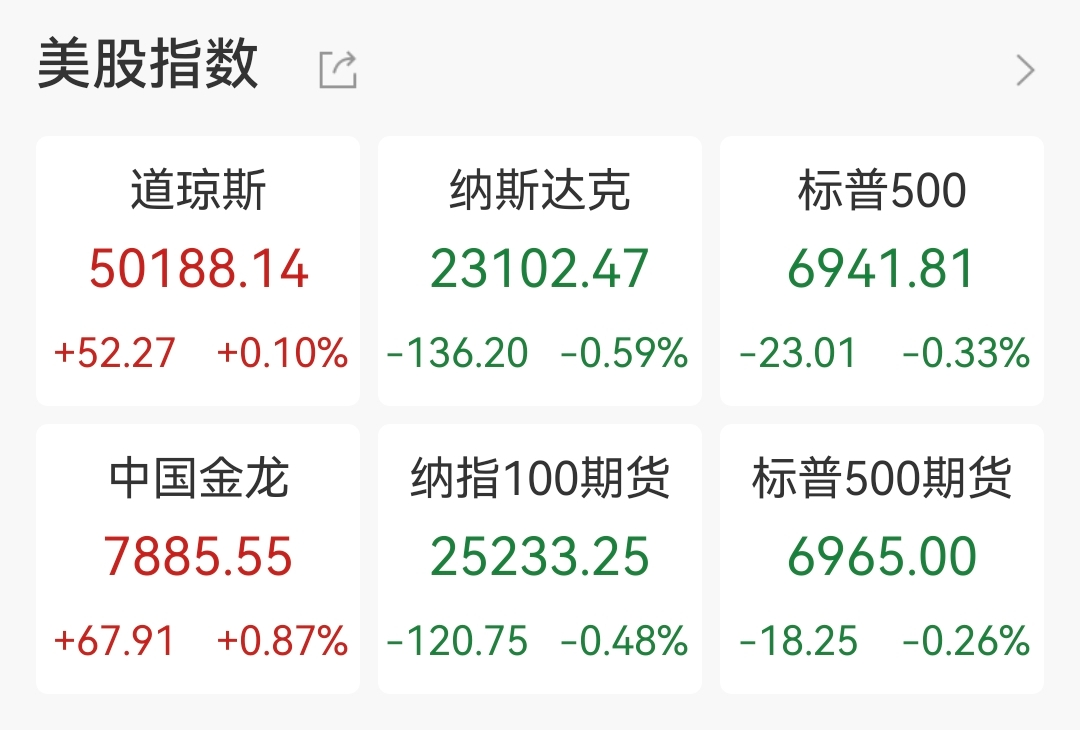
Market Performance - The US stock indices showed mixed results, with the Dow Jones increasing by 0.1% to a record close, while the S&P 500 and Nasdaq fell by 0.33% and 0.59% respectively [1][2] - The Dow reached a historical high for the third consecutive time, previously surpassing the 50,000 mark [1] Sector Performance - The software sector provided support to the market, with Datadog and ServiceNow rebounding approximately 14% and 4% respectively, and Unity's stock rising by 5% [2] - Major technology stocks mostly declined, with the Nasdaq's seven tech giants index dropping by 0.59%. Only Tesla saw an increase of nearly 2% [3][4] Company News - Datadog reported better-than-expected earnings, projecting a revenue of $3.43 billion for FY2025, a 28% year-over-year increase, with operating cash flow of $1.05 billion and free cash flow of $915 million [2] - Alphabet, Google's parent company, plans to raise nearly $32 billion through bond issuance, including a rare 100-year bond, marking a significant move in the tech sector [3] Chinese Stocks - The Nasdaq Golden Dragon China Index rose by 0.87%, with notable increases in stocks such as Dingdong Maicai (over 7%) and Sohu (over 4%) [5] Commodity Market - Gold prices experienced volatility, with spot gold down 0.78% to $5,019.46 per ounce, and silver down over 3% [6][7] Economic Data - US retail sales data showed stagnation in December, leading to increased bets on potential interest rate cuts by the Federal Reserve [7] - The probability of a 25 basis point rate cut by March is estimated at 19.6%, with a higher likelihood of maintaining current rates [7]