SanDisk

Search documents
Coinbase falls short of Q4 estimates, Applied Materials stock surges on strong Q1 earnings results
Youtube· 2026-02-12 22:30
Market Overview - The stock market experienced a broad sell-off, particularly in tech stocks, with the Nasdaq composite down approximately 2% and the S&P 500 down 1.5% [1] - Defensive sectors such as utilities and consumer staples showed resilience, with utilities up 1.5% and consumer staples reaching a record high [1] - The tech sector was notably weak, with major players like Apple and Broadcom seeing declines of about 5% and over 3% respectively [1] Applied Materials Earnings - Applied Materials reported Q1 adjusted EPS of $2.38, exceeding the consensus estimate of $2.21, and net sales of $7.01 billion, beating the expected $6.86 billion [1] - The stock surged in after-hours trading, reflecting strong investor sentiment following a nearly 30% increase in the year and a 90% rise over the past 12 months [1] - Analysts remain optimistic, with nearly 75% recommending a buy and an average price target of around $335 [1] AI and Semiconductor Market Trends - The AI capital expenditure trend is expected to drive significant investment, with estimates suggesting $837 billion will be spent by major companies on AI development by 2027 [2] - Semiconductor companies are projected to capture about 33% of the revenues from this investment, benefiting from increased demand for AI infrastructure [2] - The market is witnessing a shift towards companies with heavy assets and low obsolescence, termed "halo stocks," such as Exxon and Walmart, which have performed well this year [2] Coinbase Financial Results - Coinbase reported Q4 adjusted EPS of $0.66, below the expected $0.86, and Q4 revenue of $1.78 billion, also missing the consensus of $1.83 billion [7] - Analysts remain cautiously optimistic, with nearly 60% maintaining a buy rating and an average target price of around $314 [9] - The company is navigating challenges related to declining crypto prices and trading volumes, but there is potential for recovery with legislative clarity and institutional interest in blockchain technology [12][15] Future Outlook for Coinbase - The passage of the Clarity Act is seen as crucial for restoring confidence in the crypto market and could lead to increased institutional participation [15] - Coinbase's future growth may hinge on the adoption of stablecoins and the integration of blockchain technology into various sectors, which could enhance demand for its services [27][30] - The market is currently focused on immediate earnings, but there is a belief that as blockchain technology matures, Coinbase could emerge as a key player in the industry [30]


Panel weighs AI disruption, margin pressure and market risks
CNBC Television· 2026-02-12 15:05
>> WELCOME BACK. LET'S BRING IN OUR PANEL TO UNPACK EVERYTHING WE'VE JUST HEARD AND HOW WE NEED TO SET UP FOR THE DAY HERE. PAUL HICKEY IS CO-FOUNDER OF BESPOKE INVESTMENT GROUP.PETER BOOCKVAR IS CHIEF INVESTMENT OFFICER. AT ONE POINT, BFG WEALTH PARTNERS, ALSO CNBC LIONTRUST ASSET MANAGEMENT. WELCOME TO ALL OF YOU.SO MUCH TO GET TO. CLAIRE, I'M GOING TO KICK THIS OFF WITH YOU BECAUSE WE JUST SPOKE TO THE CEO OF ALTRUIST AND OBVIOUSLY A SMALL NAME IN A BIG MARKET TRIGGERING BIG MOVES THIS WEEK. HOW DOES IT ...

Wednesday's Earnings Movers: NET Surges, Unity (U) Sells, TMUS Sheds Customers
Youtube· 2026-02-11 15:30
分组1: Cloudflare - Cloudflare's shares rallied over 10% following strong quarterly results, with revenue growing 34% year-over-year to $614.51 million, beating expectations [2][3] - The company reported an adjusted EPS of 28 cents, slightly above the expected 27 cents, indicating positive investor sentiment [2][3] - Cloudflare attributes its growth to increased demand for AI infrastructure, positioning itself as a core infrastructure player amid the AI boom [3][4] 分组2: Unity Software - Unity Software's stock plummeted over 28% due to weak first-quarter guidance, despite beating EPS estimates at 24 cents compared to the expected 20 cents [7][9] - Revenue for the trailing quarter was reported at $503 million, but the guidance for the next quarter is between $480 to 490 million, below the expected $494 million [8][9] - Concerns about slowing momentum and potential AI disruption have negatively impacted investor confidence in Unity Software [9] 分组3: T-Mobile - T-Mobile's stock fell 5% after a mixed fourth quarter, with adjusted EPS of 214 cents beating the expected 206 cents, but revenue growth of 24.3% was below some expectations [10][11] - The company experienced increased post-paid phone churn, rising to over 1%, indicating weaker customer retention compared to the previous year [11][12] - T-Mobile's prepaid segment saw a significant decline, dropping over 40% year-over-year, reflecting a challenging competitive landscape in the wireless carrier market [12]



存储领域- 全球存储供需更新及物料清单(BOM)成本分析:预计 DRAM、NAND 及 HBM(高带宽内存)供应将进一步紧张,重申三星、海力士、闪迪(SNDK)、东京电子 “买入” 评级
2026-02-10 03:24
Summary of Semiconductor Industry Conference Call Industry Overview - The conference call focused on the semiconductor industry, specifically the memory segment, including DRAM, NAND, and HBM (High Bandwidth Memory) [1][2][3][4][41][73]. Key Points Supply and Demand Dynamics - **DRAM Supply/Demand (S/D) Forecast**: - Expected undersupply of 4.9% in 2026 and 2.5% in 2027, revised from previous estimates of 3.3% and 1.1% respectively [2][10][14]. - Anticipated to be the most severe shortage in over 15 years, driven by strong demand from server-related applications and limited capacity additions [2][10]. - **NAND Supply/Demand (S/D) Forecast**: - Expected undersupply of 4.2% in 2026 and 2.1% in 2027, revised from previous estimates of 2.5% and 1.2% respectively [3][41][50]. - Driven by robust growth in enterprise SSD demand and limited supplier spending [3][41]. - **HBM Supply/Demand (S/D) Forecast**: - Expected undersupply of 5.1% in 2026 and 4.0% in 2027, significantly revised from previous forecasts of 0.7% and 1.6% [4][80]. - Increased demand from GPUs and ASICs, with ASICs expected to comprise 33% and 36% of HBM demand in 2026 and 2027 respectively [4][74]. Pricing and Margin Expectations - **DRAM Pricing**: - Forecasted to increase by 176% for SEC and 184% for Hynix in 2026, with operating margins expected to reach 71% for SEC and 79% for Hynix [35][68]. - **NAND Pricing**: - Expected to rise by 121% for SEC and 102% for Hynix in 2026, with operating margins projected at 40% for SEC and 44% for Hynix [68][69]. - **HBM Market Size**: - Total Addressable Market (TAM) for HBM expected to reach US$54 billion in 2026 and US$75 billion in 2027, reflecting increased demand from GPUs and ASICs [4][73]. Demand Drivers - **DRAM Demand**: - Global DRAM demand expected to grow by 25% in 2026 and 17% in 2027, primarily driven by server-related applications [11][12]. - Mobile DRAM demand forecast lowered by 7% for both years due to declining smartphone shipments and rising memory costs [12][13]. - **NAND Demand**: - Global NAND demand expected to grow by 22% in 2026 and 15% in 2027, with enterprise SSD demand projected to grow by 58% and 23% respectively [47][48]. - Mobile NAND demand forecast lowered to flat growth in 2026, marking the first time in history for no growth in this segment [48][49]. Company Highlights - **Key Beneficiaries**: - Companies such as Samsung Electronics, SK Hynix, SanDisk, Tokyo Electron, Ulvac, and Disco are expected to benefit from the tighter memory industry supply/demand dynamics [6][41]. Additional Insights - **Cost Analysis**: - Higher memory costs could lead to demand destruction in PCs and smartphones, but the expected undersupply is likely to keep the DRAM market tight [5]. - **Market Trends**: - The competitive landscape for HBM is expected to intensify, with SEC and Hynix increasing their HBM capacities to meet rising demand [81][79]. This summary encapsulates the critical insights from the conference call regarding the semiconductor memory market, highlighting supply/demand forecasts, pricing expectations, and key industry players.


存储紧缺仍被低估?高盛:大幅上调供需缺口预期,涨价对需求冲击有限!
美股IPO· 2026-02-09 12:27
Core Viewpoint - The storage chip market is facing the most severe supply shortage in 15 years, with Goldman Sachs raising expectations for supply-demand tension and warning of a significant gap in DRAM by 2026 [1][3]. DRAM Market Insights - Goldman Sachs predicts that the DRAM supply shortage will reach 4.9% in 2026 and 2.5% in 2027, significantly higher than previous estimates of 3.3% and 1.1% [4]. - The primary driver of this tension is the explosive growth in server demand, with expectations for server DRAM (excluding HBM) to increase by 39% and 22% in 2026 and 2027, respectively [5]. - In contrast, demand for mobile and PC DRAM is expected to slow significantly, with growth rates of only 7% and 5% in 2026 [6]. NAND Market Insights - The NAND market is also experiencing a tightening supply-demand situation, with shortages projected at 4.2% in 2026 and 2.1% in 2027, up from earlier forecasts of 2.5% and 1.2% [8]. - Strong growth in enterprise SSD demand is a key driver, with expectations for enterprise SSD demand to rise by 58% and 23% in 2026 and 2027 [8]. HBM Market Insights - Goldman Sachs has raised the total addressable market (TAM) for HBM to $540 billion in 2026 and $750 billion in 2027, reflecting improved demand from GPUs and ASICs [11]. - ASIC demand is accelerating, with HBM demand from ASICs expected to increase by 27% and 14% in 2026 and 2027, respectively [12]. Investment Recommendations - Goldman Sachs maintains a buy rating on Samsung Electronics and SK Hynix, citing their strong positions in the traditional memory market and expected significant profit margins [15][16]. - Micron's rating has been downgraded to neutral with a target price of $235, as most positive factors have already been priced in [18]. - For equipment stocks, Tokyo Electron is highlighted for its strong market share in leading DRAM manufacturing tools, while Ulvac and Disco are recommended for their roles in capital expenditures related to DRAM and HBM [18].
高盛重磅报告:十五年来最严重的存储芯片短缺正在逼近,即便消费端需求崩塌也无法阻止
Hua Er Jie Jian Wen· 2026-02-09 06:27
Core Viewpoint - Goldman Sachs warns that the market is on the brink of the most severe memory chip supply shortage in the past 15 years, with significant supply-demand gaps in DRAM, NAND, and HBM categories expected in 2026-2027 [1] DRAM Market Summary - Goldman Sachs significantly raised its DRAM supply shortage forecast, predicting a shortfall of 4.9% in 2026 and 2.5% in 2027, surpassing previous estimates of 3.3% and 1.1% [2] - The core driver of this tight situation is the explosive growth in server demand, with server DRAM demand (excluding HBM) expected to increase by 39% and 22% in 2026 and 2027, respectively [3] - In contrast, PC and mobile DRAM demand forecasts were downgraded, with mobile DRAM growth expected to slow to 7% in 2026 and PC DRAM growth at only 5% [4] - Global DRAM supply is projected to grow by 21% and 19% in 2026 and 2027, respectively, with limited capacity expansion from major suppliers [4] NAND Market Summary - The NAND market is also tightening, with supply-demand gaps expected to reach 4.2% in 2026 and 2.1% in 2027, higher than previous forecasts [5] - Strong growth in enterprise SSD demand is a major driver, with expectations for a 58% and 23% increase in enterprise SSD demand in 2026 and 2027 [5] - Mobile and PC NAND demand is expected to show significant weakness, with mobile NAND demand forecasted to experience zero growth in 2026 [6] HBM Market Summary - Goldman Sachs raised its HBM total addressable market (TAM) forecast to $540 billion in 2026 and $750 billion in 2027, reflecting improved demand from GPUs and ASICs [7] - ASIC demand for HBM is expected to accelerate, with forecasts for HBM demand from ASICs increased by 27% and 14% in 2026 and 2027, respectively [7] - Despite an increase in HBM capacity forecasts, supply-demand gaps are expected to reach 5.1% and 4.0% in 2026 and 2027, respectively, due to higher demand adjustments [8] BOM Cost Analysis - A detailed BOM cost analysis indicates that memory costs for smartphones and PCs are expected to rise significantly, with iPhone DRAM and NAND costs projected to reach about 23% of total BOM by Q3 2026 [9] - Even under extreme scenarios, DRAM demand is expected to grow by 21% in 2026, maintaining a supply-demand imbalance [9] Investment Recommendations - Goldman Sachs maintains buy ratings for Samsung Electronics and SK Hynix, highlighting their significant exposure in traditional memory markets [10] - The 2026 traditional DRAM pricing is expected to rise by approximately 176-184%, with operating profit margins reaching historical highs [11] - Micron's rating was downgraded to neutral with a target price of $235, as most positive factors have already been priced in [12]
Donald Trump Is About To Crash Bitcoin Again | Mark Yusko's 2026 Predictions
Altcoin Daily· 2026-02-08 22:33
You I'm probably going to have, you know, the black hat show up when I say this, but you everyone thinks the president is our friend. >> Bitcoin is going to the moon. As we say, it's going to the moon.Meaning our collective friend in crypto. He's not. He He's just not. He He is definitely not.>> You know, I'm a big crypto person. I'm the one that probably helped crypto more than anybody. >> He He has a whole different agenda.>> It's impossible to proceed without it. We have to get this Clarity Act across th ...

What defensive stocks, energy & Bitcoin are quietly telling you
Youtube· 2026-02-05 02:47
Market Overview - Defensive stocks are experiencing a surge, indicating a shift in investor sentiment as they seek stability amid market volatility [10][11][12] - The energy sector has recently broken out of a two-decade trading range, suggesting potential growth opportunities [26][28] Sector Analysis - Utilities and healthcare sectors have shown signs of strength, with consumer staples reaching new all-time highs, indicating a defensive market trend [11][12][14] - The telecom sector, including companies like AT&T and Verizon, is also gaining traction, reflecting a shift towards more stable investments [15] Technology Sector - The technology sector, particularly software stocks, has faced significant challenges, with many major companies like Nvidia and Microsoft showing lackluster performance [7][8][20] - A notable decline in software stocks has been observed, with the software ETF (IGV) breaking below a long-term support level, raising concerns about future performance [21][22] Energy Sector - The energy sector is being viewed positively, with crude oil prices expected to rise after a prolonged bear market, driven by factors such as geopolitical tensions and recovering demand from China [28][29][30] - Major integrated energy companies like Exxon and Chevron are positioned to outperform in a jittery market, making energy a viable investment option [31][33] Commodities and Cryptocurrencies - Bitcoin has seen a significant sell-off, dropping 42% from its all-time high, while gold and silver have also experienced volatility [3][38] - The outlook for metals suggests a potential bounce in the short term, but a return to previous highs may not be imminent due to recent market damage [40][46] Market Sentiment - Despite geopolitical tensions, investor sentiment has become increasingly optimistic, which is unusual given the current market conditions [25][62] - The market is expected to experience volatility in the coming months, with potential corrections in various sectors, particularly in technology [23][64]

美股软件“失火”、芯片“遭殃”、科技“跳水”
华尔街见闻· 2026-02-05 01:16
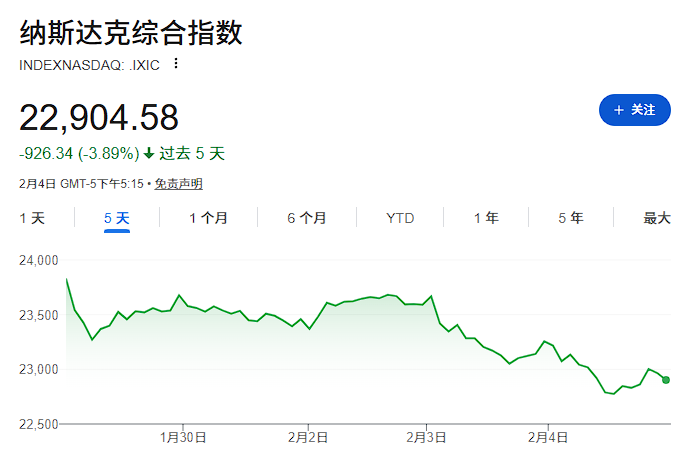
Core Viewpoint - Concerns in the software industry are rapidly evolving into a broader sell-off in the technology sector, with market panic spreading from the SaaS segment to semiconductors and AI infrastructure, significantly increasing pressure on tech stocks [2] Group 1: Market Reactions - The Nasdaq Composite Index experienced a decline, marking its first consecutive two-day drop of 1% since April of the previous year, primarily triggered by shaken investor confidence in the software industry's outlook [2] - Following the release of disappointing earnings, AMD's stock plummeted by 17%, marking its worst single-day performance since 2017 [8] - Palantir's stock fell by 12%, and SanDisk's stock dropped by 16%, with the sell-off also affecting major AI companies like Meta and Nvidia, which saw declines of 6.6% and 8.9% respectively [10] Group 2: Investor Sentiment and Valuation - There is growing concern that AI's impact on existing software business models may exceed expectations, leading to skepticism about whether tech giants can deliver on profit promises under high valuations [5] - High valuations have made the market extremely sensitive to any negative signals, prompting a rapid rotation of funds from tech stocks to traditional sectors [8][17] - The average price of loans for software companies has dropped from 94.71 cents at the end of last year to 91.27 cents, with approximately $25 billion in software loans classified as non-performing, representing nearly one-third of all bad loans [11] Group 3: AI Disruption and Overreaction - The market volatility reflects a reassessment by investors of companies facing potential disruption from AI, with analysts noting that the software industry is in a state of "pre-judgment" regarding AI risks [13] - Some industry executives and strategists argue that the sell-off may be overblown, with Nvidia's CEO stating that the pressure on software stocks is based on an illogical narrative that AI will replace them [14][15] - Baird's Antonelli suggests that enterprises are unlikely to abandon established enterprise software for untested alternatives, indicating that the market often reacts hastily to expensive stocks [16] Group 4: Fund Rotation Trends - Despite the turmoil in tech stocks, the market is not experiencing a broad retreat but rather a clear trend of fund rotation, with investors moving capital from chip stocks and large tech winners to more traditional sectors [17] - On a day when the S&P 500 index fell by 0.5%, 92 stocks reached new 52-week highs, the highest number of new highs in a single day since November 2024 [19] - This trading behavior is seen as a continuation of a trend, with recent news providing a catalyst for accelerating this shift [20]



去年4月以来最大跌幅,纳指“两连跌”:软件“失火”、芯片“遭殃”、科技“跳水”
Hua Er Jie Jian Wen· 2026-02-05 00:32
Core Viewpoint - Concerns in the software industry are rapidly evolving into a broader sell-off in the technology sector, with significant pressure on tech stocks as market panic spreads from the SaaS sector to semiconductors and AI infrastructure [1] Group 1: Market Reactions - The Nasdaq Composite Index experienced a decline, marking its first consecutive two-day drop of 1% since April of the previous year, driven by shaken investor confidence in the software industry's outlook [1] - Following the release of disappointing earnings, AMD's stock plummeted by 17%, marking its worst single-day performance since 2017 [4] - Palantir's stock fell by 12%, and SanDisk's stock dropped by 16%, with major AI companies like Meta and Nvidia also experiencing declines of 6.6% and 8.9%, respectively [7] Group 2: Valuation Concerns - High valuations are exacerbating market reactions, with current expectations being extremely high, leading to severe market responses [10] - The average price of loans for software companies has decreased from 94.71 cents at the end of last year to 91.27 cents, indicating a shift in investor sentiment [10] - Approximately $25 billion in software loans are classified as non-performing, representing nearly one-third of all bad loans [10] Group 3: AI Disruption and Overreaction - The market volatility reflects a reassessment of companies facing potential disruption from AI technologies, with the software industry perceived as having the highest risk exposure [11] - Some industry executives and strategists argue that the sell-off may be overblown, suggesting that fears of AI replacing software companies are unfounded [12] Group 4: Capital Rotation - Despite the turmoil in tech stocks, the market is not experiencing a broad retreat but rather a clear trend of capital rotation from chip stocks and large tech winners to more traditional sectors [13] - On the same day the S&P 500 index fell by 0.5%, 92 stocks reached 52-week highs, the highest number of new highs since November 2024 [13]