
Synchron

Search documents
脑机接口大盘点:从科幻到现实,谁在引领这场“读心术”的革命?
3 6 Ke· 2026-01-15 02:29
Core Insights - Neuralink's brain-computer interface (BCI) devices are set for mass production in 2024, with 13 patients already implanted, enabling them to control devices using their thoughts [1][5] - The global BCI market is projected to reach $400 billion, indicating explosive growth in this sector [2] - Various companies are competing in the BCI space, with different approaches to technology, safety, and performance [2][8] Group 1: BCI Technology Overview - BCI establishes a direct communication channel between the brain and external devices, bypassing traditional neural pathways [2][3] - The BCI process involves four steps: signal acquisition, signal decoding, outputting commands, and feedback [5][6] - There are three main technological routes for BCI: non-invasive, semi-invasive, and invasive, each with its own trade-offs in safety and performance [8][10] Group 2: Non-Invasive and Invasive Approaches - Non-invasive BCIs are safe but have weak signals, making them suitable for consumer applications [10][12] - Semi-invasive BCIs require surgery but offer better signal quality than non-invasive options [16][19] - Invasive BCIs provide high signal strength and precision but come with significant risks, including potential immune responses and long-term degradation of electrodes [19][21] Group 3: Material Innovations - New flexible materials are being developed to reduce damage to brain tissue during electrode implantation [22][26] - The focus is on creating soft, durable materials that can withstand the brain's environment while maintaining high performance [26][29] Group 4: AI's Role in BCI - AI is crucial for processing the vast amounts of data generated by BCIs, enabling real-time translation of brain signals into actions [33][35] - AI enhances the decoding of complex neural signals, making it possible for users to control devices with their thoughts [39][40] - The integration of AI is essential for both reading and writing brain signals, facilitating advanced neural modulation [40][42] Group 5: Key Players in the BCI Market - Neuralink, founded by Elon Musk, aims to create a comprehensive BCI system with high channel density and wireless capabilities [43][45] - Synchron offers a less invasive approach by implanting devices through blood vessels, focusing on practical applications for patients [69][71] - Paradromics targets high-performance BCIs with the ability to record a vast number of neural signals simultaneously [77][79] - Blackrock Neurotech is a long-established player known for its reliable Utah Array technology, widely used in BCI research [82][84] Group 6: Future Prospects and Challenges - Neuralink plans to expand its technology to enhance human capabilities, including speech and vision restoration [63][66] - The BCI industry faces ethical challenges regarding privacy, autonomy, and the implications of enhanced human capabilities [96] - The competition among BCI companies is intensifying, with various strategies being employed to capture market share and advance technology [96]

国内融资20亿、全球排队1万人:脑机接口让老人用“意念”重获新生?
3 6 Ke· 2026-01-14 08:45
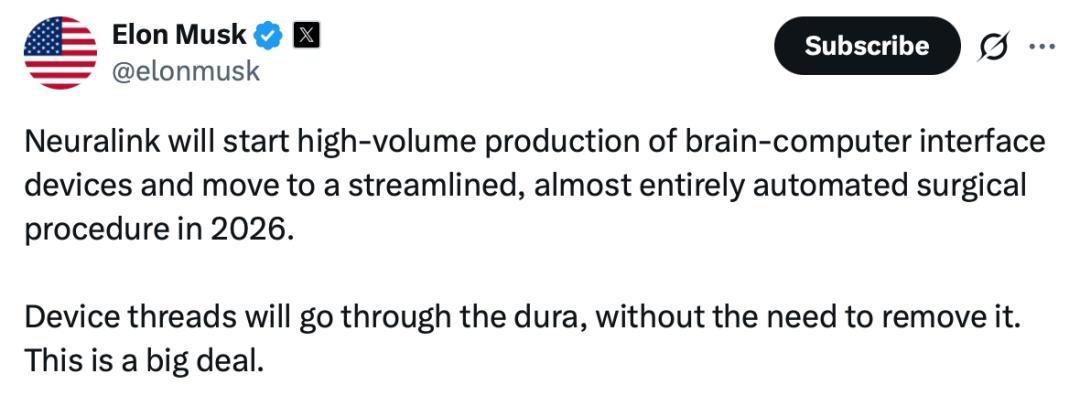
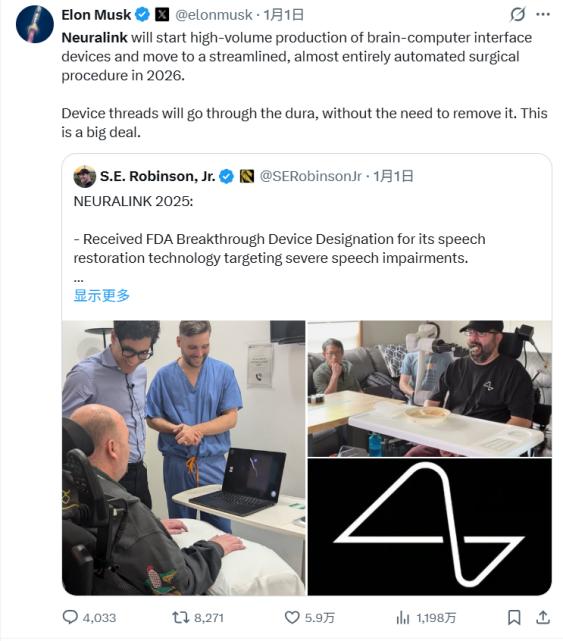
前言 然而,随着脑机接口技术的不断成熟,我们正在经历一场关于"生命终点"的叙事重构。当数字信号开始接管受损的生物信号,科技不仅在为老年人延长生 命的长度,更是在修补他们的尊严。 宣布量产,脑机接口迎来"奇点时刻" 2026年开年第一天,"钢铁侠"马斯克便抛出了一个重磅消息。 1月1日,马斯克宣布其旗下的神经科技和脑机接口公司Neuralink将在2026年进行"大规模生产",并转向"更加精简和几乎完全自动化的外科手术流程"。这 一消息迅速引发全球关注,因为它标志着脑机接口进入"商业化跃迁"的关键节点。 脑机接口(Brain-Computer Interface)是一种直接在大脑与外部设备之间建立通信路径的技术,广泛用于运动/言语重建、感觉恢复、神经调控与人机交互 等场景。科幻电影《黑客帝国》中,男主角尼奥的"脑后插管",或许就是脑机接口最初的想象。 图源:X 图源:电影《黑客帝国》剧照 如果站在更久远的未来回望,2026年或许是科幻加速踏进现实的开始。 衰老——曾被视为不可逆的命运,伴随着肌肉的萎缩,人类的意识仿佛只能在渐深的黑暗中走向消亡。 然而,现实中的脑机接口技术发展,早已超越了科幻作品。如今,这项技术 ...
光大证券:2025脑机接口行业发展现状、支持政策、临床情况及行业进展分析报告
Xin Lang Cai Jing· 2026-01-11 12:28
Industry Overview - Brain-Computer Interface (BCI) is a new cross-disciplinary technology that creates a communication channel between the brain and external devices, enabling direct information exchange [6] - BCIs can be classified into three types: invasive, semi-invasive, and non-invasive, with applications in medical rehabilitation, consumer interactions, and military fields [7] - The global BCI market is projected to reach $7.63 billion by 2029, growing from $1.2 billion in 2019 to nearly $2 billion in 2023, with a compound annual growth rate (CAGR) exceeding 13% from 2019 to 2023 [13][14] - Over 1,500 financing events in the global BCI sector have raised nearly $10 billion, with significant investments in both the U.S. and China [16] Policy Guidance - Major countries have launched brain initiatives to support BCI development, with the U.S. investing approximately $4.5 billion in its BRAIN Initiative since 2013 [37][40] - China has initiated its "Brain Science and Brain-Like Intelligence Technology" project, with funding expected to reach hundreds of billions of yuan [39][42] Clinical Situation - The medical demand for BCIs is driven by the need for rehabilitation in stroke and disabled populations, with significant clinical research already underway for various diseases [3][33] - Clinical trials for BCIs are accelerating globally, with a rapid increase in the number of trials in China [3][11] Industry Progress - Notable advancements include Neuralink's implantation of over 10 devices and Synchron's achievement of brain-controlled iPad functionality [4][4] - Key overseas companies like Neuralink and Synchron are leading in the invasive BCI field, focusing on treatment and human-computer interaction [4][4] - Domestic companies are also making strides, with clinical trials accelerating and real-time Chinese language decoding being achieved [4][4] Industry Chain Analysis - The BCI industry chain consists of upstream hardware and software supply, midstream BCI product supply, and downstream applications in various fields [18] - Upstream technology innovation barriers are high, with breakthroughs in flexible electrodes and chips being critical [20][21] - Downstream applications are primarily in the medical field, which is the most mature area for commercialization [30]


华创医药周观点:海外脑机接口代表企业布局情况 2026/01/10
华创医药组公众平台· 2026-01-10 14:06
Market Review - The CITIC Medical Index increased by 7.70%, outperforming the CSI 300 Index by 4.91 percentage points, ranking 5th among 30 primary industries [8] - The top ten stocks by increase this week include: Bibet-U, Innovation Medical, Sanbo Brain Science, and others, with significant gains [8] - The top ten stocks by decrease include: Baihua Medicine, Jinhao Medical, and others, with notable declines [8] Overall View and Investment Themes - The domestic innovative drug industry is transitioning from quantity logic to quality logic, focusing on differentiated and internationalized pipelines, with an emphasis on products that can generate profits by 2025 [11] - In the medical device sector, there is a noticeable recovery in bidding volumes for imaging equipment, with ongoing updates and acceleration in overseas expansion [11] - The innovative chain (CXO + life science services) is expected to see a rebound in overseas investment, with domestic investment stabilizing, indicating a potential bottoming out [11] - The pharmaceutical industry is anticipated to enter a new growth cycle, with cost improvements in specialty raw materials and a focus on patent expirations leading to new growth opportunities [11] Traditional Chinese Medicine - The basic drug directory is expected to be released, with unique basic drugs projected to grow faster than non-basic drugs, indicating a potential market rebound [12] - The reform of state-owned enterprises is expected to enhance the fundamental performance of companies, particularly after adjustments to the evaluation system [12] - The new medical insurance directory is expected to benefit certain companies, with a focus on OTC enterprises that cater to aging populations and have strong dividend characteristics [12] Medical Services - The anti-corruption and centralized procurement efforts are expected to purify the medical market environment, enhancing the competitiveness of private medical services [12] - The rapid expansion of commercial insurance and self-funded medical services is likely to provide more competitive advantages for private healthcare providers [12] Blood Products - The approval of plasma stations is expected to increase supply, with companies expanding their product offerings and production capacity, indicating a clear long-term growth path for the blood products industry [12]
脑机接口大盘点:从科幻到现实,谁在引领这场“读心术”革命?
硅谷101· 2026-01-10 00:30
Imagine being completely paralyzed from the neck down, able to see and think, but unable to communicate your thoughts. That was Noland's situation. In 2016, an accident left him paralyzed from the shoulders down.But now, he's transformed. He can play Civilization VI, chess , and even operate a computer faster than most people using their hands. He doesn't use his hands, feet, or even look at the keyboard; he simply thinks, and the computer moves.This isn't science fiction; it's a real event happening in 202 ...
脑机接口技术已进入“临床价值验证与早期产业化”的关键期
Zhong Guo Jing Ji Wang· 2026-01-09 06:15
Core Viewpoint - Brain-computer interface (BCI) technology is a critical area at the intersection of life sciences and information technology, with significant global competition and potential applications in medical fields, particularly in disease prevention, diagnosis, treatment, and management [1] Group 1: Current Applications and Progress - BCI technology is primarily applied in clinical settings for the rehabilitation of motor and speech functions, with motor function recovery being the most advanced area [2] - Notable examples include Neuralink's successful implantation in over ten patients and the clinical validation of products like Synchron's Stentrode and Onward Medical's ARC-BCI [2] - In speech function, the "Beijing Brain No. 1" system has made significant progress in decoding speech for patients with severe speech disorders due to conditions like ALS [2] Group 2: Technology Maturity and Challenges - The current stage of BCI technology is characterized as a critical period for clinical value verification and early industrialization, facing both unprecedented policy support and intense international competition [3] - Key evaluation metrics include safety and reliability, effectiveness and stability, and usability, with ongoing challenges in long-term safety, performance stability in real-life scenarios, and maintenance issues [4] Group 3: Technical Challenges and Breakthrough Directions - Major technical challenges include balancing high-resolution signal acquisition with low invasiveness, and developing systems that ensure low power consumption while maintaining real-time performance [5][6] - The need for "plug-and-play" capabilities in decoding algorithms and addressing individual variability and time drift are also critical areas for future breakthroughs [6] Group 4: Barriers to Large-Scale Clinical Application - Key barriers to large-scale clinical application include the need for rigorous clinical trials to establish safety and efficacy, the development of reliable manufacturing processes, and the establishment of ethical and legal frameworks [7] - Predictions suggest that semi-invasive BCIs may take 1-2 years for approval in rehabilitation applications, while invasive BCIs may require around 5 years [7] Group 5: Future Development Possibilities - Future applications of BCI technology are expected to extend beyond motor rehabilitation to include speech function restoration and treatment for severe neurological disorders, with aspirations for merging biological intelligence with artificial intelligence to enhance human capabilities [8]
马斯克量产预告 脑机接口迎商业化元年?
Sou Hu Cai Jing· 2026-01-09 01:31
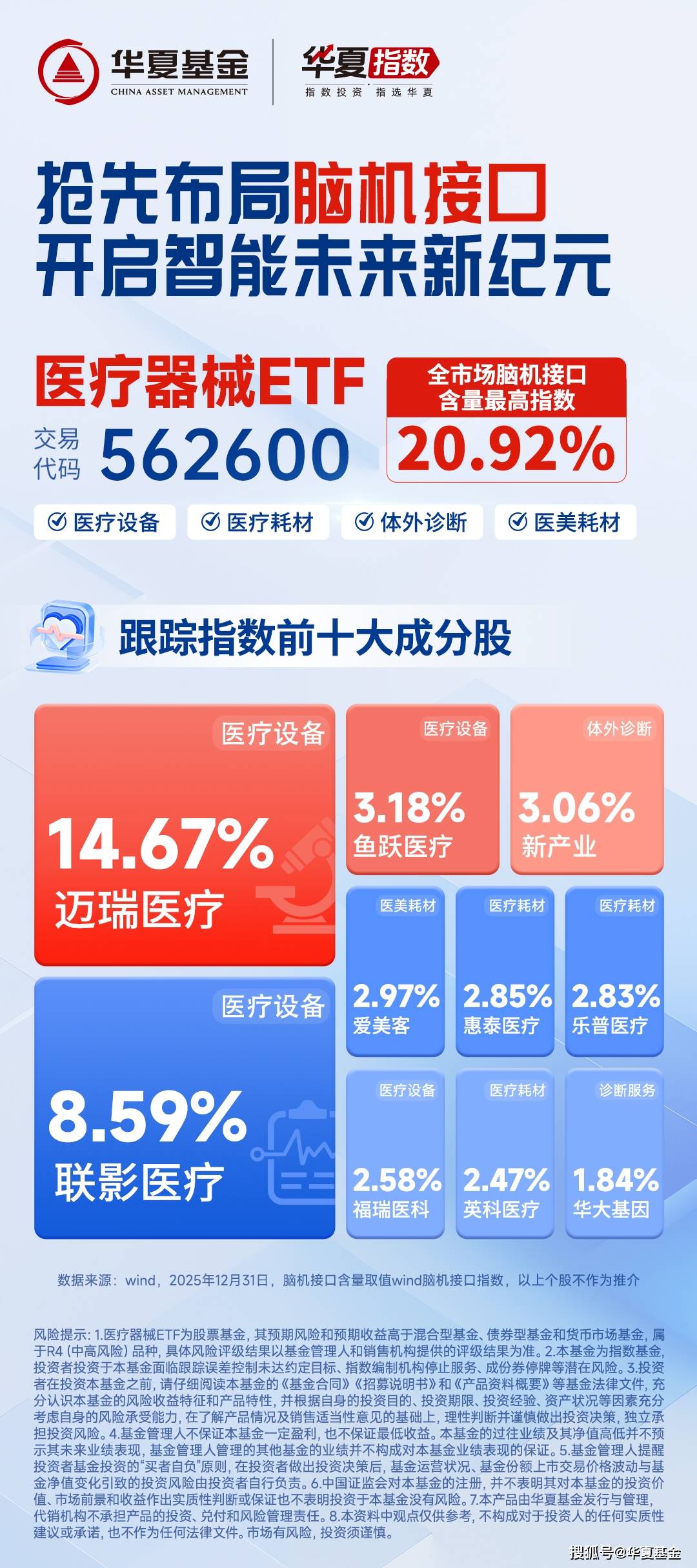
Core Viewpoint - Elon Musk's Neuralink plans to start mass production of brain-machine interfaces by 2026, marking a significant step towards the commercialization of this technology [2] Industry Developments - The brain-machine interface sector in China is accelerating, with the country becoming the second to enter clinical trials for invasive brain-machine interfaces after the United States [2] - In 2025, there were 24 financing events in the domestic brain-machine interface field, a 30% year-on-year increase [3] - Hubei Province has set a price for invasive brain-machine interface medical services at approximately 6,552 yuan, indicating a move towards making this technology more accessible [3] Technology and Market Segmentation - Brain-machine interfaces serve as a bridge between the brain and external devices, with three main technological approaches: invasive, non-invasive, and semi-invasive [4][5] - The largest market segment for brain-machine interfaces is currently in healthcare, accounting for over 56% of applications, particularly for neurological diseases like epilepsy and Parkinson's [6] - McKinsey predicts that the global market for medical applications of brain-machine interfaces could reach $40 billion by 2030 and $145 billion by 2040 [6] Investment Opportunities - While the brain-machine interface sector shows promise, most companies are still far from profitability, with significant time needed for medical applications to gain approval [7] - Instead of focusing on individual companies, it may be more prudent to consider the broader medical device industry, particularly through medical device ETFs that encompass leading firms in this space [8]
马斯克的中国竞对,一把融了20亿
创业邦· 2026-01-09 00:08
Core Viewpoint - The article discusses the significant financing of 2 billion RMB for BrainCo, positioning it as a leading player in the non-invasive brain-computer interface (BCI) sector, contrasting it with Neuralink's invasive approach, highlighting the ongoing technological rivalry in the BCI industry [5][18]. Financing and Growth - BrainCo completed a financing round of approximately 2 billion RMB, led by IDG and Huaden International, making it the second-largest BCI company in terms of funding globally, after Neuralink [5][18]. - Since 2019, BrainCo has completed four financing rounds, accumulating a total of 4.684 billion RMB [15]. Technology Pathways - BrainCo focuses on non-invasive BCI technology, utilizing devices like EEG caps to collect signals, which offers safety and ease of acceptance, while facing challenges in signal precision [6][12]. - Neuralink represents the invasive BCI route, which involves surgical implantation of electrode arrays in the brain, allowing for high-resolution signal collection but poses risks and ethical concerns [5][12]. Product Development and Market Position - BrainCo has developed several products, including smart prosthetics and sleep regulation devices, with some receiving FDA and CE certifications for international sales [6][14]. - The company achieved a milestone in 2022 by producing 100,000 units of a portable high-precision BCI product, breaking the long-standing experimental phase in the industry [14]. Competitive Landscape - The BCI market is characterized by three main technological pathways: invasive, semi-invasive, and non-invasive, each balancing performance, safety, and accessibility differently [20][22]. - Non-invasive BCIs, led by companies like BrainCo, dominate the market, accounting for approximately 82% of the BCI market share, while invasive technologies hold about 18% [22].

心玮医疗20260108
2026-01-08 16:02
Summary of New Wei Medical Conference Call Company Overview - New Wei Medical focuses on interventional brain-machine interface technology, utilizing a minimally invasive approach through the jugular vein to access brain vessels for signal collection, differentiating itself from invasive technologies like those developed by Musk's company [2][5] Key Points and Arguments - **Product Development Timeline**: New Wei Medical plans to complete type testing and animal experiments by mid-2026, initiate clinical enrollment in the second half of 2026, and expects to finish all patient enrollment and submit for regulatory approval by 2028 [2][3][4] - **Independent Subsidiary**: The company has established an independent subsidiary named "Wei Brain Technology" to focus on the development of interventional brain-machine interfaces and related investment collaborations, with plans to expand the team to 20 members [2][9] - **Technical Specifications**: The interventional brain-machine interface device uses a nickel-titanium alloy stent with electrode configurations of 4 or 16 channels, with signal processing chips placed subcutaneously beneath the clavicle [2][8] - **Animal Testing Results**: Animal experiments have shown stable signal strength, with a small-tailed sheep experiment maintaining 97%-98% signal strength after 18 months, validating the feasibility of the technology [2][11] Competitive Landscape - **Comparison with Musk's Technology**: New Wei Medical's approach avoids the need for craniotomy, which is required by Musk's invasive technology. This results in lower surgical risks and higher patient acceptance. The company claims its method ensures stable signal transmission due to the encapsulation of the electrode stent by the vessel wall, preventing displacement issues [5][10] Clinical Trial Plans - **First Patient Enrollment**: The company plans to conduct its first clinical trial in 2026, targeting 30-50 patients primarily for limb rehabilitation indications, with a follow-up period of approximately six months [4][10] - **Regulatory Recognition**: New Wei Medical is the only approved project for interventional technology routes in a national initiative co-hosted by the Ministry of Industry and Information Technology and the National Medical Products Administration, indicating recognition of its innovative technology [4][6] Challenges and Future Directions - **Technical Limitations**: The interventional approach may face challenges in accessing smaller, more distal blood vessels, necessitating the design of smaller electrode stents for broader brain area applications [11][12] - **Future Applications**: The company aims to extend its technology from motor function areas to visual and auditory functions, as well as explore emotional management and other research directions [11][12] Additional Insights - **Market Potential**: With 2,500 hospitals in China capable of performing the minimally invasive procedure, New Wei Medical is positioned to leverage a broad market for its technology [5] - **Investment and Collaboration**: The subsidiary aims to attract external partnerships and capital to enhance its operational capabilities and cover more consumer-level application scenarios [9]
脑机接口竞赛打响 多家公司预订2026里程碑
2 1 Shi Ji Jing Ji Bao Dao· 2026-01-07 23:08
Core Insights - The brain-computer interface (BCI) market is poised for significant growth, driven by advancements in technology and supportive policies, with a projected global market size reaching $40 billion by 2030 and $145 billion by 2040 in medical applications alone [3][4]. Industry Overview - BCI technology connects the brain with external devices for information exchange, categorized into three types: invasive, semi-invasive, and non-invasive, each with varying signal quality and safety [2]. - The medical sector is the primary application area for BCI technology, accounting for 56% of its applications, significantly improving the quality of life for patients with severe motor disabilities [3]. Market Dynamics - The A-share market has seen a surge in BCI-related stocks, with over 50 billion yuan flowing into the sector, indicating strong investor interest following announcements from Neuralink about large-scale production plans [1][5]. - Companies like Beiyikang, Sanbo Neurosurgery, and Aipeng Medical are actively involved in BCI development, with significant advancements in both invasive and non-invasive technologies [5][6]. Investment Landscape - Neuralink's recent funding round raised $650 million, valuing the company at $9 billion, highlighting the market's optimism for invasive BCI technologies [8]. - The BCI sector in China has experienced nearly 100 financing events in the past five years, with total funding exceeding 10 billion yuan, indicating robust investment activity [8]. Challenges and Considerations - Despite the optimistic outlook, the BCI industry faces challenges such as high development costs, lengthy clinical validation processes, and reliance on imported core components [9]. - The commercial viability of BCI products is still in its early stages, with a need for clearer pathways to market for both invasive and non-invasive products [9].