
中国铁塔

Search documents
共促西宁市低空经济产业发展 中科星图与青海铁塔等单位签约
Zheng Quan Ri Bao Wang· 2025-09-29 13:44
Core Viewpoint - The establishment of the "Xining Low-altitude Intelligent Aviation Application Platform" aims to promote the development of the low-altitude economy in Xining, focusing on various application scenarios such as logistics, tourism, and emergency rescue [1][2]. Group 1: Platform Development - The platform emphasizes the construction of a standardized system covering the entire chain of drone application, including site selection, installation, flight control, AI algorithms, and industry application scenarios [2]. - A solid data foundation has been established, integrating traditional imagery, terrain maps, and high-precision 3D modeling of Xining, covering an area of 7,606 square kilometers and detailing 270,000 buildings and approximately 1,700 roads [2]. Group 2: Industry Applications - The platform currently serves 15 major industries and covers around 300 low-altitude scenarios, aiming for cross-departmental collaboration in government flight management and resource sharing among drones [3]. - A cooperation agreement was signed between Zhongke Xingtai and China Tower Corporation's Qinghai branch to explore new paths for low-altitude economic development in Qinghai Province [3]. Group 3: Market Engagement - Zhongke Xingtai has engaged in low-altitude economic construction in over 20 cities offline and more than 50 cities online, covering key regions such as Beijing-Tianjin-Hebei, Yangtze River Delta, and Pearl River Delta [3].

具身智能 创造未来丨2025智能机器人与公共安全创新发展论坛在京成功举办
机器人圈· 2025-09-29 06:47
Core Viewpoint - The forum focused on the integration of intelligent robots and public safety, emphasizing the importance of technological advancements and practical applications in this field [1][10]. Group 1: Forum Overview - The 2025 Intelligent Robots and Public Safety Innovation Development Forum was held in Beijing on September 26, organized by the China Security and Prevention Products Industry Association [1]. - The forum gathered experts from government departments, industry associations, research institutions, and intelligent robot companies to discuss trends and breakthroughs in the integration of robotics and public safety [1][10]. Group 2: Key Speakers and Contributions - Keynote speeches were delivered by Liu Xiaojing, Vice Chairman of the China Security Association, and Liu Mingfang, former Deputy Director of the Ministry of Public Security's Science and Technology Information Committee, highlighting the strategic direction for integrating robotics with public safety [6][8]. - Various experts presented reports on the current state and future trends of intelligent robots, including the evolution of police robots and the impact of 5G technology on security applications [12][14][33]. Group 3: Technological Insights - The report by Dong Kai from the China Academy of Information and Communications Technology indicated that China’s robotics industry is now among the world's top tiers, with 2025 expected to be a pivotal year for intelligent robots transitioning from labs to market [12]. - Li Jian from the Ministry of Public Security emphasized the shift of police robots towards a collaborative intelligent system, integrating AI and 5G technology to enhance operational efficiency [14]. Group 4: Practical Applications - The application of intelligent robots in specific scenarios, such as the automatic inspection robots at East Jiang Port, was discussed, showcasing their role in enhancing national security and efficiency [17]. - Reports highlighted the need for advanced infrastructure and robust algorithms to support AI applications in the security industry, aiming for a seamless integration from model development to practical application [18][28]. Group 5: Future Directions - The forum concluded with a vision for a more intelligent, safe, and efficient human-machine collaborative governance model, driven by the deep integration of AI and robotics [33].

中国电信相关公司新增一项151.55万元的招标项目
Xin Lang Cai Jing· 2025-09-28 16:52
Core Insights - China Tower Corporation Limited, a subsidiary of China Telecom, announced a public competitive negotiation for a software licensing procurement project in the information technology sector, with a budget of 1.5155 million yuan [1] Company Summary - The project is titled "China Tower 2025 Information Technology Field Software Licensing Procurement Project - Section Two Database, Prototype Design, and Terminal Software Public Negotiation" [1] - China Telecom holds a 20.50% stake in China Tower Corporation Limited [1]



低空经济“飞入”西部之城
Zheng Quan Ri Bao· 2025-09-28 16:06
Core Viewpoint - Qinghai is leveraging its natural advantages in renewable energy to develop a low-altitude economy, attracting numerous technology companies and fostering various intelligent computing projects [1][5]. Group 1: Low-altitude Economy Development - The launch of the Xining Low-altitude Intelligent Flight Application Platform aims to integrate low-altitude economic activities with urban management, ecological monitoring, and emergency rescue [1][2]. - The platform consists of multiple operational interfaces, including a dispatch center and an algorithm center, which enhance the safety and intelligence of low-altitude flights [2][3]. - The establishment of a comprehensive Beidou satellite navigation system provides precise positioning services across Xining, supporting the low-altitude economy's safety and operational efficiency [3][4]. Group 2: Infrastructure and Technological Support - The "Digital Tower" model developed by China Tower Corporation in Qinghai is designed to support various low-altitude applications, including communication and navigation, and has been rapidly deployed across the province [4][6]. - Qinghai's unique geographical location and abundant clean energy resources facilitate the construction of zero-carbon data centers, providing stable and low-cost energy for the computing industry [5][6]. Group 3: Application Scenarios and Challenges - The low-altitude economy in Qinghai presents diverse application scenarios, such as ecological monitoring, highland logistics, emergency rescue, and tourism, benefiting from the region's low population density and favorable airspace conditions [6][7]. - Challenges remain in adapting drone technology to the complex high-altitude environment, necessitating collaboration among government, enterprises, and research institutions to refine development strategies [7].
北京PT展观察:“AI+通信”开启数智未来
Zhong Guo Xin Wen Wang· 2025-09-26 13:55
Group 1 - The 2025 China International Information Communication Exhibition showcased the integration of AI and communication technologies, highlighting new models and business formats across various industries [1] - Huawei emphasized its "5G-A×AI" core, demonstrating AI services for homes, enterprises, and industries, with 5G-A enhancing network capabilities [1][2] - China Telecom presented over 80 industry-specific AI models and applications, achieving 95% 5G coverage for 181 commercial flight routes in Shenzhen [2] Group 2 - China Tower upgraded 2.1 million communication towers to "digital towers," enhancing capabilities for agriculture, forest fire prevention, earthquake warning, and river monitoring [2] - The construction of a "5G+Beidou" high-precision differential navigation network by China Mobile, with over 4,400 ground-based Beidou enhancement stations, supports low-altitude economy and autonomous driving [3] - The Chinese AI industry is projected to exceed 900 billion yuan in 2024, necessitating a focus on technology, application, and ecosystem resonance [3]
“眨眨眼”就买单 AI接电话反诈 这些科技应用太顶了
Yang Shi Xin Wen· 2025-09-25 23:28
Group 1 - The article highlights the emergence of advanced technology applications such as AI fraud prevention, iris payment systems, and earthquake early warning systems showcased at the China International Information and Communication Exhibition [1][2] - The iris payment system, which integrates biometric recognition and VR technology, boasts a recognition error rate of less than one in a million, significantly outperforming traditional password payments [1] - An AI fraud prevention model embedded in mobile phones can automatically identify scam calls with an accuracy rate of 90%, providing real-time risk alerts during calls and generating risk analysis reports post-call [1][2] Group 2 - The industrial sector is leveraging a 5G+AI intelligent platform where robots perform tasks such as inspection and sorting, all managed through a centralized control system [1] - The earthquake early warning system in China is the largest globally, utilizing communication networks and tower resources to ensure rapid data transmission to the national earthquake bureau [2] - The earthquake intensity meter can transmit data to the China Earthquake Administration's server within seconds, enhancing the speed of national alerts [2]
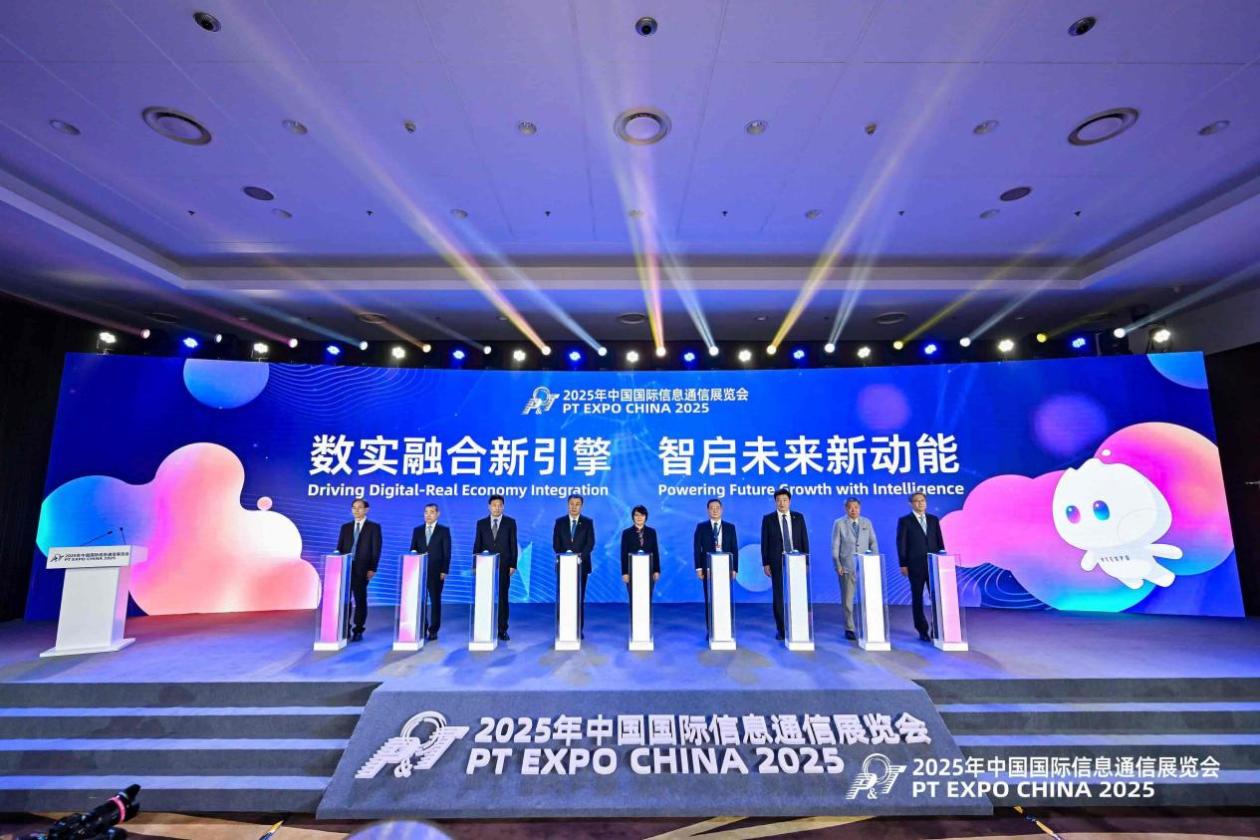
2025年中国国际信息通信展在京开幕,全面展示数实融合成果
Huan Qiu Wang· 2025-09-25 08:16
Core Viewpoint - The 2025 China International Information Communication Exhibition emphasizes the integration of digital and real economies, showcasing the latest achievements in the information and communication industry as a new engine for future development [1][3]. Group 1: Industry Insights - The exhibition highlights the role of the information and communication industry in driving the deep integration of digital and real economies, fostering new productivity [1][3]. - The Chief Engineer of the Ministry of Industry and Information Technology, Zhong Zhihong, stated that the current era is crucial for advancing national rejuvenation and that the industry must seize strategic opportunities to promote this integration [5][6]. - The International Telecommunication Union (ITU) praised China's contributions to global technology standards, particularly in AI and quantum computing, and expressed a desire for deeper international cooperation [5][6]. Group 2: Technological Developments - The exhibition features advancements in technologies such as 5G-A, AI applications in spatial governance, low-altitude smart networks, and satellite internet integration [6][8]. - The main forum of the event emphasized the acceleration of new-generation information technologies, including 5G, AI, big data, and cloud computing, as vital carriers of new productivity [8]. - A keynote report highlighted AI as a core variable in the new stage of digital and real economy integration, with cloud computing as a key support [8]. Group 3: Event Highlights - The exhibition will run until September 26, featuring over ten events, including award ceremonies and the release of more than twenty research reports and action plans [8]. - The event also includes the "2025 BRICS Digital Economy and Trade Investment Forum," aimed at expanding international cooperation and building a global digital governance system [8].



推动数实深度融合 促进AI应用繁荣
Ke Ji Ri Bao· 2025-09-24 23:41
Core Insights - The article highlights the advancements in China's information and communication industry, showcasing innovations in 5G technology and artificial intelligence, as well as the importance of integrating digital and physical infrastructures for future growth [1][2][3][4]. Group 1: Industry Developments - As of August 2023, China has established 4.646 million 5G base stations and has 1.154 billion 5G mobile phone users, maintaining a global lead in key metrics such as 5G user penetration and gigabit optical network coverage [2]. - The integration of 5G technology into 86 categories of the national economy is accelerating, with a focus on enhancing production core processes [2]. - The industry is actively pursuing technological innovation, with a push for the development of 5G-A product systems and the advancement of 6G technology [3]. Group 2: Technological Innovations - The introduction of a new disaster-resistant base station by China Tower, capable of withstanding level 8 earthquakes and level 12 winds, demonstrates the commitment to ensuring communication continuity during extreme disasters [1]. - The event showcased the integration of AI and 5G technologies, with applications such as intelligent robots performing alongside human dancers, enabled by ultra-low latency 5G networks [3][4]. - China Telecom and China Mobile are developing comprehensive computing capabilities, including quantum computing and AI models, to meet diverse industry needs [4]. Group 3: Future Outlook - The industry anticipates a shift towards AI-driven applications, with predictions that by 2030, the number of intelligent agents will surpass traditional apps, creating new opportunities for operators [4]. - There is a strong emphasis on fostering the integration of AI and manufacturing, aiming to cultivate a new generation of industrial intelligent agents [5].
中国电信相关公司新增一项625.00万元的招标项目
Xin Lang Cai Jing· 2025-09-24 12:28
Group 1 - China Tower Corporation, a subsidiary of China Telecom, announced a tender for IT system data labeling services with a budget of 6.25 million yuan [1] - The tender was published on September 24, 2025, indicating ongoing investment in IT infrastructure [1] - China Telecom holds a 20.50% stake in China Tower Corporation, highlighting the strategic partnership between the two companies [1]
中国铁塔亮相2025中国国际信息通信展览会
Zhong Guo Jing Ji Wang· 2025-09-24 11:53
Core Viewpoint - China Tower showcases its role as a key player in digital infrastructure development at the China International Information Communication Exhibition, emphasizing its contributions to national strategies and carbon reduction goals [1] Group 1: Digital Infrastructure Development - Since the 14th Five-Year Plan, China's information and communication industry has built the world's largest and most advanced communication network, achieving over 90% coverage of 5G administrative villages [1] - China Tower has constructed over 5.81 million base station projects, including more than 2.97 million 5G base stations, significantly increasing the availability of shared sites for telecom operators [1] - The sharing level of China Tower has risen from 14.3% to 86%, leading to a reduction in industry investment costs by over 220 billion yuan and operational costs by 195 billion yuan [1] Group 2: Emergency Response Capabilities - China Tower has introduced new disaster-resistant super base stations with capabilities to withstand level 8 earthquakes and level 12 winds, ensuring communication continuity for over 72 hours during extreme disasters [2] - The company has established a comprehensive emergency response system, enhancing capabilities in command and communication support, and has built the largest IoT data sensing network in the country [2] Group 3: Digital Governance and Industry Applications - China Tower is transitioning from "communication towers" to "digital towers," integrating IoT sensors and AI to create a multi-dimensional perception system for various industries [3] - The company has developed 15 specialized industry products and established distributed platforms across 31 provinces, serving over 10,000 application scenarios [3] Group 4: AI and Intelligent Applications - The company has launched the "Artificial Intelligence+" initiative, developing a large-scale model with 180 billion parameters for spatial governance, enhancing capabilities in object detection and reasoning [4] - A general-purpose intelligent system has been introduced, achieving a decision-making time of only 2.6 seconds with 100% accuracy [5] Group 5: Low-altitude Economy Development - China Tower is focusing on the low-altitude economy as a key strategic direction, building a robust infrastructure system and expanding diverse low-altitude applications [6] - The company has implemented pilot projects in several provinces, enhancing management efficiency and operational safety in low-altitude activities [6] Group 6: Energy Solutions - China Tower has become the largest operator of lightweight electric vehicle battery swapping in China, with over 82,000 swapping points across 320 cities, significantly reducing carbon emissions [7] - The company has introduced "zero-carbon base stations" utilizing solar power and energy storage systems, promoting efficient use of clean energy [7]