
君实生物

Search documents
君实生物1月14日获融资买入5575.72万元,融资余额13.25亿元
Xin Lang Cai Jing· 2026-01-15 01:27
Group 1 - The core viewpoint of the news is that Junshi Biosciences experienced a decline in stock price and significant trading activity, indicating potential investor concerns and market volatility [1] - On January 14, Junshi Biosciences' stock fell by 2.36%, with a trading volume of 678 million yuan, and a net financing outflow of 24.32 million yuan [1] - As of January 14, the total margin balance for Junshi Biosciences was 1.341 billion yuan, with a financing balance of 1.325 billion yuan, representing 4.50% of the circulating market value, which is above the 60th percentile of the past year [1] Group 2 - Junshi Biosciences, established on December 27, 2012, focuses on the research and commercialization of monoclonal antibody drugs, with 90.67% of its revenue coming from drug sales [2] - For the period from January to September 2025, Junshi Biosciences reported revenue of 1.806 billion yuan, a year-on-year increase of 42.06%, while the net profit attributable to shareholders was -596 million yuan, reflecting a 35.72% increase [2] - As of September 30, 2025, the number of shareholders increased by 15.17% to 35,900, while the average circulating shares per person decreased by 12.96% to 21,361 shares [2]

医疗AI加速十万亿级医药市场重构,科创医药ETF嘉实(588700)一键布局AI医药发展机遇
Sou Hu Cai Jing· 2026-01-14 06:13
Group 1 - The Shanghai Stock Exchange Sci-Tech Innovation Board Biopharmaceutical Index decreased by 1.00% as of January 14, 2026, with Tianzhihang leading the gain at 18.97% and Rongchang Biopharmaceuticals experiencing the largest drop at 9.83% [1] - Eight departments jointly issued the "Implementation Opinions on the Special Action of 'Artificial Intelligence + Manufacturing'," emphasizing the promotion of intelligent equipment iteration and supporting AI applications in high-end medical equipment and telemedicine [1] - Nvidia and Eli Lilly announced the establishment of an AI joint laboratory, planning to invest up to $1 billion over the next five years to accelerate drug development, indicating increased investment from leading overseas companies in domestic related fields [1] Group 2 - CITIC Securities reported that the medical AI sector is expected to accelerate the restructuring of the trillion-yuan pharmaceutical market, with a fundamental change in the payment logic for AI medical services anticipated in 2026 [2] - The top ten weighted stocks in the Shanghai Stock Exchange Sci-Tech Innovation Board Biopharmaceutical Index accounted for 48.85% as of December 31, 2025, including companies like United Imaging Healthcare and BeiGene [2] Group 3 - The Jiashi Sci-Tech Medical ETF closely tracks the Shanghai Stock Exchange Sci-Tech Innovation Board Biopharmaceutical Index, providing an opportunity for investors to easily access the biopharmaceutical sector [3]
君实生物跌2.11%,成交额4.05亿元,主力资金净流出2191.37万元
Xin Lang Cai Jing· 2026-01-14 05:23
Core Viewpoint - Junshi Biosciences' stock price has shown fluctuations, with a recent decline of 2.11%, while the company has experienced a year-to-date increase of 12.76% in stock value [1][2]. Group 1: Stock Performance - As of January 14, Junshi Biosciences' stock price is reported at 38.52 CNY per share, with a trading volume of 4.05 billion CNY and a market capitalization of 39.548 billion CNY [1]. - The stock has increased by 12.76% year-to-date, with a 1.90% rise over the last five trading days and a 5.30% increase over the last 20 days, while it has slightly decreased by 0.39% over the last 60 days [2]. Group 2: Financial Performance - For the period from January to September 2025, Junshi Biosciences achieved a revenue of 1.806 billion CNY, representing a year-on-year growth of 42.06%. However, the net profit attributable to shareholders was -596 million CNY, reflecting a year-on-year increase of 35.72% in losses [2]. Group 3: Shareholder Information - As of September 30, 2025, the number of shareholders for Junshi Biosciences is 35,900, which is an increase of 15.17% compared to the previous period. The average number of circulating shares per shareholder is 21,361, a decrease of 12.96% [2]. - Among the top ten circulating shareholders, E Fund's SSE STAR 50 ETF holds 19.3929 million shares, a decrease of 2.8203 million shares from the previous period, while Huaxia's SSE STAR 50 ETF holds 18.9720 million shares, down by 1.0745 million shares [3].
君实生物1月13日获融资买入6498.90万元,融资余额13.49亿元
Xin Lang Cai Jing· 2026-01-14 02:22
Group 1 - The core viewpoint of the news highlights the trading performance and financial metrics of Junshi Biosciences, indicating a significant level of financing activity and a high balance in margin trading [1][2] - On January 13, Junshi Biosciences saw a stock price increase of 1.71% with a trading volume of 635 million yuan, and the net financing purchase was 4.0162 million yuan [1] - As of January 13, the total margin trading balance for Junshi Biosciences reached 1.365 billion yuan, with a financing balance of 1.349 billion yuan, accounting for 4.47% of the circulating market value [1] Group 2 - Junshi Biosciences, established on December 27, 2012, focuses on the research and commercialization of monoclonal antibody drugs and other therapeutic protein drugs, with 90.67% of its revenue coming from drug sales [2] - For the period from January to September 2025, Junshi Biosciences reported a revenue of 1.806 billion yuan, reflecting a year-on-year growth of 42.06%, while the net profit attributable to shareholders was -596 million yuan, a 35.72% increase year-on-year [2] - As of September 30, 2025, the number of shareholders for Junshi Biosciences increased by 15.17% to 35,900, while the average circulating shares per person decreased by 12.96% to 21,361 shares [2]
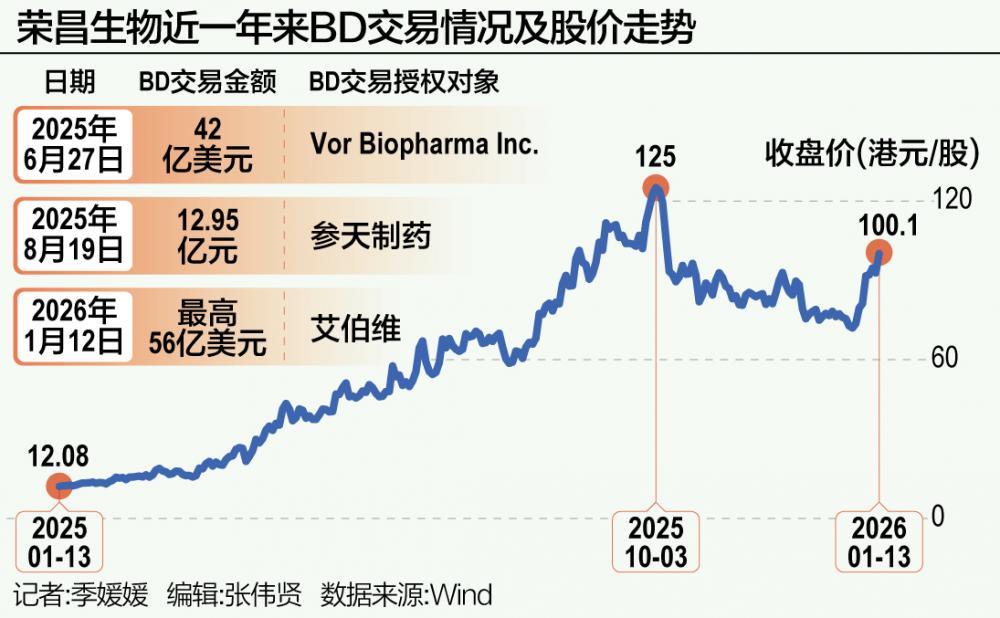
荣昌生物拿下56亿美元大单 双抗技术缘何频获跨国巨头追捧?
2 1 Shi Ji Jing Ji Bao Dao· 2026-01-13 23:12
Core Insights - The collaboration between AbbVie and Rongchang Biopharma marks a significant shift in the global oncology treatment landscape, highlighting the trend of "Chinese innovation + global market" in drug development [1][2] Group 1: Collaboration Details - AbbVie and Rongchang Biopharma signed an exclusive licensing agreement for the development, production, and commercialization of RC148, a bispecific antibody targeting PD-1 and VEGF [1] - Rongchang Biopharma will receive an upfront payment of $650 million and is eligible for up to $4.95 billion in milestone payments, along with a tiered royalty on net sales outside Greater China [1][2] Group 2: Market Implications - The deal allows Rongchang Biopharma to accelerate clinical trials for RC148 in China and globally, while also supporting the development of other pipelines [2] - AbbVie aims to enhance its product portfolio in immuno-oncology, particularly in the emerging PD-1/VEGF bispecific antibody space, which could improve its competitiveness in solid tumor treatments [2] Group 3: Industry Trends - The PD-1/VEGF bispecific antibody represents a new class of cancer therapies that may overcome tumor resistance mechanisms by simultaneously blocking PD-1 and VEGF [3][5] - Chinese companies are leading in this field, with significant advancements and approvals, such as the launch of Ak112/Ivonescimab by Kangfang Biopharma, which is the first bispecific antibody combining tumor immunity and anti-angiogenesis mechanisms [3] Group 4: Broader Market Dynamics - The global interest in PD-1/VEGF bispecific antibodies is rising, with several Chinese firms successfully engaging in business development (BD) transactions, reflecting the increasing recognition of Chinese innovative drug assets by multinational pharmaceutical companies [6][7] - In 2025, the total value of Chinese innovative drug licensing transactions exceeded $130 billion, accounting for 49% of the global total, indicating a significant shift in the global pharmaceutical landscape [7][8] Group 5: Future Outlook - The increasing number of approved innovative drugs in China, along with the growing bargaining power of Chinese companies in licensing agreements, suggests a transition from a "follow" to a "lead" position in global pharmaceutical innovation [8][10] - The ability of Chinese companies to negotiate favorable terms in BD transactions is becoming crucial, emphasizing the importance of pipeline strength, data quality, and structured deal design [9][10]


荣昌生物频获跨国巨头追捧
2 1 Shi Ji Jing Ji Bao Dao· 2026-01-13 23:08
Core Insights - The collaboration between AbbVie and Rongchang Biopharma marks a significant shift in the global oncology treatment landscape, focusing on the development of the bispecific antibody RC148 targeting PD-1 and VEGF [1][2] Group 1: Collaboration Details - AbbVie and Rongchang Biopharma signed an exclusive licensing agreement for RC148, granting AbbVie rights outside Greater China for development, production, and commercialization [1] - Rongchang Biopharma will receive an upfront payment of $650 million and is eligible for up to $4.95 billion in milestone payments, along with a tiered royalty on net sales outside Greater China [1][2] Group 2: Market Implications - This deal exemplifies the "China innovation + global market" model, providing Rongchang Biopharma with substantial cash flow to accelerate clinical trials for RC148 and support other pipeline developments [2] - The partnership with a top-tier oncology company like AbbVie enhances Rongchang Biopharma's brand and bargaining power in international markets, while AbbVie benefits from expanding its immuno-oncology product portfolio [2] Group 3: Bispecific Antibody Landscape - RC148 represents a new class of cancer therapies aimed at simultaneously blocking PD-1 and VEGF, potentially overcoming tumor resistance mechanisms [5] - The PD-1/VEGF bispecific antibody field is gaining traction, with several Chinese companies, including Kangfang Biopharma and Junshi Biosciences, making significant advancements and entering clinical trials [6][7] Group 4: Industry Trends - The Chinese innovative drug sector is experiencing a surge in licensing deals, with over $130 billion in total transaction value in 2025, surpassing the U.S. for the first time [10] - Factors driving this trend include the impending patent cliff for major drugs and declining R&D efficiency among multinational pharmaceutical companies, leading them to seek external innovations [10][11] Group 5: Future Outlook - The Chinese pharmaceutical industry is transitioning from a follower to a leader in innovation, with a clear direction for future development [14] - Companies are focusing on building a comprehensive value creation logic recognized by international partners, enhancing their negotiation power in licensing agreements [12][13]

荣昌生物拿下56亿美元大单,双抗技术缘何频获跨国巨头追捧?
2 1 Shi Ji Jing Ji Bao Dao· 2026-01-13 04:08
Core Viewpoint - The collaboration between AbbVie and Rongchang Biologics marks a significant shift in the global oncology treatment landscape, highlighting the trend of Chinese innovative drug companies partnering with multinational giants for drug development and commercialization [1][2]. Group 1: Collaboration Details - AbbVie and Rongchang Biologics signed an exclusive licensing agreement for the development, production, and commercialization of RC148, a bispecific antibody targeting PD-1 and VEGF [1]. - Rongchang Biologics will receive an upfront payment of $650 million and is eligible for up to $4.95 billion in milestone payments, along with a tiered royalty on net sales outside Greater China [1][2]. Group 2: Market Implications - This deal exemplifies the "China innovation + global market" model, allowing Rongchang Biologics to secure cash flow and accelerate clinical trials for RC148 while focusing on the Chinese market [2]. - AbbVie aims to enhance its product portfolio in immuno-oncology, particularly in the emerging PD-1/VEGF bispecific antibody space, which could synergize with existing antibody-drug conjugates (ADCs) and immuno-oncology (IO) drugs [2]. Group 3: Competitive Landscape - The PD-1/VEGF bispecific antibody represents a new class of cancer therapies that may overcome tumor resistance mechanisms by simultaneously blocking PD-1 and VEGF [3][5]. - Chinese companies are leading in this field, with notable products like Ak112/Ivonescimab and SSGJ707 entering clinical trials, indicating a competitive landscape for PD-1/VEGF bispecific antibodies [3][4]. Group 4: Industry Trends - The surge in business development (BD) transactions in the PD-1/VEGF bispecific antibody sector reflects increasing interest from multinational pharmaceutical companies in Chinese innovative drug assets [6]. - In 2025, the total value of Chinese innovative drug licensing transactions exceeded $130 billion, surpassing the U.S. for the first time, indicating a significant shift in the global pharmaceutical landscape [7][8]. Group 5: Future Outlook - The increasing recognition of Chinese innovative drugs is attributed to their rapid development and the ability to meet unmet clinical needs, enhancing their bargaining power in international collaborations [8][9]. - The industry is witnessing a transition from following to leading in drug innovation, with a clear direction for the future of Chinese pharmaceutical development [10].
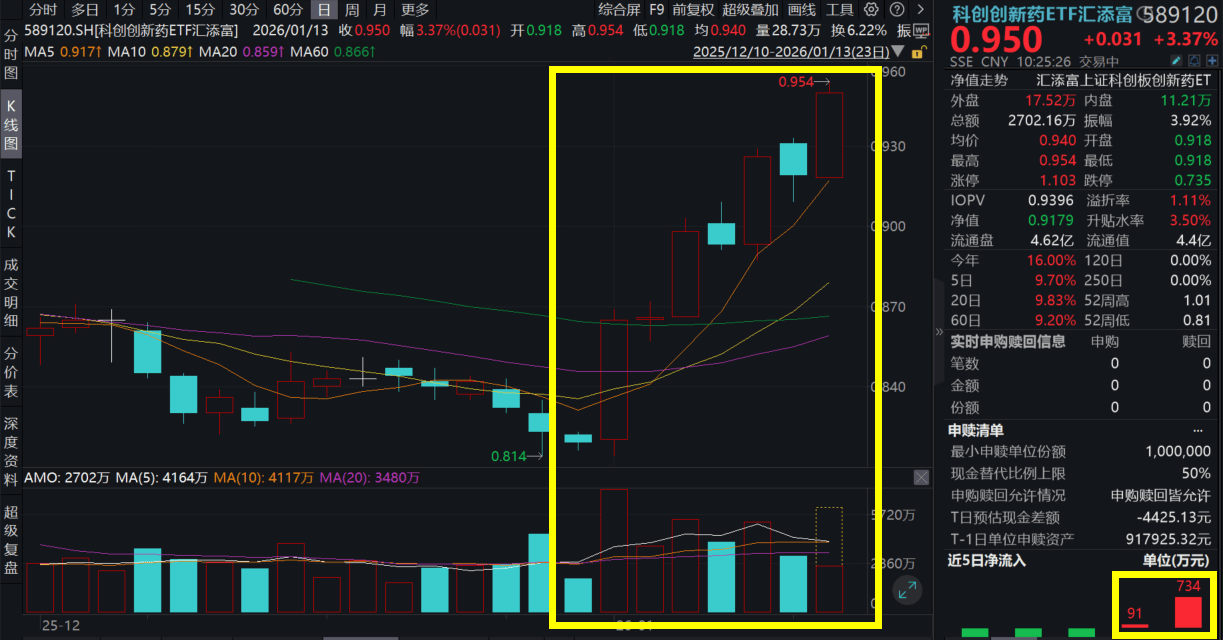
重磅BD!荣昌生物双抗新药56亿美元出海,爆涨17%!20CM科创创新药ETF汇添富(589120)放量大涨超3%,连续2日吸金!BD出海+AI催化,创新药新征途
Sou Hu Cai Jing· 2026-01-13 02:49
Group 1 - The A-share market experienced fluctuations with the Shanghai Composite Index showing volatility, while trading volume exceeded 1.8 trillion yuan, indicating sustained active trading [1] - The innovative drug sector saw significant strength, with the Science and Technology Innovation Drug ETF Huatai (589120) surging over 3% as funds continued to flow into it for two consecutive days, driven by optimism around "BD going global + AI healthcare + brain-computer interfaces" [1] - The top ten constituent stocks of the Huatai ETF include companies like BeiGene (688235) and Junshi Biosciences (688180), with Rongchang Biopharmaceuticals (688331) leading with a 17.29% increase [1][5] Group 2 - Rongchang Biopharmaceuticals announced a licensing agreement with AbbVie for RC148, which includes a $650 million upfront payment and potential milestone payments up to $4.95 billion, along with double-digit royalties on net sales outside Greater China [1][2] - The transaction size of the upfront payment ranks among the top ten for domestic innovative drug companies going global, indicating the potential of RC148 in the global market [2] - The trend in the industry is shifting from "early licensing" to "deep binding" partnerships, with companies like Hengrui Medicine and Qianxin Biopharmaceuticals actively engaging in new cooperative models that share risks and long-term benefits [4][6] Group 3 - The innovative drug sector is expected to enter a phase of significant growth, with a focus on the lifecycle of BD transactions, which includes achieving overseas clinical validation and profit-sharing from sales [3][4] - The market anticipates a busy period for BD transactions, with 49 deals totaling over $39 billion since October, as multinational corporations continue to expand in China [6] - The upcoming JPM conference in January 2026 is expected to catalyze further activity in the sector, coinciding with the annual report cycle, suggesting a peak in data disclosures and BD transactions [6]
君实生物1月12日获融资买入6041.49万元,融资余额13.45亿元
Xin Lang Cai Jing· 2026-01-13 01:17
Group 1 - The core viewpoint of the news is that Junshi Biosciences experienced a decline in stock price while showing significant activity in financing and margin trading, indicating a high level of investor interest and potential volatility in the stock [1][2] Group 2 - On January 12, Junshi Biosciences' stock fell by 1.30%, with a trading volume of 5.09 billion yuan. The financing buy-in amount for the day was 60.41 million yuan, while the financing repayment was 44.22 million yuan, resulting in a net financing buy of 16.19 million yuan [1] - As of January 12, the total margin trading balance for Junshi Biosciences was 1.36 billion yuan, with the financing balance accounting for 4.54% of the circulating market value, which is above the 70th percentile level over the past year [1] - In terms of securities lending, on January 12, Junshi Biosciences had 6171 shares repaid and 800 shares sold short, with a short selling amount of 31,000 yuan. The remaining short selling volume was 388,300 shares, with a short selling balance of 15.02 million yuan, exceeding the 90th percentile level over the past year [1] Group 3 - Junshi Biosciences, established on December 27, 2012, focuses on the research and commercialization of monoclonal antibody drugs and other therapeutic protein drugs, with 90.67% of its revenue coming from drug sales [2] - As of September 30, the number of shareholders for Junshi Biosciences was 35,900, an increase of 15.17% from the previous period, while the average circulating shares per person decreased by 12.96% [2] - For the period from January to September 2025, Junshi Biosciences reported a revenue of 1.806 billion yuan, a year-on-year increase of 42.06%, while the net profit attributable to shareholders was -596 million yuan, a year-on-year increase of 35.72% [2] - As of September 30, 2025, the top ten circulating shareholders included E Fund's SSE STAR 50 ETF and Huaxia's SSE STAR 50 Component ETF, with both funds reducing their holdings compared to the previous period [2]
JPM26: US biotech’s ‘Sputnik moment,’ Pfizer’s obesity ambitions and Bristol Myers’ big year
Yahoo Finance· 2026-01-12 17:18
Core Insights - The biotechnology industry is experiencing a shift as former startups like BridgeBio Pharma gain attention, particularly with their recent product approvals [1] - Patent expirations are expected to impact major pharmaceutical companies, necessitating solid strategies to mitigate potential revenue losses [2] - The biotech sector is showing signs of recovery after a prolonged downturn, with increased acquisition activity noted in the latter half of 2025 [4] Group 1: Industry Trends - The rise of Chinese biotech firms is prompting U.S. investors to reassess their strategies, with significant deals involving Chinese developers being reported [6][8] - Takeda Pharmaceutical's acquisition of Innovent Biologics highlights the growing influence of Chinese biotechs, with the deal valued at $1.2 billion upfront and potential milestone payments exceeding $10 billion [7] - Concerns are being raised about the U.S. potentially losing its leadership in life sciences, with calls for regulatory and health policy reforms to maintain competitiveness [9][10] Group 2: Company-Specific Developments - Bristol Myers Squibb is facing challenges as patents for key products expire, leading to intensified efforts in cost-cutting and diversification of its product portfolio [11][12] - The company reported that four emerging products surpassed $1 billion in sales last year, indicating a focus on growth despite upcoming revenue gaps [13] - Pfizer is aggressively pursuing its obesity drug ambitions following the acquisition of Metsera, with plans for 10 Phase 3 trials by the end of 2026 and expectations of $150 billion in annual sales by 2030 [16][17] Group 3: Company Challenges - Sarepta Therapeutics has faced setbacks with its Duchenne muscular dystrophy gene therapy, leading to a significant drop in share price and revenue forecasts [20][21] - Despite challenges, Sarepta reported a 9% growth in Elevidys sales, indicating some resilience in its product offerings [21] - The company is exploring new revenue opportunities through RNA drugs in collaboration with Arrowhead Pharmaceuticals, although it has refrained from providing specific financial guidance [22][23]


