优衣库

Search documents
年轻人又爱上无印良品(MUJI)了
36氪未来消费· 2025-09-29 09:25
Core Insights - MUJI has experienced a significant resurgence in the Chinese market, with a 127.5% year-on-year profit increase in the East Asia region, following three years of sluggish performance [3][5] - The brand's strategy shift towards localized products and pricing adjustments has contributed to its recovery, contrasting with the decline of competitors like Miniso and NetEase Yanxuan [5][9] Market Performance - MUJI's Chinese market accounts for approximately 20% of the group's total revenue, with over 400 stores in mainland China [4] - The brand's revenue and profit have seen continuous growth for ten consecutive months, indicating a successful turnaround [3] Brand Strategy - Initially, MUJI adopted a premium positioning strategy in China, similar to Uniqlo, which appealed to consumers seeking quality and design [7] - Despite initial success, the brand faced increased competition and began implementing price reductions from 2014, which did not yield the expected sales growth [8] Product and Pricing Adjustments - In 2022, MUJI shifted from direct price cuts to a more nuanced approach, focusing on essential goods like food and daily necessities, while also changing the sales model for larger furniture items [9][10] - The introduction of the "MUJI 500" store format, with products priced around 25 RMB, marks a significant move towards catering to local market demands [10] Localization Efforts - Under the leadership of President Sadafumi Takamatsu, MUJI has emphasized local product development, with about 70% of its grocery and food items now tailored to Chinese consumer preferences [14] - The brand has also expanded its product range to include more everyday essentials, enhancing its appeal to local consumers [14][15] Retail Innovation - MUJI has experimented with innovative retail concepts, such as farm-themed stores and restaurants, to connect with local consumers and promote the value of supporting local farmers [15] - The brand's merchandising strategy encourages one-stop shopping experiences, increasing the likelihood of additional purchases [15][16] Conclusion - MUJI's journey from peak to trough and back highlights the necessity for mid-range brands to continuously adapt and innovate in response to market dynamics and consumer preferences [16]


俞敏洪:做决策的四个“不要”
创业家· 2025-09-28 10:17
Core Viewpoint - Entrepreneurship requires continuous adaptation, keen observation, and effective resource utilization, emphasizing the importance of decision-making free from personal biases [1] Group 1: Course Overview - The "Black Horse: Rise of Consumption" course features renowned instructors from various industries, focusing on product innovation and brand expansion in the context of the Chinese and Japanese markets [3][10] - The course aims to provide insights into how companies can leverage technology and consumer needs to create market-leading products [10][12] Group 2: Insights from Japanese Companies - Japanese companies have successfully transformed technology into user-perceived value, exemplified by Sony's Walkman and Uniqlo's innovative fabrics [10] - The integration of AI in consumer products is reshaping the industry, with companies that effectively merge demand with algorithms poised to become future champions [10][12] Group 3: Market Strategies - The course discusses strategies for Chinese brands to adapt to global markets by aligning supply chain capabilities with local demands, moving from simple exportation to deeper cultural integration [13][21] - Emphasis is placed on the importance of understanding local consumer needs and building trust through effective communication and problem-solving [22] Group 4: Product Innovation and Development - The curriculum includes lessons on how to innovate products by combining cross-disciplinary technologies and AI, addressing the challenges of product aging in a saturated market [17][23] - Successful product development processes from companies like Muji and Uniqlo are analyzed to provide actionable insights for Chinese enterprises facing homogenization and inventory management issues [25][24]


新时代公关:数据真的帮助到大公司了吗?
Hu Xiu· 2025-09-27 08:32
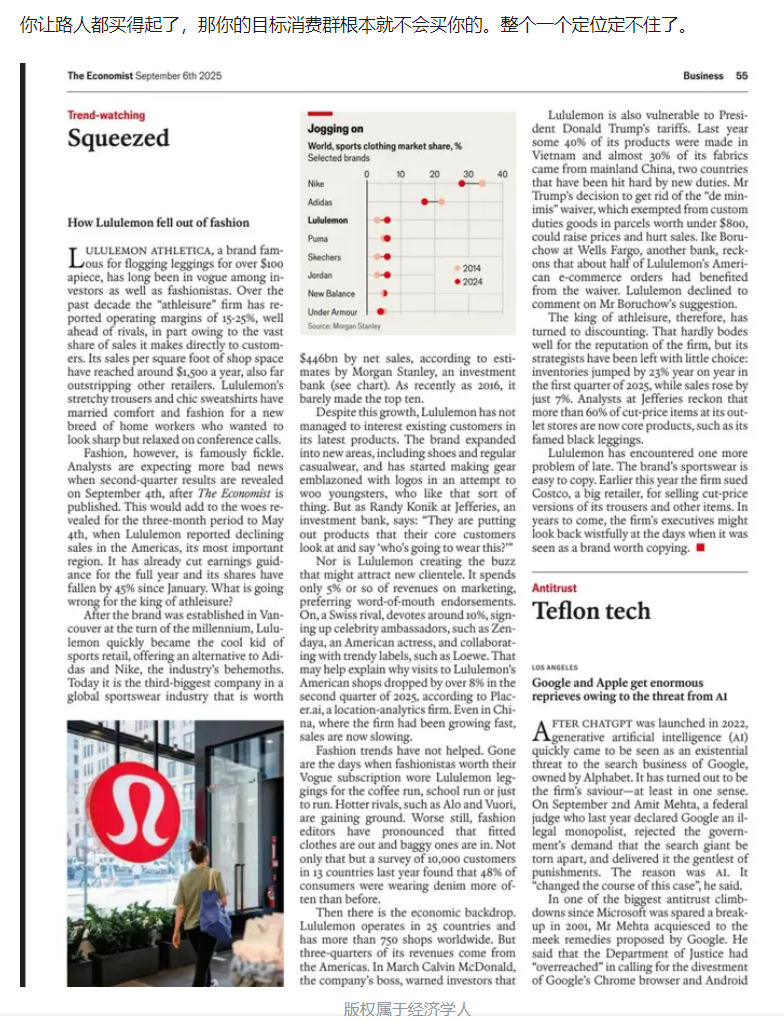
Group 1 - The article discusses the impact of big data on corporate decision-making, questioning whether data truly aids in making better decisions for large companies [1][2] - There have been several cases in the business sector this year where increased reliance on data has led to outcomes that did not meet expectations [2][29] - A specific example highlighted is a high-altitude fireworks display sponsored by an outdoor brand, raising questions about the logical connection between the event and brand identity [3][4][5] Group 2 - The article contrasts the marketing strategies of high-end brands like Porsche and Apple, which focus on relatability and humanistic values rather than exclusivity [8][10][14] - It emphasizes that many high-end brands successfully appeal to the masses, contrary to the belief that they should only target elite consumers [13][14] - The discussion includes the challenges faced by brands like Lululemon, which, despite initial success, have struggled due to an over-reliance on data-driven decisions that overlook fundamental human insights [29][35][38] Group 3 - The article points out that many companies fail to recognize the importance of understanding human nature and consumer psychology, leading to misguided decisions based on data alone [36][39][40] - It suggests that a lack of insight into genuine consumer needs can result in poor product offerings, as seen in the case of Lululemon's sizing issues [15][29][35] - The narrative concludes that businesses must balance data analysis with a deeper understanding of human behavior to avoid pitfalls in decision-making [38][40]

“杀”疯了!已经没人敢和这家“穷鬼超市”比了,拼多多也靠边站
Sou Hu Cai Jing· 2025-09-26 17:16
Core Insights - The article highlights the rise of a new retail brand, 鹿岛 (Lushida), which has successfully captured the attention of middle-class consumers, contrasting with the decline of established brands like Muji, IKEA, and Uniqlo [1][3][5] Group 1: Company Overview - 鹿岛 has rapidly expanded its presence, with over 200 stores nationwide and plans to increase this number to 300 by next year [5] - The brand has accumulated over 5 million members and achieved an impressive annual revenue of 4 billion [7][19] Group 2: Business Strategy - 鹿岛's strategy involves opening stores near established brands like Uniqlo, effectively positioning itself as a lower-cost alternative [9][11] - The brand focuses on providing emotional value to customers, utilizing low-cost methods to create "emotional hooks" that enhance customer engagement [19][21] Group 3: Unique Selling Proposition - 鹿岛 offers products at significantly lower prices, such as a cotton T-shirt priced at 19.9 yuan compared to Uniqlo's 79 yuan [11] - The store's design and product display mimic that of Uniqlo, creating a sense of familiarity while offering lower-priced alternatives [13][15] Group 4: Customer Engagement - 鹿岛 has innovatively designed its membership program, allowing for shared use among family and friends, which enhances customer relationships [25] - The brand addresses common shopping pain points, such as providing a space for bored companions to relax, thereby increasing overall customer dwell time [26] Group 5: Supply Chain and Cost Management - 鹿岛 collaborates with over 100 small manufacturers, focusing on timeless basic items to minimize design costs and inventory risks [27][28] - The brand has established a unique procurement strategy, including direct quality control and cash settlement with suppliers, allowing it to maintain low prices [30][32] Group 6: Challenges and Risks - Despite its success, 鹿岛 faces quality control issues, with complaints about product durability and quality [34] - The brand's business model, while innovative, lacks a deep competitive moat, making it vulnerable to imitation and market changes [36][38]
未来10年,最挣钱的注定是这群人
创业家· 2025-09-26 10:08
Core Insights - Amazon's report on global e-commerce trends highlights emerging consumer preferences and market opportunities driven by technology and emotional needs [1][2]. Group 1: AI-Driven Consumer Trends - Trend 1: AI Quality Space - Over 65% of consumers in Europe and the US are willing to spend more on smart home products that enhance emotional interaction and provide comfort [3][6]. - Trend 2: Sleep Economy - 37% of American adults reported a decline in sleep quality in 2023, indicating a growing market for sleep-related products and services [9][10][11]. - Trend 3: Happy Office - There is an increasing demand for ergonomic office furniture that enhances comfort and productivity, reflecting a shift in workplace expectations [12][13]. Group 2: Lifestyle and Experience Trends - Trend 4: Subtle Technology - Consumers are seeking technology that seamlessly integrates into their lives, enhancing quality without being intrusive [14]. - Trend 5: Pet Economy - The global pet industry is expected to grow by 45% over the next six years, with 55% of pet owners in developed markets willing to invest more in pet health and wellness [15][16][18]. - Trend 6: Outdoor Cooking - The rise of camping and outdoor cooking reflects a demand for products that facilitate social experiences and lifestyle enjoyment [19][21]. Group 3: Generational and Health Trends - Trend 7: Mobile Treasure Chest - Vehicles are evolving into multifunctional spaces, offering comfort and utility for various activities [22][26]. - Trend 8: Modern Generation Z - This generation values sustainability, personalization, and emotional connection in their purchasing decisions [27][28][29]. - Trend 9: Fitness Pioneers - There is a growing focus on personalized and efficient fitness solutions, supported by technology [30][33]. Group 4: Gaming and Cultural Trends - Trend 10: E-sports Enthusiasts - Emerging markets are experiencing rapid growth in e-sports, with consumers seeking high-performance equipment and immersive experiences [34][36]. - The report identifies three key drivers of these trends: accelerated technology, emotional shifts, and evolving lifestyles, reflecting complex consumer needs [37][38].

成功的企业,创始人都做到了这3点
创业家· 2025-09-26 10:08
Core Viewpoint - The article suggests that the next decade will see the emergence of new cross-industry companies similar to Pinduoduo, driven by three key factors: identifying boundaryless opportunities, securing global capital and resources, and attracting top talent to collaborate on these ventures [1]. Group 1: Insights on Product Innovation and Market Strategy - The success of Japanese companies since the 1980s serves as a model for emerging markets, emphasizing the transformation of technology into user-perceived value, as seen with Sony's Walkman and Uniqlo's comfortable basics [9]. - AI is reshaping consumer products by redefining their inherent value through algorithms, indicating that future champions will be those who effectively merge demand with technology [9]. - The course will explore how to innovate products and manage supply chains by learning from successful Japanese brands like Sony and Uniqlo [12][28]. Group 2: Consumer Market Dynamics - The article discusses the importance of identifying high-value application scenarios for AI technology to enhance efficiency and user experience, urging entrepreneurs to quickly validate demand rather than getting lost in technical perfection [18]. - It highlights the need for Chinese companies to adapt their supply chains to meet local demands in overseas markets, moving away from merely replicating domestic models [24]. - The article emphasizes the significance of building trust with local consumers in international markets by addressing their specific needs rather than just selling products [25]. Group 3: Course Details and Target Audience - The article promotes a three-day immersive course aimed at dissecting how Chinese and Japanese consumer companies can thrive in a saturated market, focusing on product innovation and brand globalization [10][30]. - The course is designed for founders and CEOs of consumer enterprises looking to break through growth ceilings, expand internationally, or innovate in response to product homogenization [30]. - Early bird pricing for the course is set at 9,800 yuan per person, down from the original price of 12,800 yuan [31].

不止入乡随俗,优衣库如何以旗舰店重塑与中国城市的“对话”?
Sou Hu Cai Jing· 2025-09-26 06:41
Core Insights - The article discusses Uniqlo's strategy of deep localization and individual store management in China, particularly through the opening of its first city flagship store in Changsha, which emphasizes regional culture and consumer engagement [1][3][18] Group 1: Store Concept and Design - Uniqlo's Changsha flagship store is designed as a cultural hub that reflects local identity, featuring products inspired by local symbols and daily life, such as designs based on "small crayfish" and "chili peppers" [4][6][9] - The store includes a UTme! customization workshop, allowing consumers to create personalized designs that resonate with local culture, enhancing emotional connections [6][9][14] Group 2: Cultural Engagement and Community Involvement - The flagship store serves as a platform for cultural experiences, showcasing local art, traditional crafts, and community businesses, thus transforming shopping into a cultural exploration [9][11][14] - Uniqlo's initiatives include collaborations with local artists and the introduction of a RE.UNIQLO STUDIO for clothing repair and upcycling, promoting sustainability and community engagement [11][14][18] Group 3: Product Offerings and Local Adaptation - Uniqlo tailors its product offerings to meet local climate needs, providing high-quality, affordable clothing solutions suitable for Changsha's variable weather [24][28][30] - The store features exclusive items that blend global quality with local cultural elements, ensuring that consumers can enjoy both familiarity and uniqueness in their purchases [21][30] Group 4: Brand Philosophy and Future Vision - Uniqlo's approach in Changsha exemplifies a shift from mere commercial transactions to a deeper value co-creation with the community, positioning itself as a partner in urban development [31][33] - The brand's philosophy of "LifeWear" evolves to encompass a commitment to cultural respect and community involvement, aiming to enrich consumer experiences and foster local identity [33]

“穷鬼超市”逆袭记:20元会员卡横扫200店,性价比碾压拼多多
Sou Hu Cai Jing· 2025-09-26 05:27
Core Insights - The article highlights the rise of "Kashima Membership Store," a budget supermarket that has thrived amidst the decline of other retail giants like Muji and IKEA, achieving over 200 stores and annual revenue of 4 billion yuan [1][3]. Group 1: Business Model and Strategy - Kashima's unique business model focuses on extreme price competitiveness, allowing customers to purchase five items for the price of one at traditional retailers, with 40% of customers making a purchase upon entry [5][12]. - The store employs clever scene-based marketing, creating Instagram-worthy spots that attract young consumers and reduce customer acquisition costs to one-fifth of traditional supermarkets [7]. - A flexible membership system allows customers to obtain a permanent membership card for 20 yuan, which can be shared among family and friends, enhancing accessibility and reinforcing price advantages [8]. Group 2: Supply Chain and Quality Control - Kashima collaborates directly with 100 small manufacturers to minimize costs by bypassing intermediaries, although this has led to some quality control issues reported by consumers [12][14]. - The company faces challenges in maintaining product quality as it scales, with customer feedback indicating inconsistencies in items like sweatshirts and pants [12][14]. Group 3: Market Challenges and Future Directions - As Kashima expands, it encounters challenges such as the potential imitation of its marketing strategies, the need for fashionable basic designs, and the risk of losing price-sensitive customers if the market improves [14][16]. - The company is seeking to innovate by enhancing its product design and optimizing its supply chain to keep pace with growth, aiming to convert price-sensitive customers into brand-loyal ones [16][20]. Group 4: Consumer Behavior and Market Trends - The success of Kashima reflects a shift in consumer behavior towards rational spending, where practical value is prioritized over brand prestige, indicating a potential opportunity for offline retail in the e-commerce era [18][20]. - The competitive landscape remains intense, with platforms like Pinduoduo and brands like Miniso continuously optimizing their models, necessitating ongoing investment in product quality and brand development for Kashima to evolve from a budget alternative to a national brand [20][22].

小赛道,才有大机会
创业家· 2025-09-25 10:11
Core Viewpoint - Successful companies in China should focus on niche markets that others overlook, as small tracks can present significant opportunities. Companies should avoid spending in areas where they cannot compete and be willing to take bold risks in areas where they can succeed [1] Group 1: Course Overview - The "Black Horse Consumption Rise Selected Course" is scheduled from October 17 to 19 in Shenzhen, featuring renowned instructors from various industries [2][5] - The course aims to provide insights into product innovation and brand expansion, particularly in the context of the stock market era [6][8] Group 2: Japanese Manufacturing Insights - The success of Japanese companies since the 1980s serves as a model for emerging economies, emphasizing the transformation of technology into user-perceived value [7] - Companies like Sony and Uniqlo succeeded not solely due to advanced technology but by addressing consumer pain points and understanding consumption scenarios [7] Group 3: AI and Consumer Innovation - AI is reshaping the essence of consumption by redefining product value through algorithms, with future champions being those who can perfectly integrate demand with AI [7][10] - Examples include Plaud's recording card and Haivivi's toys, which leverage AI to enhance user experience and emotional connection [7] Group 4: Market Strategies - The course will cover strategies for becoming champions in niche markets amidst intense competition, focusing on AI's role in creating new product categories [10] - It will also address how to find a clear market position and leverage scalable innovative products for brand differentiation [10] Group 5: Globalization and Localization - The essence of globalization is to deeply bind China's supply chain capabilities with local market demands abroad, moving from simple export to localized coexistence [11] - Trust-building with local consumers is crucial for Chinese brands entering overseas markets, requiring a connection between brand stories and local needs [19]

日赚1.3亿,创始人光靠卖衣服,八次成为首富
创业家· 2025-09-25 10:11
Core Insights - Uniqlo, founded by Tadashi Yanai, has become one of Japan's most successful companies over the past 30 years, thriving even during economic downturns [3][4] - The brand has successfully penetrated the Chinese market, generating significant revenue and expanding its store presence [8] Group 1: Company Background - Uniqlo was established in 1984, coinciding with Japan's economic downturn, which led to a shift in consumer behavior towards minimalism and cost-effectiveness [7] - By 2023, Uniqlo operates over 900 stores in China, contributing to 40% of its global revenue [8] Group 2: Business Strategy - Uniqlo's success is attributed to its high cost-performance ratio, appealing to consumers focused on value during economic challenges [9] - The brand emphasizes versatile basic clothing rather than chasing fashion trends, making it suitable for a wide range of consumers [10][11] - Uniqlo effectively utilizes "hit product" marketing strategies, quickly launching popular items that enhance brand visibility and drive sales [12][16] Group 3: Innovation and Adaptation - The company encourages collaboration across departments in product planning, allowing store managers to provide feedback and adapt to consumer needs rapidly [16] - Uniqlo's ability to leverage technology and consumer insights has been crucial in maintaining its competitive edge in the market [24]