龙大美食

Search documents
龙大美食(002726) - 2025年第三季度可转换公司债券转股情况公告
2025-10-09 11:32
| 证券代码:002726 | 证券简称:龙大美食 | 公告编号:2025-080 | | --- | --- | --- | | 债券代码:128119 | 债券简称:龙大转债 | | 山东龙大美食股份有限公司 2025 年第三季度可转换公司债券转股情况公告 本因激励对象自主行权以及公司非公开发行股票上市成功发生变化,根据公司可 转换公司债券转股价格调整的相关条款,"龙大转债"的转股价由 9.38 元/股调整 为 9.29 元/股。调整后的转股价格自 2021 年 8 月 12 日起生效。 自前次转股价格调整日至 2022 年 3 月 28 日,公司总股本因激励对象自主行 权以及限制性股票回购注销而发生变化,根据公司可转换公司债券转股价格调整 的相关条款,"龙大转债"的转股价由 9.29 元/股调整为 9.28 元/股。调整后的转 股价格自 2022 年 3 月 31 日起生效。 自前次转股价格调整日至 2022 年 8 月 17 日,公司总股本因激励对象自主行 权以及限制性股票回购注销而发生变化,根据公司可转换公司债券转股价格调整 的相关条款,"龙大转债"的转股价由 9.28 元/股调整为 9.30 元/ ...

龙大美食(002726) - 关于持股5%以上股东股份质押的公告
2025-10-09 11:30
| 证券代码:002726 | 证券简称:龙大美食 | 公告编号:2025-081 | | --- | --- | --- | | 债券代码:128119 | 债券简称:龙大转债 | | 山东龙大美食股份有限公司 关于持股 5%以上股东股份质押的公告 | | 是否为 | | | | | | | | | | | --- | --- | --- | --- | --- | --- | --- | --- | --- | --- | --- | | | 控股股 | | | | | | | | | | | | 东或第 | 本次质押数 | 占其所 | 占公司总 | 是否为限 | 是否为补 | | 质押解 | | | | 股东名称 | 一大股 | 量(股) | 持有股 | 股本比例 | 售股 | 充质押 | 质押起始日 | 除日 | 质权人 | 质押用途 | | | 东及其 | | 份比例 | | | | | | | | | | 一致行 | | | | | | | | | | | | 动人 | | | | | | | | | | | 莱阳银龙 | | | | | | | | 办理解 | 成都千领长盛 企业管理合伙 | | ...
龙大美食(002726) - 2025年第二次临时股东会决议公告
2025-10-09 11:30
山东龙大美食股份有限公司 证券代码:002726 证券简称:龙大美食 公告编号:2025-082 债券代码:128119 债券简称:龙大转债 2025 年第二次临时股东会决议公告 本公司及董事会全体成员保证信息披露内容的真实、准确和完整,没有虚假 记载、误导性陈述或重大遗漏。 特别提示: 1.本次股东会未出现否决提案的情形。 2.本次股东会未涉及变更以往股东会已通过的决议。 一、会议召开和出席情况 (一)会议召开情况 1、本次股东会的召开时间 (1)现场会议召开时间:2025 年 10 月 9 日下午 2:45; (2)网络投票时间:2025 年 10 月 9 日; 通过深圳证券交易所交易系统进行网络投票的具体时间为:2025 年 10 月 9 日上午 9:15-9:25,9:30-11:30,下午 1:00-3:00; 通过现场和网络出席会议的股东 361 人,代表股份 403,308,846 股,占上市 公司有表决权股份总数的 38.8640%(已剔除截止股权登记日公司回购账户中已 回购的股份数量,以下同)。 2、现场会议出席情况 通过现场出席会议的股东 4 人,代表股份 390,326,100 股,占上 ...
龙大美食(002726) - 北京中伦(成都)律师事务所关于山东龙大美食股份有限公司2025年第二次临时股东会的法律意见书
2025-10-09 11:30
ZHONG LUN 中倫律師事務所 特殊的普通合伙 Limited Liability Partnership 新区十点十点北段 066 号于时间区分 ith Tower of Tianfu International Finance Center 966 North High-tech Zone Chengdu Sichuan 610041 Chi : +86 28 6208 8001 传直/Fax · +86 28 6208 8111 北京中伦(成都)律师事务所 关于山东龙大美食股份有限公司 2025 年第二次临时股东会的 北京中伦(成都)律师事务所 关于山东龙大美食股份有限公司 2025 年第二次临时股东会的 法律意见书 二〇二五年十月 北京 ・ 上海 ・ 深圳 ・ 广州 ・ 武汉 ・ 成都 ・ 重庆 ・ 青岛 ・ 杭州 ・ 南京 ・ 海口 ・ 东京 ・ 香港 ・ 伦敦 ・ 留谷山 ・ 阿含水田 ・ 国会山 ・ 阿拉木田 Beijing ・Stangkia ・Shenzhen ・Grangdo ・Chongko ・Chogko ・Hanjing ・Haikou ・Rim 法律意见书 致:山东龙大美食股份 ...
食品加工板块10月9日涨0.12%,金字火腿领涨,主力资金净流出9965.89万元
Zheng Xing Xing Ye Ri Bao· 2025-10-09 08:53
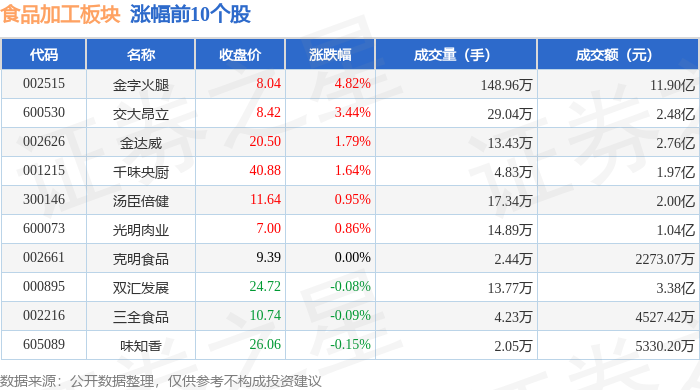
Core Insights - The food processing sector experienced a slight increase of 0.12% on October 9, with Jinzi Ham leading the gains [1] - The Shanghai Composite Index closed at 3933.97, up 1.32%, while the Shenzhen Component Index closed at 13725.56, up 1.47% [1] Stock Performance Summary - Jinzi Ham (002515) closed at 8.04, up 4.82% with a trading volume of 1.4896 million shares and a transaction value of 1.19 billion [1] - Other notable performers include: - Jiaoda Onl (600530) at 8.42, up 3.44% with a transaction value of 248 million [1] - Jindawei (002626) at 20.50, up 1.79% with a transaction value of 276 million [1] - Qianwei Yangchu (001215) at 40.88, up 1.64% with a transaction value of 197 million [1] - Tangchen Beijian (300146) at 11.64, up 0.95% with a transaction value of 200 million [1] Capital Flow Analysis - The food processing sector saw a net outflow of 99.6589 million from institutional investors, while retail investors contributed a net inflow of 43.3086 million [2] - Notable capital flows include: - Qianwei Yangchu (001215) had a net inflow of 26.7066 million from institutional investors [3] - Jinzi Ham (002515) experienced a net outflow of 14.5851 million from retail investors [3] - Guangming Meat Industry (600073) had a net inflow of 8.2557 million from institutional investors [3]


预制的中华料理,正包围日本人的餐桌
36氪· 2025-10-03 04:08
Core Viewpoint - The article discusses the rapid rise of Chinese cuisine, particularly pre-made dishes and street food, in Japan, highlighting the cultural acceptance and adaptation of these foods by Japanese consumers [4][5][129]. Group 1: Chinese Cuisine in Japan - Chinese pre-made dishes, especially items like 麻辣烫 (spicy hot pot), have become extremely popular in Japan, with many restaurants and food stalls emerging [16][61]. - 麻辣烫 has transformed into a high-end dining experience in Japan, with Japanese consumers showing a strong preference for it, often waiting in long lines to enjoy it [26][30][31]. - The average cost of a bowl of 麻辣烫 in Japan is around 2000 yen, approximately 95 RMB, which is significantly higher than other local dishes [26]. Group 2: Cultural Adaptation - Japanese consumers have embraced the ritual of eating 麻辣烫, which includes a strong emphasis on the broth, made from over 20 spices, and is often referred to as a health tonic [35][39]. - The popularity of 麻辣烫 among Japanese youth reflects a deeper cultural integration, with many expressing emotional connections to the dish [22][43]. - The article notes that the adaptation of Chinese dishes in Japan often involves modifications to suit local tastes, such as the use of sweeter flavors in 麻婆豆腐 [78][91]. Group 3: Pre-made Dishes Market - The growth of Chinese pre-made dishes in Japan is supported by a robust supply chain, with companies in China rapidly exporting frozen vegetables and prepared foods [119][127]. - The acceptance of pre-made dishes in Japan is high, with many young people preferring convenience foods, such as pre-peeled shrimp [127]. - The article emphasizes that while China’s pre-made food industry is still developing, it has already made significant inroads into the Japanese market, indicating a trend towards industrialized food production [130][131]. Group 4: Future Outlook - The success of Chinese cuisine in Japan is not just about flavor but also reflects the industrial capabilities of Chinese food production, which is becoming a key driver for the international expansion of Chinese fast food [129][132]. - The article concludes that the cultural crossover of street food like 麻辣烫 demonstrates that with a solid consumer base, any well-prepared dish can become a global culinary sensation [133].

高端食材热销、熟食拓新 双节前食品采购更加精细化、多元化
Xin Jing Bao· 2025-09-30 09:54
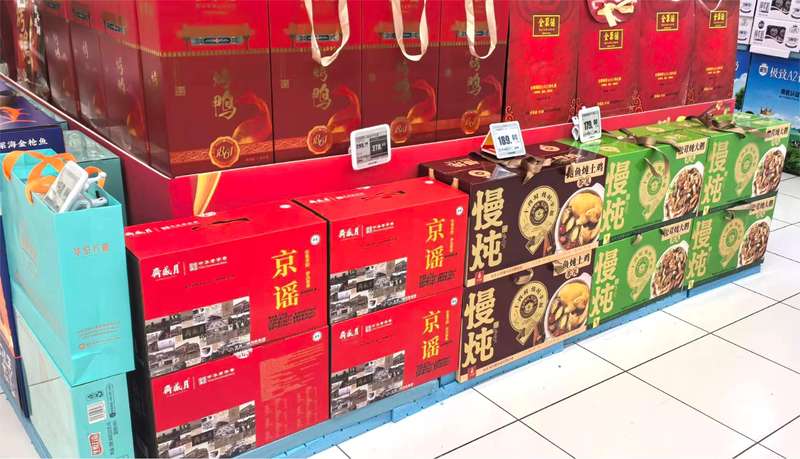
Core Insights - The upcoming National Day and Mid-Autumn Festival are driving consumer interest in health-conscious and high-quality food products, with a notable shift towards premium offerings and local specialties [1][11]. Group 1: Egg Consumption - The demand for egg gift boxes has surged, with a 6.79% increase in egg price index in Beijing due to the festive season [2]. - Consumers are increasingly opting for supermarket private labels, such as "Bountiful Countryside," indicating a shift in brand loyalty [2]. - Egg brands are facing logistical challenges due to increased order volumes, leading to potential delivery delays [2]. Group 2: Meat and Prepared Foods - Pork consumption is experiencing a spike, with sales increasing by 20-30% during the festive period, as consumers stock up on various meat products [3][11]. - New product offerings in the prepared food sector, such as gourmet gift boxes featuring traditional and innovative dishes, are attracting consumer interest [4][6]. - The trend towards high-quality, ready-to-eat meals is evident, with brands like Tianfuhao introducing new products to meet evolving consumer preferences [6]. Group 3: Seafood Market - The seafood market is bustling, with a 30% increase in orders for crab gift boxes as consumers prepare for the holiday season [7]. - High-end seafood products, including Boston lobsters and sea cucumbers, are gaining traction, reflecting a growing consumer preference for premium ingredients [8]. - The supply chain for seafood is being optimized to ensure availability during the festive period, with significant daily trading volumes reported [7][8]. Group 4: Health and Wellness Trends - There is a marked increase in consumer interest in health-oriented products, with a focus on low-sugar and low-salt options, as well as traditional health supplements [10][11]. - The trend towards "face and substance" is evident, with consumers seeking aesthetically pleasing and high-quality gift boxes that reflect both personal and cultural values [10][11]. - Local specialties are becoming a significant part of festive shopping, with a wide range of regional products available to consumers [11].

食品加工板块9月29日跌0.12%,龙大美食领跌,主力资金净流出9346.07万元
Zheng Xing Xing Ye Ri Bao· 2025-09-29 08:39
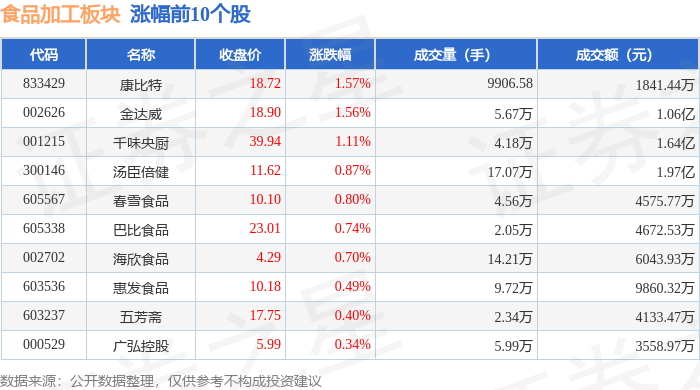
Market Overview - On September 29, the food processing sector declined by 0.12%, with Longda Food leading the drop [1] - The Shanghai Composite Index closed at 3862.53, up 0.9%, while the Shenzhen Component Index closed at 13479.43, up 2.05% [1] Stock Performance - Notable gainers in the food processing sector included: - Kangbiter (Code: 833429) with a closing price of 18.72, up 1.57% [1] - Quandawei (Code: 002626) with a closing price of 18.90, up 1.56% [1] - Qianwei Yangchu (Code: 001215) with a closing price of 39.94, up 1.11% [1] - Longda Food (Code: 002726) was the biggest loser, closing at 5.07, down 3.43% [2] Trading Volume and Capital Flow - The food processing sector saw a net outflow of main funds amounting to 93.46 million yuan, while retail investors had a net inflow of 101 million yuan [2][3] - The trading volume for Longda Food was 379,600 shares, with a transaction value of 192 million yuan [2] Individual Stock Capital Flow - Jinzi Ham (Code: 002515) had a main fund net inflow of 21.06 million yuan, while retail investors contributed a net inflow of 25.93 million yuan [3] - Spring Snow Food (Code: 605567) experienced a main fund net inflow of 3.62 million yuan, but had a net outflow from retail investors of 1.16 million yuan [3]


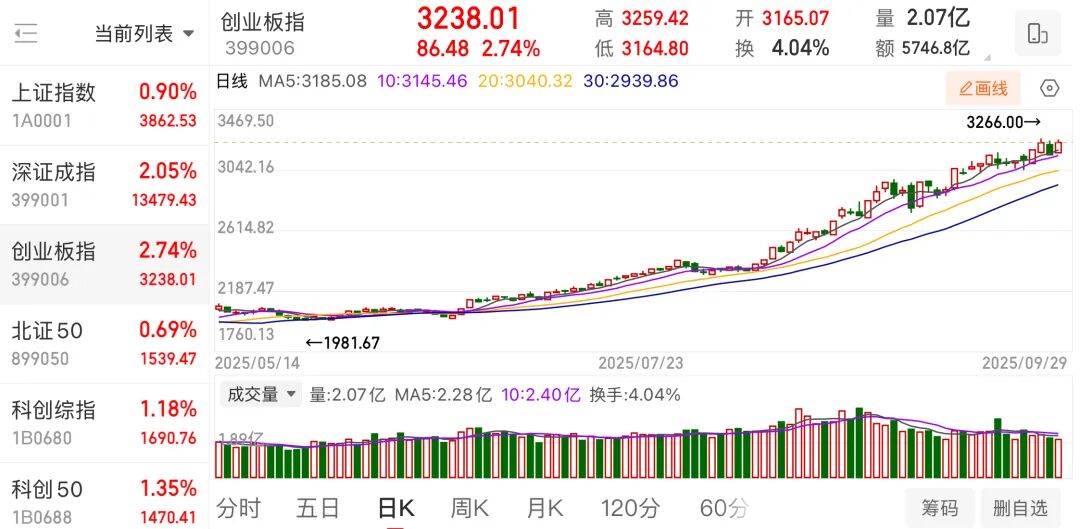
创业板指涨2.74%,超3500股收涨!
Guo Ji Jin Rong Bao· 2025-09-29 08:01
Market Overview - The total trading volume in the Shanghai, Shenzhen, and Beijing markets reached 21,781 billion yuan, an increase of 12 billion yuan compared to the previous day, with over 3,500 stocks rising [1] - On September 29, all three major A-share indices rose, with the Shanghai Composite Index up by 0.9%, the Shenzhen Component Index up by 2.05%, and the ChiNext Index up by 2.74% [2] Sector Performance - The securities, battery, non-ferrous metals, and steel sectors saw significant gains, while the education, pork, coal, and chemical pharmaceuticals sectors experienced declines [1] - Specific stocks such as Huatai Securities, Guosheng Financial Holdings, and GF Securities hit the daily limit, indicating strong performance in the securities sector [7] - The gold and non-ferrous metals sectors also performed well, with stocks like Wolong New Energy and Xingye Silver Tin reaching their daily limit [7] - Solid-state battery and energy storage sectors showed explosive growth, with over ten stocks including Wanrun New Energy and Fengshan Group hitting the daily limit [7] Notable Stock Movements - Stocks in the education sector, such as Kevin Education and China High-Tech, faced significant declines, with some hitting the daily limit down [7] - Pork and food stocks also lagged, with companies like Jingji Zhino and Aonong Biological experiencing notable drops [7]




《餐饮供应链趋势发展报告2025》:2.8万亿市场角逐,供应链驱动餐饮产业持续进化
Xi Niu Cai Jing· 2025-09-29 07:54
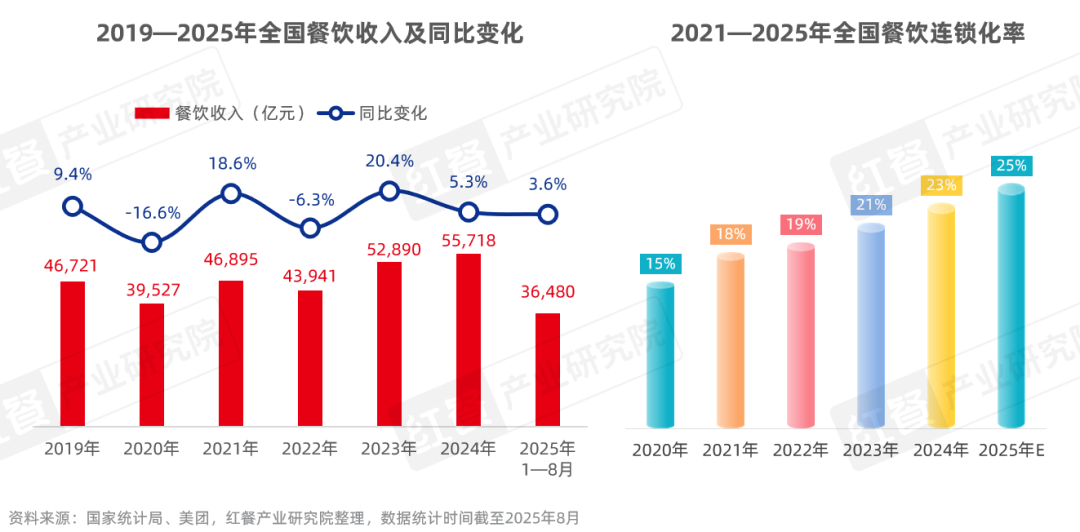
Core Insights - The restaurant industry in China is transitioning from "incremental" growth to "stock" market, facing challenges such as rising costs and declining per capita consumption prices, leading brands to focus on cost reduction and efficiency improvement [1][2][9] - The importance of the restaurant supply chain is increasingly recognized as a key driver of industry development, with a shift in the role of supply chain companies from supporters to market leaders [10][11] Industry Trends - The restaurant supply chain is becoming more refined, with a market size projected to reach 2.8 trillion yuan in 2025, reflecting an 8.1% growth from 2024 [7][9] - The chain rate in the restaurant industry has increased from 15% in 2020 to 23% in 2024, indicating a trend towards higher concentration and standardization [4] - Supply chain companies are evolving to meet the higher demands for food quality, safety, and innovation from chain brands, pushing the supply chain towards greater standardization and professionalism [4][6] Supply Chain Evolution - The supply chain is entering a 3.0 phase, where companies proactively lead market trends and develop products ahead of demand, providing comprehensive solutions to restaurant brands [9][10] - The supply chain is upgrading in five key directions: health-oriented, regional, segmented, customized, and globalized [11][24] Health-Oriented Development - There is a significant focus on health in the supply chain, with companies introducing healthier ingredients and products in response to consumer demand for food safety and health [12][14] Regional Focus - Regional specialties are becoming crucial for differentiation, with supply chain companies exploring local ingredients and flavors to meet consumer preferences [15][17] Segmentation and Customization - The trend towards segmentation is deepening, with specialized companies emerging that focus on specific products, providing tailored solutions to meet diverse brand needs [18][20] - Supply chain companies are expanding their services to include product development, menu optimization, and logistics, enhancing their value proposition to restaurant brands [21][23] Globalization and Digitalization - Supply chain companies are actively expanding into international markets, establishing production and distribution systems abroad to address challenges faced by Chinese cuisine overseas [24] - Digital tools and smart devices are driving the digital transformation of the supply chain, enhancing efficiency and precision across various operational aspects [25][27] Conclusion - The restaurant supply chain is at a pivotal moment, with opportunities for flexible customization, product innovation, and the development of "hit products" as key competitive strategies [34]