
房地产

Search documents
“十五五”规划学习体会:“十五五”规划中科技、内需、产业的细节
KAIYUAN SECURITIES· 2026-03-20 07:44
Economic Goals - The "15th Five-Year Plan" aims for GDP growth to remain within a reasonable range, targeting a doubling of per capita GDP by 2035 compared to 2020 levels, requiring an average annual growth rate of 4.17%[18] - The focus shifts from quantity to quality, with the frequency of terms like "high quality" increasing by 0.05 percentage points compared to the "14th Five-Year Plan" while terms like "construction" and "development" decreased[18] Technological Development - Emphasis on breakthroughs in basic research and the cultivation of new industrial clusters, with new industries including robotics and smart driving added to the strategic emerging industries[6] - The plan introduces 10 new "industrial tracks" aimed at fostering new economic growth points, such as commercial aerospace and low-altitude equipment[6] Consumption - The plan aims to significantly increase the resident consumption rate, which currently stands at approximately 39.6%, with a potential increase of 15-20 percentage points compared to OECD countries[38] - Measures include enhancing income distribution and social security levels to boost consumer spending, alongside optimizing service consumption experiences in areas like elderly care and childcare[7][41] Investment - Investment focus is on human capital, new infrastructure, and energy security, with a call for increased participation from private investment[8] - Specific targets include a nuclear power capacity increase from 70 million kW to 110 million kW and a tenfold increase in non-fossil energy consumption over the next decade[44] Social Welfare - The "15th Five-Year Plan" emphasizes improving the quality of services for the elderly and children, with a goal of achieving comprehensive coverage of childcare services in city-level centers[9] - The plan aims to enhance the quality of elderly care services, with a target of 70% coverage for community-based elderly care facilities[46] Environmental Goals - The plan sets a target for a cumulative reduction of 17% in carbon emissions per unit of GDP by 2030, with a compound annual reduction rate of 3.7%[49] - The implementation of a dual control system for carbon emissions will begin in 2026, transitioning from energy consumption control to carbon emissions control[49] Safety and Security - Increased focus on energy security and national defense modernization, with specific quantitative targets for energy production capacity and strategic resource management[10]
2023年中国钢铁行业研究:"反内卷"大势机遇,钢铁行业迎价值重估
Tou Bao Yan Jiu Yuan· 2026-03-11 12:09
Investment Rating - The report indicates a positive investment outlook for the steel industry, highlighting a value reassessment period driven by the "anti-involution" trend and supply-side reforms [2]. Core Insights - The Chinese steel industry is transitioning from a capacity expansion model to a focus on quality and efficiency, driven by stricter capacity replacement policies, upgraded environmental standards, and dual control of energy consumption. Leading companies are leveraging technological upgrades and product structure optimization to build differentiated advantages, which is expected to enhance profitability [2]. - The report identifies three main drivers of the steel industry's "anti-involution": policy constraints on capacity and carbon emissions management, the rise of high-end manufacturing and new energy steel demand, and low-carbon technology and product upgrades on the supply side [2]. - The report emphasizes the need for the industry to increase the scrap steel ratio to 40% and shift from construction steel to manufacturing steel, particularly in light of the real estate downturn and the growth of plate and special steel [3]. Summary by Sections Industry Overview - The steel products include pig iron, crude steel, and steel materials, categorized by chemical composition into carbon steel and alloy steel, and by form into long products, flat products, pipes, and others [6][8]. - The global steelmaking process primarily utilizes long processes (blast furnace-converter) and short processes (electric arc furnace), with the latter significantly reducing carbon emissions [11][13]. Market Dynamics - The report notes that the Chinese steel industry has seen a decline in demand due to a significant drop in real estate, with traditional sectors peaking and new sectors continuing to grow. The current supply-demand imbalance is heavily influenced by macroeconomic policies and industry self-discipline [4][36]. - The report forecasts that from 2025 to 2030, the global iron ore supply will increase while Chinese steel demand is expected to decline, leading to a significant oversupply and downward pressure on prices [25]. Production and Consumption Trends - China's crude steel production is projected to decrease from 1.035 billion tons in 2021 to 850 million tons by 2030, with an annual decline rate of 2.2%. Meanwhile, the apparent consumption is expected to drop from 995 million tons to 770 million tons during the same period [50]. - The report highlights a structural shift in steel consumption, with traditional sectors declining and new sectors, such as high-strength and specialized products, experiencing growth [41][43]. Competitive Landscape - The report outlines a concentrated market structure, with the top ten steel producers in China accounting for over 51.6% of total crude steel production in 2024. China Baowu Steel Group leads with a production of 130.09 million tons, significantly ahead of its closest competitor [32][33].




2026年政府工作报告学习体会
2026-03-09 05:18
Summary of Key Points from Conference Call Records Industry or Company Involved - The conference call records primarily discuss the macroeconomic outlook and policy directions for China, focusing on the 2026 government work report and the "14th Five-Year Plan" (14th FYP) and its implications for various industries. Core Points and Arguments 1. **GDP Growth Target for 2026**: The GDP growth target is set at 4.5% to 5%, aligning with the long-term goal of doubling per capita GDP by 2035, which requires a minimum annual growth rate of 4.73% [1][6] 2. **Fiscal Policy**: The deficit rate is proposed at 4%, with a deficit scale of 5.89 trillion yuan, marking a significant increase in public budget expenditure, which is expected to exceed 30 trillion yuan for the first time [1][12] 3. **Monetary Policy**: The monetary policy is expected to remain moderately loose, with expectations for both reserve requirement ratio (RRR) cuts and interest rate reductions, although the pace will be cautious due to constraints from bank net interest margins [1][16] 4. **PPI and Corporate Profits**: The Producer Price Index (PPI) is anticipated to turn positive in 2026, particularly in the second and third quarters, which is expected to support corporate profit improvements [1][8] 5. **Investment Focus**: The "9+6" framework emphasizes strategic industries such as integrated circuits, low-altitude economy, and future energy sources like hydrogen and nuclear fusion [1][10] 6. **Digital Economy Goals**: The core value added of the digital economy is targeted to increase from approximately 10% to 12.5% by 2025, indicating a strong commitment to advancing digital transformation [1][5] 7. **Environmental Goals**: The plan includes a commitment to reduce carbon emissions per unit of GDP by 17% during the 14th FYP period, aligning with China's carbon peak and neutrality goals [1][5] 8. **Real Estate Policy**: The government emphasizes stabilizing the real estate market through targeted measures, including inventory reduction and supply optimization [1][10][11] 9. **Capital Market Dynamics**: The capital market is shifting towards an investor-centric model, with dividends surpassing IPOs and refinancing, indicating a significant change in market dynamics [1][10] 10. **Long-term Trends in Asset Allocation**: Key trends include a gradual shift towards low-interest rates, a reallocation of household assets from physical to financial assets, and a focus on technological innovation and industrial upgrades [1][17] Other Important but Possibly Overlooked Content - The government work report serves as a critical anchor for investment decisions amid rising external uncertainties, providing clarity on policy direction and economic assessments for the year [1][3] - The emphasis on innovation and R&D investment, with a target of 7% annual growth in R&D spending, reflects a commitment to high-quality development and industrial upgrades [1][4] - The report highlights the importance of external trade dynamics, with expectations for improved trade and investment environments in 2026, despite geopolitical tensions [1][13][14]
4.5~5%——18图全观两会目标
一瑜中的· 2026-03-05 03:18
Economic Development Goals - The GDP growth target for 2025 is around 5%, with an actual value of 5% for 2026, aiming for a range of 4.5%-5% [2][4] - The urban survey unemployment rate is targeted to be controlled within 5.5% for both 2025 and 2026, with an expected addition of over 12 million urban jobs each year [16][10] - The consumer price index (CPI) target for both 2025 and 2026 is set at around 2% [5] Innovation and Technology - The average annual growth of R&D expenditure is expected to exceed 7%, with the digital economy's core industry value added accounting for 12.5% of GDP [2] - The government aims to enhance the manufacturing sector's stability and promote the development of a modern industrial system [2] Green Development - The forest coverage rate is targeted to reach 24.1%, with a focus on reducing carbon emissions by 17% per unit of GDP by 2026 [3] - The government plans to eliminate heavy pollution weather and urban black and odorous water bodies [3] Fiscal Policy - The fiscal deficit rate is proposed to be around 4% for the current year, with a deficit scale of 5.89 trillion yuan, an increase of 230 billion yuan from the previous year [8] - The total scale of new government debt is expected to reach 11.86 trillion yuan, with a significant increase in fiscal spending [12] Investment and Infrastructure - Central budget investment is planned at 755 billion yuan, with 800 billion yuan allocated for long-term special bonds to support major projects [12][19] - Local government special bonds are set at 4.4 trillion yuan for 2025, with a focus on infrastructure and debt replacement [12][11] Employment and Social Welfare - The average education level of the working-age population is targeted to increase to 11.3 years, with per capita disposable income growth synchronized with GDP growth [3][17] - The government aims to improve the medical service network and increase the proportion of nursing beds in elderly care institutions to 73% [3] Real Estate and Housing - The government emphasizes that housing is for living, not speculation, with ongoing efforts in urban affordable housing construction and rural housing renovation [25]


两会前瞻|宏观经济如何定调?机构热议年内工作“重头戏”
Bei Ke Cai Jing· 2026-02-27 10:32
Core Viewpoint - The upcoming National People's Congress (NPC) in 2026 is significant as it marks the beginning of the "14th Five-Year Plan," with a focus on expanding domestic demand and boosting consumption as primary tasks for the government this year [1][10]. Economic Growth Targets - The GDP growth target for 2026 is likely to be set between 4.5% and 5%, allowing for more flexibility in reforms [2][4]. - A cautious approach is reflected in the economic growth targets set by local governments, with 17 out of 31 provinces lowering their targets, leading to an average GDP growth target of 5%, down by 0.3 percentage points from the previous year [4][11]. Inflation and Monetary Policy - The Consumer Price Index (CPI) target is expected to remain around 2%, consistent with previous years [5]. - A more proactive fiscal policy and moderately loose monetary policy are anticipated for this year, with a potential fiscal deficit rate around 4% [6][8]. Focus on Domestic Demand and Consumption - The government’s primary task is to expand domestic demand, shifting the focus from subsidy-driven consumption to a combination of subsidies and income increases [10][12]. - Local governments are prioritizing economic stability and domestic demand, with many regions aligning their goals with the central government's economic work conference [11]. Technological Innovation and Industry Development - Promoting technological innovation and developing artificial intelligence are expected to be major focuses of government work this year, with various regions outlining specific projects in green energy, robotics, and new technologies [13]. - The modernization of the industrial system is seen as a foundation for China's modernization, with an emphasis on supporting technological innovation and optimizing traditional industries [13]. Real Estate and Carbon Neutrality - The real estate sector is under scrutiny, with policies aimed at stabilizing the market and focusing on the operation of existing properties [15][17]. - The "dual carbon" goals are a significant focus, with challenges in reducing carbon emissions highlighted, as the current trajectory may not meet the ambitious targets set for 2030 [14][18].
市场下探后持续反弹,关注A500ETF易方达(159361)、沪深300ETF易方达(510310)等产品投资价值
Sou Hu Cai Jing· 2026-02-26 11:07
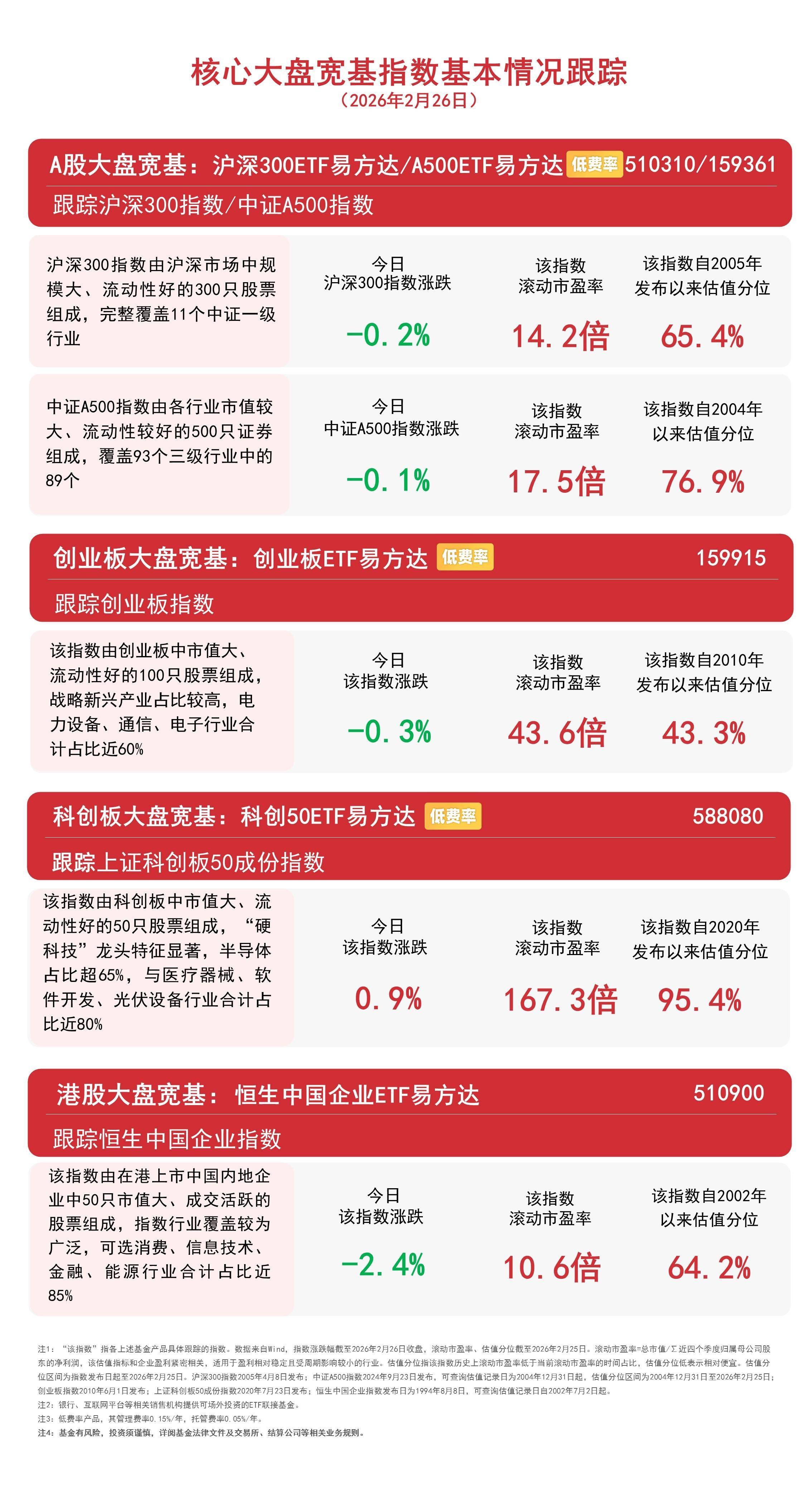
Group 1 - The A-share market experienced fluctuations on February 26, with the Shanghai Composite Index slightly declining and total market turnover exceeding 2.55 trillion yuan, an increase of over 70 billion yuan compared to the previous day [1] - In terms of sector performance, CPO, copper cable high-speed connections, optical fibers, PCBs, liquid-cooled servers, wind power equipment, aviation engines, cultivated diamonds, semiconductors, and sugar substitute concept stocks saw significant gains, while sectors such as film and television, insurance, real estate, short drama games, complete automobiles, precious metals, duty-free shops, liquor, and retail faced notable declines [1] - By the market close, the CSI A500 Index fell by 0.1%, the CSI 300 Index decreased by 0.2%, and the ChiNext Index dropped by 0.3%, while the Shanghai Stock Exchange Science and Technology Innovation Board 50 Index rose by 0.9%, and the Hang Seng China Enterprises Index declined by 2.4% [1] Group 2 - The ChiNext ETF tracks the ChiNext Index, which consists of 100 stocks from the ChiNext market that have large market capitalization and good liquidity, with a high proportion of strategic emerging industries, particularly in the power equipment, communication, and electronics sectors, which together account for nearly 60% [4] - The Science and Technology Innovation Board ETF tracks the SSE STAR 50 Index, composed of 50 stocks from the STAR Market with large market capitalization and good liquidity, characterized by "hard technology" leaders, with semiconductors accounting for over 65%, and combined with medical devices and software development, these sectors represent about 80% [4]
ETF收评 | AI硬件股全线领涨,中韩半导体ETF逼近涨停
Ge Long Hui· 2026-02-26 07:37
Market Performance - The three major A-share indices showed mixed results, with the Shanghai Composite Index down 0.01%, the Shenzhen Component Index up 0.19%, and the ChiNext Index down 0.29% [1] - The total trading volume in the Shanghai, Shenzhen, and Beijing markets reached 25,566 billion yuan, an increase of 757 billion yuan compared to the previous day, with over 2,400 stocks rising [1] Sector Performance - Leading sectors included CPO, copper cable high-speed connections, optical fibers, PCBs, liquid-cooled servers, wind power equipment, aviation engines, cultivated diamonds, semiconductors, and sugar substitute concepts, which saw significant gains [1] - Underperforming sectors included film and television, insurance, real estate, short drama games, complete automobiles, precious metals, duty-free shops, liquor, and retail, which experienced notable declines [1] ETF Performance - AI hardware stocks led the gains, with the China-Korea Semiconductor ETF nearing a limit-up, while various communication ETFs saw increases of 3.41%, 2.78%, 2.58%, and 2.54% [1] - The electric grid sector also performed well, with the electric grid ETF and electric grid equipment ETF rising by 3.23% and 2.91%, respectively [1] - The medical sector faced declines, with the Hang Seng Medical ETF and other related ETFs dropping over 3%, while the real estate ETF fell by 3% [1]
连板股追踪丨A股今日共62只个股涨停 这只化工股4连板
Di Yi Cai Jing· 2026-02-11 07:27
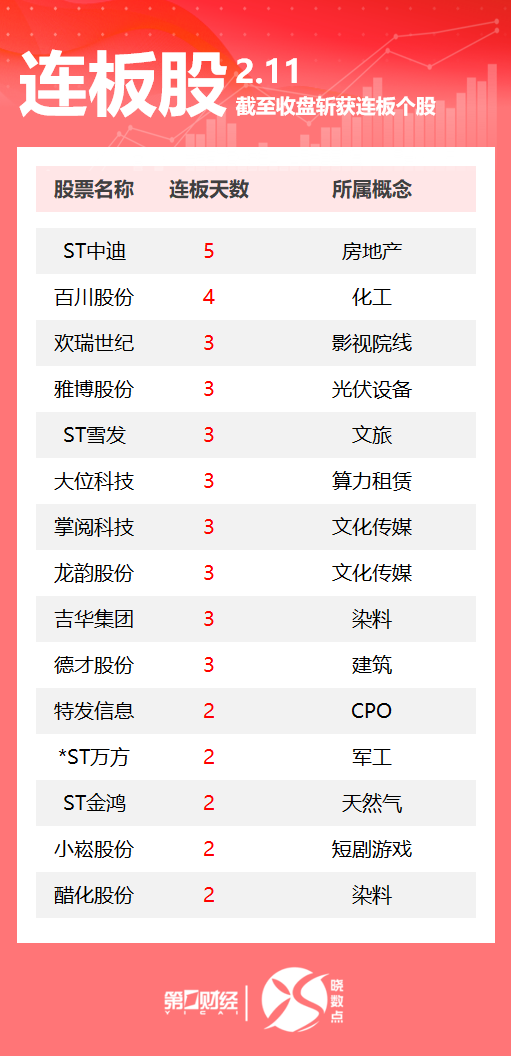
Group 1 - The A-share market saw a total of 62 stocks hitting the daily limit up on February 11, indicating strong market activity [1] - Notable stocks include Baichuan Co., which achieved a four-day limit up streak, and Huayi Brothers, which recorded a three-day limit up in the film and television sector [1][2] - Other sectors with significant performance include dye stocks, with Jihua Group also achieving a three-day limit up [1][2] Group 2 - The table lists stocks with consecutive limit up days, highlighting ST Zhongban with five days in real estate, and Mucai Co. with four days in chemicals [2] - Several companies, including Yabo Co. and ST Xuefa, recorded three consecutive limit ups in sectors such as photovoltaic equipment and cultural tourism, respectively [2] - The data reflects a diverse range of industries experiencing upward momentum, including cultural media and construction [2]
南山铝业20260209
2026-02-10 03:24
Summary of Nanshan Aluminum Industry Conference Call Company Overview - **Company Name**: Nanshan Aluminum Industry - **Industry**: Aluminum Production - **Founded**: Established in 1993, originally as Longkou Xinhua Plush Factory in July 1989 [2][3] Key Points and Arguments Industry Dynamics - The electrolytic aluminum industry is experiencing increasing prosperity, with domestic production capacity facing limitations, leading to overseas expansion opportunities [1][3] - Nanshan Aluminum has established a significant presence in Indonesia with a 4 million ton alumina production line, ensuring raw material supply [1][3][15] - Future plans include a 1 million ton electrolytic aluminum capacity in Indonesia, enhancing profitability in a high-margin environment [1][19] Financial Performance - Revenue growth from CNY 222.3 billion in 2020 to CNY 335 billion in 2024, with a CAGR of 10.7% [5] - Net profit increased from CNY 2.05 billion to CNY 4.83 billion during the same period, with a CAGR of 23.9% [5] - For the first three quarters of 2025, revenue reached CNY 26.3 billion, up 9% year-on-year, and net profit was CNY 3.77 billion, up 8% year-on-year [6] Product Segmentation - Core business segments include cold-rolled products and alumina, with cold-rolled products accounting for over 50% of revenue [6][7] - High-end product sales increased from 12.66% in 2021 to 14% in the first half of 2025, with corresponding gross margins improving from 19.89% to 23% [7] Cost Structure and Profitability - The company maintains a competitive cost structure, with alumina production costs in Indonesia significantly lower than domestic prices [9][16] - Gross margin for alumina reached 48.7% in the first half of 2025, reflecting strong operational efficiency [8][15] Shareholder Returns - Nanshan Aluminum has a strong commitment to shareholder returns, with a cumulative cash dividend of CNY 16 billion and an average payout ratio of 45% since listing [11][12] - A special dividend of CNY 2.584 per share was announced for 2025, totaling CNY 3 billion [12] Market Position and Future Outlook - The company is positioned as a leader in the aluminum industry, benefiting from both domestic and international resource advantages [32] - The global demand for aluminum, particularly in the automotive and aerospace sectors, is expected to grow, with significant opportunities in lightweight materials [22][24] - The electrolytic aluminum market is projected to face supply constraints due to limited new capacity and increasing demand from sectors like electric vehicles and energy storage [25][31] Investment Recommendation - Given the company's strong growth prospects, competitive positioning, and commitment to shareholder returns, a "Buy" rating is recommended [32] Additional Important Information - The company has engaged in multiple share buybacks, totaling CNY 1.7 billion to CNY 3.4 billion, indicating strong confidence in its market value [13] - Nanshan Aluminum's international expansion includes plans for additional electrolytic aluminum capacity in Indonesia, with a focus on sustainable energy initiatives [20][21] This summary encapsulates the key insights from the conference call regarding Nanshan Aluminum's strategic positioning, financial performance, and market outlook, providing a comprehensive overview for potential investors.

建筑材料行业投资策略周报:普通电子布涨价超预期,上海拟收购二手房用作保租房-20260208
GF SECURITIES· 2026-02-08 09:10
Core Insights - The report indicates that the price of ordinary electronic cloth has exceeded expectations, with significant price increases observed in recent months, suggesting a sustained high demand in the market [12][13] - Shanghai's initiative to purchase second-hand homes for rental purposes is expected to boost the supply of rental housing and stimulate the construction materials market [13][14] - The construction materials industry is currently at a historical valuation low, with potential for recovery as demand stabilizes and supply-side improvements take effect [23][25] Group 1: Price Trends and Market Dynamics - The price of ordinary electronic cloth has seen cumulative increases of 1-1.2 RMB/m due to supply-demand imbalances and rising copper prices, indicating a long-term bullish trend [12] - The Shanghai government has launched a program to acquire second-hand homes for rental purposes, focusing on small-sized units, which is anticipated to enhance the supply of rental properties and invigorate the construction materials sector [13] - Recent data shows a recovery in second-hand home transactions, with significant year-on-year increases, suggesting a potential rebound in the real estate market [14][15] Group 2: Industry Fundamentals and Company Performance - The construction materials sector is experiencing a bottoming out phase, with various sub-sectors like cement and fiberglass showing signs of recovery, supported by supply-side adjustments and improved market conditions [23][25] - The report highlights that leading companies in the consumer building materials segment are demonstrating resilience, with improved revenue growth rates compared to the overall market, indicating strong operational capabilities [29] - Cement prices have recently decreased by 1%, but the overall market is expected to stabilize as companies implement price control measures and benefit from lower coal costs [25][26] Group 3: Investment Opportunities - The report suggests focusing on leading companies in the consumer building materials sector, such as Three Trees, Rabbit Baby, and Oriental Yuhong, which are well-positioned to benefit from the ongoing market recovery [23][25] - In the cement industry, companies like Huaxin Cement and Conch Cement are highlighted as potential investment opportunities due to their strong market positions and historical performance [25][26] - The fiberglass sector is also noted for its growth potential, with leading firms like China Jushi and Zhongtai Technology expected to capitalize on increasing demand for high-end electronic cloth [26][28]


