昊海生科

Search documents
【前瞻分析】2025年生物医用材料行业区域、企业竞争分析
Sou Hu Cai Jing· 2025-09-03 10:15
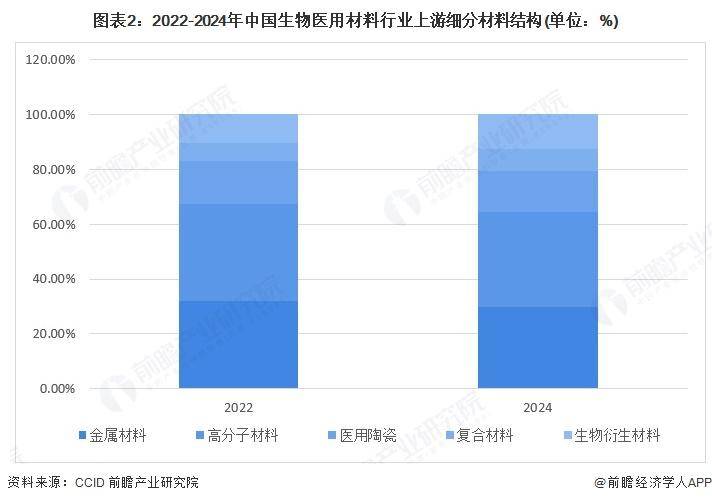
Industry Overview - In 2022, the structure of the upstream materials in China's biomedical materials industry showed a high proportion of metal and polymer materials. By 2024, composite materials and bio-derived materials are expected to gain market share due to advancements in 3D printing technology and increased demand in the medical aesthetics sector, while metal materials, polymer materials, and medical ceramics may see slight declines in market share due to substitution effects and market competition [1][2]. Competitive Landscape - The competitive landscape of the biomedical materials industry can be divided into three tiers based on revenue: - Tier 1 companies have revenues exceeding 2 billion yuan, including companies like Lepu Medical, Haohai Biological, and Dabo Medical. - Tier 2 companies have revenues between 1 billion and 2 billion yuan, represented by Weigao Orthopedics, Xinmai Medical, and Blue Sail Medical. - Tier 3 companies have revenues below 1 billion yuan, including Guoci Materials, Bairen Medical, and Zhenghai Biological [3][6]. Business Layout Comparison - Companies such as Aojing Medical, Weigao Orthopedics, and Haohai Biological derive nearly 100% of their revenue from biomedical materials, while others have a relatively low proportion of revenue from this segment [5][6]. Business Planning and Innovation - The business planning in the biomedical materials sector is characterized by diversification, focusing on technological innovation, market expansion, and industry chain integration. Leading companies are investing in R&D and international expansion, while smaller firms are seeking breakthroughs through differentiated technologies such as regenerative medicine and 3D printing. Future competitive cores are expected to revolve around biodegradable materials, smart devices, and precision medicine [7][9]. Company-Specific Strategies - Guoci Materials focuses on new material platforms, achieving a 70% market share in nano-alumina materials for dental implants and high-end aesthetic restorations, with products entering over 20 countries [9]. - Aojing Medical specializes in regenerative repair implants, with products widely used in various surgical fields and a strong international market presence [9]. - Weigao Orthopedics is adjusting its business model to address procurement policies and is expanding into new fields such as minimally invasive spine and arthroscopic surgery [10]. - Lepu Medical's core business is cardiovascular intervention materials, with products like the NeoVas bioabsorbable stent and MemoSorb® fully degradable occluders [10]. - Xinmai Medical is focusing on drug-coated stents and has entered special review channels for innovative medical devices [10]. Revenue and Market Share Insights - The revenue of key companies in the biomedical materials sector varies significantly, with Weigao Orthopedics reporting 14.51 billion yuan from its orthopedic materials, representing 100% of its total revenue [6]. - Lepu Medical generated 33.27 billion yuan from cardiovascular system materials, accounting for 54.51% of its total revenue [6]. Future Trends - The industry is expected to see increased emphasis on biodegradable materials and smart medical devices, driven by policy support and technological advancements [7].


昊海生科(688366) - H股公告:截至二零二五年八月三十一日止月份股份发行人的证券变动月报表
2025-09-03 09:45
FF301 股份發行人及根據《上市規則》第十九B章上市的香港預託證券發行人的證券變動月報表 截至月份: 2025年8月31日 狀態: 新提交 致:香港交易及結算所有限公司 | | | 備註: 第 1 頁 共 11 頁 v 1.1.1 公司名稱: 上海昊海生物科技股份有限公司 (「本公司」)(於中華人民共和國註冊成立的股份有限公司) 呈交日期: 2025年9月3日 I. 法定/註冊股本變動 1. 股份分類 普通股 股份類別 H 於香港聯交所上市 (註1) 是 證券代號 (如上市) 06826 說明 H股 法定/註冊股份數目 面值 法定/註冊股本 上月底結存 38,529,240 RMB 1 RMB 38,529,240 增加 / 減少 (-) 0 RMB 0 本月底結存 38,529,240 RMB 1 RMB 38,529,240 | 2. 股份分類 | 普通股 | 股份類別 | A | | 於香港聯交所上市 (註1) | | 否 | | | --- | --- | --- | --- | --- | --- | --- | --- | --- | | 證券代號 (如上市) | N/A | 說明 | | A股 ...
从“规模扩张”到“价值深耕” 医美行业重塑竞争格局
2 1 Shi Ji Jing Ji Bao Dao· 2025-09-02 10:15
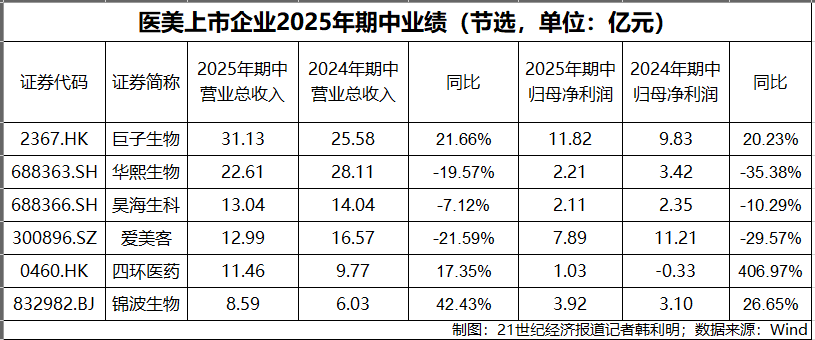
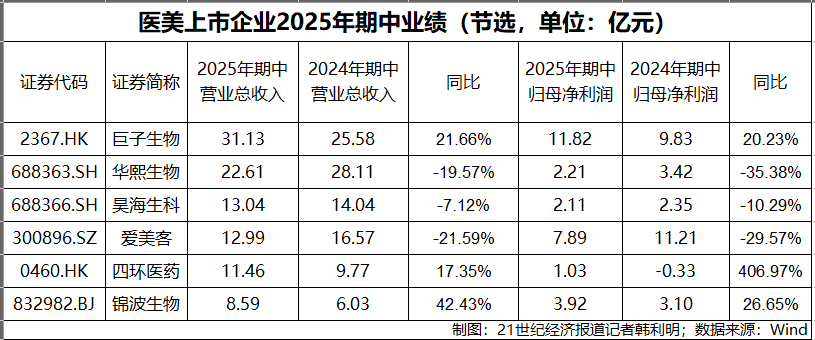
Core Viewpoint - The performance of listed medical beauty companies in China shows significant divergence in the first half of 2025, with major players in the hyaluronic acid market facing growth bottlenecks, while companies in the recombinant collagen segment are experiencing substantial growth [1][2][7]. Group 1: Performance of Major Companies - Huaxi Biological reported revenue of 2.261 billion yuan, a year-on-year decline of 19.57%, and a net profit of 221 million yuan, down 35.38% [1][2]. - Haohai Biological achieved revenue of 1.304 billion yuan, a decrease of 7.12%, with a net profit of 211 million yuan, down 10.29% [1][2]. - Aimeike's revenue was 1.299 billion yuan, down 21.59%, with a net profit of 789 million yuan, a decline of 29.57% [1][2]. - In contrast, Jinbo Biological, the first stock of recombinant collagen on the Beijing Stock Exchange, reported revenue of 859 million yuan, an increase of 42.43%, and a net profit of 392 million yuan, up 26.65% [1][2]. - Giant Biological's revenue reached 3.113 billion yuan, a year-on-year increase of 21.66%, with a net profit of 1.182 billion yuan, up 20.23% [1][2]. Group 2: Market Trends and Competition - The medical beauty market in China has seen rapid growth, with the market size increasing from 99.3 billion yuan in 2017 to 189.2 billion yuan in 2021, reflecting a compound annual growth rate of 17.5% [4]. - The competition in the hyaluronic acid sector has intensified, leading to price reductions and impacting the performance of leading companies [4][6]. - The demand for aesthetic products is evolving, with a shift towards user-oriented solutions and a growing emphasis on product innovation and technology [3][7]. Group 3: Strategic Adjustments and Innovations - Huaxi Biological is shifting its marketing strategy to focus on brand building and consumer engagement through platforms like Xiaohongshu and WeChat, moving away from price-driven promotions [5]. - Haohai Biological is also adapting its product offerings, with new high-end hyaluronic acid products showing promising market performance [6]. - The recombinant collagen market is projected to grow significantly, with estimates suggesting it will reach 585.7 billion yuan by 2025, driven by new product launches and market expansion [8][9]. Group 4: Regulatory and International Expansion - The medical beauty industry is witnessing an increase in compliant products, with several companies obtaining third-class medical device registration certificates, enhancing market offerings [10][11]. - Companies like Huaxi Biological and Haohai Biological are actively pursuing international markets, with Huaxi reporting significant revenue from overseas operations [11][12]. - Aimeike's acquisition of a majority stake in a South Korean company highlights the trend of domestic firms expanding their global footprint [12].

从“规模扩张”到“价值深耕”,医美行业重塑竞争格局
2 1 Shi Ji Jing Ji Bao Dao· 2025-09-02 10:09
Core Viewpoint - The performance of listed medical beauty companies in China shows significant divergence in the first half of 2025, with major players in the hyaluronic acid market facing growth bottlenecks while companies in the collagen reconstruction sector are experiencing substantial growth [1][2]. Group 1: Performance of Major Companies - Huaxi Biological reported revenue of 2.261 billion yuan, a year-on-year decline of 19.57%, and a net profit of 221 million yuan, down 35.38% [2]. - Haohai Biological achieved revenue of 1.304 billion yuan, a decrease of 7.12%, with a net profit of 211 million yuan, down 10.29% [2]. - Aimeike's revenue was 1.299 billion yuan, down 21.59%, with a net profit of 789 million yuan, a decline of 29.57% [2]. - In contrast, Jinbo Biological, the first stock of collagen reconstruction on the Beijing Stock Exchange, reported revenue of 859 million yuan, an increase of 42.43%, and a net profit of 392 million yuan, up 26.65% [1][2]. Group 2: Market Dynamics - The medical beauty industry is undergoing a transformation driven by increasing aesthetic demands and technological upgrades, necessitating higher core technology and product innovation capabilities from companies [3]. - The competition in the hyaluronic acid sector has intensified, with a significant increase in supply and aggressive pricing strategies from downstream medical beauty institutions [4]. - The market for collagen reconstruction products is rapidly growing, with projections indicating a compound annual growth rate of 44.93%, reaching 585.7 billion yuan by 2025 [9][10]. Group 3: Strategic Adjustments - Companies like Huaxi Biological are shifting from a traffic-driven sales model to a brand communication strategy based on scientific validation, aiming to enhance brand efficacy and customer acquisition [5][6]. - Haohai Biological is focusing on high-end hyaluronic acid products, with the "Haimeiyuebai" product showing promising market performance despite overall revenue declines in its hyaluronic acid segment [7]. - Aimeike acknowledges the shift towards a user-oriented market, emphasizing the importance of product innovation and systematized competition [8]. Group 4: Regulatory and International Expansion - The medical beauty industry is witnessing an increase in compliant products, with several companies obtaining third-class medical device registration certificates, enhancing market options [11][12]. - Companies are actively pursuing international markets, with Huaxi Biological reporting 331 million yuan in international raw material business revenue, accounting for 52.93% of its raw material income [12][13]. - Aimeike's acquisition of a majority stake in a South Korean company marks its strategic entry into the global regenerative injection market [13].
2025年中国生物医用材料上游市场现状分析 金属和高分子材料应用更广【组图】
Qian Zhan Wang· 2025-09-02 08:30
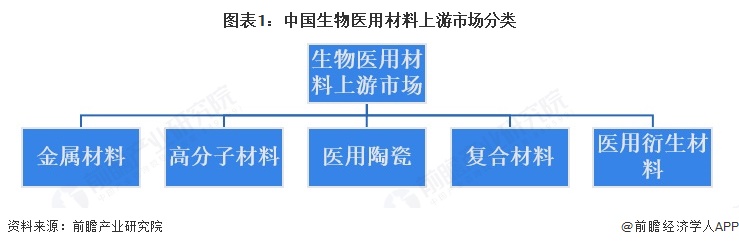
Core Viewpoint - The article discusses the current state and future trends of the biomedical materials industry in China, highlighting the competitive landscape and the significance of various material types in the market [1][3]. Group 1: Industry Overview - The biomedical materials industry is categorized into five main types: metal materials, polymer materials, medical ceramics, composite materials, and medical-derived materials [1]. - In 2022, metal and polymer materials held a significant share in the biomedical materials market, while composite and bio-derived materials are expected to gain market share due to technological advancements and increased demand in the medical aesthetics sector [3]. Group 2: Innovation and Competitiveness - The Ministry of Industry and Information Technology and the National Medical Products Administration have initiated a collaborative innovation task for biomedical materials, with a notable number of polymer material companies leading in the selection of innovation tasks [6]. - Companies from Beijing and Shandong provinces have shown strong competitiveness, as they have the highest number of selected units in the first batch of innovation tasks [7]. Group 3: Market Development Trends - The development trends for various types of biomedical materials in China are as follows: - Metal materials are focusing on high-strength, low-modulus, bioactive modifications, and biodegradable alloys to enhance long-term compatibility of implants and reduce the need for secondary surgeries [13]. - Polymer materials are evolving towards high functionality, smart responsive designs, and biodegradable controls to meet the precise needs of medical applications [13]. - Medical ceramics are enhancing bioactivity, nanoscale modifications, and optimizing porous structures for complex tissue engineering applications [13]. - Composite materials are centered on low-cost mass production and high-performance multifunctional integration for advanced medical devices [13]. - Medical-derived materials are transitioning from passive repair to active induction through intelligent regeneration systems, integrating personalized medicine and tissue regeneration technologies [13].
上半年业绩增速放缓,本土美妆老大珀莱雅筹划港股上市
Di Yi Cai Jing· 2025-08-26 13:28
Group 1 - The beauty industry in China is experiencing a capital acceleration process since 2025, despite challenges in the first half of the year [1][2] - Proya (603605.SH) reported a revenue of 5.362 billion yuan, a year-on-year increase of 7.21%, and a net profit of 799 million yuan, up 13.80% [1] - The growth rate of Proya's performance has slowed compared to the previous year, where revenue and net profit growth were around 40% [1] Group 2 - The retail sales of cosmetics in China reached 229.1 billion yuan in the first half of the year, with a year-on-year growth of 2.9%, lower than the 5% increase in total retail sales [1] - Other beauty companies reported mixed results, with Shanghai Jahwa (600315.SH) achieving a revenue of 3.48 billion yuan (up 4.8%) and a net profit of 270 million yuan (up 11.7%), while Haohai Biological (688366.SH) saw a revenue decline of 7.12% [2] - Proya is planning to issue H-shares and list on the Hong Kong Stock Exchange, potentially becoming the only domestic beauty brand listed in both markets [2][3] Group 3 - The capital market has shown increased interest in domestic beauty companies, with successful IPOs like Maogeping (01318.HK) which saw a significant stock price increase after its listing [3] - The trend of domestic beauty brands seeking to go public in Hong Kong has accelerated, with brands like Lin Qingxuan and Ying Tong also pursuing listings [3]

2025年中国生物医药材料中游产品市场现状——骨科关节耗材 国内厂商集采优势明显【组图】
Qian Zhan Wang· 2025-08-26 04:09
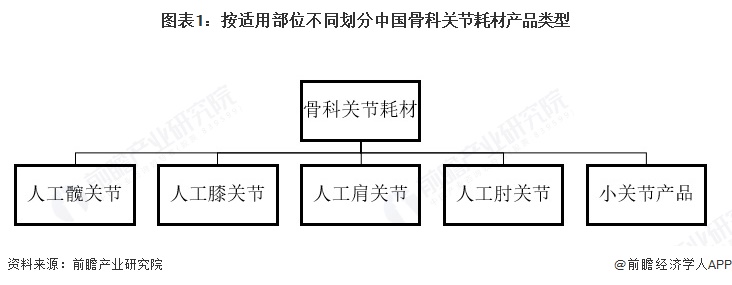
转自:前瞻产业研究院 行业主要上市公司:国瓷材料(300285.SZ)、威高骨科(688161.SH)、昊海生科(688366.SH)、乐普医疗 (300003.SZ)、蓝帆医疗(002382.SZ)、心脉医疗(688016.SH)等 本文核心数据:市场规模;集采现状 1、定义及分类 骨科关节耗材按照适用部位的不同,可以分为人工髋关节、人工膝关节、人工肩关节以及人工肘关节,此 外,还有较少的小关节产品,例如指关节、踝关节等。 2、骨科关节置换手术量逐年攀升 随着中国老龄人口数量的增加、生活压力增加等因素影响,近年来中国骨科关节相关疾病的患者数量不断增 加,骨科关节置换手术量近年来呈现快速上升趋势,2024年中国骨科关节置换手术量为244万台,同比上涨 22%。 3、2024年市场规模达到173亿元 在我国集采政策的推动下,我国骨科关节耗材价格下滑,使得消费数量不断提升;同时,随着我国老龄人口 数量的增加以及骨科疾病患者数量的上升,带动我国骨科关节耗材需求量持续上升。根据《中国医疗器械蓝 皮书》、国家医疗器械计量中心披露的数据显示,2019年中国骨科关节耗材行业市场规模为86亿元,2024年 达到173亿元,5 ...
昊海生科营利双降,两大主营业务均下滑
Xin Lang Cai Jing· 2025-08-26 01:12
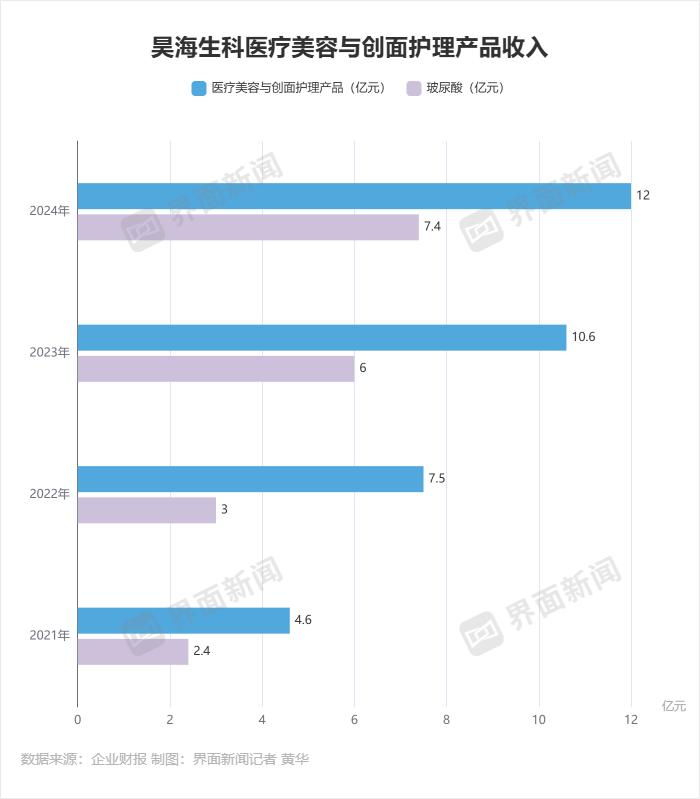
Group 1 - The core viewpoint of the article is that Haohai Biological's revenue and net profit have declined in the first half of 2025, indicating challenges in its key business segments, particularly in medical aesthetics and ophthalmology [1][2][3] - The company reported a revenue of 1.304 billion yuan, a year-on-year decrease of 7.12%, and a net profit attributable to shareholders of 211 million yuan, down 10.29% [1][2] - The main product segments, including medical aesthetics, ophthalmology, and orthopedics, all experienced revenue declines, with medical aesthetics generating 575 million yuan, down 9.31%, ophthalmology 368 million yuan, down 18.61%, and orthopedics 227 million yuan, down 2.58% [2][3] Group 2 - The decline in the hyaluronic acid business is attributed to changes in VAT rates affecting sales revenue and weak sales of entry-level products, which have not sustained their market advantage for nearly a decade [3][4] - The company’s high-end products, such as the third-generation and fourth-generation hyaluronic acid series, are performing well, but the overall medical aesthetics business may face negative growth for the first time this year [5][6] - The ophthalmology segment has seen significant revenue drops, particularly in cataract surgery products, which fell by 28.76%, largely due to national medical cost control policies [6][7] Group 3 - The company is actively responding to declining performance by focusing on high-end products and has seen a 73.82% increase in sales of mid-range pre-filled non-spherical products [9][10] - The competitive landscape in the medical aesthetics market is challenging, with several leading companies reporting similar revenue declines, indicating a broader industry adjustment [5][6] - The strategic shift towards mid-to-high-end products is seen as an opportunity, but the company faces challenges in product development and market penetration due to strong competition from imported brands [9][10]
爱美客(300896)2025年半年报业绩点评报告:H1业绩短期承压 产品高毛利与研发储备夯实长期竞争
Xin Lang Cai Jing· 2025-08-25 00:43
Core Viewpoint - Despite short-term performance pressure, high-margin products and increased R&D investment solidify long-term competitiveness [2] Financial Performance - In the first half of 2025, total revenue was 1.299 billion yuan, a year-on-year decrease of 21.59%; net profit attributable to shareholders was 790 million yuan, down 29.57% year-on-year [1] - Operating cash flow net amount decreased by 43.06% year-on-year due to the decline in net profit and changes in working capital [1] - Revenue from core injection products, "solution" and "gel" categories, fell by over 23%, indicating pressure on market demand or sales [2] - Operating costs increased slightly by 1.2%, while gross margin remained above 90%, indicating strong profitability [2] - Financial expenses rose by 121.63%, primarily due to foreign currency investment exchange losses [2] R&D and Product Pipeline - R&D investment in the first half of 2025 was 157 million yuan, accounting for 12.05% of revenue, with 182 authorized patents [3] - The company has successfully commercialized several skin fillers and is advancing the development of recombinant proteins and peptides [3] - The existing product pipeline includes 12 Class III medical devices and ongoing research on products like type A botulinum toxin and semaglutide injection [3] Strategic Initiatives - On March 10, the company announced the acquisition of 85% of Korean REGEN for 190 million USD, enhancing its international presence and resource integration [2] - This acquisition is expected to inject new momentum into the company's performance growth by accelerating internationalization [2] Profit Forecast and Investment Rating - Revenue forecasts for 2025-2027 have been adjusted to 2.723 billion yuan, 3.126 billion yuan, and 3.548 billion yuan, down from previous estimates [4] - Net profit forecasts for the same period are now 1.768 billion yuan, 1.952 billion yuan, and 2.246 billion yuan, also revised down from earlier projections [4] - The company's projected PE ratios for 2025-2027 are 31.0, 28.1, and 24.4 times, respectively [4] - The company maintains a "buy" rating based on steady growth in its main business and ongoing investment in innovative product development [4]
【投资视角】启示2025:中国医疗美容行业投融资及兼并重组分析(附投融资事件、产业基金和兼并重组等)
Qian Zhan Wang· 2025-08-24 01:13
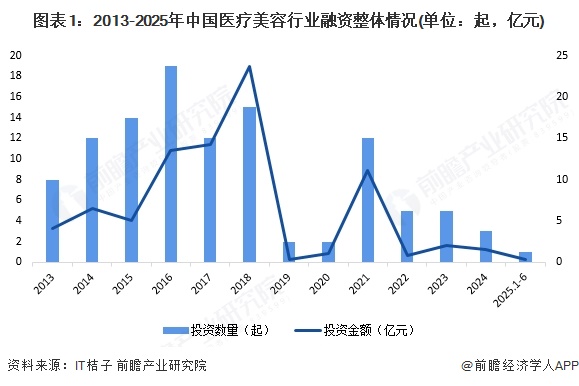
Group 1 - The core viewpoint of the article highlights the fluctuating investment and financing trends in China's medical beauty industry, with a peak in 2016 and a decline thereafter [1][17] - Investment events peaked in 2016 with 19 occurrences and an investment amount of 1.353 billion RMB, while the highest investment amount was recorded in 2018 at 2.374 billion RMB [1] - By 2024, only 3 investment events occurred with a total investment of 150 million RMB, and as of June 5, 2025, only 1 event with an investment of 30 million RMB was reported [1] Group 2 - The majority of investment rounds in the medical beauty industry are concentrated in early stages, particularly angel and A-round financing [2] - The industry encompasses various fields such as medical beauty raw materials, equipment, and service platforms, indicating strong innovation and technical barriers [2] Group 3 - Investment activities are primarily concentrated in Beijing and Guangdong, with 49 and 23 financing events respectively, followed by Sichuan and Shanghai with 12 and 9 events [4] - The focus on these regions is attributed to the concentration of resources and opportunities in the medical beauty sector [4] Group 4 - The investment direction is primarily focused on the construction of medical beauty platforms [6] Group 5 - The main investment entities in the medical beauty industry are capital organizations, accounting for 73% of the total, while industrial entities like Gree Electric and Xiaomi Group make up 27% [5] Group 6 - There are few industry investment funds specifically targeting medical beauty, with only 2 private funds identified [13] Group 7 - Recent years have seen a trend of horizontal acquisitions among midstream enterprises in the medical beauty industry as a means to expand scale [15] - Notable acquisition events include 康哲药业 acquiring 旭俐医疗 with a 100% stake and 新氧 acquiring 奇致激光 [16] Group 8 - Overall, the investment and financing landscape in China's medical beauty industry has shown fluctuations, with a concentration of activities in Beijing and Guangdong, primarily driven by capital investment institutions [17]