Lumentum Holdings Inc.

Search documents
硬件与网络_AI 需求向数据中心外拓展,带来跨规模与多链路机遇;预计总潜在市场规模超 100 亿美元-Hardware & Networking_ AI Demand Expanding Outside the DC with Scale-Across and Multi-Rail Opportunities; Estimate $10 bn+ TAM
2025-12-08 15:36
Summary of J.P. Morgan Research on AI Data Center Opportunities Industry Overview - The report discusses the expanding demand for AI data centers and the associated networking technologies, particularly focusing on the data center interconnect (DCI) market, which is estimated to have a total addressable market (TAM) of over $10 billion [1][13]. Key Concepts - **Scale-Up**: Refers to XPU-to-XPU connectivity within a tightly coupled node or local cluster. - **Scale-Out**: Involves the fabric linking multiple nodes across racks and pods within a single data center. - **Scale-Across**: Focuses on enabling distributed training between geographically separated data centers. - **Multi-Rail**: Increases fiber density to expand DCI capacity and support new use cases [1]. Market Opportunities - The report estimates that Scale-Across and Multi-Rail opportunities could represent a combined TAM of over $10 billion for the DCI market, matching the current DCI TAM [1]. - A specific example of Scale-Across involves a U.S. hyperscaler interconnecting two data centers over approximately 100 km, enabling 20-25 Pb/s of aggregate AI training traffic [5][7]. Financial Projections - The DCI content for Scale-Across opportunities could range from $300 million to $500 million per DCI connection, excluding optical fiber cable and connectors [11]. - The revenue opportunity per DCI connection is broken down as follows: - **Coherent Pluggable Modules**: 55,000 units at an ASP of $4,000 to $6,000. - **Reconfigurable Line Systems (RLS)**: 860 units at an ASP of $20,000 to $50,000. - **Ethernet Switches**: 1,720 units at an ASP of $700 to $1,000 [11][12]. Company Positioning - Companies best positioned for the DCI opportunity include: - **Networking**: Arista and Cisco. - **Optical**: Ciena, Coherent, Corning, Fabrinet, and Lumentum [15]. Infrastructure Challenges - Increasing fiber density requirements are driving the need for innovation in existing infrastructure rather than simply adding more equipment [17]. - Traditional in-line amplifier (ILA) huts are becoming bottlenecks due to their limited capacity, necessitating the development of multi-rail technology to increase fiber pair capacity from 16 to 128 or even 256 pairs [23][33]. Future Projections - Lumen's ambitious plan to expand its network fiber miles from 12 million in 2022 to 47 million by 2028 could represent a significant opportunity, with an estimated total revenue opportunity of $200 million to $300 million for the incremental Lumen opportunity alone [29][33]. Conclusion - The report highlights significant growth potential in the AI data center market, driven by technological advancements and increasing demand for high-capacity interconnect solutions. Companies involved in networking and optical technologies are well-positioned to capitalize on these emerging opportunities [1][15].




结账信号?
Datayes· 2025-12-08 11:21
Core Viewpoint - The recent Central Political Bureau meeting emphasizes a focus on economic development, with a commitment to maintaining macroeconomic policy continuity and prioritizing domestic demand expansion. The expected economic growth target for next year is around 5% [3][5]. Summary by Sections Economic Outlook - The meeting highlighted the importance of achieving "qualitative effective improvement and reasonable quantitative growth" in the economy, indicating a potential downward adjustment of growth targets for the coming year [3][4]. - The phrase "cross-cycle" was reiterated, but the previous term "extraordinary" was removed, suggesting a more cautious approach to large-scale stimulus measures [3][4]. Policy Directions - The meeting called for a more proactive fiscal policy and moderately loose monetary policy, emphasizing the need for synergy between existing and new policies [5][4]. - There is a strong focus on stabilizing employment, with the meeting stating that employment stability is a top priority [3][4]. Trade and External Relations - The meeting acknowledged the need to balance domestic economic work with "international economic and trade struggles," reflecting ongoing vigilance regarding potential trade conflicts, particularly with the U.S. [5][4]. - Despite a temporary pause in U.S.-China tariff disputes, the decision-makers remain cautious about future trade tensions, especially as China's trade surplus exceeds $1 trillion [5]. Sector Performance - Recent export data showed a 5.9% increase in November, surpassing previous values and forecasts, indicating a diversification of exports to non-U.S. markets [6]. - The electronics sector, particularly companies involved in optical communication and robotics, has seen significant activity, with stocks like Lumentum and related firms experiencing price increases due to strong demand [11][21]. Investment Trends - The A-share market has shown positive momentum, with major indices rising and significant trading volumes reported, indicating renewed investor confidence [11][13]. - Key sectors such as robotics, storage, and aerospace are gaining traction, with notable investments and project developments reported [18][19][21]. Financial Market Dynamics - The net inflow of capital into the electronic sector has been substantial, with specific stocks like Tianfu Communication and New Yisheng leading the gains [23][27]. - The overall market sentiment remains cautious, with certain sectors like pharmaceuticals and food and beverage experiencing outflows [31][23].





研报 | AI数据中心引爆光通信激光缺货潮,英伟达策略性布局重塑激光供应链格局
TrendForce集邦· 2025-12-08 09:07
Core Insights - The article highlights the critical role of high-speed interconnect technology in the performance and scalability of AI data centers, with a significant increase in demand for 800G optical transceiver modules projected to reach 24 million units in 2025 and nearly 63 million units by 2026, representing a growth of 2.6 times [2]. Supply Chain Dynamics - The demand for 800G optical transceiver modules has created a severe supply bottleneck at the upstream laser source level, particularly due to Nvidia's strategic monopoly on EML laser chip suppliers, leading to delivery times extending to 2027 [2][3]. - Major suppliers of EML lasers include Lumentum, Coherent, Mitsubishi, Sumitomo, and Broadcom, with the complexity and high production barriers limiting the number of global suppliers [3]. Technology Trends - EML lasers are becoming essential for long-distance transmission due to their ability to maintain signal stability over longer distances, while Nvidia's slow progress in silicon photonics production necessitates reliance on pluggable optical transceiver modules to meet GPU cluster demands [3]. - In contrast, CW (Continuous Wave) lasers, which do not integrate modulation functions within the laser chip, are gaining traction among cloud service providers as a substitute for EML lasers due to their simpler structure and lower production barriers [5]. Market Competition - The production capacity for CW lasers is also constrained by equipment delivery times, making it challenging to meet the high demand driven by AI applications [5]. - The shortage of EML lasers has prompted many laser manufacturers to outsource the back-end processes of laser chip cutting and aging tests to other firms, tightening the overall laser supply chain and leading to expansion plans among laser suppliers [5]. High-Speed PD Demand - The demand for high-speed photodiodes (PD) is rising alongside the need for faster laser sources, with companies like Coherent, Macom, and Broadcom developing 200G PDs to match the transmission speeds of new laser technologies [6]. - Laser manufacturers are prioritizing their crystal growth capacity for laser sources while outsourcing INP crystal growth to specialized foundries to manage production effectively [6]. Industry Implications - The article concludes that the significant demand from AI is not only causing shortages in memory but also tightening the supply of lasers, with Nvidia's monopoly accelerating the adoption of CW lasers and silicon photonics technology among non-Nvidia players [7]. - This capacity competition is reshaping the supply chain dynamics, providing growth momentum for suppliers with advanced compound semiconductor crystal growth and processing capabilities [7].

OCS光交换机:AI算力集群时代的新蓝海 | 投研报告
Zhong Guo Neng Yuan Wang· 2025-12-08 08:09
Core Insights - The global OCS (Optical Circuit Switch) market is projected to grow from $0.7 billion in 2020 to $7.8 billion by 2025, with a compound annual growth rate (CAGR) of 62%, and is expected to reach $20.2 billion by 2031, with a CAGR of approximately 17.2% from 2025 to 2031 [1][2] Market Overview - The OCS market is currently concentrated, with the top four manufacturers expected to hold about 69% of the market share by 2025, with major players including Google and Coherent [1][2] - The OCS industry chain consists of upstream core components, midstream equipment integration, and downstream applications, with high technical barriers and many participants concentrated in single segments [2] Technical Advantages - OCS technology is ideal for AI model training due to its high bandwidth, low latency, and low power consumption, making it a preferred solution for interconnectivity [1] - OCS operates without the need for optical-electrical conversion and packet processing, providing advantages in reliability and hardware longevity [1] Application Scenarios - OCS is primarily applied in three scenarios within AI computing clusters: Scale-Up (enhancing single-node performance), Scale-Out (multi-node collaboration), and Scale-Across (interconnecting data centers) [1] - For instance, a Google TPU cluster with 4096 TPU v4 chips requires 48 OCS switches, demonstrating an 85:1 ratio of TPU to OCS, which improves to 192:1 with future expansions [1] Company Focus - Yingtang Zhikong is expanding from electronic component distribution to semiconductor design and manufacturing, planning to acquire Guilin Guanglong Integration by 2025 to strengthen its OCS capabilities [3] - Saiwei Electronics, a leader in MEMS technology, is set to begin mass production of MEMS-OCS in 2023, with a significant portion of its revenue (83%) coming from MEMS business, indicating strong growth potential in the AI computing sector [3]


OpenAI faces investor skepticism as Alphabet emerges as AI leader
BusinessLine· 2025-12-08 04:28
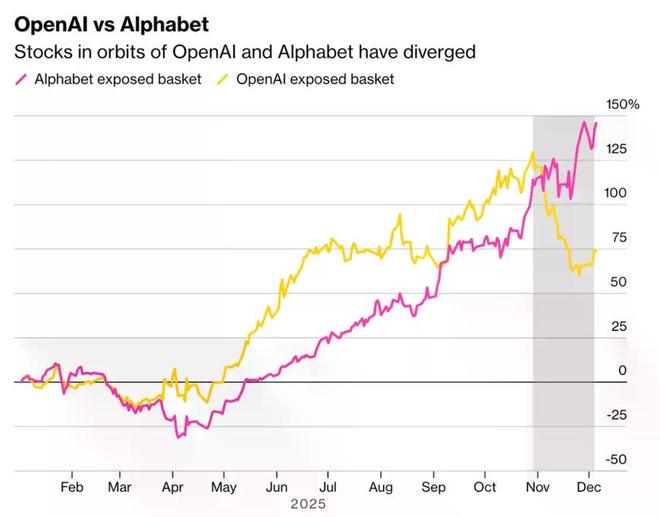
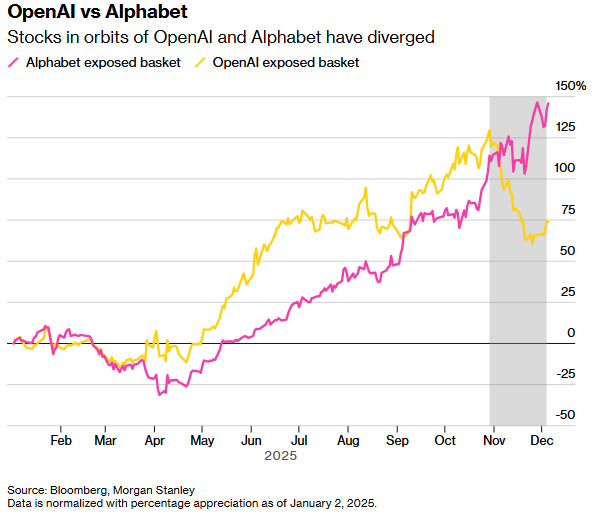
Core Insights - Wall Street's sentiment is shifting from OpenAI to Alphabet Inc., with OpenAI facing profitability concerns while Alphabet is seen as a strong competitor in AI [1][2][3] Company Performance - OpenAI's stock is under heavy selling pressure, affecting associated companies like Oracle, CoreWeave, and AMD, while Alphabet's stock is rising, benefiting companies like Broadcom and Lumentum [2][9] - OpenAI's associated companies saw a 74% gain in 2025, but Alphabet-exposed stocks surged by 146% [4] Market Dynamics - The rapid change in sentiment towards OpenAI has significant implications for the AI sector, which has been a major driver of the stock market's rally [3][10] - Alphabet's market capitalization is among the highest in the S&P 500, with substantial cash reserves and a diverse business portfolio, enhancing its competitive position [6][7] Competitive Landscape - There is a growing belief that Alphabet is positioned to become the leading AI model builder, a title that was previously attributed to OpenAI [7] - OpenAI's recent struggles, including mixed reactions to its GPT-5 and the success of Alphabet's Gemini AI, have raised doubts about its future [5][10] Financial Concerns - OpenAI's ambitious spending plans, estimated to exceed $207 billion by 2033, have led to skepticism about its ability to generate sufficient revenue [13][14] - Analysts suggest that OpenAI needs to improve revenue, manage costs better, or seek additional capital to close the financial gap [14] Investment Sentiment - Investors are becoming more cautious, shifting from a bullish outlook on tech to skepticism, particularly regarding companies associated with OpenAI [11][12] - Despite the current weakness in stocks tied to OpenAI, some analysts see potential buying opportunities as these stocks trade at a discount compared to those linked to Alphabet [15] Future Outlook - There is optimism about untapped demand across industries, which could support growth for companies involved in AI, as long as they focus on monetization [16]

OpenAI光环褪去 彭博:它已从股市救星沦为负担
Jin Rong Jie· 2025-12-08 01:12
Core Viewpoint - The perception of AI-related companies on Wall Street is shifting, with OpenAI facing skepticism regarding its profitability and growth, while Alphabet is gaining favor due to its strong financial position and diverse AI-related ventures [1][2]. Group 1: OpenAI's Challenges - OpenAI is no longer seen as the leading representative of AI technology and is under pressure due to insufficient profitability and the need for rapid expansion to manage high expenses [1][2]. - The stock prices of companies within the OpenAI ecosystem, such as Oracle, CoreWeave, and AMD, are experiencing significant sell-off pressure [1]. - OpenAI's stock performance has lagged behind Alphabet's, with related companies seeing a cumulative stock price increase of 74% since 2025, compared to Alphabet's 146% increase [5]. Group 2: Alphabet's Strengths - Alphabet's resurgence is attributed to its substantial financial resources and its extensive involvement in various AI sectors, including Google Cloud and semiconductor manufacturing [6]. - The release of Alphabet's Gemini AI model has received positive feedback, further enhancing investor confidence in the company [5][6]. - Companies associated with Alphabet, such as Lumentum and Broadcom, have seen significant stock price increases, with Lumentum's stock rising over twofold this year [7]. Group 3: Market Sentiment and Future Outlook - The market's sentiment towards OpenAI has shifted dramatically, with concerns about its complex financing structure and debt issues becoming more pronounced [2]. - OpenAI's CEO has raised alarms about the company's ability to meet its ambitious project commitments, leading to increased scrutiny from investors [7][10]. - Analysts predict a significant funding gap for OpenAI, estimated at around $207 billion by 2033, raising concerns about its long-term viability and the impact on the broader AI industry [10].

AI王座争夺战风向生变:OpenAI光环褪色成“负担”,Alphabet凭“全能”生态重获追捧
智通财经网· 2025-12-08 00:04
智通财经APP了解到,华尔街对人工智能相关公司的情绪正在转变,而这主要围绕着两家公司: OpenAI势头下滑,而Alphabet(GOOGL.US)则蒸蒸日上。 这家ChatGPT制造商不再被视为站在AI技术的最前沿,并正面临对其缺乏盈利能力以及需要快速扩张以 支付巨额开支承诺的质疑。与此同时,Alphabet正成为一个财力雄厚、触角遍布AI产业链各环节的竞争 者。 "今年早些时候,OpenAI还是天之骄子,而Alphabet被以截然不同的眼光看待,"第一富兰克林金融服务 公司的首席市场策略师布雷特·尤因表示,"如今,市场对OpenAI的情绪已经冷静得多。" 因此,处于OpenAI生态圈的公司——主要是甲骨文(ORCL.US)、CoreWeave(CRWV.US)和 AMD(AMD.US),同时也包括微软(MSFT.US)、英伟达(NVDA.US)以及持有OpenAI 11%股份的软银集团 ——的股票正面临沉重的抛售压力。与此同时,Alphabet的强劲势头不仅推高了其自身股价,也提振了 与其相关的公司,如博通(AVGO.US)、Lumentum(LITE.US)、天弘科技(CLS.US)和TTM科技(TTM ...

晚报 | 12月8日主题前瞻
Xuan Gu Bao· 2025-12-07 14:31
Group 1: Securities Industry - The China Securities Regulatory Commission (CSRC) aims to strengthen classified regulation, providing appropriate relaxation for quality institutions and optimizing risk control indicators to enhance capital utilization efficiency [1] - Huachuang Securities believes the securities industry is shifting from a defensive contraction to an offensive expansion, opening up space for further improvement in ROE [1] - The approval of the merger between Guotai Junan and Haitong Securities, along with CICC's integration with Dongxing and Xinda, marks a new phase of "aircraft carrier-level" consolidation in the industry [1] Group 2: Optical Fiber Technology - China Telecom has launched the world's first cross-border hollow-core fiber and ultra-low latency commercial transmission system, achieving a 30% increase in light signal transmission speed and over 40% reduction in equipment processing latency [2] - The hollow-core fiber technology, which uses air and inert gases instead of solid fiber cores, significantly reduces communication latency, making it a promising medium for global optical communication [2] - The compound annual growth rate (CAGR) for hollow-core fiber commercialization is expected to reach 56.52% over the next six years [2] Group 3: Cultivated Diamonds - The 2025 Cultivated Diamond Industry Conference in Zhengzhou signed 30 projects with a total investment of no less than 15 billion yuan, highlighting the rapid growth potential of China's cultivated diamond market [3] - The market size for cultivated diamonds in China is currently around 14 billion yuan, projected to exceed 102.5 billion yuan by 2030 [3] - The demand for diamond heat dissipation technology is expected to grow due to advancements in 5G, AI, and cloud computing, positioning China as a leader in the superhard materials industry [3] Group 4: Cybersecurity - The National Internet Information Office has drafted a risk assessment method for network data security, requiring annual assessments for important data processors [4] - The data security industry in China is transitioning from passive compliance to proactive protection, with a projected market size exceeding 150 billion yuan by 2025 [4] - The market is expected to surpass 1 trillion yuan by 2027 and reach 500 billion yuan by 2030 [4] Group 5: Agriculture - The Ministry of Agriculture and Rural Affairs is accelerating the establishment of a standard system to promote high-quality agricultural development [5] - The focus is on achieving a balance between economic, social, and ecological benefits, transitioning from quantity expansion to quality improvement [5] - The high-quality development of agriculture is expected to enter a "fast lane" with continuous policy support and technological innovation [5] Group 6: Hydrogen Energy - China has successfully developed a 110 kW thermal coupling seawater direct electrolysis hydrogen production system, marking a key breakthrough in engineering applications [6] - This technology addresses the traditional reliance on freshwater resources for hydrogen production and offers innovative pathways for renewable energy development [6] - The technology is expected to achieve large-scale commercial application within the next 10-15 years, supporting global energy transition and carbon neutrality goals [6] Group 7: Innovative Drugs - The National Healthcare Security Administration has added 114 new drugs to the national medical insurance directory for 2025, including 50 innovative drugs [7] - The introduction of a commercial health insurance innovative drug directory is expected to improve payment pathways for high-value innovative drugs [7] - The innovative drug sector remains a key focus in the pharmaceutical industry, with potential for continued growth and investment opportunities [7] Group 8: Macro and Industry News - The CSRC has released a draft regulation for listed companies, marking the introduction of dedicated regulatory legislation aimed at enhancing investor protection and company quality [8] - The Ministry of Commerce is promoting new growth points in service consumption, including travel and sports events, to stimulate domestic demand [8] - The Financial Regulatory Bureau is adjusting risk factors for insurance companies' stock investments to cultivate patient capital [10]
Jim Cramer on Lumentum: “It’s Okay as Long as You Recognize It’s a Spec”
Yahoo Finance· 2025-12-06 05:34
Company Overview - Lumentum Holdings Inc. (NASDAQ:LITE) specializes in optical and photonic products, including chips, components, and lasers, which are essential for cloud data centers, AI infrastructure, and various manufacturing sectors such as semiconductors, solar cells, and electric vehicle batteries [2]. Investment Insights - Jim Cramer highlighted Lumentum as a "red-hot spec stock" that is profitable, suggesting it is acceptable to invest in it as long as investors recognize its speculative nature [1]. - Cramer advised a caller to sell half of their Lumentum shares, indicating a strategy to secure profits while still maintaining a position in the stock [2]. - There is a belief that certain AI stocks may offer greater upside potential and carry less downside risk compared to Lumentum, suggesting a competitive landscape for investment opportunities [2].

Transportation ETFs Move Into Top Gear With AI in the Driving Seat
ZACKS· 2025-12-05 17:06
Core Insights - The transportation sector is experiencing a significant transformation driven by artificial intelligence (AI), which is enhancing operational efficiency and attracting investor interest [1][2][7] Industry Performance - The U.S. Transportation and Warehousing sector generated a GDP of $744 billion in Q2 2025, indicating robust growth [1] - The sector has shifted from slow growth to a dynamic field for innovation, primarily due to AI and electric vehicles [2] AI Integration - AI is being utilized to address challenges such as driver shortages, rising operational costs, and supply chain disruptions [4] - Applications of AI include optimizing shipping routes, predictive maintenance for vehicle fleets, and the use of AI-powered drones for logistics [5][6] Investment Opportunities - The transformation in the transportation sector is creating substantial profitability for companies adopting AI technologies, leading to a new ecosystem of "smart transportation" [8] - Key players include traditional transportation companies and technology firms like NVIDIA and Taiwan Semiconductor, which provide essential technologies [8][9] ETFs Performance - iShares U.S. Transportation ETF (IYT) has assets of $870.5 million, with a year-to-date gain of 12.6% [12] - State Street SPDR S&P Kensho Smart Mobility ETF (HAIL) has assets of $21.6 million, with a year-to-date surge of 23.5% [13] - SmartETFs Smart Transportation & Technology ETF (MOTO) focuses on autonomous and electric vehicles, achieving a year-to-date increase of 28.2% [14]