
中国电力

Search documents
“YYDS”的反击 | 谈股论金
水皮More· 2025-11-03 10:46
Market Overview - The three major A-share indices collectively rose slightly today, with the Shanghai Composite Index up 0.55% closing at 3976.52 points, the Shenzhen Component Index up 0.19% at 13404.06 points, and the ChiNext Index up 0.29% at 3196.87 points [3] - The total trading volume in the Shanghai and Shenzhen markets reached 2.1071 trillion yuan, a decrease of 210.7 billion yuan compared to the previous trading day [3] Private Fund Insights - Notable private fund managers, including Yang Dong and Chen Guangming, have announced fund closures, which should be taken seriously by investors. Chen Guangming, a former president of Dongfang Securities, has stated that his firm, Ruiyuan Fund, will no longer accept new subscriptions [4] - The key difference between private and public funds lies in their scale management, with private funds often making timely decisions to reduce size when indices reach certain highs [4] Market Dynamics - The Shanghai Composite Index showed resilience with minimal declines at the opening, primarily driven by major players like the "three oil giants" (PetroChina, CNOOC, Sinopec) and the banking sector, particularly Industrial and Commercial Bank of China [5] - The Shenzhen market experienced a maximum drop of 1.65% during the day but rebounded in the afternoon, largely due to the performance of four stocks, leading to a final increase of approximately 0.20% in the Shenzhen Component Index [6] Trading Sentiment - The market is currently in a phase of uncertainty regarding whether the recent small gains represent a continuation of a downtrend or a potential bottoming out, with further validation needed in upcoming sessions [6] - Approximately 3,479 stocks rose while about 1,500 fell today, with a median increase of around 0.6%. However, there was a net outflow of approximately 27 billion yuan from major funds, with northbound trading also seeing an outflow of about 25 billion yuan [6] Sector Performance - Strong performing sectors included AI applications (gaming, cultural media), military shipbuilding, photovoltaic, and coal, while underperforming sectors were primarily semiconductors, securities, insurance, and lithium batteries [6] - The current market sentiment and trading intensity are significantly lower compared to previous trends, indicating a lack of clear direction as mainstream funds have retreated [7]





离岸观澜 | 巴克莱将“入局”熊猫债 2025年熊猫债净融资规模同比增长近两成
Xin Hua Cai Jing· 2025-10-30 13:54
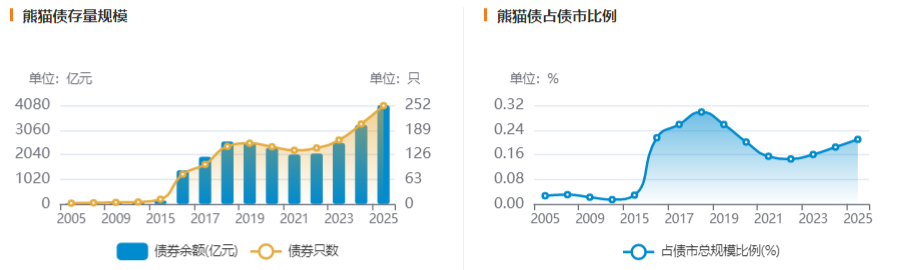
Core Viewpoint - The issuance of "Panda Bonds" is gaining momentum, with Barclays Bank planning to issue its first Panda Bond in the Chinese interbank bond market, indicating a growing interest from foreign institutions in the Chinese bond market [1][2]. Group 1: Panda Bond Market Overview - As of October 30, 2023, the net financing scale of Panda Bonds has surpassed 800 billion RMB, reflecting a year-on-year growth of nearly 20% [1][3]. - The Panda Bond market has seen significant activity in October, with various foreign issuers, including the UAE and Morgan Stanley, successfully issuing bonds totaling 40 billion RMB and 20 billion RMB, respectively [3]. - The total issuance volume of Panda Bonds in 2023 has reached 1,569.50 billion RMB, with a net financing scale of 821.50 billion RMB, marking an 18.7% increase compared to the previous year [3][7]. Group 2: Funding Utilization and Market Dynamics - Barclays Bank's bond proceeds will primarily be used to meet the demand for RMB-denominated assets, enhance liquidity in the offshore RMB market, and optimize the overall financing structure of the group [2]. - The average issuance interest rate of Panda Bonds has decreased significantly, providing a financing cost advantage compared to USD-denominated bonds, attracting foreign issuers [7]. Group 3: Investor and Issuer Landscape - The diversity of issuers in the Panda Bond market is increasing, with a notable rise in foreign issuers, including major banks and corporations, indicating a shift towards a "sovereign + industry" dual-driven development model [8][9]. - The holder structure of Panda Bonds is evolving, with non-legal person products accounting for 38.03% of holdings, followed by state-owned commercial banks at 19.55% and foreign institutions at 17.43% [9]. - The participation of international rating agencies and improved disclosure standards from foreign issuers are enhancing cross-border credit research, thereby enriching the funding sources for RMB bonds [9]. Group 4: Future Outlook - The Panda Bond market is expected to continue thriving due to the dual drivers of interest rate differentials and supportive policies, with projections indicating that the stock of Panda Bonds may exceed 600 billion RMB by the end of 2025 [9]. - The entry of Barclays Bank into the Panda Bond market signifies confidence in China's financial openness and the long-term potential of RMB assets, suggesting a shift towards "local currency-driven" financing strategies for foreign institutions [9].

公用事业行业央企ESG评价体系:绿色安全+能源转型是核心社会责任担当是基石:公用事业行业央企ESG评价体系
Shenwan Hongyuan Securities· 2025-10-30 11:23
Investment Rating - The report assigns a "Buy" rating for several key companies in the public utility sector, including China Resources Power, Guodian Power, and Inner Mongolia Huadian [28]. Core Insights - The public utility sector is crucial for achieving national "dual carbon" goals, with a strong emphasis on environmental and social issues in the ESG evaluation framework [5][4]. - The ESG evaluation system for public utilities includes four categories of positive indicators and one category of negative indicators, focusing on objective assessment metrics [8][23]. - Recent policies from various government departments emphasize the need for green transformation, pollution prevention, and social welfare in the public utility sector [5][4]. Summary by Sections 1. ESG Policy in Public Utilities - The public utility sector is a major contributor to energy consumption and carbon emissions, making its green transformation essential for national goals [5]. - Key policies include the "14th Five-Year" energy conservation and emission reduction plan, which outlines specific requirements for green transformation and public service stability [5][4]. 2. ESG Evaluation System Construction - The ESG evaluation system consists of four positive categories: General Indicators, Environmental Indicators, Social Indicators, and Governance Indicators, with a total of 18 primary indicators and 35 secondary indicators [8][23]. - The negative category focuses on violations and penalties, with specific metrics for environmental, social, and governance aspects [23]. 3. General Indicators - General indicators assess the authenticity and standardization of ESG reports, including the basis for report preparation, third-party verification, and the publication of ESG-specific reports [10][9]. 4. Environmental Indicators - Environmental indicators are based on energy conservation, low carbon, and circular economy principles, with a total of four primary indicators focusing on emissions management, ecological compliance, resource utilization, and climate strategy [11][12]. 5. Social Indicators - Social indicators highlight the public utility sector's role in community development and social stability, with six primary indicators covering community contributions, employee development, innovation, supply chain responsibility, product safety, and core operational responsibilities [15][16][17]. 6. Governance Indicators - Governance indicators aim to enhance corporate governance and decision-making, with five primary indicators focusing on party leadership, industry reform, compliance risk management, governance structure, and information transparency [19][20][21]. 7. Negative Indicators - The negative indicators focus on compliance issues, with penalties for violations in environmental, social, and governance areas, deducting points for each violation [23][25].





中国电力(02380):赵永刚获委任为执行董事兼总裁
Zhi Tong Cai Jing· 2025-10-30 10:25
Group 1 - The company announced the resignation of Mr. Gao Ping as executive director and president, effective from October 30, 2025, due to other work arrangements [1] - Mr. Zhao Yonggang has been appointed as the new executive director and president of the company, effective from the same date [1] - Mr. Zhao Yonggang will also take over Mr. Gao Ping's positions in the Risk Management Committee, Strategic and Sustainable Development Committee, and Executive Committee [1]
中国电力(02380.HK):赵永刚获委任为执行董事兼总裁
Ge Long Hui· 2025-10-30 09:56
Core Viewpoint - China Power (02380.HK) announced the appointment of Zhao Yonggang as the executive director and president, effective from October 30, 2025, succeeding Gao Ping who has resigned from these positions [1] Group 1 - Zhao Yonggang will also be appointed as a member of the Risk Management Committee, the Strategy and Sustainable Development Committee, and the Executive Committee following Gao Ping's resignation [1]
中国电力(02380) - 董事名单及其角色与职能
2025-10-30 09:45
中 國 電 力 國 際 發 展 有 限 公 司 China Power International Development Limited (在香港註冊成立的有限責任公司) (股份代號:2380) 趙永剛 非執行董事 胡建東 周杰 黃青華 陳鵬君 獨立非執行董事 李方 邱家賜 許漢忠 董事局已成立五個委員會,董事在各委員會擔任的職位如下。 董事名單及其角色與職能 中國電力國際發展有限公司董事局(「董事局」)成員載列如下。 董事局主席兼執行董事 王子超 執行董事兼總裁 C 主席 M 成員 * 執行委員會成員包括本公司高級管理人員 香港,二零二五年十月三十日 | | 委員會 | 審核 | 薪酬及提名 | 風險管理 | 戰略與 可持續發展 | 執行 | | --- | --- | --- | --- | --- | --- | --- | | 董事 | | 委員會 | 委員會 | 委員會 | 委員會 | 委員會* | | 王子超 | | | | C | C | C | | 趙永剛 | | | | M | M | M | | 胡建東 | | | | | M | | | 周杰 | | | | | M | | | 黃青華 ...
中国电力(02380) - 董事及董事局委员会成员之变更
2025-10-30 09:44
香港交易及結算所有限公司及香港聯合交易所有限公司對本公告的內容概不負責,對其準確性或完整性 亦不發表任何聲明,並明確表示,概不就因本公告全部或任何部份內容而產生或因倚賴該等內容而引致 的任何損失承擔任何責任。 中 國 電 力 國 際 發 展 有 限 公 司 China Power International Development Limited (在香港註冊成立的有限責任公司) (股份代號:2380) 董事及董事局委員會成員之變更 董事局欣然宣佈以下變更,自二零二五年十月三十日起生效: 趙永剛先生獲委任為本公司執行董事兼總裁。趙先生獲委任以接替已辭任 上述職務的高平先生。 趙先生亦於高先生辭任後獲委任為本公司風險管理委員會、戰略與可持續 發展委員會及執行委員會的成員。 董事的辭任 中 國 電 力 國 際 發 展 有 限 公 司 (「 本公司 」,連同其附屬公司,統稱為「 本 集 團」)董事局(「董事局」)宣佈,由於其他工作安排,高平先生已辭任本公 司執行董事、總裁,以及本公司風險管理委員會、戰略與可持續發展委員會 和執行委員會的成員職務,自二零二五年十月三十日起生效。 高先生已確認,彼與董事局並無意見分歧, ...
中国电力技术装备有限公司与马来西亚国家能源公司签署合作项目谅解备忘录
Zhong Guo Neng Yuan Wang· 2025-10-30 09:04
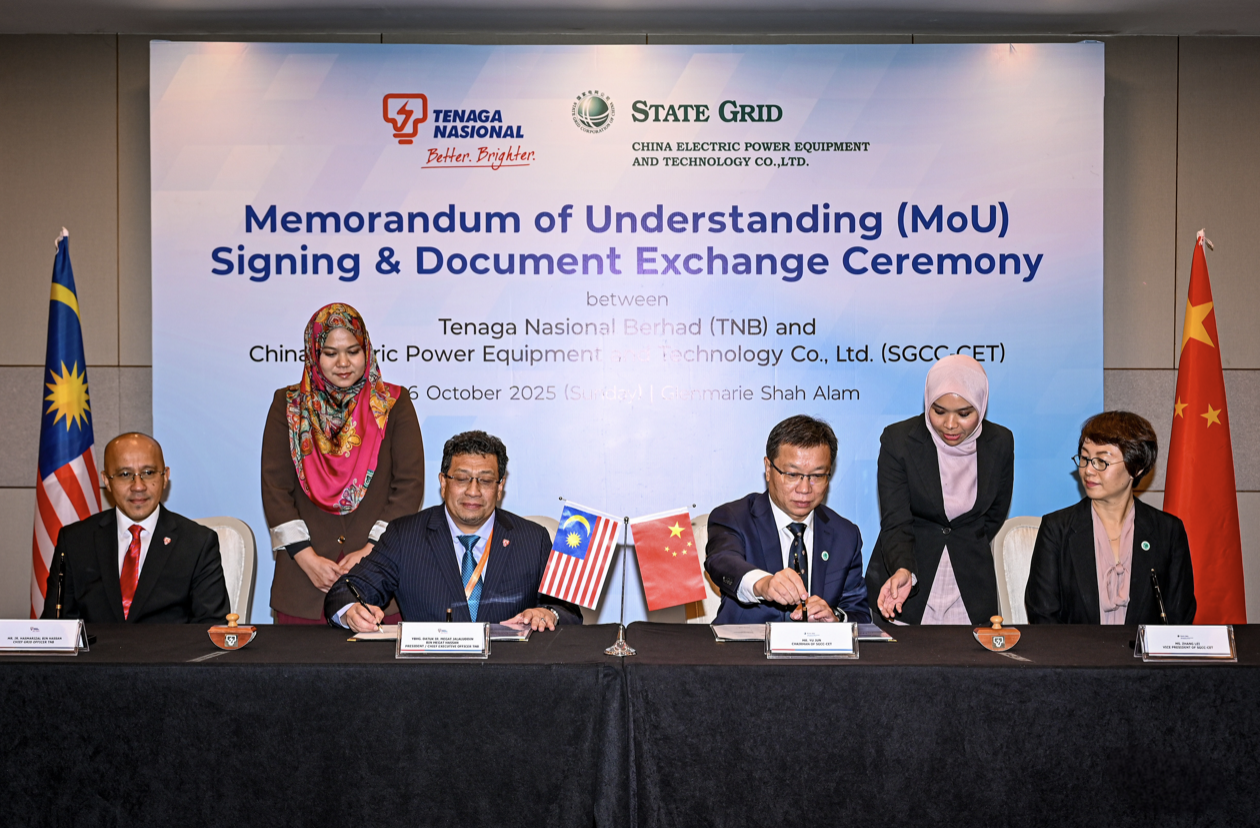
Core Viewpoint - The signing of the memorandum of understanding between China Electric Power Equipment and Technology Co., Ltd. and Tenaga Nasional Berhad (TNB) aims to enhance cooperation in addressing the urgent needs of energy transition in Malaysia [1][3]. Group 1: Collaboration Details - The memorandum is based on the principle of "complementary advantages and demand matching," focusing on technical exchanges and project cooperation in areas such as power system planning and integration, smart resilient grids, and digital and AI solutions [3]. - The collaboration seeks to integrate China's advanced technology in power transmission and transformation with Malaysia's energy development needs, supporting the implementation of Malaysia's national energy transition roadmap [3]. Group 2: Future Actions - China Electric Power Equipment will closely align with Malaysia's energy transition development needs and the cooperation outlined in the memorandum, enhancing resource allocation and conducting technical research to pragmatically advance deep cooperation in the electricity sector between China and Malaysia [5].
公用事业行业央企ESG评价体系:绿色安全+能源转型是核心,社会责任担当是基石
Shenwan Hongyuan Securities· 2025-10-30 08:48
Investment Rating - The report maintains a positive outlook on the public utility sector's central enterprises with a focus on the ESG evaluation system [1]. Core Insights - The establishment of the ESG evaluation system for public utilities is based on a balanced emphasis on environmental and social issues, crucial for achieving national carbon neutrality goals [3][9]. - The evaluation system consists of four categories of positive indicators and one category of negative indicators, with a total of 18 primary indicators and 35 secondary indicators [12][28]. - Key policies guiding the sector include promoting renewable energy, enhancing energy efficiency, and ensuring equitable public services [9][11]. Summary by Sections 1. ESG Policy: Balancing Environmental and Social Issues - The public utility sector is a major contributor to energy consumption and carbon emissions, making its green transition vital for national carbon goals [3][9]. - Recent policies emphasize the development of clean energy and pollution control, with specific directives from various government bodies [9][11]. 2. Constructing the ESG Evaluation System: Multi-Dimensional Assessment - The ESG evaluation system is structured with four positive categories: General Indicators, Environmental Indicators, Social Indicators, and Governance Indicators, along with one negative category for violations [12][28]. - Each category has specific indicators designed to objectively assess the performance of enterprises in the public utility sector [12][28]. 3. General Indicators - General indicators assess the authenticity and standardization of ESG reports, including the basis for report preparation, third-party verification, and the publication of ESG-specific reports [12][14]. 4. Environmental Indicators - Environmental indicators focus on energy efficiency and circular economy principles, with metrics for emissions management, ecological compliance, resource utilization, and climate strategy [15][17]. 5. Social Indicators - Social indicators highlight the sector's role in public service, with metrics for community contributions, employee development, innovation, supply chain responsibility, and customer rights [19][21]. 6. Governance Indicators - Governance indicators aim to enhance corporate governance standards, focusing on party leadership, industry reform, compliance risk management, governance structure, and information transparency [23][26]. 7. Negative Indicators - The negative category includes penalties for violations, with specific metrics for environmental, social, and governance infractions, where each violation results in a deduction of points [28][31]. 8. Valuation of Key Companies - The report includes a valuation table for key companies in the public utility sector, indicating ratings and projected earnings per share (EPS) for the years 2025 to 2027 [34].
远达环保三季度业绩稳健增长 重大资产重组顺利推进
Zheng Quan Shi Bao Wang· 2025-10-29 15:36
Core Insights - The company reported a slight increase in revenue and a notable rise in net profit for the third quarter, indicating stable financial performance amidst ongoing restructuring efforts [1][2] - The completion of the major asset restructuring is expected to enhance the company's operational efficiency and expand its business scope in the hydropower sector [2] Financial Performance - The company achieved operating revenue of 1.11 billion yuan in Q3, a year-on-year increase of 0.12% [1] - The net profit attributable to shareholders was 40.72 million yuan, reflecting a year-on-year growth of 12.26% [1] - The net profit after deducting non-recurring items was 39.75 million yuan, up by 9.47% year-on-year [1] Asset Restructuring - The company has received approval from the CSRC for its major asset restructuring, which includes issuing approximately 2.017 billion shares to China Power International Development Limited, 1.184 billion shares to Hunan Xiangtou International Investment Co., Ltd., and 398 million shares to State Power Investment Corporation Guangxi Electric Power Co., Ltd. [1] - The restructuring aims to acquire 100% equity of Wuling Power and 64.93% equity of Changzhou Hydropower, with a plan to raise up to 5 billion yuan in supporting funds [1] Strategic Development - Post-restructuring, the company will expand into hydropower and integrated development operations of watershed hydropower stations, enhancing its business footprint [2] - The support from State Power Investment Group is expected to facilitate the company's transformation and improve asset quality, operational efficiency, and core competitiveness, laying a solid foundation for sustainable development [2]
