
毕马威

Search documents
全球合作乘“数”而来
Zhong Guo Qing Nian Bao· 2025-09-10 13:43
Group 1 - The 2025 China International Service Trade Fair (CIFTIS) opened on September 10, showcasing a vibrant array of international participation and innovative technologies [1][3] - In the first half of the year, China's service trade import and export totaled 3.9 trillion yuan, marking an 8% year-on-year increase, the highest for the same period in history [1] - The fair features over 2,000 enterprises, including nearly 500 Fortune 500 companies, with an international participation rate exceeding 20% [4] Group 2 - Australia is the guest country for this year's fair, with nearly 60 institutions and enterprises participating, highlighting the strength of China-Australia cooperation [3][4] - Norway's participation includes a focus on sustainable aquaculture, with a company preparing to enter the Chinese market with Atlantic salmon products [4][5] - Johnson & Johnson has introduced 40 innovative drugs to the Chinese market, with 32 included in the national medical insurance, emphasizing the company's commitment to patient-centered healthcare [5][6] Group 3 - The fair features advanced healthcare technologies, including robotic applications in surgery, which significantly enhance operational precision and patient safety [8] - The education service section showcases AI-driven educational tools, attracting interest from educators and industry professionals [10] - A total of 113 enterprises are set to launch 198 new products and achievements during the fair, indicating a strong focus on innovation and collaboration in the service trade sector [10]


85个国家和国际组织设展办会,服贸会呈现“数智领航”新趋势
Xin Jing Bao· 2025-09-10 12:08
Core Points - The 2025 China International Service Trade Fair (CIFT) opened on September 10, 2025, at Shougang Park, marking the first time the event is held at a single location [1] - The theme for this year's fair is "Digital Intelligence Leading, Service Trade Renewed," focusing on the trends of digitalization, intelligence, and sustainability in service trade [1] - A total of 26 forums and meetings were held on the opening day, with 12 enterprises and institutions releasing 25 new achievements across various fields including e-commerce and artificial intelligence [1] Group 1: Event Structure and Participation - The fair has transitioned from a "one fair, two locations" format to "one fair, one location," consolidating activities at Shougang Park, which has undergone significant upgrades [2] - 85 countries and international organizations, including Australia and Germany, are participating, with nearly 2,000 enterprises exhibiting, including around 500 Fortune 500 companies [2] - The event will feature 13 thematic forums, 82 specialized forums, and 81 promotional activities, with over 260 high-profile guests attending [2] Group 2: Innovations and Exhibits - A total of 113 enterprises will unveil 198 new products and achievements, including 109 new product launches and 36 authoritative releases [3] - The fair will showcase a variety of activities aimed at promoting new service consumption models, including art performances and sports events [3] - Australia and Anhui Province are the guest countries and provinces, respectively, with Australia organizing nearly 60 institutions and enterprises to participate [4] Group 3: Technology and Interactive Experiences - The event emphasizes interactive experiences, showcasing new technology applications and solutions, particularly in education and cultural tourism [4] - Notable exhibits include AI-driven educational solutions and advanced virtual reality experiences that recreate historical sites [4] - The health services section will feature innovative products, such as an intelligent device for detecting chronic diseases through retinal imaging [5] Group 4: Engagement and Activities - A "check-in" activity has been introduced, allowing attendees to engage with the fair through a dedicated app, completing tasks at various locations to earn points and redeem souvenirs [6]
英国劳动力市场持续降温 新雇员工资增速降至四年来新低
智通财经网· 2025-09-08 02:41
Group 1 - The wage growth for new employees in the UK has dropped to its lowest level in over four years, indicating a weakening labor market that is alleviating inflationary pressures [1] - The survey conducted by the Recruitment and Employment Confederation (REC) and KPMG shows that the growth rate of starting salaries fell to its lowest since March 2021, coinciding with the pandemic restrictions [1] - There is a significant increase in the number of job seekers, while demand for labor continues to decline, reflecting a complex business environment and mixed feedback on corporate confidence [1] Group 2 - The REC survey indicates that the growth rate of candidates has reached its fastest pace since 2020 due to layoffs and hiring freezes, with many employees seeking new jobs out of job security concerns [2] - The number of job vacancies has decreased significantly, with the largest drop in retail and hospitality sectors, while only the construction industry saw an increase in demand for full-time employees [2] - Despite a slowdown in the decline of full-time job availability, the overall situation remains bleak, with all eyes on the upcoming autumn budget to avoid further impacts on the labor market [2]
外资加码投资中国 资本市场对外开放提速
Zhong Guo Zheng Quan Bao· 2025-09-03 22:46
Core Viewpoint - Foreign investment in Chinese assets is increasing, driven by policy support and favorable market conditions [1][3][6] Group 1: Foreign Investment Trends - As of the end of July, the number of Qualified Foreign Institutional Investors (QFII) reached 900, with 40 new additions this year [1] - By the end of June, QFII had entered the top ten shareholders of 1,145 A-share listed companies, with a total holding value of 143.46 billion yuan, an increase of 21.29 billion yuan from the previous quarter [2] - In the first half of the year, foreign investors net increased their holdings in domestic stocks and funds by 10.1 billion USD, reversing a two-year trend of net reductions [2] Group 2: Market Confidence Factors - China's economic fundamentals remain strong, with rapid industrial upgrades in sectors like renewable energy and artificial intelligence [3] - High valuations and improving profitability of quality listed companies enhance the attractiveness of the stock market [3][4] - Investor sentiment towards the A-share market has significantly improved, driven by market rebounds and supportive policies [4] Group 3: Policy Support and Market Access - The China Securities Regulatory Commission (CSRC) plans to accelerate the implementation of key measures for capital market opening by 2025, including optimizing the QFII system [6] - Recommendations include expanding investment scope and increasing foreign ownership limits to facilitate foreign capital inflow [6][7] - The introduction of more cross-border financial products and improved access mechanisms is expected to enhance cross-border investment convenience [6][7]
外资加码投资中国资本市场对外开放提速
Zhong Guo Zheng Quan Bao· 2025-09-03 22:42
Core Viewpoint - Foreign investment in Chinese assets is increasing, supported by policy reforms and favorable market conditions [1][2][3] Group 1: Foreign Investment Trends - As of the end of July, the number of Qualified Foreign Institutional Investors (QFII) reached 900, with 40 new additions this year [1] - QFII has entered the top ten shareholders of 1,145 A-share listed companies, with a total holding value of 143.464 billion yuan, an increase of 21.29 billion yuan from the previous quarter [1] - In the first half of the year, foreign investors net increased their holdings in domestic stocks and funds by 10.1 billion USD, reversing a two-year trend of net reductions [1] Group 2: Market Confidence and Valuation - Goldman Sachs reported a net inflow of 4.076 billion USD into mainland Chinese stock funds from August 21 to August 27, leading among emerging markets [2] - The overall confidence of investors in Chinese investments has been steadily increasing this year, particularly in the context of global asset allocation trends [2] - The Chinese economy remains stable, with rapid industrial upgrades in sectors like renewable energy and AI, attracting foreign investment [2][3] Group 3: Policy Support and Market Outlook - The China Securities Regulatory Commission (CSRC) plans to accelerate the implementation of key measures for capital market opening by 2025, including optimizing the QFII system [3][4] - Suggestions include expanding investment scope and increasing foreign ownership limits to enhance foreign capital inflow while managing potential risks [4][5] - The establishment of cross-border asset management pilots and the issuance of RMB-denominated green bonds are recommended to attract long-term capital [5]


好创意总被埋没?可能需要设计一个漏斗
3 6 Ke· 2025-09-03 03:03
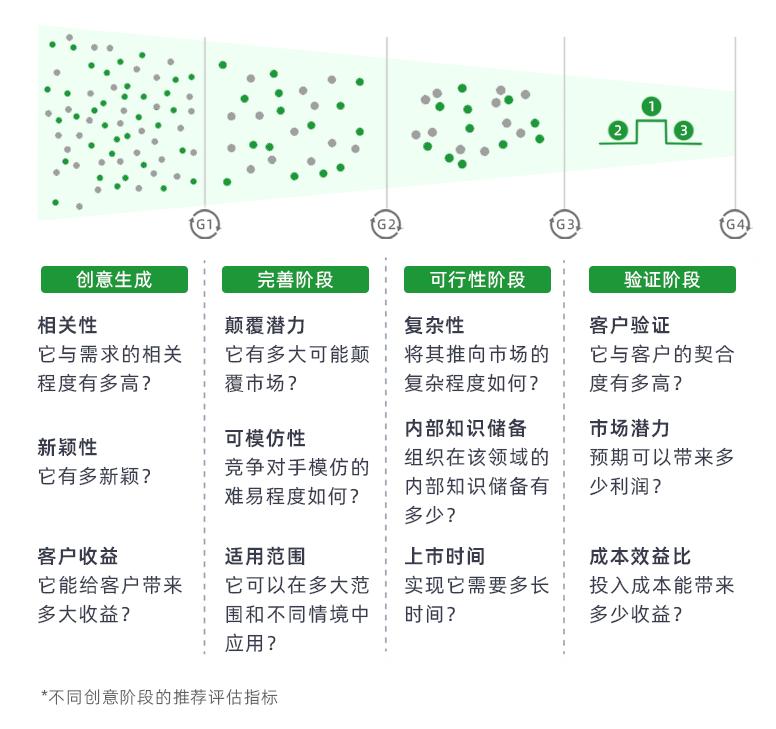
Core Insights - Over 95% of creative ideas fail to meet expectations or reach the market due to a lack of structured processes, highlighting the need for a systematic innovation funnel to filter and develop high-potential ideas [1] - A well-designed innovation funnel helps teams evaluate ideas at each stage, reducing risks and aligning innovation with strategic goals [1][4] Structured Innovation Funnel Components - The structured innovation funnel is a cyclical system that guides ideas from initial conception to the launch of new products or services, consisting of clear stage definitions, decision points, evaluation criteria, and effective management tools [2] - Each stage corresponds to specific steps in the innovation process: idea collection, concept development, business case creation, testing, and implementation, with decision points assessing strategic fit, technical feasibility, and market potential [2][10] Stages of the Innovation Funnel - **Stage 1: Idea Collection and Generation** This stage encourages the sharing of original ideas from employees, customers, or partners, focusing on quantity and openness [11] - **Stage 2: Concept Definition and Market Research** Selected ideas are refined into detailed concepts, defining core value propositions and potential users while validating assumptions through preliminary market research [15] - **Stage 3: MVP and Development Stage** Concepts are turned into Minimum Viable Products (MVPs) to test basic functionalities and gather user feedback, ensuring only technically mature and strategically aligned projects proceed [17] - **Stage 4: Implementation and Scaling** Focus shifts to executing solutions, including beta testing and market entry strategies, ensuring all departments are prepared for product launch [19] - **Stage 5: Integration into Product and Service Portfolio** Successful ideas are integrated into existing offerings, with lessons learned feeding back into the innovation process for continuous improvement [26] Decision Points and Evaluation Criteria - Each stage includes specific decision points that assess ideas based on criteria such as strategic alignment, novelty, market readiness, and resource availability [12][18][24] - The evaluation process involves cross-functional teams to enhance assessment quality and reduce biases [2][4]
好创意总被埋没?可能需要设计一个漏斗 | 红杉汇内参
红杉汇· 2025-09-03 00:08
Core Insights - Over 95% of creative ideas fail to meet expectations when implemented, primarily due to a lack of structured processes. A systematic innovation funnel is essential for filtering, refining, and advancing the most promising concepts [3][4] Group 1: Importance of a Structured Innovation Funnel - A well-designed innovation funnel helps teams evaluate ideas at each stage, reducing risks and aligning innovation with strategic goals [3][4] - The funnel guides ideas through specific stages, from generation to concept development, testing, and full launch, ensuring only viable projects proceed [6][8] Group 2: Components of the Innovation Funnel - The structured innovation funnel consists of clear stage definitions, decision points, evaluation criteria, and effective management tools, which work together to identify high-potential ideas [6][8] - Each stage corresponds to specific steps in the innovation process: idea collection, concept development, business case creation, testing, and application [6][8] Group 3: Stages of the Innovation Funnel - Stage 1: Idea Collection and Generation focuses on encouraging contributions from employees, customers, and partners, emphasizing quantity and openness [15] - Stage 2: Concept Definition and Market Research involves refining selected ideas into detailed concepts, defining core value propositions, and conducting preliminary market research [19] - Stage 3: MVP and Development Stage aims to create a Minimum Viable Product (MVP) to test basic functionalities and gather user feedback [20] - Stage 4: Idea Implementation and Scaling shifts focus to execution, including beta testing and market entry strategies [24] - Stage 5: Integration into Product and Service Catalog finalizes the process by incorporating successful ideas into existing offerings, ensuring lasting impact and continuous improvement [28] Group 4: Real-World Examples - KPMG combines AI with human insights to drive creative discovery, utilizing a structured funnel to filter high-potential ideas [9] - Cisco's global innovation initiative aggregates thousands of ideas on a single platform, employing a structured model to evaluate and scale innovations [11]

毕马威发布《银行业转型:新的议程》报告,揭示通过降本增效实现成功转型的路径
Sou Hu Cai Jing· 2025-09-02 02:40
Core Insights - The banking industry is actively pursuing transformation strategies focused on cost reduction and efficiency enhancement due to narrowing profit margins and increasing regulatory demands [1][10] - A recent report by KPMG surveyed over 228 banking executives globally, providing insights and data to guide management in successful transformation paths [1] Group 1: Key Transformation Initiatives - The three main transformation initiatives prioritized by banks include cost strategies, AI technology integration, and addressing cybersecurity and fraud issues [4] - 53% of banks aim to reduce costs by at least 10% by 2030, with nearly one-third targeting reductions exceeding 20% [10] - 38% of surveyed banks are incorporating AI into their operations, while 33% focus on cybersecurity, and approximately 29% are enhancing data analysis capabilities [12] Group 2: Successful Practices of Leading Banks - Successful banks set clear cost reduction targets, with 56% having established specific goals and 49% documenting their cost reduction strategies [32] - A centralized and accountable governance model is crucial, as leading banks are 2.5 times more likely to adopt such an approach compared to average banks [34] - 50% of respondents believe that a centralized approach is the most effective for transformation, while 54% support a hub-and-spoke model for coordination [29] Group 3: Challenges in Transformation - A significant barrier to achieving transformation goals is the lack of alignment between operational and cost strategies, with only 31% of banks reporting complete alignment [24] - Governance and structural inefficiencies hinder progress, with 53% of banks struggling to prioritize and coordinate major change initiatives [26] - Despite the push for technology adoption, only 24% of large banks (annual revenue over $5 billion) have seen significant success in cost reduction efforts [20] Group 4: Case Studies and Outcomes - A case study highlighted a bank that implemented a cost reduction plan targeting over 25%, resulting in a 35% increase in sustainable productivity after one year [18][19] - Another case study showed a multinational bank saving over $400 million through operational improvements and enhanced customer service processes [31] Group 5: Recommendations for Effective Transformation - Banks should adopt a comprehensive, end-to-end perspective in their transformation efforts, focusing on customer needs while ensuring alignment with strategic goals [35] - A disciplined, phased approach to transformation is recommended, involving clear tracking and measurement of progress [36][38]

告别ESG报告“盖章机器”: 新规给第三方鉴证机构戴上金箍
Zhong Guo Zheng Quan Bao· 2025-08-31 23:20
Core Viewpoint - The recent public consultation by the Chinese Institute of Certified Public Accountants aims to establish a clear regulatory framework for sustainable information verification, marking a new phase of standardization and professionalism in ESG verification in China [1] Group 1: Challenges in Sustainable Information Verification - Current challenges in China's sustainable information verification include fragmented standards, significant differences in methods and indicators among verification institutions, and inadequate risk assessment capabilities [2] - The consultation draft aims to address these issues by proposing key measures to fill the gaps and resolve related challenges [2] Group 2: Standardization and Quality Control - The consultation draft is expected to resolve the long-standing fragmentation issue in the industry by establishing standardized procedures and requirements for verification [2] - It emphasizes the need for quality control mechanisms and clear anti-fraud requirements to provide reliable institutional guarantees for the market [1][2] Group 3: Incorporating International Experience and Local Adaptation - The draft draws on international frameworks like ISSA 5000 while considering the local context of China's nascent sustainable information disclosure and verification practices [3] - It proposes detailed requirements for dual materiality assessment and expert competency evaluation, aligning with domestic regulatory frameworks [3] Group 4: Enhancing Verification Quality - The draft sets stringent requirements for verification institutions, including the need for project partners to possess adequate competency in sustainable information [4] - It highlights the importance of maintaining independence and quality management within verification processes [5] Group 5: Addressing Fraud and Data Verification Challenges - The identification of fraud remains a significant challenge in sustainable information verification, particularly due to the lack of standardized metrics for non-financial data [7] - The draft suggests implementing technological solutions and cross-departmental collaboration to enhance data verification and fraud detection [8] Group 6: Strengthening Accountability and Regulatory Mechanisms - The establishment of a robust accountability framework is crucial, with suggestions for dual accountability for fraudulent activities involving both companies and verification institutions [9] - A two-way data reporting platform is proposed to facilitate communication between verification institutions and regulatory bodies, enhancing the identification of high-risk entities [10]
毕马威:上半年资本市场为消费提供了进一步发展动力
Sou Hu Cai Jing· 2025-08-31 08:40
Core Insights - Consumption has become the core engine of economic growth in China, contributing over 50% in the first half of the year [1] - The retail sales of consumer goods achieved a year-on-year growth of 5.0% in the first half of 2025, driven by various factors including effective government policies and an increase in disposable income [1] - The capital market is providing further development momentum for consumption, with a shift in capital flow towards companies with strong cash flow, brand strength, high chain operations, and digitalization [1] - Future optimization and upgrading of consumption structure will be achieved through the collaboration of policies, markets, and capital [1]