
良品铺子

Search documents
2025年中国轻食行业门店运营分析 一线及新一线门店较多【组图】
Sou Hu Cai Jing· 2025-11-14 13:16
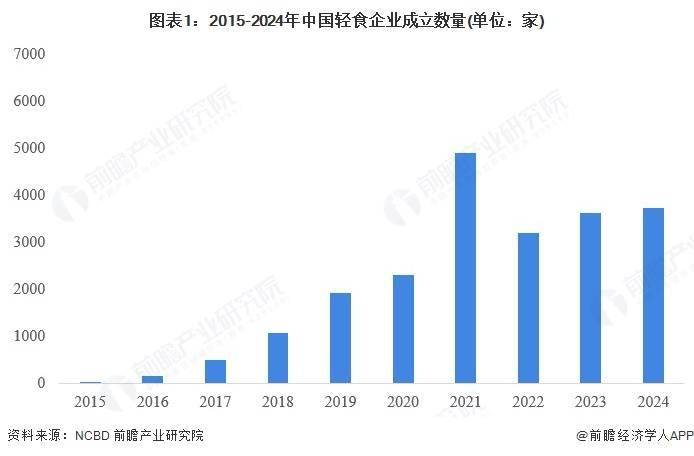
Group 1 - The number of light food-related restaurant establishments in China reached a record high of 4,905 in 2021, followed by a rational development phase with 3,738 establishments projected for 2024 [1] - The majority of light food stores are concentrated in first-tier, new first-tier, and some second-tier cities, with first-tier cities accounting for 13.4% of the total and new first-tier cities making up nearly 25% [3] - As of 2025, the top ten cities with the highest number of light food stores in China are Shanghai, Guangzhou, Beijing, Shenzhen, Chengdu, Hangzhou, Chongqing, Wuhan, Suzhou, and Dongguan [4] Group 2 - The leading brands in the light food industry as of August 2025 include Jinshi Fitness Nutrition Meal, Shaye Light Food, Manwei Light Food, Chaoneng Deer Battle Team, and Shiye SAYYEAH Creative Light Food [5] - The closure rate for light food establishments is relatively high, with a closure rate of 27.0% from 2023 to 2024, exceeding the average closure rate of 22.6% for the restaurant industry, indicating it is a "high-risk category" [8]

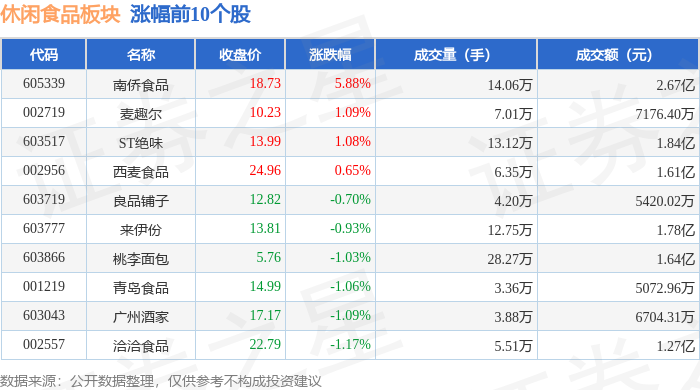
休闲食品板块11月14日跌1.44%,元祖股份领跌,主力资金净流出2.07亿元
Zheng Xing Xing Ye Ri Bao· 2025-11-14 08:51
Core Viewpoint - The leisure food sector experienced a decline of 1.44% on November 14, with Yuanzu Co. leading the drop. The Shanghai Composite Index closed at 3990.49, down 0.97%, while the Shenzhen Component Index closed at 13216.03, down 1.93% [1]. Group 1: Market Performance - The leisure food sector saw a net outflow of 207 million yuan from major funds, while retail investors had a net inflow of 283 million yuan [2][3]. - Major stocks in the leisure food sector showed varied performance, with Nanjiao Food rising by 5.88% to close at 18.73 yuan, while Yuanzu Co. fell by 3.46% to 13.11 yuan [1][2]. Group 2: Individual Stock Analysis - Nanjiao Food had a trading volume of 140,600 shares and a transaction value of 267 million yuan, indicating strong investor interest [1]. - Yuanzu Co. recorded a trading volume of 117,600 shares with a transaction value of 159 million yuan, reflecting significant selling pressure [2]. - Other notable declines included Salted Fish Co. and Lihai Food, both down by over 3% [2]. Group 3: Fund Flow Analysis - The fund flow analysis indicates that major funds withdrew from several stocks, including ST Juewei and Lihai Food, while retail investors showed interest in stocks like Qingdao Food, which saw a net inflow of 631,050 yuan [3]. - The net inflow for retail investors in Qingdao Food was 12.44%, indicating a potential shift in investor sentiment towards this stock [3].

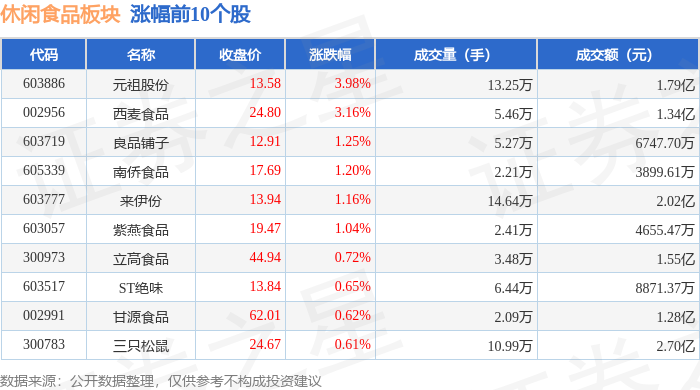
休闲食品板块11月13日涨0.21%,元祖股份领涨,主力资金净流出1.54亿元
Zheng Xing Xing Ye Ri Bao· 2025-11-13 08:44
Market Overview - The leisure food sector increased by 0.21% on November 13, with Yuanzi Co. leading the gains [1] - The Shanghai Composite Index closed at 4029.5, up 0.73%, while the Shenzhen Component Index closed at 13476.52, up 1.78% [1] Individual Stock Performance - Yuanzi Co. (603886) closed at 13.58, up 3.98% with a trading volume of 132,500 shares and a turnover of 179 million yuan [1] - Ximai Food (002956) closed at 24.80, up 3.16% with a trading volume of 54,600 shares and a turnover of 134 million yuan [1] - Other notable performers include: - Liangpinpuzi (603719) at 12.91, up 1.25% [1] - Nanjiao Food (605339) at 17.69, up 1.20% [1] - Laiyifen (603777) at 13.94, up 1.16% [1] Capital Flow Analysis - The leisure food sector experienced a net outflow of 154 million yuan from institutional investors, while retail investors saw a net inflow of 248 million yuan [2] - The capital flow for individual stocks shows: - Yuanzi Co. had a net inflow of 16.71 million yuan from institutional investors [3] - Salted Fish (002847) had a net inflow of 7.79 million yuan from institutional investors [3] - Purple Onion Food (603057) had a net inflow of 5.88 million yuan from institutional investors [3] Summary of Trading Data - The trading data for the leisure food sector indicates varied performance among stocks, with some experiencing significant gains while others faced declines [1][2] - The overall market sentiment appears positive, as indicated by the rise in major indices and the performance of leading stocks in the leisure food sector [1]


休闲食品板块11月12日跌0.01%,桂发祥领跌,主力资金净流出1.71亿元
Zheng Xing Xing Ye Ri Bao· 2025-11-12 08:42
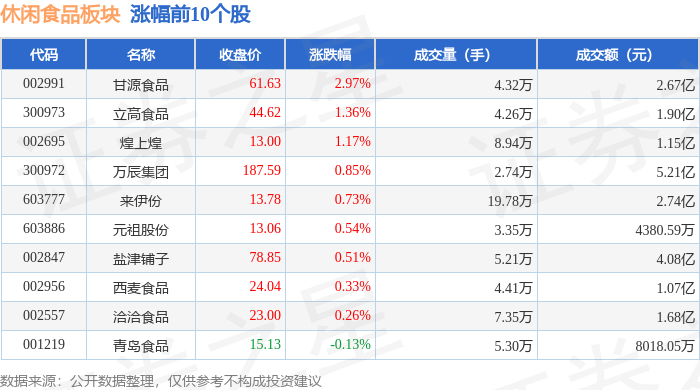
Market Overview - The leisure food sector experienced a slight decline of 0.01% on November 12, with Gui Faxiang leading the drop [1] - The Shanghai Composite Index closed at 4000.14, down 0.07%, while the Shenzhen Component Index closed at 13240.62, down 0.36% [1] Stock Performance - Notable gainers in the leisure food sector included: - Ganyuan Food: closed at 61.63, up 2.97% with a trading volume of 43,200 lots and a transaction value of 267 million [1] - Lihai Food: closed at 44.62, up 1.36% with a trading volume of 42,600 lots and a transaction value of 206.1 million [1] - Major decliners included: - Gui Faxiang: closed at 14.30, down 2.26% with a trading volume of 273,100 lots and a transaction value of 394 million [2] - Ziyan Food: closed at 19.27, down 2.18% with a trading volume of 29,900 lots and a transaction value of 58.19 million [2] Capital Flow - The leisure food sector saw a net outflow of 171 million from institutional investors, while retail investors contributed a net inflow of 249 million [2] - Specific stock capital flows included: - Ganyuan Food: net inflow of 17.70 million from institutional investors, with a net outflow of 12.58 million from speculative funds [3] - Lihai Food: net inflow of 10.29 million from institutional investors, with a net outflow of 7.30 million from speculative funds [3]


休闲食品行业专题报告之一:大浪淘沙,沉者为金
Guoxin Securities· 2025-11-11 11:18
Investment Rating - The report maintains an "Outperform" rating for the leisure food industry and specific companies such as Wei Long Mei Wei, Yan Jin Pu Zi, Jin Zai Food, and Wan Chen Group [4][5]. Core Insights - The leisure food market in China is projected to reach 1.344 trillion yuan in 2024, with a year-on-year growth of 5.3% and a CAGR of 4.4% from 2019 to 2024, expected to increase to 5.5% from 2025 to 2029 [1][15]. - The industry is characterized by a highly fragmented competitive landscape, with the top five and ten companies holding only 5.9% and 10.4% of the market share, respectively [1][22]. - Structural changes are reshaping the industry, including the rise of new retail channels, increased health consciousness among consumers, vertical integration in supply chains, and accelerated globalization efforts by leading companies [1][2][33]. Summary by Sections Industry Overview - The leisure food sector is a multi-billion market with diverse product categories, including snacks, nuts, and baked goods, focusing on fulfilling various consumer needs beyond mere hunger [15][18]. - The market is expected to continue expanding, with significant room for growth in per capita consumption, currently at 954.4 yuan, which is substantially lower than in the US and Japan [2][15]. Competitive Landscape - The industry is marked by intense competition and low concentration, with major players like Mars and Mondelez holding a small market share compared to their counterparts in the US [22][23]. - The competitive dynamics are shifting from price wars to differentiation and efficiency battles, as consumer demands become more diverse and nuanced [2][3]. Structural Changes - New retail formats such as bulk snack stores and instant retail are emerging, challenging traditional retail channels [33][34]. - Health awareness is driving innovation in product offerings, with a notable rise in demand for healthier snack options like konjac products, which are low in calories and high in dietary fiber [66][70]. Future Outlook - The report identifies three core drivers for industry growth: product innovation, scenario extension, and international expansion [2][3]. - Leading brands are expected to strengthen their market positions, with opportunities for both manufacturing and channel-focused companies to benefit from evolving consumer preferences and retail dynamics [2][3][4]. Company-Specific Insights - Wei Long Mei Wei and Yan Jin Pu Zi are highlighted as key players in the konjac snack segment, with significant revenue growth anticipated [3][70]. - Jin Zai Food is undergoing channel reforms and launching new products, while Wan Chen Group is expanding its discount supermarket presence, indicating potential for long-term growth [3][4].
良品铺子陷“渠道萎缩+价格下降”负循环控制权转让终止后如何自救?
Xin Lang Ke Ji· 2025-11-11 09:11
Core Viewpoint - The financial performance of Liangpinpuzi has significantly deteriorated, with a revenue decline of 24.45% year-on-year and a loss of approximately 122 million yuan in the first three quarters of 2025, marking a stark contrast to a profit of 19.39 million yuan in the same period last year [1][3]. Financial Performance - In the first three quarters of 2025, Liangpinpuzi achieved revenue of approximately 4.14 billion yuan, down 24.45% year-on-year, and incurred a loss of about 122 million yuan compared to a profit of 19.39 million yuan in the previous year [1]. - The company's gross margin has decreased from nearly 29% in Q3 2023 to 24.96% in Q3 2025, indicating a continuous decline [3][4]. - The sales expense ratio reached 24.27%, contributing to a total expense ratio of 28.71% [3]. Market Position and Strategy - Liangpinpuzi, positioned as a "high-end snack" brand, has seen its growth engines of "premiumization" and "channel expansion" stall amid weak terminal demand and intense competition in the snack market [3]. - The company has initiated large-scale price reductions and closed franchise stores starting November 2023, which has led to further sales shrinkage and declining gross margins [3][4]. Channel Dynamics - The traditional e-commerce channel has become saturated, with e-commerce revenue declining nearly 40% compared to 2021 [4]. - As of mid-2023, the company closed 259 stores, reducing its total to 2,445 [4]. Shareholder Actions and Control Issues - Following a significant drop in stock price, major institutional investors have begun to reduce their holdings, with notable exits from the top shareholder list [5]. - The controlling shareholder, Ningbo Hanyi, has been reducing its stake and facing high pledge risks, with 35.23% of shares pledged as of August 2023 [5][6]. - A planned transfer of control to Guangzhou Light Industry Group was halted due to unresolved conditions, adding uncertainty to the company's governance [6]. Competitive Landscape - Liangpinpuzi's performance contrasts sharply with competitors such as Yanjinpuzi, Laiyifen, and Three Squirrels, which have recorded positive revenue growth in the same period [6].
休闲食品板块11月11日涨0.93%,黑芝麻领涨,主力资金净流入3460.97万元
Zheng Xing Xing Ye Ri Bao· 2025-11-11 08:37
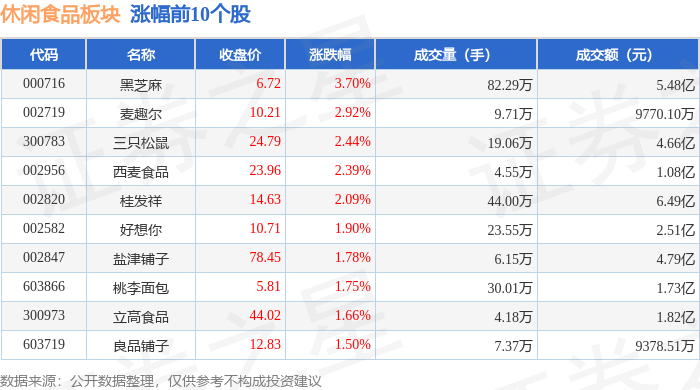
Market Overview - The leisure food sector increased by 0.93% on November 11, with Hei Zhima leading the gains [1] - The Shanghai Composite Index closed at 4002.76, down 0.39%, while the Shenzhen Component Index closed at 13289.0, down 1.03% [1] Stock Performance - Hei Zhima (000716) closed at 6.72, up 3.70% with a trading volume of 822,900 shares and a transaction value of 548 million [1] - Other notable performers include: - Mai Jiao Er (002719) at 10.21, up 2.92% [1] - San Zhi Song Shu (300783) at 24.79, up 2.44% [1] - Xi Mai Food (002956) at 23.96, up 2.39% [1] - Gui You Xiang (002820) at 14.63, up 2.09% [1] Capital Flow - The leisure food sector saw a net inflow of 34.61 million from main funds, while retail funds experienced a net outflow of 25.13 million [2] - The main funds' net inflow for Hei Zhima was 39.29 million, representing 7.17% of its total trading volume [3] - San Zhi Song Shu had a main fund net inflow of 30.52 million, accounting for 6.55% of its trading volume [3] Individual Stock Analysis - Hei Zhima experienced a significant net outflow from retail investors of 42.06 million, indicating a divergence in investor sentiment [3] - San Zhi Song Shu also faced a retail net outflow of 26.17 million, suggesting potential concerns among smaller investors [3] - Other stocks like Yan Jin Pu Zi (002847) and Xi Mai Food (002956) showed mixed capital flows, with Yan Jin Pu Zi having a net inflow from main funds of 13.91 million [3]

良品铺子陷“渠道萎缩+价格下降”负循环 控制权转让终止后如何自救?
Xin Lang Cai Jing· 2025-11-11 08:17
Core Viewpoint - The company, Liangpinpuzi, reported a significant decline in revenue and net profit for the first three quarters of 2025, indicating a continuous downward trend in performance and raising concerns about its financial stability [1][2]. Financial Performance - For the first three quarters of 2025, Liangpinpuzi achieved revenue of approximately 4.14 billion yuan, a year-on-year decrease of 24.45%, and incurred a loss of about 122 million yuan, compared to a profit of 19.39 million yuan in the same period last year [1][2]. - The company's gross margin fell from nearly 29% in Q3 2023 to 24.96% in Q3 2025, while the sales expense ratio reached 24.27%, leading to a total expense ratio of 28.71% [2][3]. - Inventory and accounts receivable did not decrease in tandem with the declining revenue, with accounts receivable increasing by 6% to 281 million yuan, and inventory remaining stable at 394 million yuan [4]. Market Position and Strategy - Liangpinpuzi has positioned itself as a "high-end snack" brand since 2018, but has faced challenges due to weak terminal demand and intense competition in the snack market, leading to a halt in its growth engines of "premiumization" and "channel expansion" [2][3]. - The company has initiated large-scale price reductions and the closure of franchise stores starting November 2023, which has directly contributed to sales shrinkage and further decline in gross margin [2][3]. Ownership and Control Issues - Following a significant drop in stock price, major investors have begun to reduce their holdings, with the total market value of Liangpinpuzi falling from over 30 billion yuan at its peak to around 5 billion yuan currently [5][6]. - The planned transfer of control from the current major shareholder, Ningbo Hanyi, to Guangzhou Light Industry Group was terminated due to unmet conditions, adding uncertainty to the company's governance [7]. - The current major shareholder has a high percentage of pledged shares, raising concerns about potential risks associated with shareholding stability [6][7].
县域零售冰火两重天:一条街上,折扣店火爆,超市、便利店冷清
3 6 Ke· 2025-11-11 02:31
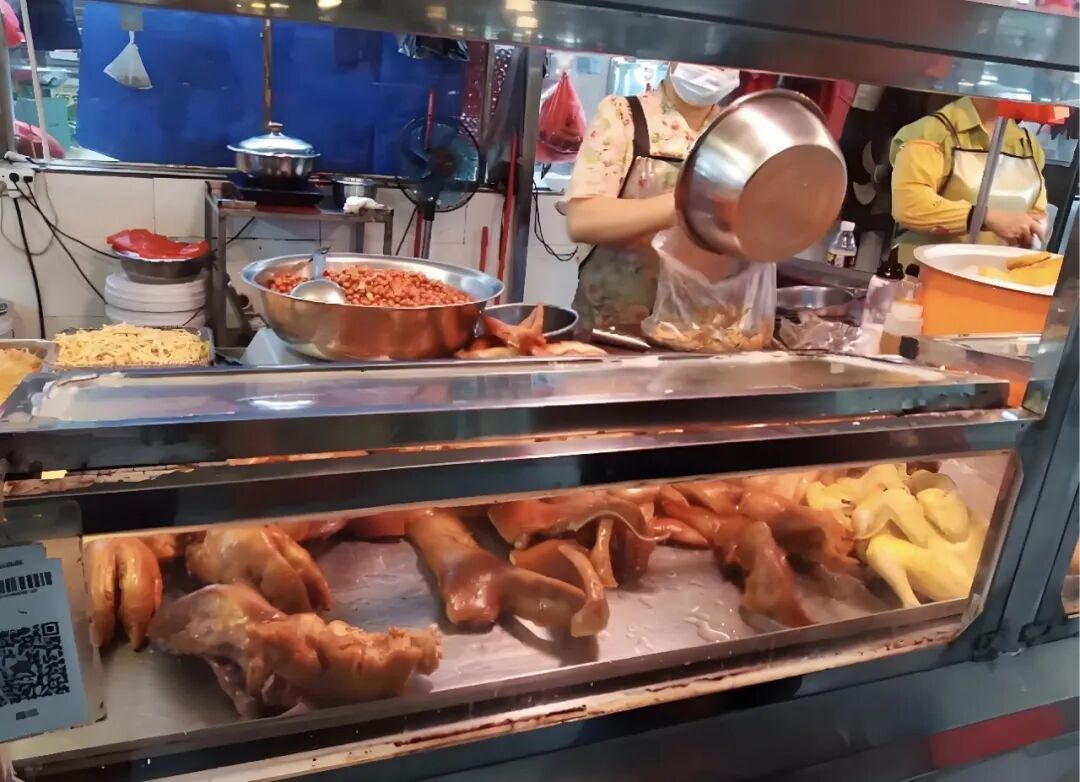
Core Insights - The retail landscape in county-level cities in China is experiencing significant divergence, with some businesses thriving while others struggle to survive [7][12][18] - Consumer preferences have shifted towards value and quality, leading to a decline in traditional retail formats [19][23] - The rise of discount stores and specialized food shops is reshaping the competitive dynamics in the retail sector [10][25] Summary by Sections Business Performance - Zhang Ning's熟食店 has been successful, selling around 500 kg of cold dishes daily, while other nearby stores are struggling [1][5] - The county has a low population density of approximately 400,000 residents, with a significant shift in consumer behavior towards new urban areas [3][5] - Discount stores are gaining traction, with one store achieving daily sales of 5,000 yuan shortly after opening, and sales peaking during holidays [8][10] Market Trends - The discount store model is expanding rapidly, with a projected 67% increase in the number of stores in 2024, particularly in county markets [10][11] - Consumers in county areas prioritize price, with 71% citing value for money as their primary consideration [10][11] - Traditional supermarkets are facing a decline, with average customer traffic down 23% and sales down 18% in 2024 [11][12] Consumer Behavior - There is a notable shift in consumer purchasing habits, with a significant increase in online shopping from 32% in 2019 to 58% in 2024 [21][19] - Consumers are increasingly favoring specialized stores over traditional supermarkets, which struggle to compete on price and convenience [14][23] Industry Dynamics - The retail industry is moving towards specialization, with discount stores focusing on specific product categories to enhance efficiency [23][25] - Rising operational costs, particularly in rent and labor, are challenging traditional retail formats, making it difficult for them to maintain profitability [25][26] - Capital investment is increasingly directed towards high-potential sectors like discount stores and specialty food shops, leaving traditional formats with less financial support [25][26] Regional Disparities - There are significant regional differences in consumer spending, with eastern coastal counties showing higher retail sales per capita compared to central and western counties [17][18] - The retail landscape is characterized by a mix of thriving and failing businesses, reflecting broader economic trends and consumer preferences [27]
良品铺子优化调整营收降至41亿 走高端还是性价比面临两难选择
Chang Jiang Shang Bao· 2025-11-09 23:31
Core Viewpoint - The leisure snack industry is undergoing significant changes, putting the company, Liangpinpuzi, in a difficult position as it faces declining revenues and profits due to increased competition from low-cost snack models [1][2][4]. Financial Performance - In the first three quarters of 2025, Liangpinpuzi reported revenue of approximately 4.1 billion yuan, a year-on-year decline of about 24%, and a net profit loss of 122 million yuan, marking a significant downturn [4][5]. - The company's revenue and net profit have been consistently declining since 2023, with revenues of 5.999 billion yuan and 5.480 billion yuan in the first three quarters of 2023 and 2024, respectively, reflecting declines of 14.33% and 8.66% [4][5]. - The net profit for 2024 was -46 million yuan, indicating the first annual loss for the company [5][6]. Market Dynamics - The rise of low-cost snack models has created intense competition, significantly impacting traditional high-end snack brands like Liangpinpuzi [2][9]. - The leisure snack market in China is over one trillion yuan, characterized by fragmentation and intense price competition [9]. Strategic Adjustments - Liangpinpuzi has attempted to adapt by reducing prices and entering the low-cost snack market, but these efforts have yielded limited results [3][10]. - The company has optimized its offline store strategy, leading to a reduction in store numbers and a corresponding decrease in sales [6][10]. Future Outlook - The company faces a critical juncture, needing to decide whether to continue its high-end strategy or pivot to compete in the low-cost segment, which could undermine its established brand positioning [11][12].