青岛银行

Search documents
金价、银价再创历史新高 银行保险箱租赁紧俏
Xin Lang Cai Jing· 2026-01-16 03:54
Group 1 - The demand for bank safe deposit boxes has surged due to the rising prices of gold and other precious metals, leading to a shortage of available boxes, especially smaller ones [1][8] - Many banks are now requiring clients to have a minimum financial asset threshold, often set at 1 million yuan, to rent a safe deposit box [1][5] - The price of gold futures recently exceeded $4600 per ounce, while silver prices approached $84 per ounce, both reaching historical highs due to geopolitical uncertainties [2][9] Group 2 - The supply of safe deposit boxes has not kept pace with the high demand, resulting in long waiting lists for potential renters [6][14] - Some banks have ceased offering new safe deposit box rentals due to high operational costs and limited profitability, indicating a potential decline in this service [14] - Banks are exploring innovative solutions, such as smart upgrades and service integration, to enhance operational efficiency and attract clients [15] Group 3 - The market anticipates that if gold and silver prices remain high, the demand for safe deposit boxes will continue to grow, driven by an increasing number of high-net-worth individuals seeking asset security [15]


银行“十万亿俱乐部”成员达10家
21世纪经济报道· 2026-01-16 03:03
记者丨叶麦穗 编辑丨方海平 银行业绩快报捷足先登,截至1月15日,已经有浦发银行、中信银行2家银行先后发布了2025 年的"成绩单",双双实现归母净利润正增长,不过从业绩快报来看,两家银行去年的发展路 径,有一定的区别,其中中信银行"稳扎稳打",浦发银行则是"高举高打",值得一提的是, 两大股份行还联袂迈入"10万亿俱乐部",至此该俱乐部的成员达到10家 。 规模指标上,报告期末,浦发银行集团口径下资产总额达100817.46亿元,较上年末增加 6198.66 亿 元 , 增 长 6.55%; 负 债 总 额 92573.16 亿 元 , 较 上 年 末 增 加 5402.17 亿 元 , 增 长 6.20%。 资产质量方面,两家银行则全部得以改善。中信银行不良率1.15%,略降0.01个百分点;拨备 覆盖率203.61%,同比下降5.82个百分点。整体来看算是"稳扎稳打"。 浦发银行则明显更加"进攻"。不良率1.26%,同比下降0.10个百分点;拨备覆盖率200.72%, 同比上升13.76个百分点显示出要将"蛋糕做大"的想法。 浙商证券银行业分析师邱冠华的观点认为,2025年浦发银行规模增长方面,总资产同 ...


银行财富管理架构变阵 抢滩300万亿居民资产
2 1 Shi Ji Jing Ji Bao Dao· 2026-01-15 15:07
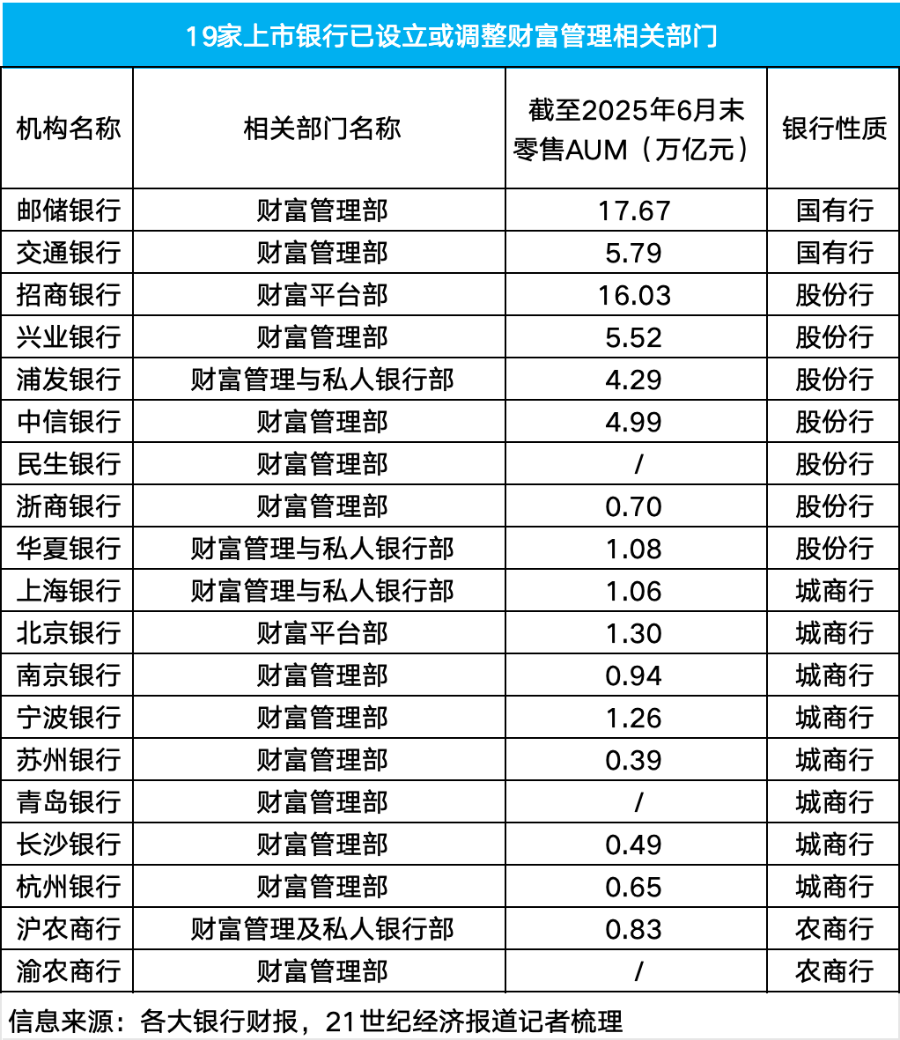
Core Insights - The wealth management market is heating up, with banks accelerating the integration of their wealth management departments to capture this promising market [1][2] - By June 2025, China's investable assets are expected to exceed 300 trillion yuan, indicating significant growth potential in wealth management as many assets remain "asleep" [1] - Major banks are restructuring their organizational frameworks to enhance their wealth management strategies and business layouts [1] Group 1: Bank Actions and Adjustments - In 2025, several major banks, including Bank of Communications and Postal Savings Bank, announced the establishment of wealth management departments at the head office level [3] - As of June 2025, 19 listed banks have established or adjusted their wealth management-related departments, including 2 state-owned banks, 7 joint-stock banks, 8 city commercial banks, and 2 rural commercial banks [3][4] - The establishment of these departments is seen as a key move for state-owned banks to deepen their wealth management strategies and promote digital transformation [3] Group 2: Strategic Focus and Market Dynamics - Different banks are focusing on various aspects of wealth management, with some emphasizing the establishment of wealth management departments as a core strategy [5] - The restructuring of wealth management departments signals a strategic shift in response to narrowing interest margins and evolving customer demands for diversified asset allocation [6][7] - The actions of major state-owned banks serve as a bellwether for the industry, indicating a shift from incremental competition to in-depth management of existing clients [8] Group 3: Wealth Management Market Landscape - As of June 2025, the retail asset management scale (AUM) among 42 listed banks shows a clear tiered structure, with state-owned banks leading the market [11] - The first tier includes major state-owned banks like ICBC, ABC, and CCB, with AUMs of 24 trillion yuan, 23.68 trillion yuan, and 22 trillion yuan respectively [11] - The second tier consists mainly of joint-stock banks, while the third tier includes city commercial banks and rural commercial banks, which are crucial for local wealth management ecosystems [11] Group 4: Future Competition and Technological Integration - Future competition in wealth management will focus on service quality, technological capabilities, and comprehensive financial ecosystems [13] - The establishment of wealth management departments aims to shift banks from product-driven to customer-driven models, enhancing service consistency and customer loyalty [13] - Financial technology is expected to play a critical role in enhancing service depth and breadth, with AI being utilized for investment advisory and customer experience management [14][15]
家庭资配视角:日本存款也搬家了吗?
NORTHEAST SECURITIES· 2026-01-15 14:42
Investment Rating - The report assigns an "Outperform" rating for the banking sector, indicating that the sector is expected to outperform the market benchmark in the next six months [5]. Core Insights - The core insight of the report is that the allocation of household assets in Japan is primarily influenced by the risk-return ratio. Even with declining deposit rates, the proportion of cash and deposits in household asset allocation tends to increase when risk aversion rises. There is no systemic shift of deposits towards riskier assets observed in the long term [1][10][16]. Summary by Sections Household Asset Allocation - The report examines the changes in household asset allocation in Japan since 1990, highlighting that the core factor influencing this allocation is the risk-return ratio. When risk aversion increases, the proportion of cash and deposits rises despite falling interest rates [1][10]. - The report suggests that household wealth allocation behavior aligns with the "Merton Rule," where the proportion of risk assets depends on expected returns, excess returns over risk-free rates, risk levels, and the household's risk aversion coefficient [2][12]. Financial Asset Flow and Structure - From a short-term perspective, the net flow of equity and fund investments is closely correlated with stock market performance. Positive net inflows occur during strong market performance, while negative outflows happen during weak performance [3][13]. - Long-term observations show that from 1994 to 2002, the proportion of deposits and cash increased from 49% to 54%, despite a shift in the structure of deposits where time deposits saw negative net flows while demand deposits increased [14][15]. Investment Outlook for 2026 - The report anticipates that high real interest rates will continue to suppress credit demand from private enterprises and retail sectors, with local state-owned enterprises expected to drive growth due to increased investment in larger provinces as per the "14th Five-Year Plan" [26]. - It is expected that there will be a significant interest rate cut in the first quarter of 2026, which may improve bank interest margins in the latter half of the year [26].
城商行板块1月15日跌0.59%,青岛银行领跌,主力资金净流入2.21亿元
Zheng Xing Xing Ye Ri Bao· 2026-01-15 08:59
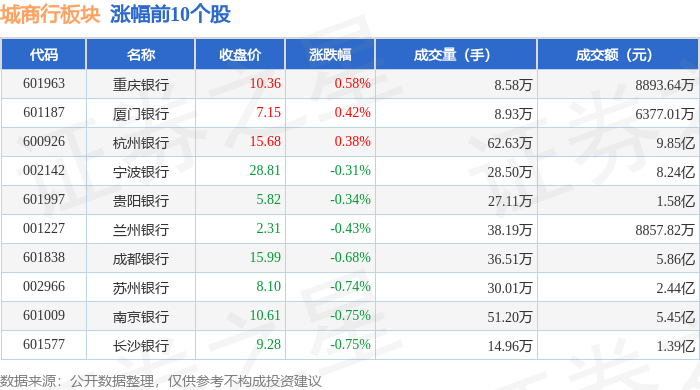
Market Performance - The city commercial bank sector declined by 0.59% on January 15, with Qingdao Bank leading the decline [1] - The Shanghai Composite Index closed at 4112.6, down 0.33%, while the Shenzhen Component Index closed at 14306.73, up 0.41% [1] Individual Stock Performance - Chongqing Bank closed at 10.36, up 0.58% with a trading volume of 85,800 shares and a transaction value of 88.94 million [1] - Xiamen Bank closed at 7.15, up 0.42% with a trading volume of 89,300 shares and a transaction value of 63.77 million [1] - Hangzhou Bank closed at 15.68, up 0.38% with a trading volume of 626,300 shares and a transaction value of 9.85 billion [1] - Ningbo Bank closed at 28.81, down 0.31% with a trading volume of 285,000 shares and a transaction value of 824 million [1] - Chengdu Bank closed at 15.99, down 0.68% with a trading volume of 365,100 shares and a transaction value of 586 million [1] Capital Flow Analysis - The city commercial bank sector saw a net inflow of 221 million from institutional investors and a net inflow of 296 million from speculative funds, while retail investors experienced a net outflow of 517 million [2] - Hangzhou Bank had a net inflow of 123 million from institutional investors, accounting for 12.51% of its total [3] - Shanghai Bank had a net inflow of 97.02 million from institutional investors, representing 20.87% of its total [3] - Nanjing Bank had a net inflow of 37.40 million from institutional investors, making up 6.86% of its total [3]

金价飙升后,银行里的“一尺铁柜”成了抢手货
Xin Lang Cai Jing· 2026-01-15 00:02
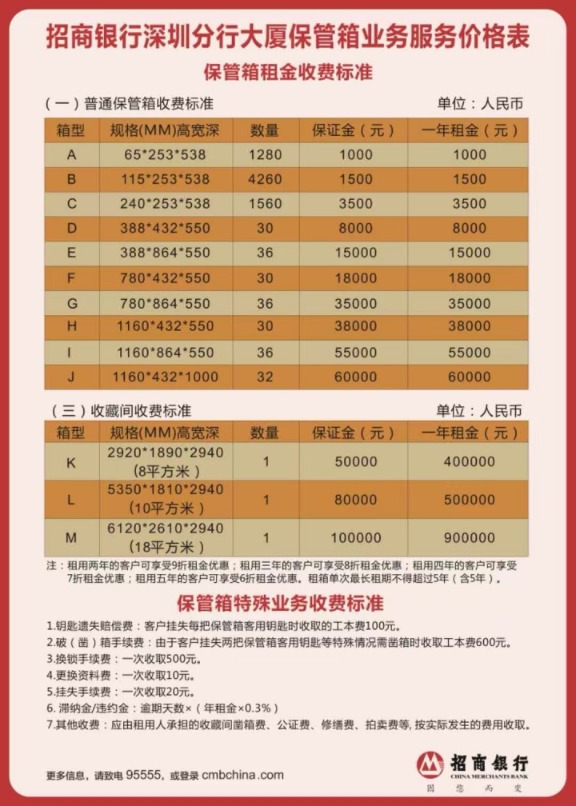
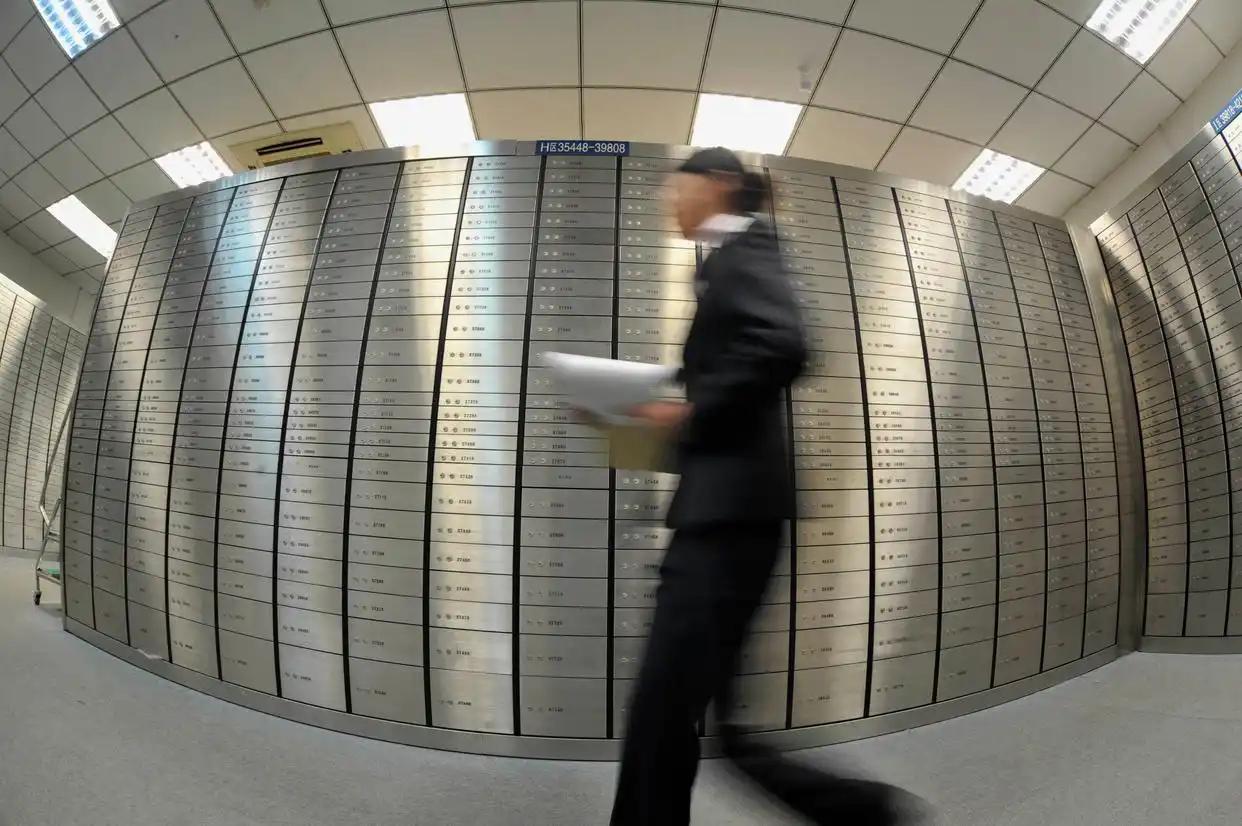
Core Insights - The rising gold prices have sparked a surge in demand for bank safe deposit boxes, leading to a situation where they are in high demand but low supply [1][4][12] - Many banks in Beijing report that all safe deposit boxes are currently rented out, with waiting lists exceeding 100 customers at some locations [2][10] - The demand for safe deposit boxes is driven by increased interest in gold investments, as geopolitical risks continue to elevate the appeal of gold as a safe-haven asset [4][12] Demand and Supply Dynamics - The demand for safe deposit boxes has significantly increased, with banks reporting a notable rise in inquiries since last year [4][12] - Banks are struggling to keep up with the demand, as the supply of safe deposit boxes has not increased in tandem, leading to a shortage [6][15] - Some banks have ceased offering safe deposit box services altogether due to high maintenance costs and low profitability [15][16] Pricing and Features - Different banks offer various sizes and pricing structures for safe deposit boxes, with significant variations in rental fees [3][11] - For example, at China Merchants Bank, the smallest box has a monthly rental fee of 50 yuan, while larger boxes can cost up to 42,000 yuan annually [11] - Postal Savings Bank offers a fully automated safe deposit box with advanced security features, including 24-hour monitoring and multiple verification methods for access [5][13] Market Trends - The ongoing geopolitical tensions and expectations of continued low interest rates are expected to sustain the demand for gold and, consequently, safe deposit boxes [4][12] - Investors are increasingly looking for secure storage options for their gold investments, as concerns about home security grow [4][12] - Some banks are innovating their services, such as offering promotional deals for customers purchasing gold products, to attract more clients [16]


青岛银行股份有限公司 首次公开发行A股前已发行股份上市流通提示性公告
Zhong Guo Zheng Quan Bao - Zhong Zheng Wang· 2026-01-14 22:51
登录新浪财经APP 搜索【信披】查看更多考评等级 本行及董事会全体成员保证公告内容的真实、准确和完整,没有虚假记载、误导性陈述或者重大遗漏。 特别提示: 1.首次公开发行A股前已发行股份本次解除限售的数量为80,005股,占青岛银行股份有限公司(以下简 称"本行")A股股份的0.0023%,占本行股份总额的0.0014%。 2.上述限售股上市流通日期为2026年1月16日(星期五)。 一、首次公开发行A股前已发行股份概况 1.首次公开发行A股情况 根据中国证券监督管理委员会《关于核准青岛银行股份有限公司首次公开发行股票的批复》(证监许可 ﹝2018﹞1727号),本行首次公开发行人民币普通股(A股)450,977,251股。根据深圳证券交易所《关 于青岛银行股份有限公司人民币普通股股票上市的通知》(深证上﹝2019﹞26号),本行于2019年1月 16日在深圳证券交易所挂牌上市。首次公开发行A股前,本行已发行的股份总额为4,058,712,749股;首 次公开发行A股后,本行股份总额增至4,509,690,000股。 2.本行A股上市后股份总额变动情况 2022年1月,本行按每10股配售3股的比例,向全体A股 ...
金价飙升后 银行里的“一尺铁柜”成了抢手货
Zhong Guo Zheng Quan Bao· 2026-01-14 21:10
Core Viewpoint - The surge in gold prices has led to a significant increase in demand for bank safe deposit boxes, resulting in a shortage of available boxes in Beijing banks [1][4]. Group 1: Demand for Safe Deposit Boxes - There is a booming demand for safe deposit boxes as residents are increasingly investing in gold, with reports indicating that many banks are fully booked and customers are facing long waiting lists [1][2]. - Some banks have reported waiting lists exceeding 100 people, with estimates suggesting that new customers may not be able to rent boxes until 2026 [2][4]. Group 2: Supply Constraints - The supply of safe deposit boxes has not kept pace with the rising demand, as only larger bank branches typically offer this service, and many smaller branches do not have safe deposit box facilities [1][6]. - Factors such as space limitations and high maintenance costs have prevented banks from expanding their safe deposit box offerings, leading to a decline in the availability of this service [6]. Group 3: Pricing and Variability - Different banks offer various sizes and pricing structures for safe deposit boxes, with significant differences in rental fees based on box dimensions [3][4]. - For example, at China Merchants Bank, the smallest box has a monthly rental fee of 50 yuan, while larger boxes can cost up to 42,000 yuan annually [3]. Group 4: Investor Sentiment and Alternatives - Investors express concerns about the safety of storing physical gold at home, leading many to prefer bank safe deposit boxes for their perceived security [5]. - Some investors are considering alternatives such as home safes due to the high rental costs and long wait times associated with bank safe deposit boxes [7]. Group 5: Innovations and Promotions - To address the supply-demand imbalance, some banks are exploring smart upgrades and promotional offers to attract customers, such as free rental periods for new clients purchasing gold products [7]. - For instance, Qingdao Rural Commercial Bank has offered promotional incentives for customers purchasing gold products, including free usage of safe deposit boxes for a limited time [7].
金价飙升后银行里的“一尺铁柜”成了抢手货
Zhong Guo Zheng Quan Bao· 2026-01-14 20:51
Core Insights - The rising gold prices have led to increased demand for bank safe deposit boxes, resulting in a shortage of available boxes in Beijing [1][3] - Many banks are experiencing a significant influx of customers seeking to rent safe deposit boxes, with some reporting waiting lists of over 100 people [1][3] - The supply of safe deposit boxes has not kept pace with the growing demand, leading to a situation where many banks are fully booked [1][4] Summary by Category Demand for Safe Deposit Boxes - Residents are increasingly interested in gold investments, prompting a surge in demand for safe deposit boxes for secure storage [3][4] - Bank staff have noted a marked increase in inquiries about safe deposit box rentals since last year [3][4] - Customers express concerns about storing physical gold at home due to security risks, further driving the demand for bank storage solutions [3][4] Supply Constraints - Many banks, particularly smaller branches, do not have safe deposit boxes available, and customers are often directed to larger branches where they may face long wait times [1][4] - The limited availability of safe deposit boxes is exacerbated by banks' reluctance to expand their facilities due to high costs and space constraints [4][5] - Some banks have ceased offering safe deposit box services altogether, citing low profitability and high maintenance costs [5] Pricing and Features - Rental prices for safe deposit boxes vary significantly across banks, with some offering lower-cost traditional boxes and others providing more expensive automated options [2][4] - For example, Beijing Bank charges 800 yuan per month for a specific automated box, while other banks have a wide range of pricing based on box size and features [2] - Banks are exploring innovative solutions, such as smart upgrades and promotional offers, to attract customers and alleviate supply issues [6]
金价大涨 银行保管箱“一箱难求”
Shang Hai Zheng Quan Bao· 2026-01-14 14:28
Core Viewpoint - The demand for bank safe deposit boxes has surged, leading to a situation where they are difficult to obtain, particularly in major cities like Shenzhen, Beijing, Shanghai, and Guangzhou. This trend has been primarily driven by a growing interest in precious metal investments, especially gold [1][7]. Group 1: Demand Dynamics - The phenomenon of "one box hard to find" has become prominent in the past year, with a significant increase in demand attributed to the investment boom in precious metals [1][7]. - Many banks, including major state-owned banks, are experiencing long waiting lists for safe deposit boxes, with some clients facing wait times of several years [2][5]. - The price of gold has been on the rise, reaching approximately $4,635 per ounce, with a year-to-date increase of about 6.5%, further fueling the demand for safe deposit boxes [7]. Group 2: Supply Constraints - The supply of safe deposit boxes has not kept pace with the rising demand, leading to a tightening of availability. Many banks are not expanding their services and some are even reducing them due to high operational costs and space limitations [8][9]. - The cost of establishing new high-security vaults is substantial, and the relatively low fees for safe deposit box rentals do not justify the investment for banks [9]. - Some banks have announced the discontinuation of safe deposit box services at certain branches due to operational adjustments [9]. Group 3: Customer Behavior and Preferences - Customers are increasingly seeking safe deposit boxes for storing not only traditional valuables but also investment gold bars, important documents, and sentimental items, reflecting a shift in the perception of asset security [8][9]. - The typical customer base for safe deposit boxes includes individuals and families looking for secure storage solutions for their valuable assets [6][10]. Group 4: Strategic Responses - In response to the demand-supply imbalance, banks are exploring strategies such as optimizing existing space and implementing technology to enhance operational efficiency [9][10]. - There is a growing recognition that the role of safe deposit boxes is evolving from mere storage to safeguarding both asset security and emotional value, necessitating a more nuanced approach to service offerings [9][10].