
新大陆

Search documents
计算机周观点第21期:城域“毫秒用算”行动启动,智算迎政策持续推荐-20251021
Haitong Securities International· 2025-10-21 12:34
Investment Rating - The report maintains an "Outperform" rating for the computer sector, suggesting a positive outlook for the industry [1][12]. Core Insights - The metropolitan "millisecond computing" initiative emphasizes low latency and high computing power requirements, with specific goals set for 2027 [12]. - Shanghai's smart terminal action plan aims to strengthen intelligent computing terminals and create computing clusters, promoting the application of core components like GPUs and interconnect modules [12]. - The emergence of domestic EDA and high-end testing equipment indicates a clear pace of domestic substitution in the industry [12]. Summary by Sections Metropolitan "Millisecond Computing" Initiative - The initiative sets three clear goals: computing center interconnection under 1 millisecond, resource access under 1 millisecond, and terminal network delay under 10 milliseconds by 2027 [12]. - Emphasis on the application of 400Gbps optical transmission and new network protocols is expected to benefit optical transmission, networks, edge nodes, and scheduling software [12]. Shanghai Smart Terminal Action Plan - The plan aims to enhance the capabilities of intelligent computing terminals and create a billion-level scale for local enterprises [12]. - It promotes the mass production of AI computers and smartphones, as well as the development of plug-and-play edge solutions [12]. Domestic EDA and Testing Equipment - New domestic EDA software and high-end testing equipment have been introduced, showcasing advancements in high-end measurement and industrial software [12]. - Taiwan Semiconductor Manufacturing's Q3 results exceeded expectations, indicating strong demand driven by AI and high-performance computing [12].


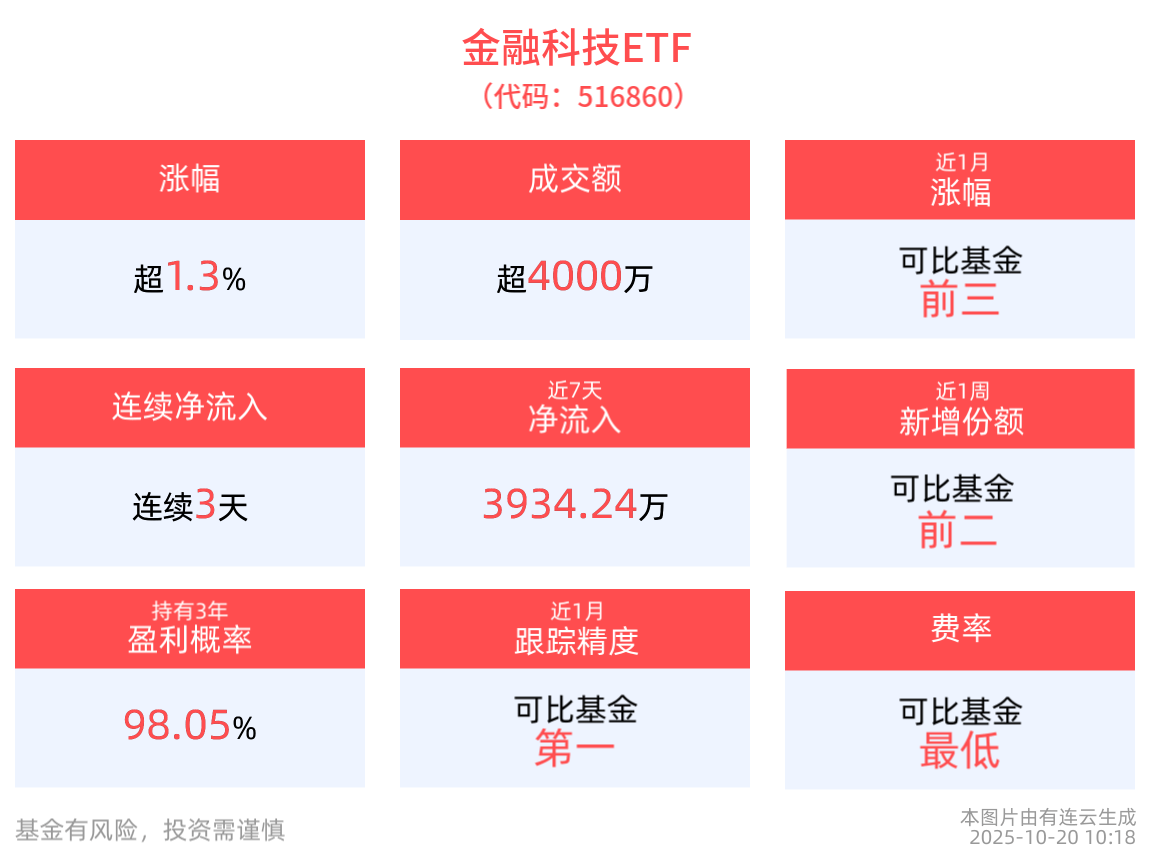
上海“AI-FI”实验室宣告成立,金融科技ETF(516860)涨超1%,连续3日获资金净流入
Sou Hu Cai Jing· 2025-10-20 02:56
Group 1 - The core viewpoint of the news highlights the strong performance of the financial technology sector, with the China Securities Financial Technology Theme Index rising by 1.52% and the Financial Technology ETF increasing by 1.38% as of October 20, 2025 [2][3] - The Financial Technology ETF has shown a significant increase of 26.79% over the past six months, ranking 3rd out of 6 comparable funds [2] - The trading volume of the Financial Technology ETF reached 43.1491 million yuan, with a turnover rate of 1.79% [2] Group 2 - The establishment of the "Shanghai AI-Financial Laboratory" during the Global Wealth Management Forum aims to promote the integration of AI technology with the financial industry, marking a significant step in Shanghai's financial technology ecosystem [3] - The Vice President of the People's Bank of China emphasized the need for countries to develop financial systems that align with their technological development stages [3] - The Financial Technology ETF's latest scale reached 2.376 billion yuan, ranking 2nd out of 6 comparable funds [3] Group 3 - The Financial Technology ETF has seen a net inflow of 28.4017 million yuan over the past three days, with a maximum single-day net inflow of 20.9822 million yuan [4] - The index closely tracks companies involved in financial technology, with the top ten weighted stocks accounting for 55.55% of the index [4]



有的“+收益” 有的“-本金” “固收+”基金同类不同命
Zhong Guo Zheng Quan Bao· 2025-10-19 22:33
Core Insights - The "fixed income +" funds have become a market hotspot, with several large fund companies launching new products and increasing their holdings in existing ones [1][6] - There is significant performance differentiation among "fixed income +" funds, with some achieving over 20% returns while others have negative returns, leading to a performance gap exceeding 40 percentage points [1][4] Performance Analysis - As of October 16, 79 mixed bond funds achieved returns over 20% in the past year, with median returns of 3.18% for mixed bond type I funds and 6.02% for mixed bond type II funds [1] - High-performing "fixed income +" funds predominantly invested in convertible bonds and had substantial equity positions, particularly in technology stocks [2][3] Fund Characteristics - The top-performing mixed bond type II fund, Huashang Fengli Enhanced Open-End Bond, recorded a return of 39.48%, with an equity position of approximately 18.93%, indicating a more aggressive investment strategy [2] - Similar strategies were observed in other high-return funds, such as Huabao Enhanced Income Bond, which also focused on a diversified stock portfolio with a strong emphasis on technology stocks [3] Investment Strategy - The performance of "fixed income +" funds is influenced by stock allocation, bond configuration, and yield enhancement strategies, leading to significant performance disparities [4][5] - The core differences in "fixed income +" funds lie in the stock-bond ratio and the extent and method of the "+" component, affecting expected returns, volatility, and maximum drawdown [5] Market Trends - Since September, "fixed income +" products have gained traction in the market, with major fund companies launching new products and actively managing existing ones [6] - The current low-risk-free interest rates make pure bond products less appealing, while the high volatility of equity products may not suit all investors, positioning "fixed income +" as a balanced investment solution [6]
“固收+”基金同类不同命
Zhong Guo Zheng Quan Bao· 2025-10-19 20:13
Core Insights - The "fixed income +" funds have become a market hotspot, with several large fund companies launching new products and increasing their holdings in existing ones [1][4] - There is significant performance differentiation among "fixed income +" funds, with some achieving over 20% returns while others have negative returns, leading to a performance gap exceeding 40 percentage points [1][3] Performance Analysis - As of October 16, 79 mixed bond funds achieved returns over 20% in the past year, with median returns of 3.18% for mixed bond type I funds and 6.02% for mixed bond type II funds [1] - High-performing "fixed income +" funds tend to have substantial positions in convertible bonds and a higher equity allocation, particularly in technology stocks [1][2] - For instance, the Huashang Fengli Enhanced Open-End Bond Fund achieved a return of 39.48%, with an equity position of approximately 18.93% [1] Fund Strategies - The performance of "fixed income +" funds is influenced by stock allocation, bond configuration, and yield enhancement strategies [3] - Successful funds often utilize a combination of convertible bonds, equity investments, and other strategies to enhance returns [3] - Conversely, some funds have underperformed due to a lack of equity exposure or poor stock selection, leading to negative returns [2][3] Market Trends - Since September, "fixed income +" products have gained traction as the equity market enters a volatile phase, prompting major fund companies to launch new products [3][4] - The current low-risk interest rates make pure bond products less appealing, while the high volatility of equity products does not suit all investors, positioning "fixed income +" as a balanced investment solution [4][5] Investor Appeal - "Fixed income +" products are seen as a stabilizing asset allocation tool for conservative investors, offering a blend of fixed income and equity characteristics [5] - The strategy aims to provide a flexible response to varying market conditions, maintaining a balance between growth and risk mitigation [5]
首尾差异超40个百分点!“固收 +”基金的冰与火
Zhong Guo Zheng Quan Bao - Zhong Zheng Wang· 2025-10-19 03:51
Core Insights - The "fixed income +" products have gained popularity due to their combination of stability and yield flexibility, with several large fund companies launching new "fixed income +" funds and intensifying marketing efforts for existing products [1][9] - Over the past year, the overall performance of "fixed income +" products has been impressive, but there is significant performance disparity among them, with some funds achieving over 20% returns while others have negative returns [1][6] Performance Disparity - The performance difference among mixed bond-type secondary funds has exceeded 42 percentage points over the past year [2][7] - As of October 16, 79 mixed bond-type primary and secondary funds have achieved returns exceeding 20%, with median returns of 3.18% for primary funds and 6.02% for secondary funds [3] Fund Characteristics - Funds with returns over 20% typically have high allocations in convertible bonds and a significant equity position, actively investing in technology stocks [4] - The top-performing mixed bond-type secondary fund, Huashang Fengli Enhanced Open-End Bond, achieved a return of 39.48%, with an equity allocation of approximately 18.93% [4] - The Huabao Enhanced Income Bond Fund also showed strong performance with over 37% returns, focusing on aggressive allocations in small and mid-cap technology stocks [4] Investment Strategies - The best-performing mixed bond-type primary funds are primarily convertible bond funds, with notable returns such as 29.81% for Everbright High-Grade Bond Fund and over 23% for Minsheng Jia Yin Xinxiang Bond Fund [5] - The performance of "fixed income +" funds is significantly influenced by stock allocation, bond configuration, and yield enhancement strategies [7][9] Market Trends - Since September, the equity market has entered a volatile phase, making "fixed income +" products a hot topic for fund companies, with several large firms launching new products [9] - The current low-risk interest rates make pure bond products less appealing, while the high volatility of equity products does not suit all investors, positioning "fixed income +" as a compromise solution [9][10]
支付行业深度洗牌:年内11张牌照注销,资本竞逐新赛道
Huan Qiu Wang· 2025-10-19 02:24
Group 1 - The non-bank payment industry is undergoing a wave of consolidation and exit, with 11 payment institutions having their licenses revoked this year, indicating increasing survival pressure on smaller players amid stricter regulations and fierce market competition [1] - Major players in the industry, such as Shanghai Fuyou Payment and Lakala, are strengthening their market positions through capital increases and mergers, reflecting a trend of capital concentration [1] - The number of active third-party payment companies has decreased from 271 to 164 since the issuance of licenses by the central bank, highlighting a significant industry consolidation [1] Group 2 - The implementation of the new regulatory guidelines in July 2024 will raise the minimum registered capital requirement for non-bank payment institutions to 100 million yuan, significantly increasing the entry barriers for the industry [3] - This regulatory change indicates a shift from scale competition to quality competition, with payment licenses concentrating on entities that have ecosystems, scenarios, and compliance capabilities [3] Group 3 - Cross-border payment is emerging as a new growth area, with companies like Lianlian Digital and PayPal actively acquiring overseas payment licenses to accelerate their global expansion [5] - Lianlian Digital reported a 27.9% year-on-year revenue growth in its 2024 financial report, demonstrating strong development momentum [5] - The industry is expected to focus on the "Payment+" strategy, extending into high-value sectors such as supply chain finance and SaaS services, as domestic competition intensifies [5]

抢滩万亿跨境支付市场
21世纪经济报道· 2025-10-18 15:07
Core Insights - The cross-border payment sector is experiencing rapid growth, with foreign institutions acquiring domestic licensed entities to gain access to China's payment licenses [1][14] - The global cross-border payment market is projected to reach $320 billion by 2030, with a compound annual growth rate (CAGR) of 7.1% [1][5] - China's cross-border e-commerce imports and exports are expected to grow by 10.8% in 2024, reaching 2.63 trillion yuan, providing new opportunities for payment institutions [1][4] Market Dynamics - The competitive landscape in China's payment market is intensifying, prompting established payment institutions to explore overseas markets [1][5] - The cross-border payment market is supported by a significant market potential, with the global market size reaching approximately $212.55 billion in 2024 [5][4] - The growth of cross-border e-commerce is a key driver for the expansion of cross-border payment services, with a CAGR of about 15% from 2020 to 2024 [4][5] Strategic Moves by Companies - Companies like Lakala and others are actively pursuing internationalization strategies, including issuing H-shares and expanding their cross-border payment services [6][7] - New players in the cross-border payment space are focusing on emerging markets, with some achieving profitability within two years of operation [8][10] - Established companies are also enhancing their cross-border payment capabilities, with significant investments in technology and service offerings [7][10] Regulatory Environment - The tightening of regulations in the domestic payment industry is pushing companies to acquire licensed entities to ensure compliance and enhance service capabilities [12][14] - Recent regulatory changes require foreign non-bank institutions to establish local entities to provide cross-border payment services, making acquisitions of licensed firms a strategic necessity [12][14] Future Opportunities - The B2B cross-border trade payment, import e-commerce, and localized payment solutions are identified as key growth areas with significant potential [8][10] - The demand for cross-border payment services is expected to continue growing, driven by the increasing globalization of businesses and the need for efficient payment solutions [12][14]



年内11张牌照注销 支付行业整合出清持续
Zhong Guo Jing Ying Bao· 2025-10-18 13:08
Core Insights - The non-bank payment industry in China is undergoing significant consolidation, with 9 non-bank payment institutions undergoing major changes this year, including increased shareholding by major stakeholders in some companies [1] - The industry is entering a deep reshuffling phase characterized by compliance and consolidation, with new regulations raising the minimum registered capital for non-bank payment institutions to RMB 100 million [2] - The trend indicates a shift from scale competition to quality competition, with payment licenses concentrating among entities with ecosystems, scenarios, and compliance capabilities [2] Industry Developments - A total of 271 third-party payment companies have received payment licenses since the central bank began issuing them, with only 164 currently holding valid licenses as of October 2025 [2] - Recent actions by payment institutions, such as capital increases and executive changes, reflect their proactive approach to regulatory compliance and market adaptation [3] Capital Flow and Market Trends - The cross-border payment sector is experiencing rapid growth, contrasting with the contraction of the traditional card payment market [4] - Companies like Lianlian Digital and PayPal are actively acquiring overseas payment licenses, indicating a strategic push towards international markets [4][5] - Lianlian Digital reported a revenue of RMB 1.315 billion for 2024, a 27.9% increase year-on-year, with a gross profit of RMB 683 million and a gross margin of 51.9% [4] Strategic Focus - Payment institutions are advised to view compliance as a lifeline and invest in technology for risk control, data security, and fraud prevention [4] - There is a growing emphasis on deepening service scenarios and enhancing technological capabilities to provide innovative and high-quality payment products and services [5]
抢滩万亿跨境支付市场
2 1 Shi Ji Jing Ji Bao Dao· 2025-10-17 12:38
Core Insights - The cross-border payment sector is experiencing rapid growth, with foreign institutions like Payoneer and Sunrate acquiring domestic licensed entities to gain access to China's payment licenses [1][10] - The global cross-border payment market is projected to reach $320 billion by 2030, with a compound annual growth rate (CAGR) of 7.1% from $212.55 billion in 2024 [1][3] - China's cross-border e-commerce imports and exports are expected to grow by 10.8% in 2024, reaching 2.63 trillion yuan, highlighting the resilience of foreign trade and the growth opportunities for payment institutions [2][3] Industry Trends - The competitive landscape in China's payment market is intensifying, prompting established payment institutions to expand into overseas markets, while new entrants like LianLian and PingPong leverage their first-mover advantages in cross-border payments [1][3] - The demand for cross-border payment services is driven by the expansion of global e-commerce, with a CAGR of 17% in the cross-border e-commerce sector [3][6] - The Chinese payment industry is transitioning from a phase of rapid expansion to stable development, with increasing market concentration as smaller players consolidate or exit the market [3][5] Company Developments - Companies like Lakala and Newland are signaling their commitment to cross-border payment services through strategic initiatives and resource allocation [5][7] - Notable foreign payment brands are entering the Chinese market through acquisitions of local licensed institutions, enhancing their compliance and service capabilities [9][10] - Startups in the cross-border payment space are focusing on emerging markets, with some achieving profitability within two years by partnering with licensed domestic payment institutions [6][8] Regulatory Environment - The tightening of regulations in China necessitates that foreign non-bank institutions establish local entities to provide cross-border payment services, making the acquisition of licensed institutions a strategic priority [9][11] - The recent regulatory changes emphasize the importance of compliance and local operations for foreign payment providers seeking to enter the Chinese market [9][11]
新大陆:截至2025年9月30日,公司股东人数为66036户
Zheng Quan Ri Bao Wang· 2025-10-17 10:41
Core Insights - The company Newland (000997) reported that as of September 30, 2025, the number of shareholders is 66,036 [1] Company Summary - Newland's shareholder count is projected to reach 66,036 by the end of September 2025 [1]