
跨境支付

Search documents
全国政协委员、工商银行原董事长陈四清:加大金融赋能力度 助力外贸高质量发展
Xin Lang Cai Jing· 2026-03-09 00:12
Core Viewpoint - Financial services play a crucial role in promoting high-quality development of foreign trade, and there is a need to enhance support and service quality for foreign trade [1][4]. Economic Performance - In the past year, China's economy has shown resilience and vitality, reaching a total economic output of 140 trillion yuan, with foreign trade maintaining a stable growth, reporting a goods import and export value exceeding 45 trillion yuan [1][4]. Challenges in Foreign Trade - The environment for foreign trade is becoming increasingly complex, with rising uncertainties and unpredictable factors, including fluctuating tariff policies, prolonged trade frictions, ongoing geopolitical conflicts, high international energy and raw material prices, and increased risks in cross-border financial settlements and exchange rate fluctuations [1][5]. Financial Support Strategies - To enhance financial support for high-quality foreign trade development, four key areas of focus are proposed: embedding a new overseas comprehensive service system, meeting the new financial needs of outbound enterprises, assisting in the construction of a new cross-border RMB framework, and optimizing services for new outbound business models [2][5]. Integration of Financial Services - Financial services should be deeply integrated into the overseas comprehensive service system, collaborating with customs, legal, and logistics institutions to optimize cross-border payment, financing, and guarantee products, providing full-process and integrated financial support for outbound enterprises [2][5]. Risk Management for Outbound Enterprises - Outbound enterprises face challenges in risk management due to rapidly changing international conditions and global financial markets, necessitating better strategies to avoid financial burdens from currency and term mismatches, and to enhance fund utilization efficiency [2][5]. Product Diversification - Financial institutions need to expand their product offerings beyond basic services like payment and financing to include exchange rate hedging, export credit insurance, and cross-border cash pools, as well as advisory and structured financing services to support safe outbound operations [3][6]. RMB Internationalization - Improving the cross-border RMB layout and accelerating the establishment of a RMB international "reflow" mechanism is essential, with a focus on enhancing export settlement in local currency and gradually increasing capital account openness [3][6]. Support for New Business Models - Financial support should adapt to the trends of digitalization and greening in foreign trade, actively engaging with new business models such as cross-border e-commerce and overseas warehouses, creating suitable financial products, simplifying settlement processes, and improving financing efficiency [3][6].

两会|全国政协委员陈四清:加大金融赋能外贸高质量发展力度
券商中国· 2026-03-08 06:53
Core Viewpoint - Financial services play a crucial role in promoting high-quality development of foreign trade, and there is a need to enhance support and service quality for foreign trade [1]. Group 1: Economic Performance - In the past year, China's economy has shown resilience and vitality, achieving a total economic output of 140 trillion yuan, with foreign trade maintaining growth and quality improvements [1]. - The total import and export value exceeded 45 trillion yuan, with a historical trade surplus surpassing 1 trillion USD [1]. Group 2: Challenges in Foreign Trade - Despite notable achievements, China's foreign trade faces increasingly complex environments, including fluctuating tariff policies, prolonged trade frictions, and rising geopolitical risks [1]. - Additional challenges include high international energy and raw material prices, disrupted logistics, increased cross-border financial settlement risks, and elevated compliance standards affecting Chinese enterprises' overseas market expansion [1]. Group 3: Financial Support Strategies - Financial services need to be deeply integrated into overseas comprehensive service systems, collaborating with customs, legal, and logistics institutions to optimize cross-border payment, financing, and guarantee products [2]. - There is a necessity to enhance financial products to help enterprises manage risks related to currency mismatches and improve fund utilization efficiency, addressing the needs of companies operating in multiple currencies and accounts [2]. - Strengthening the cross-border RMB layout and establishing a mechanism for RMB international "reflow" is essential, promoting the use of local currency for exports and gradually increasing capital account openness [2]. Group 4: New Business Models - To optimize services for new business models, financial support should align with the trends of digitalization and greening in foreign trade, facilitating the integration of service trade and domestic and foreign trade [3]. - Financial products should be tailored to meet the demands of emerging business models such as cross-border e-commerce and overseas warehouses, simplifying settlement processes and enhancing financing efficiency [3].


传统业务承压 支付机构亟待转型
Zhong Guo Zheng Quan Bao· 2026-02-03 20:27
Core Insights - Several payment institutions, including Lakala and Newland, have recently released their 2025 performance forecasts, indicating that while some companies show profit growth due to non-recurring gains, their core net profits have generally declined after excluding these gains [1][2] Group 1: Financial Performance - Lakala expects a net profit attributable to shareholders of between 1.06 billion to 1.2 billion yuan for 2025, representing a growth of 202% to 242% year-on-year. However, its net profit after excluding non-recurring gains is projected to decline by 26% to 46%, amounting to 300 million to 410 million yuan [1] - Newland anticipates a net profit attributable to shareholders of 400 million to 500 million yuan for 2025, reflecting a year-on-year increase of 70.79% to 113.49%. Its net profit after excluding non-recurring gains is expected to decrease by 8.60% to 28.91%, totaling 350 million to 450 million yuan [1] - Highsun Technology, the parent company of Suixing Pay, reported an operating loss of approximately 240 million Hong Kong dollars for the first 11 months of 2025, with expectations of continued losses for the entire year [2] - Cuiwei Co., the parent company of Haike Rongtong, forecasts a net loss of between 490 million to 450 million yuan for 2025, which is a reduction in losses by 197 million to 237 million yuan compared to the previous year [2] Group 2: Business Challenges - The decline in net profit after excluding non-recurring gains is attributed to multiple factors, including the impact of digital payment competition, shrinking acquiring business, and a decrease in bank card payment transaction volumes [2][3] - Newland reported that its transaction volume for domestic acquiring business is expected to be approximately 14.7 trillion yuan for 2025, remaining stable compared to the previous year, but revenue and gross margin from acquiring and value-added services have decreased [3] - Cuiwei Co. indicated that its subsidiary Haike Rongtong is facing intense market competition and declining gross margins in the acquiring industry, leading to anticipated operating losses [3] Group 3: Business Transformation - In response to the pressures on traditional payment businesses, many payment institutions are seeking to explore new business areas, such as cross-border payments and AI integration [4] - Newland is increasing resource investment in cross-border payment business, focusing on product development and bank channel construction to enhance competitiveness [4] - Lakala plans to further integrate payment services with SaaS and AI in 2026 to drive transformation [4]
开联通支付被罚款3843万元 涉违规开展T+0交易结算等7项违法行为
Feng Huang Wang Cai Jing· 2026-01-22 09:44
Core Viewpoint - Kailiantong Payment has been penalized for multiple violations, resulting in a total fine and confiscation amounting to approximately 38.43 million yuan [1][2][3]. Group 1: Violations and Penalties - The company was found guilty of seven types of violations, including failure to ensure transaction information is true, complete, and traceable, and not strictly implementing risk monitoring requirements [1][2]. - The total amount confiscated from the company was 25.557 million yuan, with an additional fine of 12.878 million yuan, leading to a combined penalty of 38.43 million yuan [1][2]. - A specific individual, Song Mou Ping, was held directly responsible for five of these violations and fined 224,548.57 yuan [1][2]. Group 2: Previous Penalties - This incident marks the second penalty for Kailiantong Payment since last year, with a previous fine of 1.1885 million yuan imposed on February 8, 2025, for three violations related to customer identity verification and reporting obligations [3]. Group 3: Company Background - Kailiantong Payment was established in 2010 with a registered capital of 100 million yuan and is one of the first 27 non-bank payment institutions to receive a payment business license from the People's Bank of China [2]. - The company's main services include prepaid card issuance and acceptance, internet payment, cross-border payment, and customized enterprise payment solutions [2].
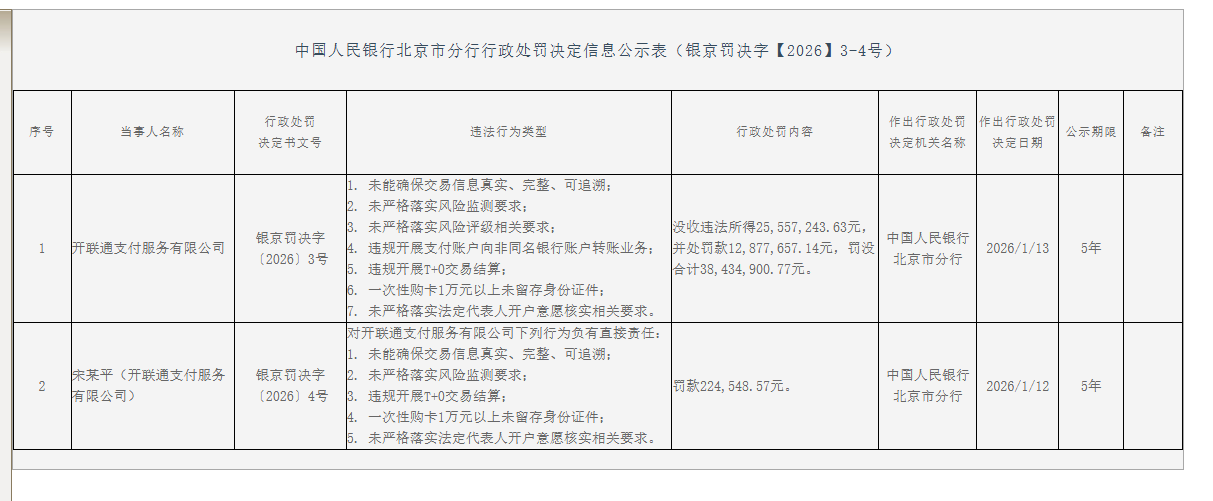
开联通支付,被重罚3843万元!
Shen Zhen Shang Bao· 2026-01-22 04:37
Core Viewpoint - The People's Bank of China (PBOC) has imposed a total fine of 38.43 million yuan on Kailiantong Payment Service Co., Ltd. for seven violations, including illegal T+0 transaction settlements and failure to ensure the authenticity and traceability of transaction information [1][3][5]. Group 1: Violations and Penalties - Kailiantong Payment was fined 25.56 million yuan for illegal gains and an additional 12.88 million yuan in penalties, totaling 38.43 million yuan [1][3]. - The seven types of violations include: 1. Failure to ensure transaction information is authentic, complete, and traceable 2. Not strictly implementing risk monitoring requirements 3. Not adhering to risk rating requirements 4. Conducting transfers from payment accounts to non-matching bank accounts 5. Engaging in T+0 transaction settlements 6. Failing to retain identification documents for card purchases over 10,000 yuan 7. Not verifying the account opening intentions of legal representatives [3][4]. Group 2: Company Background and Previous Penalties - Kailiantong Payment, established in 2010 with a registered capital of 100 million yuan, is one of the first 27 non-bank payment institutions to receive a payment business license from the PBOC [5]. - The company has received penalties previously, including a fine of 1.19 million yuan in February 2025 for failing to identify customers properly [5]. - The company has multiple execution records and has been urged to pay overdue taxes, including value-added tax and urban maintenance construction tax [5].
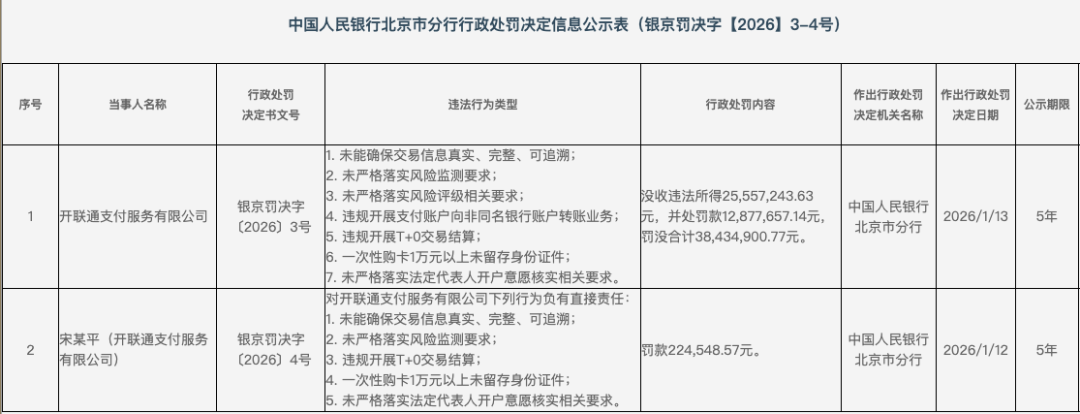
促进生产性服务业扩能提质
Jing Ji Ri Bao· 2026-01-20 22:12
Core Insights - The production service industry is crucial for enhancing production efficiency and supporting agricultural and industrial activities, as highlighted in the "14th Five-Year Plan" which emphasizes the need for specialization and high-end value chain extension [2][4] Group 1: Industry Development - The production service industry has seen significant growth, with revenue from large-scale enterprises reaching 119 trillion yuan in 2023, reflecting an average annual growth rate of 12.1% from 2020 to 2023, surpassing GDP growth during the same period [5] - The integration of production services with advanced manufacturing is essential for driving the transformation and upgrading of the manufacturing sector, fostering a dual cycle of service support for manufacturing and vice versa [6][7] Group 2: Technological Integration - The application of technologies such as artificial intelligence, big data, and industrial internet is enhancing the efficiency and value of production services, facilitating a more intelligent and digitalized manufacturing process [5][8] - The promotion of smart technologies and the establishment of platforms for technology transfer are critical for accelerating the transition from laboratory innovations to production applications [6][8] Group 3: Policy Recommendations - To optimize the development environment for the production service industry, it is recommended to promote the application of digital technologies, cultivate diverse service providers, and enhance policy support mechanisms [8][9] - Expanding financial incentives and tax benefits for high-end production services, while lowering market entry barriers, is essential for fostering a competitive and efficient production service sector [9]
金融活水润泽文旅小微 多方聚力共绘发展新篇
Zheng Quan Ri Bao Wang· 2026-01-19 11:49
Core Insights - The "Golden Enterprise Project - Visa Promoting Cultural and Tourism Consumption, Micro and Small Enterprises Financial Empowerment Plan" aims to enhance the financial resilience of micro and small enterprises in the cultural and tourism sectors, promoting high-quality development of the private economy in these industries [1][2] Group 1: Project Overview - The project is organized by the China Financial Education Development Foundation and Visa, with support from various local organizations, and focuses on integrating financial services with cultural and tourism sectors [1] - The initiative has been implemented in 20 cities across China, reaching over 30,000 micro and small enterprises, thereby injecting financial resources into the cultural and tourism sectors [2][3] Group 2: Implementation and Activities - The project employs both online and offline formats, focusing on specific local cultural and tourism development characteristics, and covers areas such as "Cultural Tourism + Foreign Trade," "Cultural Tourism + Commerce," and "Cultural Tourism + AI" [3] - It includes specialized training and expert-led online lectures to help enterprises understand financial support policies and opportunities in the cultural and tourism sectors, enhancing skills in cross-border payment optimization and digital marketing [3]
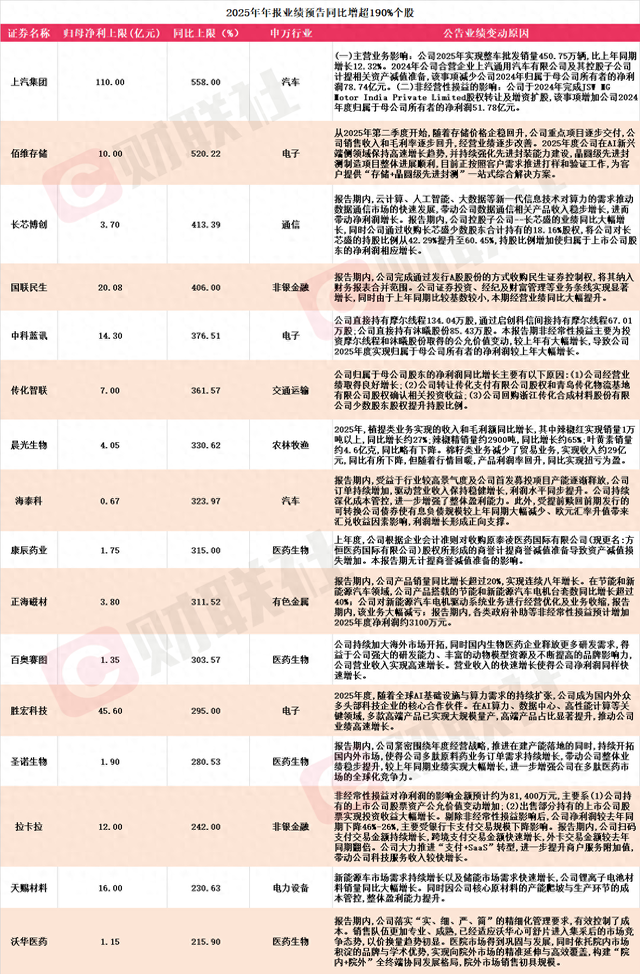
A股年报行情发布,16家上市公司净利最高同比预增超200%
Sou Hu Cai Jing· 2026-01-19 02:53
Group 1 - The core viewpoint of the news is that several A-share companies have released their 2025 annual profit forecasts, with significant expected growth in net profits for multiple firms, particularly in the automotive and technology sectors [1][4][5] Group 2 - A total of 366 A-share listed companies have announced their 2025 annual profit forecasts, with 16 companies, including SAIC Motor, Bawei Storage, and Changxin Bochuang, expecting a year-on-year increase in net profit exceeding 200% [4] - SAIC Motor leads with an expected net profit of 9 billion to 11 billion yuan, representing a year-on-year increase of 438% to 558%, driven by increased vehicle wholesale sales and a low base from asset impairment provisions in 2024 [4] - Bawei Storage anticipates a net profit of 850 million to 1 billion yuan, with a growth rate of 427.19% to 520.22%, and a projected Q4 net profit of 820 million to 970 million yuan, significantly above analyst expectations [4] - Changxin Bochuang expects a net profit of 320 million to 370 million yuan, reflecting a growth of 344.01% to 413.39%, supported by the demand for data communication products driven by advancements in cloud computing and AI [5] - Lakala, a cross-border payment concept stock, forecasts a net profit of 1.06 billion to 1.2 billion yuan, marking a growth of 202% to 242%, attributed to increased investment income and a surge in payment transaction volumes [5]

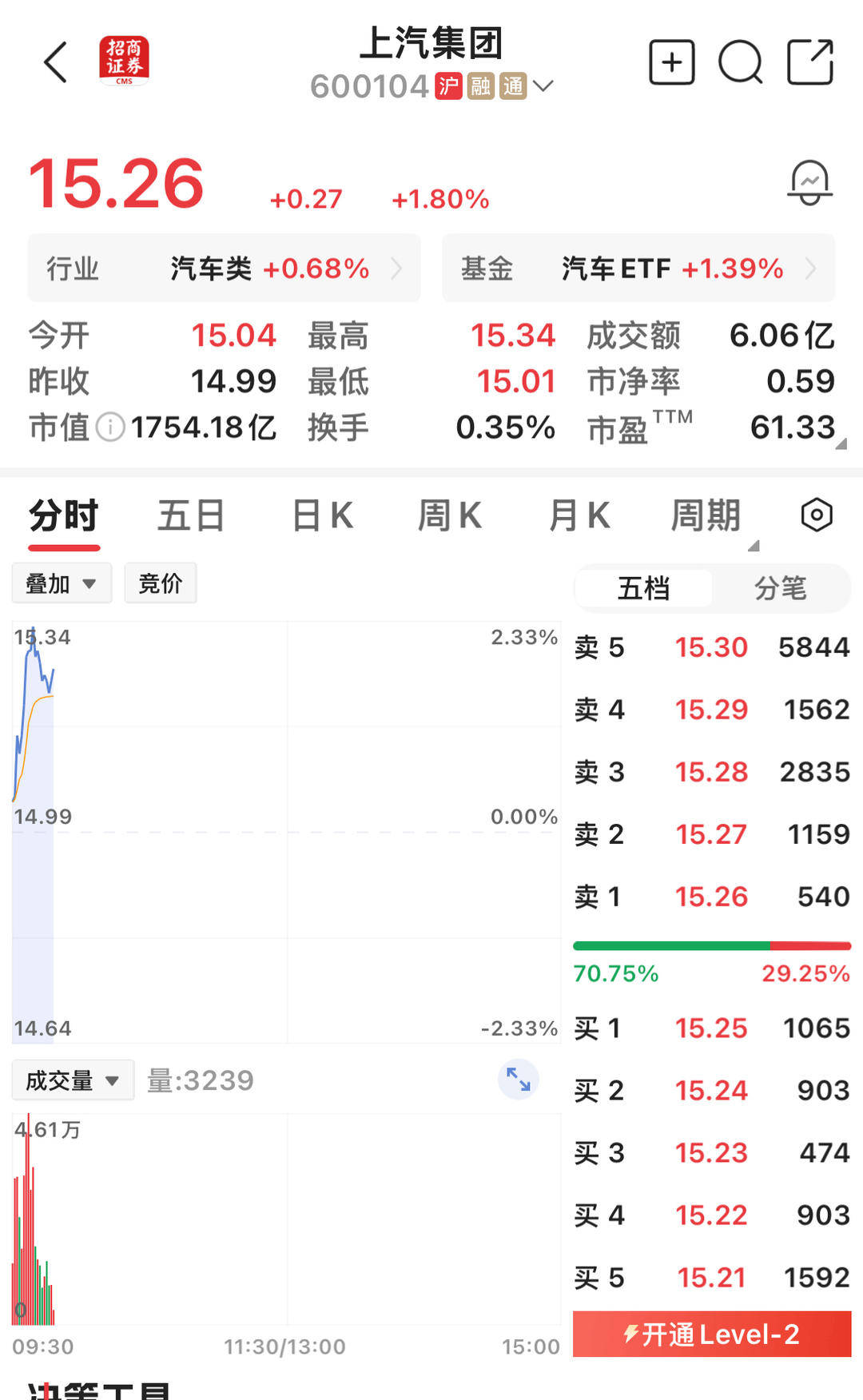
应声20CM涨停!A股年报行情如火如荼,16家上市公司净利最高同比预增超200%
Xin Lang Cai Jing· 2026-01-18 09:48
Core Viewpoint - The A-share annual report season is in full swing, with significant performance forecasts for 2025 from various companies, leading to notable stock price increases for several firms [1] Group 1: Performance Forecasts - A total of 366 A-share listed companies have released their 2025 annual performance forecasts, with 16 companies expecting a year-on-year net profit increase of over 200% [1] - SAIC Motor Corporation leads with an expected net profit increase of 438% to 558%, projecting a profit of 9 billion to 11 billion yuan due to increased vehicle sales and a low base from asset impairment in 2024 [2][3] - BAW Storage anticipates a net profit of 850 million to 1 billion yuan, representing a year-on-year growth of 427.19% to 520.22%, driven by a recovery in storage prices and strong demand in AI sectors [3] Group 2: Sector Highlights - Longxin Bochuang expects a net profit of 320 million to 370 million yuan, reflecting a growth of 344.01% to 413.39%, supported by increased demand in data communication markets [5] - Lakala forecasts a net profit of 1.06 billion to 1.2 billion yuan, a growth of 202% to 242%, attributed to increased transaction volumes in cross-border payments and stock investment gains [5] - Shanhua Pharmaceutical anticipates a net profit of 165 million to 194 million yuan, with a growth of 38.16% to 62.45%, driven by strong order volumes in both domestic and foreign markets [7] Group 3: Market Reactions - Following the performance forecasts, several companies experienced significant stock price increases, with Lakala and Shanhua Pharmaceutical both hitting the 20% daily limit up [1][5] - BAW Storage's stock rose over 17% after its earnings announcement, reflecting positive market sentiment towards its growth prospects in AI and advanced packaging solutions [3]




拉卡拉荣获2025年度最具影响力企业榜单“最具投资价值奖”
Quan Jing Wang· 2026-01-13 05:21
Core Viewpoint - Lakala Payment Co., Ltd. has been awarded the "Most Investment Value Award" at the 2025 Zhitong Finance Investment Annual Conference, reflecting strong recognition from the capital market for its business model and long-term growth potential [1] Group 1: Company Performance - In the first three quarters of 2025, Lakala achieved a revenue of 4.068 billion yuan and a net profit attributable to shareholders of 339 million yuan [2] - The total transaction volume for domestic comprehensive acquiring and cross-border payments reached 2.99 trillion yuan, maintaining a leading position in the industry [2] - Cross-border payment amounts reached 60.2 billion yuan, showing a year-on-year growth of 77.56% [2] Group 2: Business Strategy - Lakala is transitioning from "scale expansion" to "value enhancement" in the payment industry, actively integrating AI with its business to create a more resilient and profitable growth path [1] - The company is advancing its "Payment + SaaS" transformation, with technology service revenue growing by 108.75% year-on-year in the third quarter [2] Group 3: Shareholder Returns - Lakala emphasizes shareholder returns, characterized by a "high dividend + stable cash flow" model, having distributed approximately 2.616 billion yuan in cash dividends since its IPO in 2019 [2] - The company's dividend payout ratio has consistently ranked among the top in A-share listed companies, demonstrating strong cash generation capabilities and a long-term commitment to investor returns [2] Group 4: Future Outlook - In the context of accelerated upgrades in the payment industry, Lakala plans to continue leveraging its solid payment infrastructure, expanding SaaS and international capabilities, and maintaining stable performance to unlock long-term investment value [2]
