荣耀

Search documents
收到就能骑、售后上门修 京东电动自行车“百补下乡”活动首站落地济南济阳
Yang Guang Wang· 2026-01-31 09:23
Core Viewpoint - JD Auto has launched a nationwide series of activities called "Billion Subsidy to Rural Areas" for electric bicycles, starting in Jiyang District, Jinan City, aimed at enhancing rural consumption and promoting green travel [1][3]. Group 1: Event Details - The first event will take place at the Jiyang Cultural and Sports Center Art Museum, showcasing multiple models of electric bicycles that meet new national standards, allowing residents to experience them conveniently [3]. - Consumers attending the event can enjoy discounts ranging from 30% to 80% on brand electric bicycles, along with customized gifts such as "Ma Shun Shun" stickers, reinforcing the commitment to providing quality products at affordable prices [3]. Group 2: Service Offerings - JD Auto leverages its online and offline service channels to provide a seamless one-stop shopping experience, allowing consumers to purchase electric bicycles through the JD APP and enjoy home delivery and registration services [5]. - The company promises reliable on-site maintenance services, addressing the repair challenges faced by rural users, and offers free air inflation services at JD maintenance stores [5]. Group 3: Market Context - Electric bicycles are increasingly popular in rural markets, but there has been a prevalence of non-compliant products that pose safety and durability risks, leading to a growing demand for compliant and safe vehicles among rural users [5]. - The "Billion Subsidy to Rural Areas" initiative by JD Auto responds to the urgent need for quality, compliant products and aims to extend its service network into lower-tier markets [5]. Group 4: Additional Promotions - On January 31, JD also launched the "National Subsidy to Rural Areas - Jiyang Station" event, featuring thousands of home appliances and 3C products from well-known brands, with cashback offers for purchases over 3000 yuan [6]. - During the New Year Festival, JD's self-operated electric bicycles will participate in the "17 Cycling Festival," offering various promotional activities, including group purchases and exclusive discounts [6].


雷军又要直播、荣耀又有新品、vivo、OPPO在忙什么?
Sou Hu Cai Jing· 2026-01-31 05:34
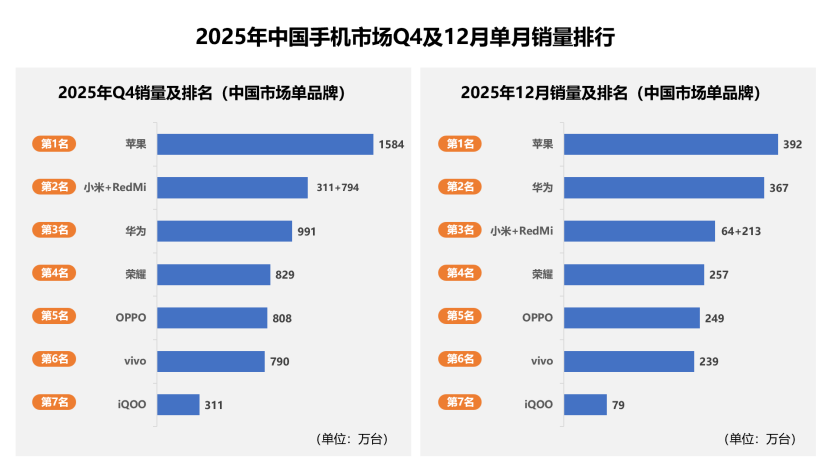
Group 1 - Lei Jun announced a live stream on February 1 at 8 PM to showcase Xiaomi's new SU7 development and discuss recent hot topics related to Xiaomi cars, marking his third live stream in a month [3] - Xiaomi has pushed the Surge OS to older models, including the Xiaomi 12 series and Xiaomi 12S series, allowing users to check for updates [4] Group 2 - Honor is set to release new lightweight and performance laptops, expected to be launched alongside the Honor Magic V6 and a tablet, indicating a recovery in the brand's market position [6] - Honor has returned to the top five in the domestic market and is the fastest-growing brand globally in 2026, currently ranked seventh, with potential to enter the top five [6] Group 3 - OPPO held its annual meeting where Zhou Yibao won several prizes and plans to give them away to the public, indicating a positive company culture [9] - OPPO's Reno15 is the most popular model in its category, and the company ranked second in global ASP in Q4 2025, leading in revenue among domestic brands [9] - Vivo is currently focused on its New Year sales event, promoting its main models like the Vivo X300 series and Vivo S50 series, particularly appealing to photography enthusiasts [9]

华米OV耀打响春节营销战:「AI年味」成为标配,今年卷出哪些新玩意?
3 6 Ke· 2026-01-30 12:51
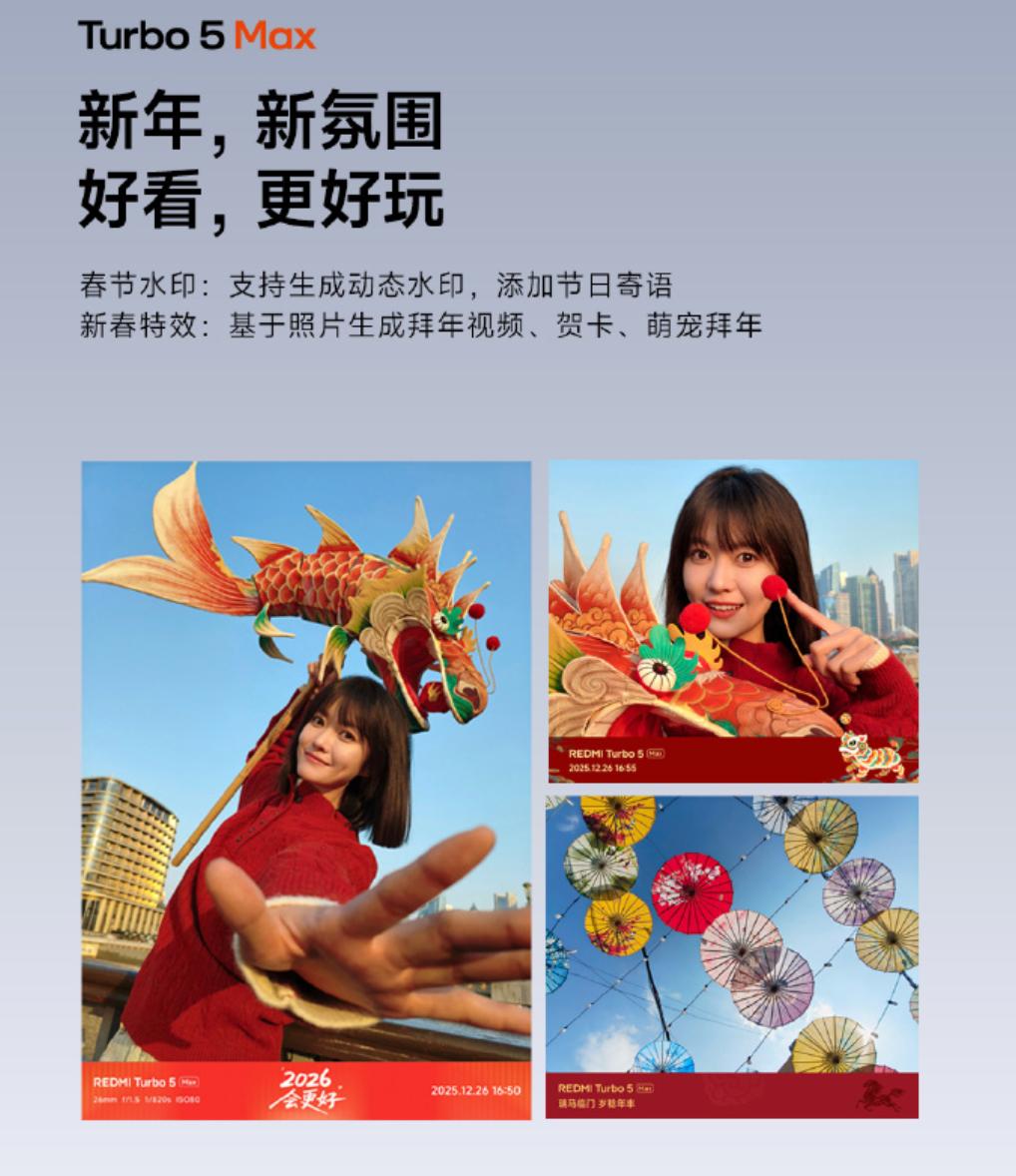
Core Viewpoint - The annual Spring Festival prompts smartphone manufacturers to launch various limited-time features, which, while seemingly repetitive, serve a strategic purpose in enhancing brand recognition and user engagement during a peak social media sharing period [1][3][19]. Group 1: New Features and Strategies - Smartphone manufacturers are introducing new Spring Festival features such as themed watermarks, festive themes, and special effects, which are designed to be user-friendly and enhance the festive experience [1][3]. - The importance of watermarks is emphasized, with some manufacturers like Vivo offering customizable animated watermarks that enhance user engagement and creativity during photo-taking [4][7]. - Companies like Huawei and OPPO are also focusing on emotional value, providing features like short video compilations of memorable moments and countdown timers for New Year's Eve, aiming to create a festive atmosphere [7][9]. Group 2: User Engagement and Brand Recognition - The introduction of these features is not merely for decoration; they aim to increase brand visibility through shared images on social media platforms, as watermarks can significantly enhance brand recognition [3][12]. - The competition among manufacturers to create unique and engaging features is crucial, as effective implementation can lead to extensive free brand exposure, potentially surpassing traditional marketing efforts [18][25]. - However, there is a concern about user fatigue due to the repetitive nature of these features, which may lead to a perception of forced engagement rather than genuine interest [19][21]. Group 3: Future Directions - The future of Spring Festival features should focus on practicality and efficiency, allowing users to create content more easily and with less effort, rather than merely offering decorative options [22][23]. - Manufacturers are encouraged to develop features that automate the content creation process, making it more enjoyable and less of a chore for users during the busy holiday season [22][25]. - Ultimately, the goal is to transform these seasonal features into a practical "Spring Festival toolbox" that enhances user experience without overwhelming them with unnecessary prompts [25].

“非洲手机之王”传音去年净利预降超五成,存储涨价致承压
Nan Fang Du Shi Bao· 2026-01-30 10:37
Core Viewpoint - Transsion Holdings, known as the "King of African Mobile Phones," is facing significant challenges due to rising supply chain costs and intensified market competition, leading to a projected net profit decline of approximately 54.11% for 2025 compared to the previous year [2][3]. Financial Performance - The company expects to achieve an annual revenue of approximately 655.68 billion yuan for 2025, a decrease of about 4.58% from 687.15 billion yuan in 2024 [4]. - The projected net profit attributable to shareholders is around 25.46 billion yuan, down approximately 30.03 billion yuan year-on-year [4]. - The non-GAAP net profit, which excludes non-recurring gains and losses, is expected to be about 19.04 billion yuan, reflecting a significant decrease of 58.06% compared to the previous year [4]. Cost and Margin Pressures - The decline in profitability is attributed to rising costs of components, particularly storage chips, which have seen price increases due to a "super cycle" in the semiconductor industry [5]. - The company's overall gross margin has been negatively impacted by these rising costs, particularly affecting its mid-to-low-end product lines [5]. Competitive Landscape - Despite maintaining over 40% market share in the African smartphone market, Transsion is facing increased competition from Chinese brands like Xiaomi, Honor, and OPPO, which are expanding aggressively in Africa [6]. - Competitors have shown faster sales growth, prompting Transsion to increase marketing and R&D expenditures, further compressing profit margins [6]. Legal Challenges - Since 2025, Transsion has been embroiled in multiple patent infringement lawsuits globally, involving major technology companies such as Qualcomm and Huawei, which poses additional risks to its operations [7]. Strategic Initiatives - In response to financial pressures and a complex external environment, Transsion is seeking new financing avenues and has submitted an application for an IPO on the Hong Kong Stock Exchange, aiming for a dual listing [7]. - This move is seen as a strategic effort to secure international capital and enhance its competitive position in the global market [7]. Market Performance - As of January 30, the company's A-share price was reported at 58.13 yuan, reflecting a decline of 3.93%, with a total market capitalization of approximately 669.2 billion yuan [8].

2026,手机业进入轻资产生存时代
Feng Huang Wang· 2026-01-30 07:59
Core Insights - The smartphone market is entering a phase of intense competition, with the youngest player, Honor, showing potential for growth amidst a challenging environment [1][21] - The Chinese smartphone market is characterized by a fragile balance among the top six players, with market shares fluctuating around 15% [2][4] Market Dynamics - The competition is becoming increasingly fierce, with every percentage point of market share requiring significant resource investment [4] - Honor's global smartphone shipments are projected to exceed 71 million units in 2025, marking a 9% year-on-year growth [4][9] Competitive Positioning - Honor, as the youngest and only single-brand player among the top six, demonstrates unique resilience in a competitive landscape [5] - The company is avoiding the pitfalls of heavy asset models by maintaining a lean organizational structure and flexible channel strategies, allowing for greater financial agility [6][12] Strategic Focus - Honor is strategically positioned in the mid-to-high-end market segment, focusing on the $300-$499 price range to avoid price wars in the sub-$200 category [9] - The brand is actively pursuing high-end market opportunities, evidenced by successful product launches like the Magic8 Pro Air and the RSR Porsche Design model [11] Global Expansion - Honor's overseas market share is set to surpass 50% in 2025, with significant growth in Latin America and the Middle East and Africa [9][14] - The company is transitioning from a broad market approach to a more focused strategy, emphasizing key regions and building a structured growth framework [14][20] Leadership and Strategy - Under the leadership of CEO Li Jian, Honor has implemented a clear strategy focusing on youthfulness, high-end positioning, and globalization [21] - The company has successfully restructured its competitive capabilities, positioning itself as a significant player in the global market within five years of independence [21]
Omdia:小米2025年出货1.654亿部,全球第三
Feng Huang Wang· 2026-01-30 04:23
Core Insights - The report from Omdia indicates that Xiaomi is projected to ship 165.4 million units in 2025, maintaining its position as the third-largest smartphone manufacturer globally, despite a 2% decrease from 168.6 million units in 2024 [1] Group 1: Shipment Forecast - Xiaomi's shipment volume for Q4 2025 is expected to be 37.8 million units, which represents an 11% decline compared to 42.7 million units in Q4 2024 [1] - The decline in shipments is attributed to weak demand for entry-level models and significant contraction in key markets [1] Group 2: Market Share - In 2025, the global smartphone market share for the top ten manufacturers is projected as follows: Apple 19%, Samsung 19%, Xiaomi 13%, Vivo 8%, OPPO 8%, Transsion 8%, Honor 6%, Lenovo 5%, Huawei 4%, and Realme 3% [1] Group 3: Cost Impact - The report notes that rising costs of key components and memory have begun to suppress shipment expectations for 2026 [1]

Omdia:2025年OPPO出货1.007亿部,全球第五
Feng Huang Wang· 2026-01-30 04:20
2025年全球智能手机前十大厂商市场份额排名:苹果19%、三星19%、小米13%、vivo8%、OPPO8%、 传音8%、荣耀6%、联想5%、华为4%、realme3%。 2025年第四季度,OPPO出货量2680万部,相较于2024年第四季度的2460万部,同比增长9%。 报告称,随着realme自2026年并入OPPO后,OPPO体系将更为庞大,有望取得更高排名。 凤凰网科技讯1月30日,根据市场研究机构Omdia最新报告,2025年OPPO出货量达1.007亿部,同比下 降3%,全球排名第五。 ...
2026年成eSIM「爆发元年」:iPhone Air降价,联通强推,手机厂商集体入局
3 6 Ke· 2026-01-30 03:26
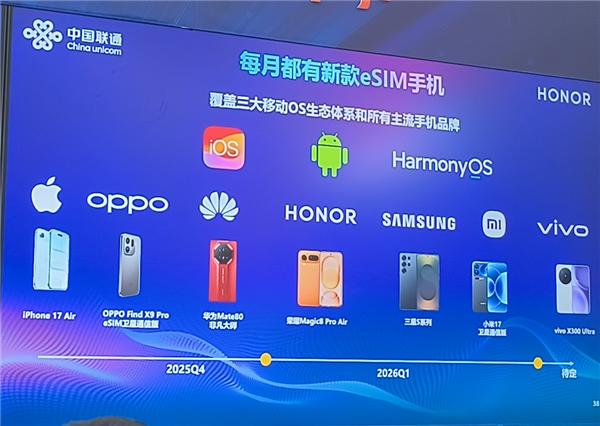
Core Insights - Apple unexpectedly announced a price drop for the iPhone Air, with the 256GB version reduced from 7999 yuan to 5499 yuan after discounts, leading to a rapid sell-out and delayed shipping dates [1] - The iPhone Air's sales were below expectations, with only around 200,000 activations, significantly lower than other models in the iPhone 17 series, primarily due to consumer resistance to eSIM technology [1] Group 1: eSIM Market Dynamics - China Unicom announced plans to launch at least one new eSIM-supported device each month in 2026, indicating a significant push for eSIM adoption [3][4] - The eSIM technology is expected to see a surge in user numbers in 2026, driven by the simultaneous readiness of key industry players, including manufacturers and carriers [6][10] - The first batch of eSIM-supported devices confirmed for release includes models from major brands like Samsung, Xiaomi, and Vivo, highlighting a collective industry shift towards eSIM [4][6] Group 2: Industry Challenges and Opportunities - The transition to eSIM is not merely a technical upgrade but involves significant changes in device design and user experience, which has made manufacturers cautious in the past [7] - The current competitive landscape among carriers is shifting, as traditional user acquisition strategies become less effective due to market saturation, making eSIM a potential new battleground for growth [10][13] - eSIM technology allows for more flexible device designs and reduces the risk of SIM card theft, which could enhance user convenience and attract tech-savvy consumers [12][13] Group 3: Future Outlook - The year 2026 is positioned as a turning point for the mobile communication market, with eSIM transitioning from a niche feature to a standard requirement in new devices [15] - The successful implementation of eSIM services will depend on how well carriers and manufacturers can streamline the user experience and support services [15]


Omdia:苹果手机2025年出货超2.4亿部创新高,vivo首次跻身全球第四
Feng Huang Wang· 2026-01-30 03:15
Group 1 - Apple achieved a record annual shipment of 240.6 million iPhones in 2025, marking a 7% year-on-year increase and maintaining its position as the global leader for the third consecutive year [5] - In Q4, Apple set a new quarterly shipment record, with a 26% year-on-year growth in the Chinese mainland market, driven primarily by demand for the iPhone 17 series [5] Group 2 - Xiaomi shipped 165.4 million units in 2025, retaining its position as the third-largest global smartphone manufacturer, although its Q4 shipments declined by 2% [6] - Vivo entered the global top four for the first time with shipments of 105.3 million units, reflecting a 4% year-on-year growth [6] - OPPO shipped 100.7 million units, experiencing a 3% year-on-year decline, but returned to growth in Q4 due to new product launches [6] Group 3 - The report indicates that rising costs of key components and memory chips at the end of the year have begun to suppress shipment expectations for 2026 [6] Group 4 - In 2025, the market share of the top ten global smartphone manufacturers was as follows: Apple 19%, Samsung 19%, Xiaomi 13%, Vivo 8%, OPPO 8%, Transsion 8%, Honor 6%, Lenovo 5%, Huawei 4%, and Realme 3% [7]
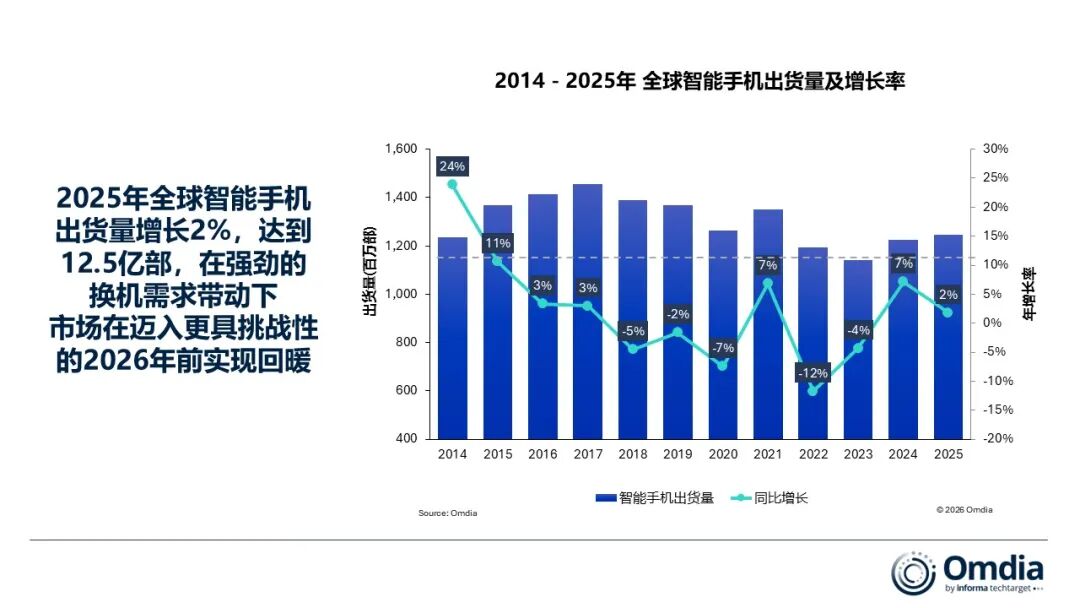
Omdia:2025年全球智能手机出货量增长2% 达到12.5亿部
Zhi Tong Cai Jing· 2026-01-30 01:41
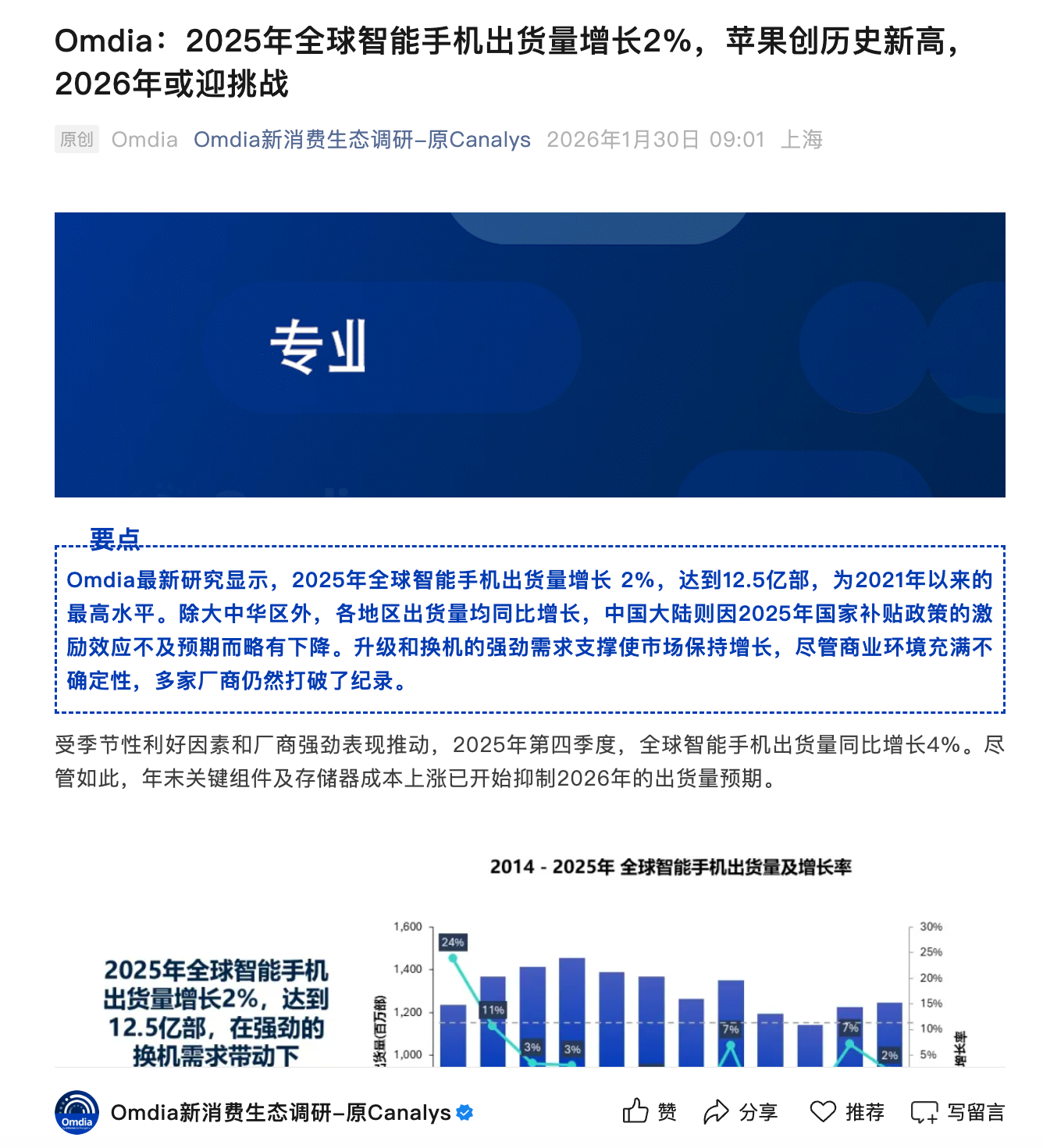
Core Insights - Global smartphone shipments are projected to grow by 2% in 2025, reaching 1.25 billion units, marking the highest level since 2021, with all regions except Greater China experiencing year-on-year growth [1] - The fourth quarter of 2025 saw a 4% year-on-year increase in global smartphone shipments, driven by seasonal factors and strong vendor performance, although rising costs of key components began to suppress expectations for 2026 [1] Group 1: Company Performance - Apple achieved a record annual shipment of 240.6 million iPhones in 2025, a 7% increase year-on-year, maintaining its position as the largest smartphone manufacturer for the third consecutive year [4] - Samsung rebounded in 2025 with a 7% year-on-year increase in shipments, closing the year with a strong fourth quarter, driven by resilient demand for flagship models and a recovery in the entry-level market [4] - Xiaomi defended its top three position despite a 2% decline in fourth-quarter shipments, impacted by weak entry-level demand and significant market contraction [5] Group 2: Market Dynamics - Vivo entered the fourth position for the first time, with a 4% year-on-year increase in shipments to 10.53 million units, supported by success in the Indian market and stable domestic performance [5] - OPPO ranked fifth, with annual shipments of 10.07 million units, experiencing a 3% year-on-year decline, but returning to growth in the fourth quarter with the launch of new models [5] - Despite challenges, several manufacturers outside the top five maintained positive growth, with Honor and Lenovo achieving year-on-year increases of 11% and 6%, respectively [5] Group 3: Future Outlook - Concerns for 2026 are emerging due to escalating supply-side pressures on DRAM, NAND, and other semiconductors, which may compress profit margins and force price adjustments [8] - Companies must effectively manage supply chain pressures and strengthen long-term partnerships to mitigate the impact of rising costs on consumer demand [8] - The focus for manufacturers will shift towards profitability and exploring alternative revenue sources, with a strategic opportunity to capture upgrade demand and ensure market share sustainability [11]