平安人寿

Search documents
2900亿新能源央企上市首日,刷新了两个纪录
2 1 Shi Ji Jing Ji Bao Dao· 2025-07-16 23:44
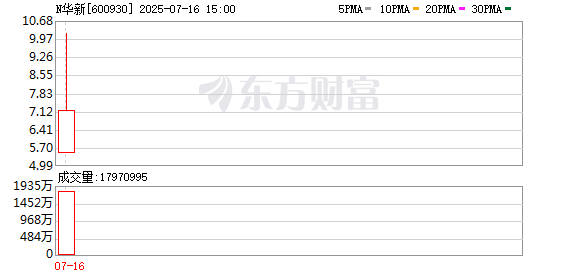
Core Viewpoint - Huadian New Energy (600930.SH) experienced a remarkable debut on the A-share market, with a first-day increase of 125.79% and a market capitalization of 294.2 billion yuan [2] Group 1: Market Performance - On its first trading day, Huadian New Energy's stock price peaked with a maximum increase of over 220%, setting a record for A-share energy companies and surpassing China Petroleum's previous record of 191.14% [5] - The company's market capitalization reached nearly 300 billion yuan by the end of trading on July 16, with an intraday peak exceeding 400 billion yuan [5] - The trading volume on the first day was significant, with a total transaction amount of 12.702 billion yuan and a turnover rate of 71.74% [8] Group 2: IPO Details - Huadian New Energy's IPO is one of the hottest and largest fundraising projects in the past two years, with a final online subscription rate of 0.56%, marking a new high since the implementation of the registration system in A-shares [7] - The company issued a total of 4.669 billion shares, raising 18.171 billion yuan, which is the largest IPO fundraising in A-shares this year [8] Group 3: Shareholder Structure - Prior to the IPO, major insurance funds became shareholders, with China Life holding 796 million shares (2.21%) and Ping An Life holding 219 million shares (0.61%) [9] - Post-IPO, China Life's holdings increased to 1.097 billion shares (2.68%), maintaining its position as the third-largest shareholder [9] - New significant shareholders include two funds controlled by China Guoxin Holdings, each holding 636 million shares (1.55%) [9] Group 4: Company Performance - For Q1 2025, Huadian New Energy reported a revenue of 9.628 billion yuan, a year-on-year increase of 16.19%, and a net profit attributable to shareholders of 2.922 billion yuan, up 5.89% [10] - For the first half of the year, the company expects revenue between 18.95 billion yuan and 21 billion yuan, representing a year-on-year growth of 9.84% to 21.72%, while net profit is projected to range from 5.76 billion yuan to 6.69 billion yuan, with a potential decline of 7.19% to an increase of 7.79% [11] Group 5: Capacity and Market Share - As of the end of 2024, Huadian New Energy is the largest state-owned enterprise in the domestic renewable energy sector, with a total installed capacity of 68.6171 million kilowatts, including 32.0245 million kilowatts from wind power and 36.5926 million kilowatts from solar power [9]

保险保障 资金支持 科技赋能——2024年山东保险业:多维发力筑牢实体经济根基
Zhong Guo Fa Zhan Wang· 2025-07-16 04:48
Core Viewpoint - The 2024 Shandong Insurance Industry Development and Social Responsibility Report highlights the active role of insurance institutions in supporting the modernization of Shandong's industrial system and ensuring social stability and people's well-being through robust insurance mechanisms [1] Group 1: Financial Support for the Real Economy - Insurance funds are being utilized to provide diverse financing services to the real economy, with significant investments made by various insurance companies in Shandong, including 498 billion yuan by Shandong People's Insurance, 765.51 billion yuan by Taikang Insurance, and 1,415.48 billion yuan by Ping An Life [2] - These investments are crucial for the development of major infrastructure projects and the growth of high-tech enterprises in Shandong, contributing to the province's economic transformation [2] Group 2: Risk Protection for Economic Development - Insurance institutions are focusing on key areas such as national strategies and small and micro enterprises, providing tailored insurance solutions to strengthen risk management [3] - Notable risk coverage includes 1 billion USD for the "Guohe No.1" nuclear power project and 374.9 billion yuan for Shandong Steel Group, showcasing the commitment to safeguarding significant projects [3] Group 3: Support for Small and Micro Enterprises - Ping An Property & Casualty provided over 32 trillion yuan in risk protection for more than 114,000 small and micro enterprises, highlighting the importance of these businesses in the economy [4] - Other companies, such as Dadi Insurance and Taiping Life, also contributed significantly to employee health and financial support for small businesses, ensuring a stable working environment [4] Group 4: Technological Empowerment in Insurance - Shandong insurance institutions are developing comprehensive insurance solutions for technology companies, addressing challenges such as high risk and financing difficulties [5] - The use of advanced technologies like big data and IoT is transforming insurance services from reactive claims to proactive risk management, significantly reducing overall societal risks [6] Group 5: Agricultural Risk Management - The application of drones and satellite technology in agriculture is enhancing monitoring and disaster prevention, shifting from passive compensation to proactive defense [7] - The insurance sector in Shandong is committed to integrating insurance protection, financial investment, and technological empowerment to effectively serve the real economy [7]

2220亿元险资试点基金集结 为资本市场注入长期动力
Jin Rong Shi Bao· 2025-07-16 01:41
Core Viewpoint - The approval of Sunshine Asset Management to establish Sunshine Hengyi Private Fund Management Company marks a significant development in the insurance asset management sector, increasing the number of insurance-funded private fund management companies in China to five [1][2]. Group 1: Establishment of Private Fund Management Companies - Sunshine Asset Management has been approved to set up Sunshine Hengyi with a capital of 10 million yuan [1]. - The five insurance-funded private fund management companies include Guofeng Xinghua, Taikang Stable, Hengyi Chiying, and Taibao Zhiyuan, in addition to Sunshine Hengyi [3]. - Two of these companies, Guofeng Xinghua and Taikang Stable, have already launched private fund products and commenced operations [3]. Group 2: Fund Scale and Investment Focus - The total scale of the three batches of pilot funds has reached 2,220 billion yuan, aimed at long-term equity investments in the capital market [5][6]. - The pilot funds are designed to focus on long-term holdings, primarily targeting stocks in key industries that are vital to the national economy [7]. - The investment strategy emphasizes high dividend, low volatility stocks, and sectors aligned with national development strategies, such as high-end manufacturing and artificial intelligence [8].

银行股可以捡钱了?国家队汇金5亿买入信号,散户要看懂3个信号
Sou Hu Cai Jing· 2025-07-14 09:01
2024年,A股银行股上演了一出惊心动魄的"财富大戏"。 曾经被公募基金冷落,常年低配的银行股,如 今却成为机构争相追逐的"香饽饽",股价扶摇直上,甚至创下历史新高。 农业银行、建设银行股价屡 创新高,工商银行市值逼近3万亿,稳坐A股"一哥"宝座。 这背后,究竟隐藏着怎样的秘密? 外资的谨慎态度与内资的狂热形成鲜明对比。北向资金在四大行股价创新高之际选择反手减持,这一幕 与2023年"中特估"行情中内资拉高、外资撤退的景象如出一辙,预示着潜在的风险。 而保险资金,无 疑是这波行情中当之无愧的绝对主力。2025年一季度,险资重仓A股银行股市值高达2657.8亿元,占其 股票持仓的45%;仅恒生金融指数前七大银行股,险资持仓就超过5600亿元,占流通市值的58%! 平安 人寿更是凶悍,半年内七次举牌农行、邮储等H股,对招行H股的持股比例甚至飙升至15%。 中央汇金 一季度通过沪深300ETF间接加仓银行股5.02亿份,社保基金也紧盯常熟银行等优质标的。 港股通资金 也参与其中,6月份从腾讯、阿里等科技股撤出400亿港元,迅速转向银行股,上演了一场"乾坤大挪 移"。 然而,保险资金的疯狂举牌背后,还隐藏着另一个关键 ...
政策“组合拳”协同发力险资“长钱长投”打开空间
Shang Hai Zheng Quan Bao· 2025-07-13 19:46
Group 1 - The core viewpoint of the articles highlights the acceleration of insurance capital's entry into the market, driven by a series of supportive policies aimed at promoting long-term investments [1][2][4] - Insurance capital has made 19 equity stakes in listed companies this year, which is consistent with the total from the previous year, indicating a stable investment trend [2][4] - The implementation of policies such as increasing the proportion of equity asset allocation and expanding long-term investment pilot programs has provided more opportunities for insurance capital to invest [2][4][5] Group 2 - A total of 1,720 billion yuan has been approved for long-term investment pilot funds, with many insurance companies actively participating in these initiatives [2][4] - The financial regulatory authority has raised the equity asset allocation limits for insurance companies, potentially increasing their investment capacity by approximately 500 billion yuan [5] - The recent adjustments in risk factors for insurance stock investments are expected to lower the capital requirements, allowing more funds to be allocated to the stock market [5][7] Group 3 - The introduction of a long-term assessment mechanism for state-owned insurance companies aims to encourage a shift from short-term to long-term investment strategies [6][8] - There is a growing interest among smaller insurance companies to participate in long-term stock investment trials, indicating a broader industry trend towards long-term capital deployment [3][4] - Industry experts suggest further optimization of solvency requirements and risk factor assessments to enhance the effectiveness of insurance capital in the market [7][8]
股民疯抢中国“银伟达”
吴晓波频道· 2025-07-11 18:13
点击上图▲立即收听 " 不论是中国和美国股市,它们的关键都在于三个点 ' 利率、风险偏好和企业利润 ' 。 文 / 巴九灵(微信公众号:吴晓波频道) 年少不知工行香,错把科技加满仓。 年少不知农行好,错把汽车当成宝。 年少不知中行醉,错把白酒当安慰。 年少不知建行强,错把芯片当栋梁。 当西方投资者为英伟达冲上 4 万亿美元市值而欢呼时,太平洋对岸的中国投资者,也迎来了自己的"银伟达"。 2025 年 7 月 9 日晚,全球芯片巨头英伟达股价触及 164.42 美元,总市值突破 4 万亿美元大关,创下历史纪录。 美国纽约证 券 交易大厅上显示英伟达公司 " 随后两个交易日, A 股银行板块持续走强, 工农中建四大行股价持续创下历史新高。 由于今年银行股的涨势过于疯狂,股民开始把 " 银行 " 与 " 英伟达 " 结合起来,将银行股称为 "银伟达" ,把上证指数叫作"银斯达克"。 在大金融的带领之下,上证指数成功突破关键点位,稳稳站上 3500 点大关,尽管在周五,早盘的过猛攻势导致银行板块有所回落,但"银伟达"的 迅猛势头依然牢牢吸引了市场的目光。 再说个冷知识, A股35年历史中,真正站稳过3500点就三次, ...




空缺三年后补位,牛增亮升任华泰人寿总经理
Guo Ji Jin Rong Bao· 2025-07-10 15:40
Group 1 - Huatai Life announced that Niu Zengliang will serve as the new General Manager starting from July 10, 2025, following approval from the Beijing Financial Regulatory Bureau [1] - Niu Zengliang has extensive experience in the insurance industry, particularly in actuarial fields, holding qualifications as a Chinese actuary, North American actuary, and American actuary [3] - Since 2022, the position of General Manager at Huatai Life has been vacant for three years, with temporary leadership provided by Zheng Shaowei before Niu's appointment [4] Group 2 - Huatai Life has shown stable growth in insurance business revenue from 2020 to 2024, with figures of 6.246 billion, 6.474 billion, 7.112 billion, 7.312 billion, and 9.293 billion yuan respectively [4] - The net profit of Huatai Life experienced a decline from 2020 to 2021, with figures of 412 million and 282 million yuan, and turned negative in 2022 with a loss of 225 million yuan, further worsening to a loss of 893 million yuan in 2023 [5] - In 2024, Huatai Life returned to profitability with a net profit of 92 million yuan, and in the first quarter of 2025, it reported insurance business revenue of 2.953 billion yuan, a year-on-year decrease of 8.71%, but a significant recovery in net profit to 93 million yuan compared to a loss of 286 million yuan in the same period last year [5]
再次领涨!持续涌入银行的资金“洪流”有哪些?
Sou Hu Cai Jing· 2025-07-10 04:04
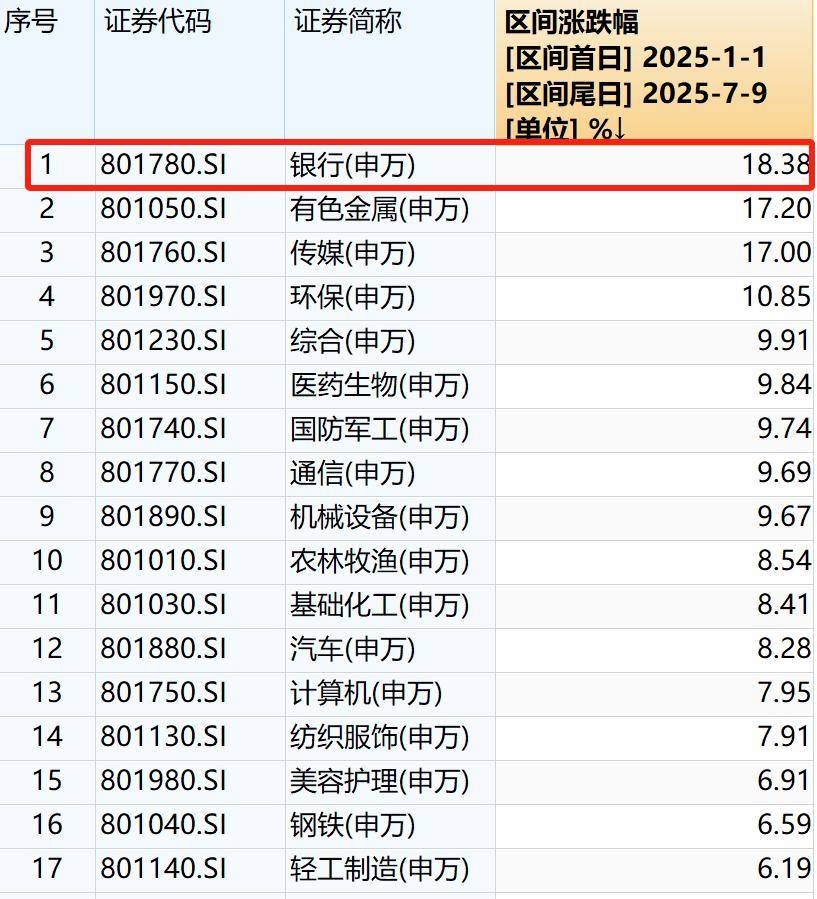
Core Viewpoint - The banking sector is experiencing significant growth, with substantial increases in stock prices and strong inflows of capital, making it a key area for investment opportunities [1][2][3]. Group 1: Stock Performance - Bank stocks have shown remarkable performance, with a year-to-date increase of 18.38%, leading all 31 sectors in the Shenwan classification [2]. - Major banks such as Minsheng Bank, China Merchants Bank, and Industrial and Commercial Bank of China have seen stock price increases of around 2% to 5% recently [1]. Group 2: Capital Inflows - Insurance funds are increasingly favoring high-dividend assets, with bank stocks offering an average dividend yield of 3.86%, making them attractive for insurance capital allocation [3]. - The Stock Connect program has seen significant inflows, with net purchases of bank stocks amounting to 186 billion yuan in the second quarter, reflecting a growing interest from institutional investors [4]. Group 3: Passive Investment Trends - The passive investment trend is gaining momentum, with net inflows into the CSI 300 index-related funds reaching 549.6 billion yuan, of which the banking sector accounts for 15.7% [7]. - The scale of passive funds has surpassed that of active funds, indicating a sustained influx of capital into high-weighted sectors like banking [7]. Group 4: Fund Allocation and Valuation - Public funds currently have a low allocation to the banking sector, with a heavy position of only 2.33%, indicating potential for significant capital inflows as this allocation improves [8]. - The banking sector is showing a comparative advantage over other investment vehicles, with characteristics such as low volatility, low valuation, and stable dividends enhancing its attractiveness [8]. Group 5: ETF Performance - The Bank AH Preferred ETF (517900) has seen a year-to-date increase of 26%, with its fund size increasing nearly sevenfold, indicating strong investor interest [8][11]. - The ETF employs an AH rotation strategy, effectively capturing undervalued bank stocks across markets, with a cumulative return of 102.11% since its inception [11].
+2!险资系私募证券基金,增至5只!
证券时报· 2025-07-10 03:54
Core Viewpoint - The establishment of two new insurance capital private equity funds has increased the total number of such funds to five, indicating a growing trend in long-term investment strategies by insurance companies [1][7]. Group 1: Fund Establishment and Management - Two new funds, Honghu Fund Phase 3 (1 and 2), were established on July 7 and registered on July 8, increasing the total number of insurance capital private equity funds to five [3][7]. - The five funds include the Honghu Fund series (Phase 1, 2, and 3) managed by Guofeng Xinghua, and the Taikang Stable Phase 1 Fund [2][7]. - The Honghu Fund Phase 3 (1) has a total scale of 22.5 billion yuan, with contributions from Xinhua Insurance and China Life, each investing 11.25 billion yuan [4][5]. Group 2: Investment Strategy and Objectives - The Honghu Fund Phase 1 aims to implement a long-term investment philosophy through low-frequency trading and long-term holding to achieve stable dividend income [6]. - The fund focuses on large listed companies that are part of the CSI A500 index, emphasizing good corporate governance, stable operations, and liquidity [6]. - The total approved amount for the Honghu Fund Phase 3 is 40 billion yuan, with interest from several small and medium-sized insurance companies [5]. Group 3: Industry Context and Implications - The long-term investment pilot program for insurance funds has a total approved amount of 222 billion yuan, involving major insurance companies and several small and medium-sized insurers [8]. - This initiative is expected to help stabilize insurance company profits and enhance equity investments, contributing to the healthy operation of the capital market [8].

+2!险资系私募证券基金,增至5只!
券商中国· 2025-07-10 02:01
Core Viewpoint - Recently, two insurance capital private equity funds have been established, bringing the total number of such funds in operation to five [1]. Group 1: Fund Establishment and Management - The five funds include the Honghu Fund series managed by Guofeng Xinghua, which consists of Phase I, II, and two funds from Phase III, as well as the Taikang Stable Phase I Fund [2]. - The Honghu Fund Phase III consists of two funds, which were established on July 7 and registered on July 8 with the Asset Management Association of China [3]. - The total scale of the Honghu Fund Phase III is 400 billion yuan, with China Life and Xinhua Insurance each contributing 112.5 billion yuan to the Phase III Fund I [3][4]. Group 2: Investment Strategy and Focus - The Honghu Fund Phase III is an equity private securities investment fund, focusing on large listed companies that are part of the CSI A500 index, with a preference for companies with good governance and stable operations [4]. - The fund aims to adopt a long-term investment strategy through low-frequency trading and long-term holding to achieve stable dividend income [3][4]. Group 3: Current Status of Insurance Capital Private Funds - With the addition of the two new funds, five insurance capital private equity funds are now operational, including the previously established funds that have a total scale of 500 billion yuan fully invested [5]. - The insurance capital long-term investment pilot program has three batches, with a total approved amount of 222 billion yuan, involving various major insurance companies [6].